.png)
‘We Put All Of Our Effort, Sweat, And Tears Into Each And Every Film We Make’: Ghibli Cinematographer Atsushi Okui On ‘Arrietty,’ ‘Whisper Of The Heart’ (EXCLUSIVE)
Stay informed with free updates
Sign up to get our news digest — delivered directly to your inbox twice a week.
Studio Ghibli’s coming-of-age gem Whisper of the Heart hit North American IMAX theaters with a stunning 4K remaster last month, and the iconic Japanese studio will grace American cinemas this week with another touched-up fan favorite, The Secret World of Arrietty.
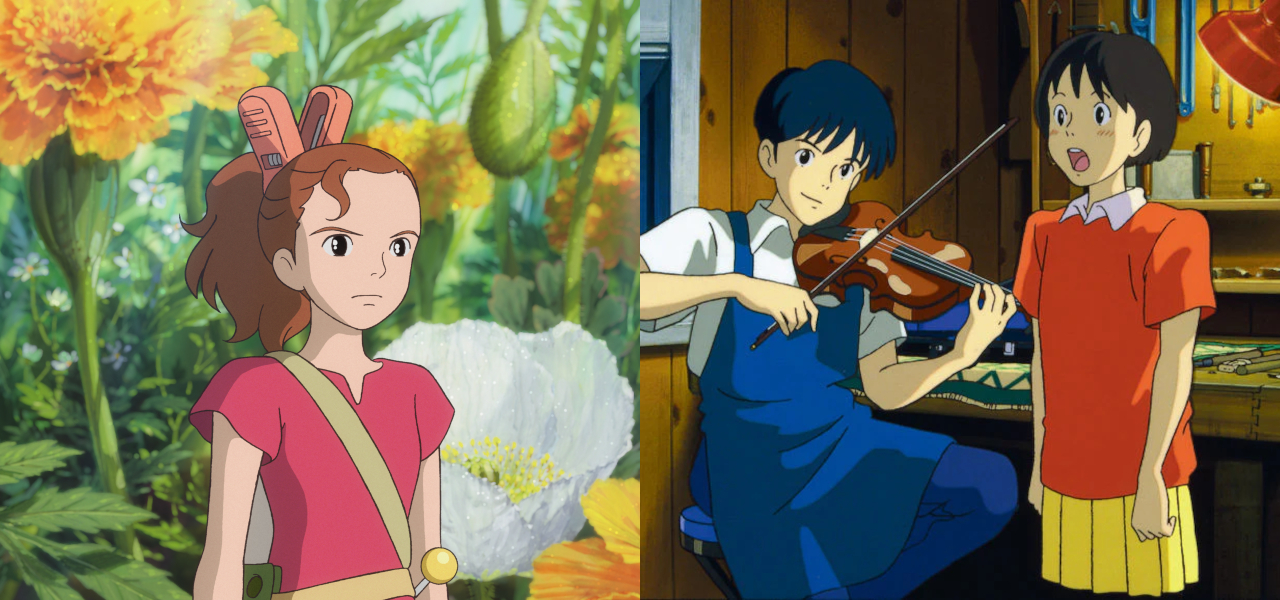
Directed by Hiromasa Yonebayashi and adapted from Mary Norton’s classic children’s novel The Borrowers, the charming fantasy feature follows a tiny family secretly living beneath the floorboards of a human home. To celebrate the return of these films, Cartoon Brew caught up with Atsushi Okui, the cinematographer on nearly all of Studio Ghibli’s films from 1993 onward and the driving force behind the studio’s recent spree of 4K remasters, to discuss both of the Ghibli greats that got theatrical re-releases this year.
It’s the perfect occasion for a conversation, aided by interpreter Mihoko Imai, with a figure who can speak to both the studio’s past and present. Okui engages with our questions with a warm smile. We discuss the process of constructing key sequences, location scouting, the directorial style of the late Yoshifumi Kondo, and much more.
Cartoon Brew: In the West, Whisper of the Heart is one of Ghibli’s most overlooked and underrated films. Is this equally true at home, do you feel?
Atsushi Okui: If you take box office results, Whisper of the Heart might not have had the huge receipts that other Ghibli titles have had, but there is a core demographic that truly loves this film. For example, the town in which the story is set is called Seiseki-Sakuragaoka, and it’s considered a very sacred spot for these fans — many people go to this town as a pilgrimage, so to speak. That’s the kind of film that it is.
Tell me about the remastering process of these films.
All of the Ghibli titles are on streaming services in HD quality. Over a decade ago, we scanned all of our titles and archived them in digital data format because, of course, film deteriorates over the years. We archived that data across multiple hard drives and multiple media.
Was there additional work involved in creating the theatrical 4K release?
They have been “retouched,” for lack of a better word, for the 4K remastered releases. The archival process was done in 4K, so we’re working from that. Color grading tools have evolved quite a lot since then in terms of the software we work with and color science. So we have done the color grading to bring you the highest quality possible with these 4K remasters.
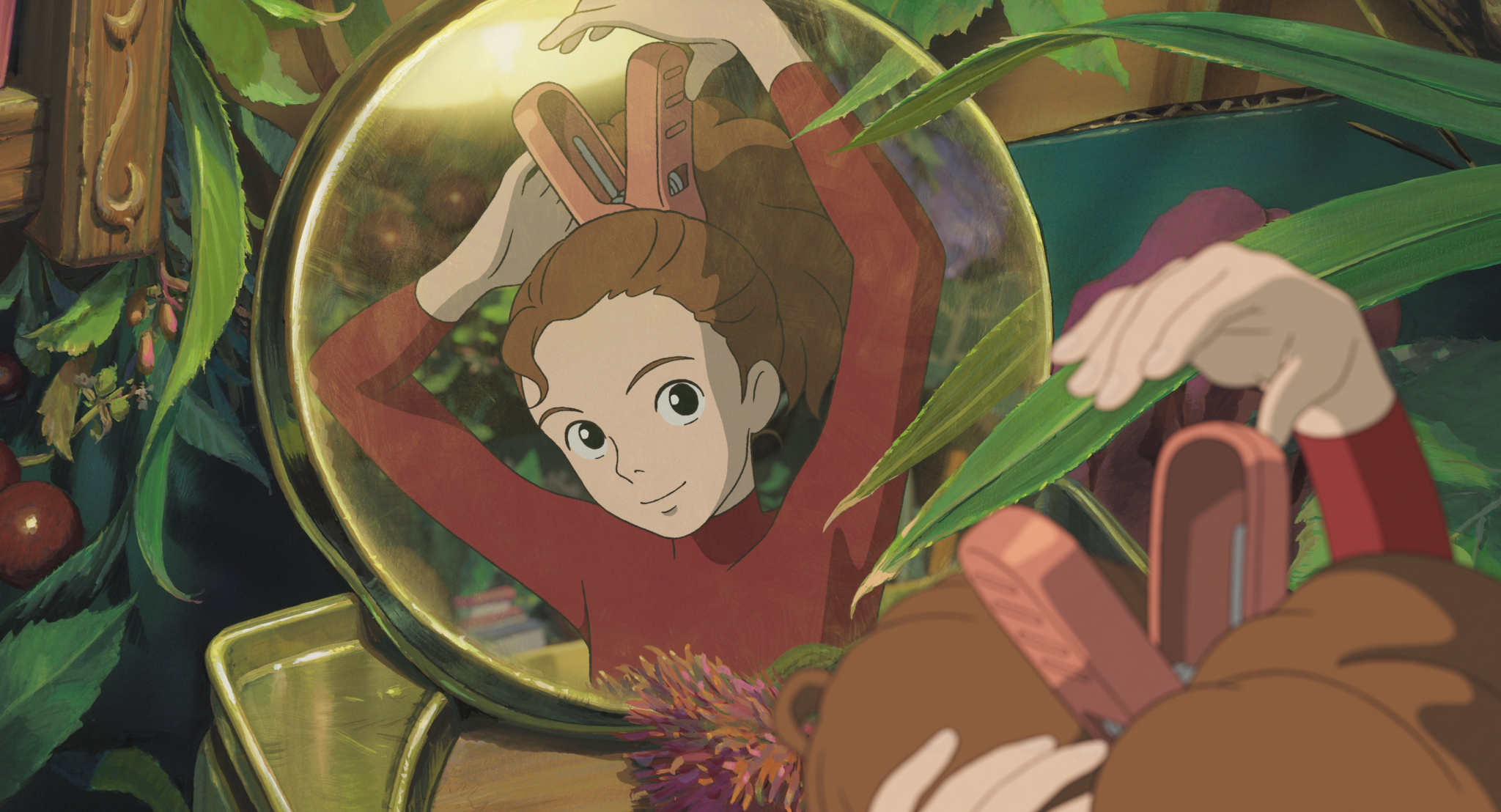
Tell me more about the color grading in Whisper. I really love the film’s palette — it’s composed of creams and earthy reds — quite muted, but equally very rich, unique within the studio’s filmography.
In animation, first, you have the background art, which is drawn on paper, and then you overlay the cel art on which the characters are drawn. The color of the paint within that cel art tends to be very vivid, doesn’t it? However, the end result that we as audience members see is different from the coloring of the cel art itself, because it’s on film — we see the color that is filtered through the film. What we aimed to do was not to make the cel art as vivid as possible color-wise, but to recreate what the audience saw when they originally saw it on film.
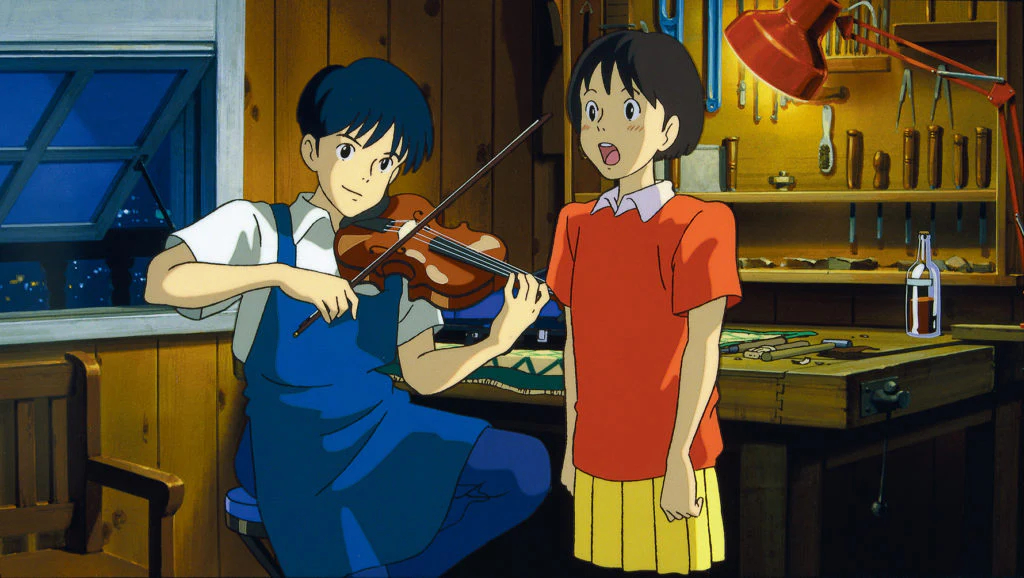
What place does Whisper of the Heart have within your own heart and memory? What memory immediately springs to mind if I asked you to recall your time working on it?
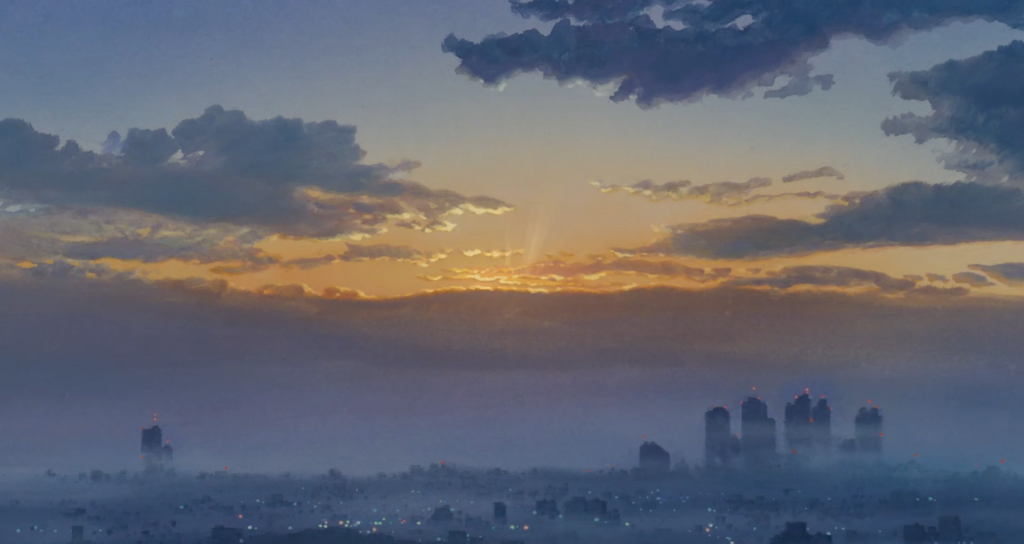
What really stands out in my memory is how we prepared to create that final scene, where the sun is rising against the clouds. We location-scouted a spot west of the Tama River, a very hilly area. We went there on a very cold morning. It was February, I believe. We were in this hilly place called Tama Kyuryo. There’s an amusement park there called Yomiuri Land. They have this steel tower, which we got permission to climb. I remember all of us carrying video equipment. It was early in the morning, around 5 a.m., and the sun was just rising. We captured this magnificent sunrise with all of the Shinjuku skyscrapers in the foreground. We had our art director and the entire film crew there to capture that scene, and that became the final scene of the film.
How did you then translate that moment to animation?
To talk about what we recorded with our video cameras that morning and how we created the animation based on that, I first have to say that what was more important to me was not necessarily what we were able to capture on camera that morning, but what was seared into my memory at the moment when I witnessed the sunrise. I had that in my mind while we were all working with our art director and background artist on this. Because we wanted to capture the light that shines onto the city and the town in a very particular way, the background art was a very layered process.
First of all, you draw the background on paper, which you copy onto transparent celluloid film. Then there are certain spots within that frame that you want to emit light, or where you want to show light reflected onto certain portions. So what we would do was mask over the parts of the frame that we didn’t want to have light shined on. We would layer the masked parts of that frame and then the unmasked parts, which we also lit from behind — so the backlight process was incorporated. The sun was yet another process, in which we created another layer so that it would emit the sun’s particular light. It was a very layered celluloid process.
This was a singular and atypical project — loosely based on a shojo manga, scripted by Miyazaki, and the sole directorial effort of the late Yoshifumi Kondo. Could you tell me about that creative genesis and synergy?
First and foremost, the director, Kondo. Of course, he was an animator, so he was good at bringing a very distinct reality to the characters’ movements — how they move across the screen. And, of course, Miyazaki is an animator as well, but he’s also a great storyteller. He pushes forward his projects with a great sense of intuition.
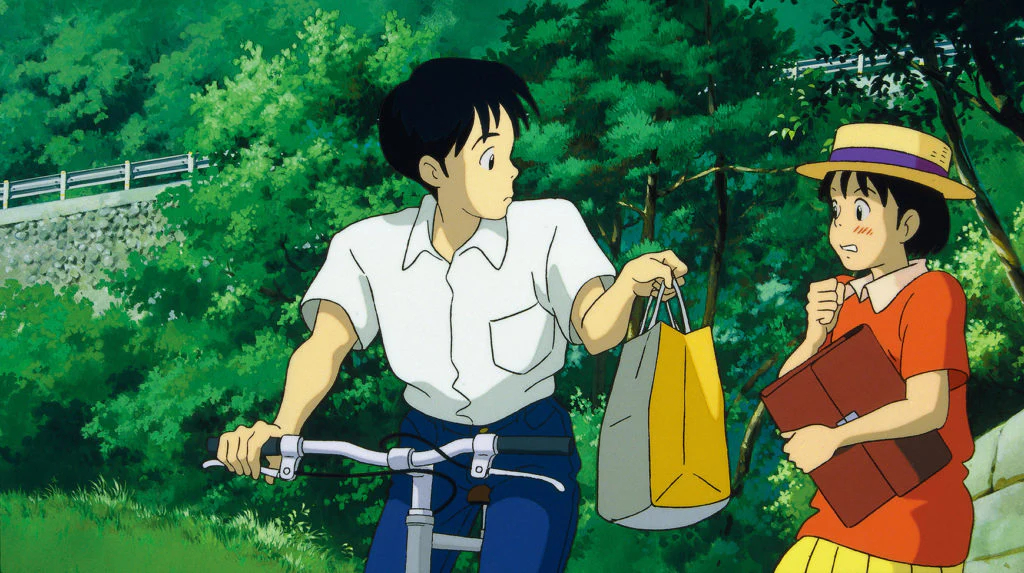
But what we really had to be careful about this time around with Whisper of the Heart was the fact that we were depicting the school life and everyday life of two junior high students. We had to bring a very detailed sensibility to how they would move about as they live their school life and everyday life, and this was all the more necessary because the film is based on a shojo manga. The attraction of shojo manga is these sparkly eyes and this dream-like sensibility. It’s all about the visual impact of the drawings. But, of course, you can’t make a feature-length film out of just that. So what we brought to the IP, for lack of a better word, was what Ghibli does best, which is grounding the story and characters in a very distinct realism.
Tell me about working with Yoshifumi Kondo on this feature. What do you recall about his artistic approach, and how would you define his artistic voice?
I think with Kondo, his talent really lies in the detailed ways in which he could capture quotidian life. Because, again, as an animator you have to be grounded in the details. With Whisper of the Heart, you’ll notice when our protagonist runs up the stairs to the school roof, the way her skirt hem wavers in the wind is very particular and very real. This is what Kondo excelled in.
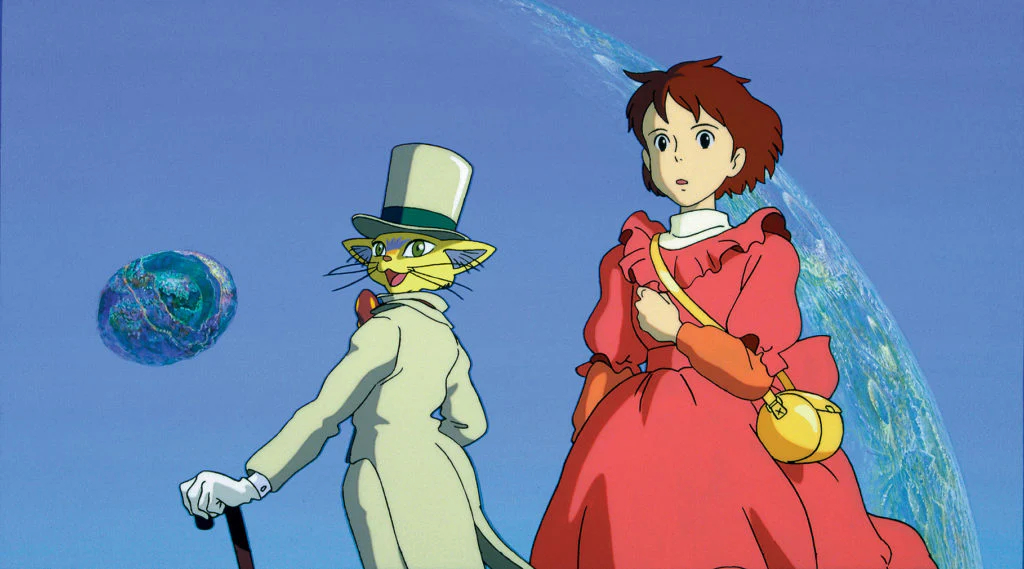
There is, of course, one sequence of pure fantasy in the film — and that comes in the form of Shizuku’s writing: the storybook sequence in which she fly-falls through the air in her reddish-pink dress, the Baron by her side. This moment gives the film its key poster visual. Could you tell me about creating this sequence? I understand that you made use of digital techniques in crafting it.
For the fantastical sequences, the background art was done by the artist Naohisa Inoue, and it was Miyazaki who directed them. We employed digital technology because there were certain ways in which we wanted to capture things, and characters flying through the world in a way that would not be possible with just optical effects.
If you have background art and you’re overlaying characters onto that, there’s only so much you can do in terms of movement, or the way we perceive them flying through these scenes. Therefore, we employed digital technology. It’s not that we wanted a 3D digital effect at all, but, for example, when you have something flying through the sky and clouds in the background or foreground of the frame as they fly, that depth of field isn’t there. You want to enlarge or shrink the size of the clouds, for example, which gives you a sense of movement. That’s the kind of thing we wanted to employ, and therefore we had to use digital effects.
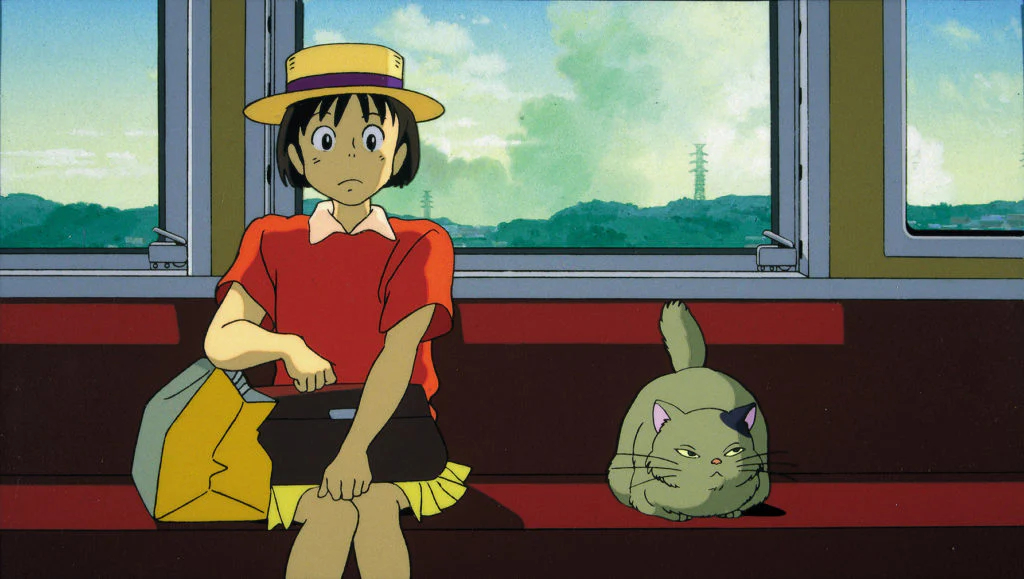
There are two other sequences that I would love to know if you have particular anecdotes or memories about. One is Shizuku and Moon on the train, with the cat looking out of the window.
I was very particular about the scenery that you see outside that window. There’s a particular way in which a train accelerates once it leaves the station. I videotaped the train leaving Higashi-Koganei Station, which is right by Studio Ghibli. I remember recording that on video so that I could recreate the precise way in which the scene accelerates or pulls away from us as the train accelerates.
Another wonderful sequence is the end credits scroll projected against the wall — characters passing by, meeting, and parting along the road above.
We’re looking at the passage of time here. We have very early morning, in which the students are on their way to school. You have pedestrians and neighborhood residents walking their dogs or jogging and so forth. Then you have the afternoon scenes, in which vehicles pass by. Then we have the evening sequence, in which the students are on their way home from school after classes are over, and you will notice Yuko and Sugimura, who have finally become girlfriend and boyfriend.
I’d also love to discuss Arrietty, another directorial debut, this time from another collaborator of yours, Hiromasa Yonebayashi. Equally, it’s an unusual adaptation of its source material. Could you share some memories of working on this film?
This was back in 2010. This was a time when we were employing a lot of new up-and-coming directors. Just before that was Goro Miyazaki’s feature film debut. With this one as well, we had a first-time director, Yonebayashi. Of course, he was an animator, but this was his first time directing a film.
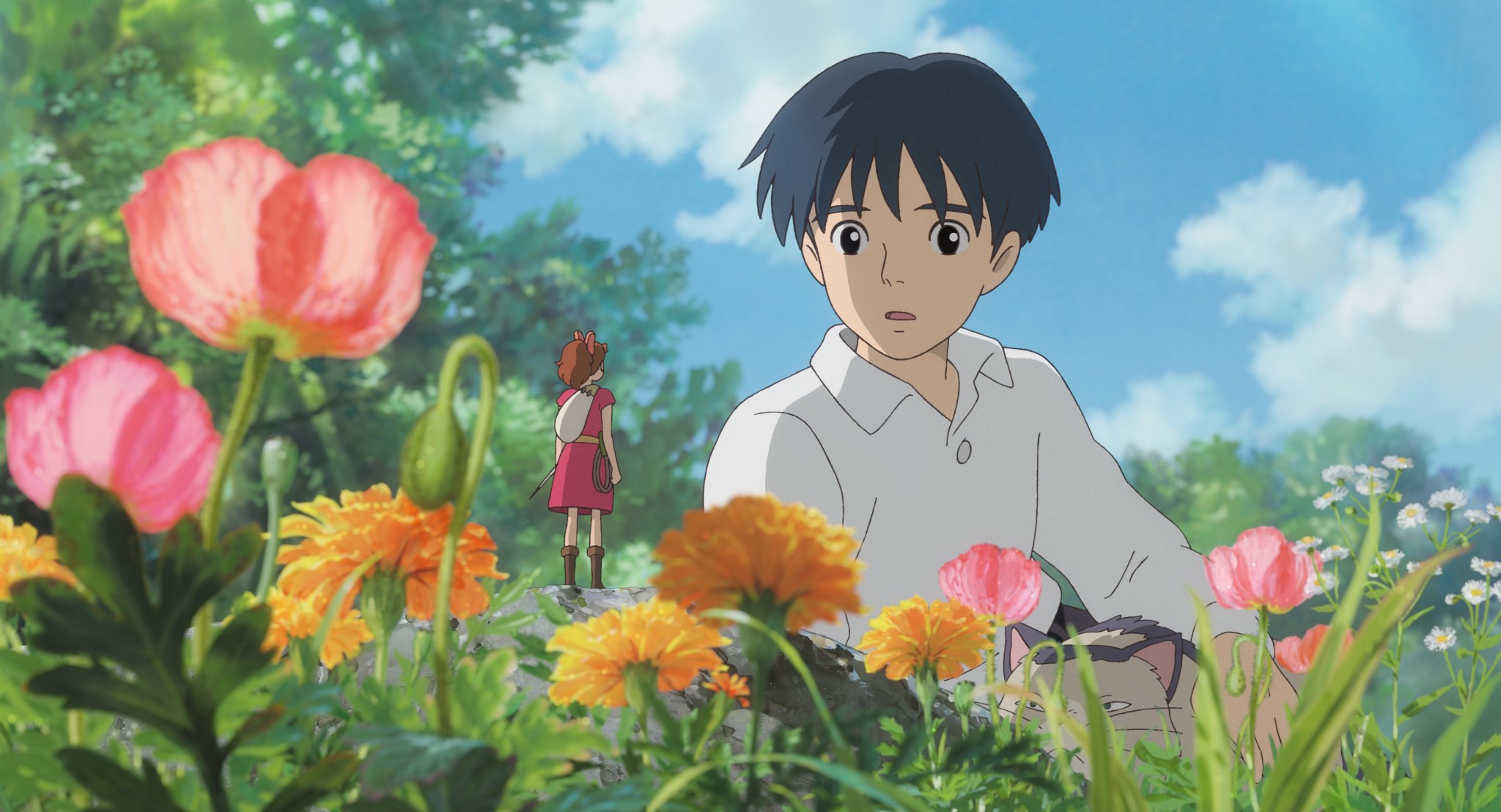
A lot of it was this sense of embarking upon a challenge in which we didn’t really know what was going to happen. It was all about, “How do we support this director’s feature film debut?” Needless to say, although the director was a first-timer, all of the staff members were veteran crew members. So it was that kind of teamwork.
We were able to bring forth Yonebayashi-san’s personality with this film. In other words, he’s very, very good at drawing female characters. I think it was good that we were able to create this film with him, with a female protagonist in the form of Arrietty.
It feels poignant for both Whisper of the Heart and Arrietty to get rereleases one after another. How does it feel to restore these undersung Ghibli works and release them to fresh audiences, especially internationally, where many of these audiences may have seen the Miyazaki films but may not be familiar with these lesser-known Ghibli works?
In our minds, there isn’t a divide between the films directed by Miyazaki and those that are not. We put all of our effort, sweat, and tears into each and every film we make, so that we can deliver it to audiences in the way that we aspire to.
That being said, Whisper of the Heart and Arrietty were indeed non-Miyazaki films, but up until The Boy and the Heron, Arrietty was, in terms of box office receipts, the most successful among the Ghibli titles. But now, coming to today, all the Ghibli titles are accessible through streaming services. It is quite a wonderful thing, I think, to be able to bring these two titles to the big screen again.
Are there any final comments or reflections that you’d like to share?
As we discussed, it was over a decade ago that we digitally archived our films. Up until then, everything existed only on film, and this was something that we did for the Blu-ray releases of the titles. Because we wanted to use manpower as efficiently as possible, we also decided, in conjunction with that, to create the DCPs for future theatrical releases.
There was not a lot of opportunity in the domestic market or internationally back then to utilize these DCPs, although there were, for example, regions in North America where the Ghibli titles had not yet been released. Then we ventured into 4K mastering with The Boy and the Heron, and that incentivized us to 4K-remaster other Ghibli titles, because up until then we only had 2K data packages for the other films.
Now that we’ve gone through the 4K remastering process for these titles, it brings us great joy to be able to bring the films to audiences in this form because, of course, the in-theater environment has evolved since then, hasn’t it? It’s great to be able to bring Ghibli works to the screen in the best way possible.
This interview was translated from Japanese by Mihoko Imai.