.png)
Lost For 40 Years, Mexico’s Third Animated Feature, ‘Roy Del Espacio,’ Is Back With Help From Two Animators (EXCLUSIVE CLIP)
Stay informed with free updates
Sign up to get our news digest — delivered directly to your inbox twice a week.
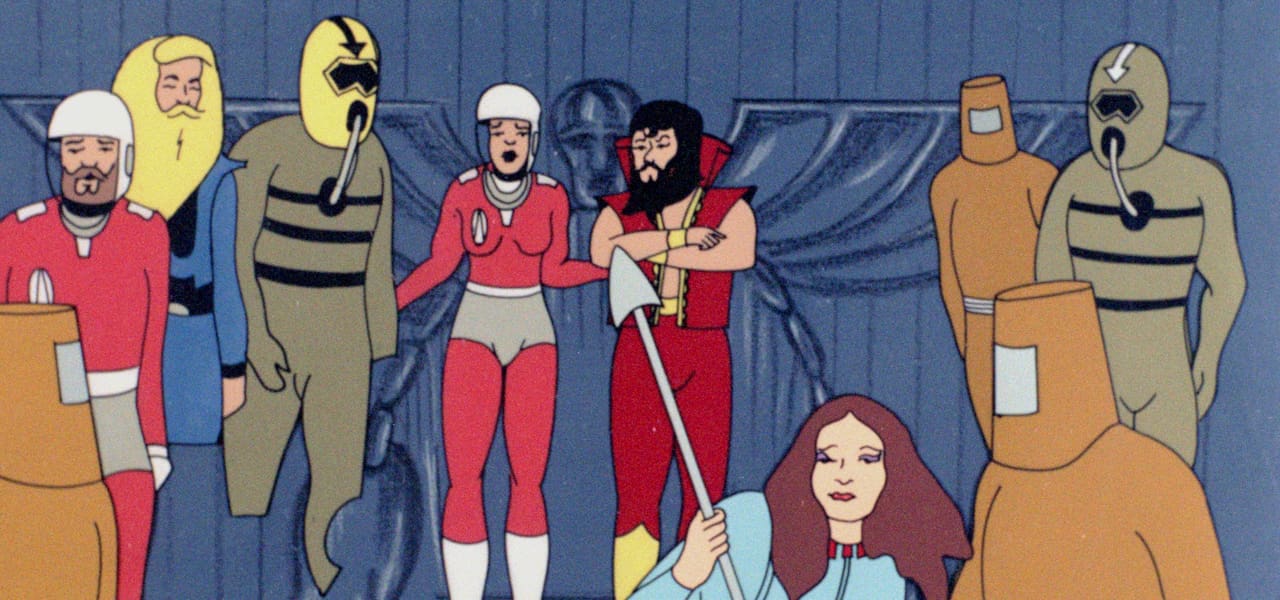
For more than four decades, Roy del Espacio was more rumor than movie. Mexico’s third animated feature had opened in a dozen Mexico City theaters in March 1983, disappeared almost immediately, and never surfaced again on TV or home video. Its reputation survived through a small handful of promotional images and some mostly unkind retrospective accounts.
Now, the 64-minute sci-fi adventure, released in English as Roy From Space, has a new restoration from boutique label Deaf Crocodile, which scanned the original film’s 35mm negative, preserved at Mexico’s Cineteca Nacional, and rebuilt what was salvageable, adding new animation to replace what, for legal reasons, should never have been there in the first place. More on that later.
The restored film will now get a North American Blu-ray release with a booklet, interviews with members of the filmmakers’ families, and a featurette about its most unusual new contribution: roughly four and a half minutes of animation created more than 40 years after the movie’s original production.
Independent animators Isabelle Aspin, director of shorts including Help Me Help You and Rituals, and Brian Smee, best known for his Slamdance-premiering short Lazy Daze, were asked to produce that footage after Deaf Crocodile discovered that the original negative contained several minutes lifted without permission from Kinji Fukasaku’s 1978 Japanese live-action feature Message from Space. Aspin and Smee’s job was not to improve Roy, smooth over its eccentricities, or make a 1983 film conform to contemporary standards. It was to resurrect the film as authentically and accurately as possible with the resources available to them today.
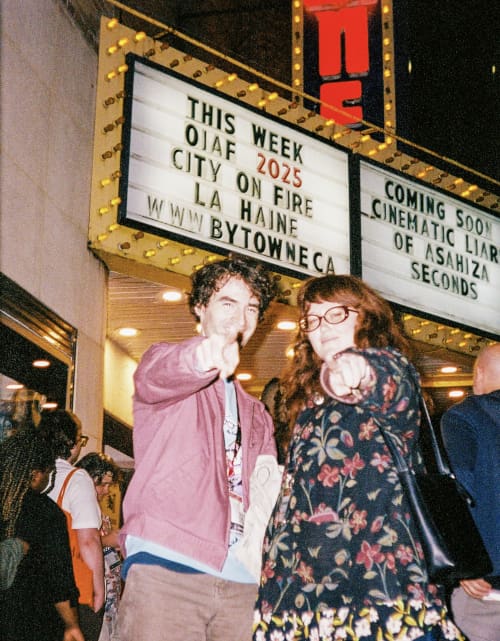
“The goal really was that this should be as seamless as possible and we should be invisible,” Smee told Cartoon Brew.
The result is a cross-cultural and cross-generational collaboration between two contemporary filmmakers finishing sequences begun decades ago by an inexperienced, largely teenage crew in Mexico in the late 1970s and early ’80s, using hand-painted backgrounds, inked cels, cutouts, improvised camera tricks, and even a dwindling supply of vintage cel paint.
Lost But Not Gone
Roy del Espacio was produced from 1979 to 1982 and released on March 3, 1983. An account assembled by Colombian researcher Alejandro Vidal Charris from Cineteca Nacional records and interviews identifies Héctor López Carmona as director and cinematographer, Ulises Pérez Aguirre and Rafael Ángel Gil as executive producers, and Pérez Aguirre as the source of the original idea. Ernesto Cortázar composed the music. Salvador Nájar voiced Roy, with Rubén Moya as King Alom and Patricia Martínez as the Princess.
The premise is pulp science fiction played straight, with influences clear enough that they bordered on, and sometimes included, plagiarism. Cosmic radiation from Mars threatens Earth, prompting the United Nations to send the world’s greatest astronaut, Roy, on a peace mission with Dr. Faz and psychologist Helena. Their odyssey unfolds as a procession of robots, despots, princes, brainwashing, monsters, romantic entanglements, and space battles.
Upon its release, the film immediately occupied an unusual position in Mexican animation. Its predecessors, Los tres Reyes Magos and Los Supersabios, had been made by experienced animation professionals. Roy, by contrast, was a homemade undertaking led by a filmmaker known for title sequences and commercials and a team of mostly first-time animators.
“Basically everyone who worked on it was teenagers and very young people hired who had no animation experience and were learning on the job,” Aspin explained. “It’s just a really fun context for it, obviously, with the way that it looks and the quality—and I mean that in a positive way.”
The historical record supports that description. Pérez Aguirre’s children and their cousins helped draw and paint cels while still adolescents. Another participant recalled that much of the crew came from a high-school job-placement program. Veteran Mexican animator Ignacio “Nacho” Rentería appears to have been the sole experienced animator, and later described an improvised production in which recruits traced projected frames from the 1936 Flash Gordon serial.
The movie’s theatrical life was brutally short. Research drawn from period exhibition records places it in 12 Mexico City cinemas on opening day. Ten dropped it after two days; the remaining two kept it only until the following Wednesday. Opinions on the film from the time are non-existent, meaning any assessments of the feature were published at least two decades later.
By the 2010s, Mexican publications were describing Roy as lost media, because no copies were known to exist in circulation. However, Vidal Charris later discovered that the original negative had remained at the Cineteca Nacional, in the producer’s family’s possession. The movie had vanished from the public eye, but not from the vault.
When Deaf Crocodile began investigating the film, there was no guarantee they’d find anything worth the effort. According to Aspin, the company secured the rights and paid to scan the negative without first being able to watch the film.
“No one had seen this since it came out,” she said. “When they got back the scans, they were like, ‘This is incredible!’”
Cutting Room Floor
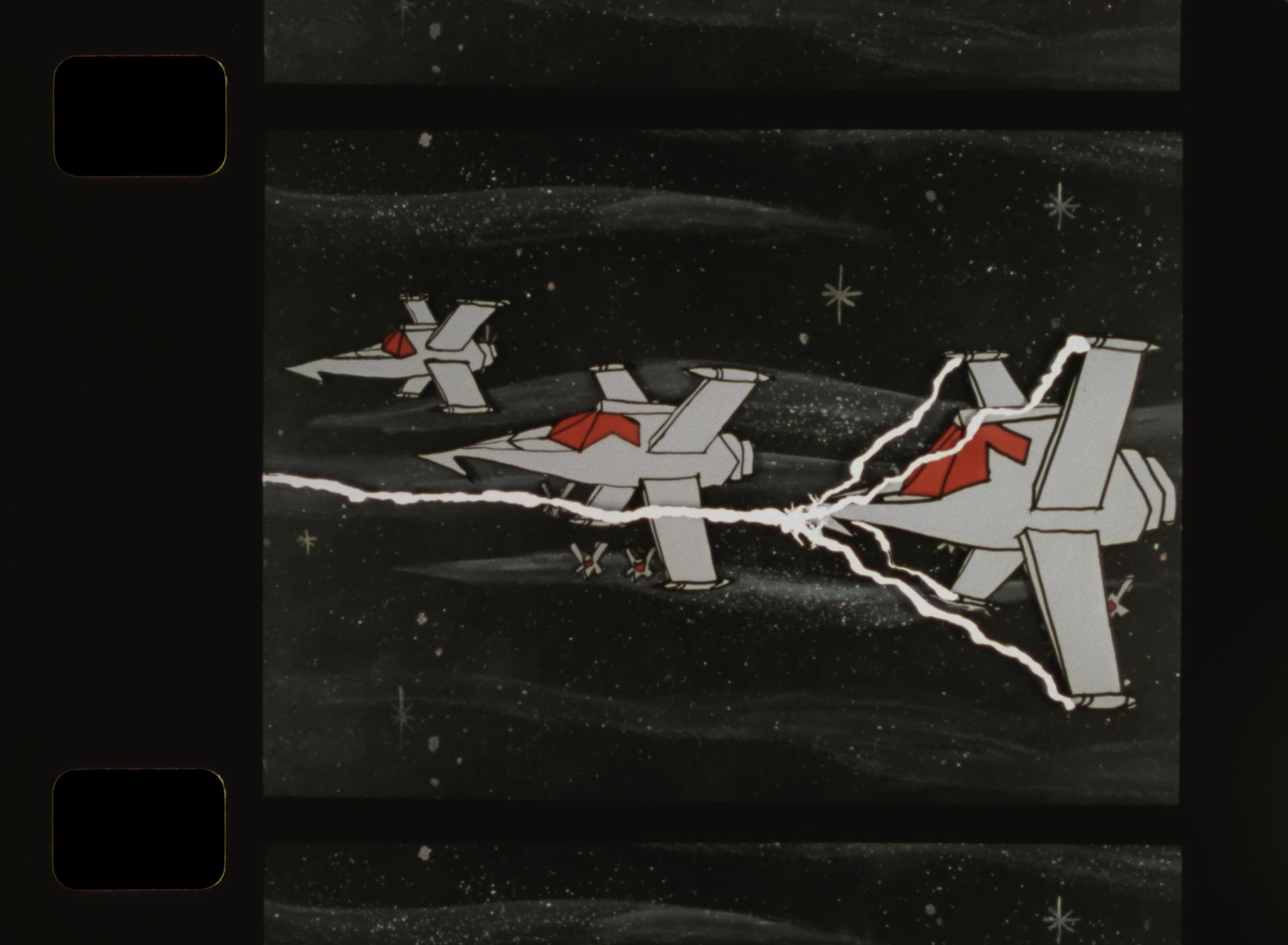
The restored scan revealed live-action spaceships and battle footage alongside the film’s animated sequences. Earlier researchers, working on rumors and without access to the film, had speculated that the shots came from the original Battlestar Galactica. Once the movie was finally examined under scrutiny, Deaf Crocodile co-founder Dennis Bartok recognized the actual source as Message from Space.
Regardless of how that footage made its way into Roy, Deaf Crocodile did not have the rights to include it in the restoration. One proposal was to insert explanatory cards describing the missing action, as a silent film would have. The label ultimately chose the more ambitious and, for viewers, rewarding solution: commission artists to produce replacement animation for those unusable live-action scenes.
Programmer Alex McDonald recommended Aspin and Smee after seeing their retro-influenced music-video work, including Across My Jaw, and felt their handmade aesthetic suited the project.
“Originally, because so much of the original animation in Roy is rotoscoped off of Flash Gordon serials, the idea at first was: This movie is kind of crazy, so just rotoscope these live-action scenes,” Smee recalled.
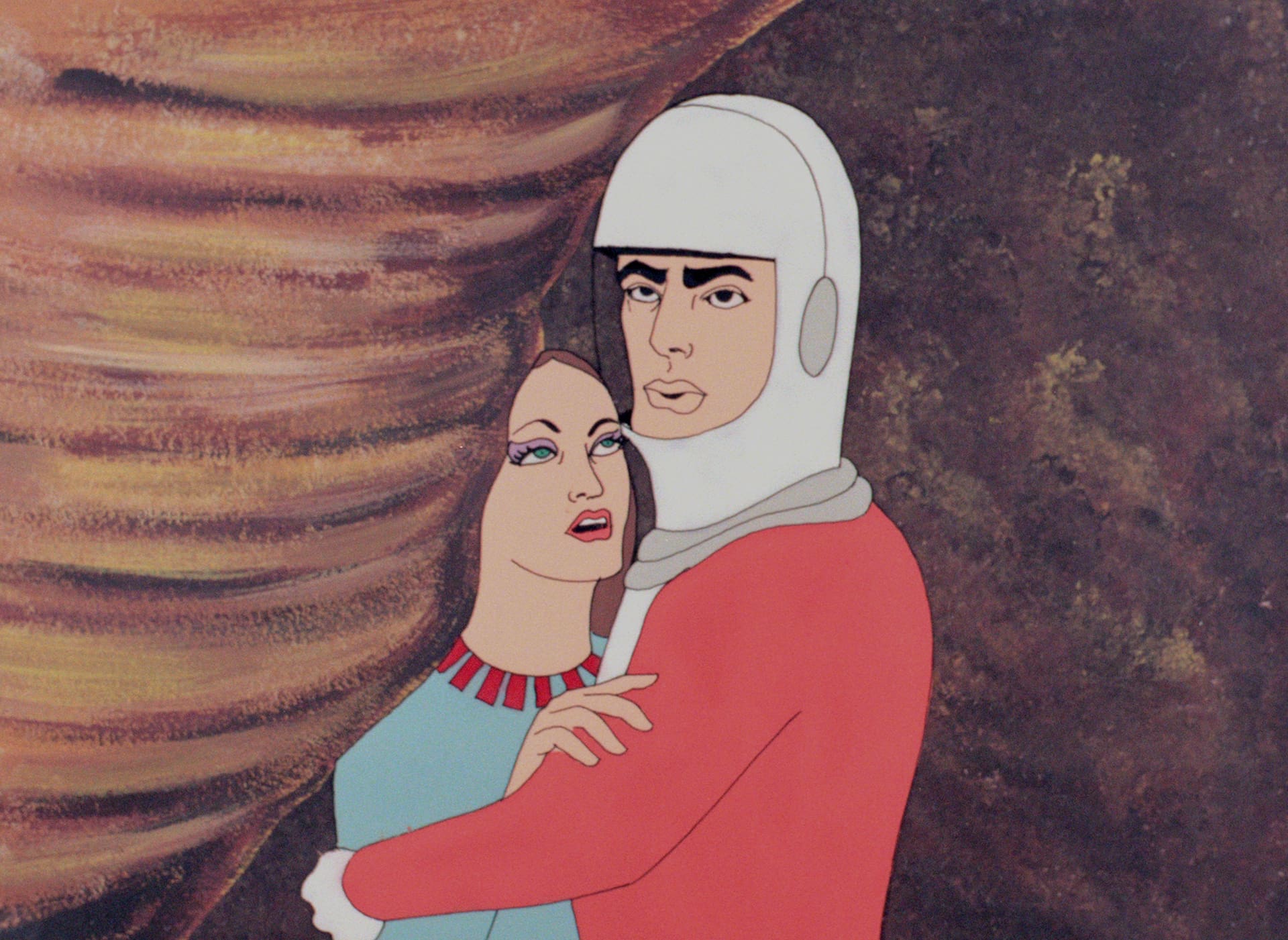
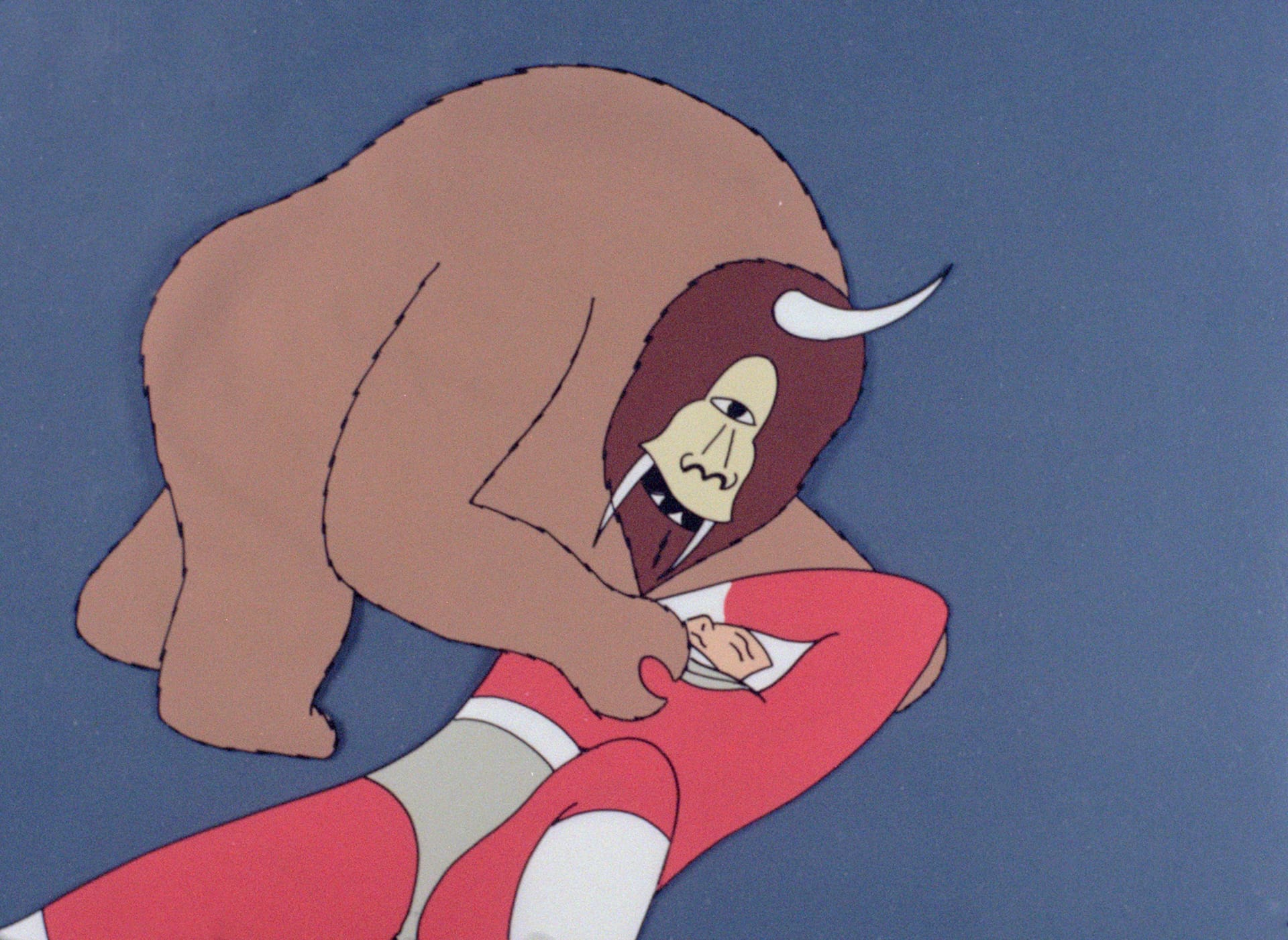
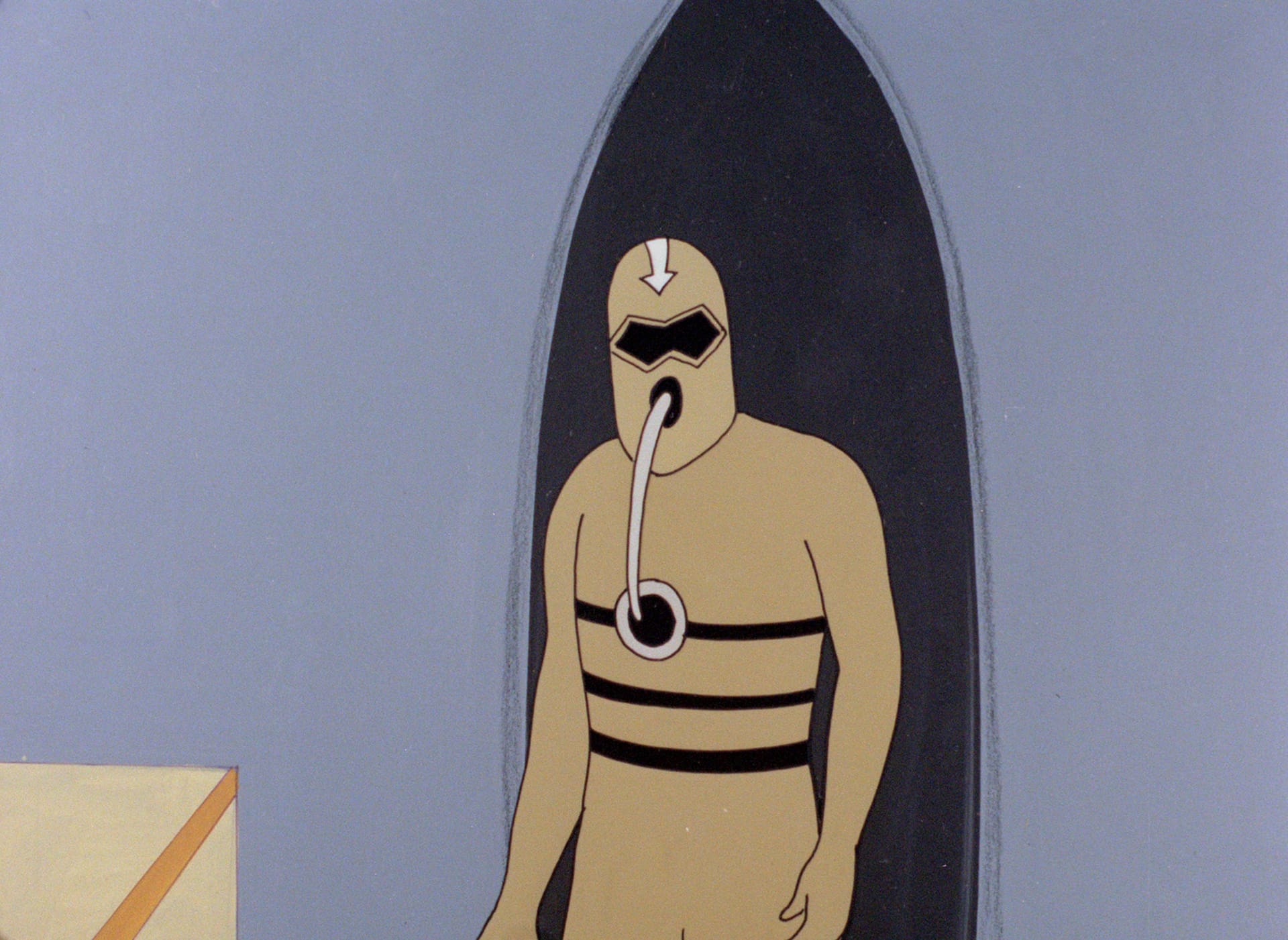
After several viewings, the duo changed their minds. Straight rotoscoping of Message from Space would reproduce action that did not behave like the rest of Roy. The two productions did not share a visual fidelity. The source footage zoomed, panned, and carried the camera through space. That directly conflicted with López Carmona’s more novice aesthetic, which was far more fixed and tactile.
“We started coming up with rules based on how they were shooting their animation and what the footage was that we were replacing,” Smee said. “A couple of rules were: no zooming with the lens; the camera has to remain still; it can’t move up and down on the downshooter. And all the footage we were replacing did all of those things.”
That left Aspin and Smee with some stylistic questions: How would Roy del Espacio have represented a flight through a canyon if its original crew had animated the shot? How would it turn a camera move into movement by a painted object beneath a stationary lens?
“We had to figure out ways to practically, under the camera, communicate zooming through a canyon or panning through a space background,” Smee said.
Their friend and animator Patricia Luna helped them understand the Spanish dialogue and its comic tone. She suggested treating the borrowed material as a kind of placeholder or animatic, rather than part of the finished film.
“That was a real lightbulb moment,” Smee said. “This is just like an unfinished animatic. So we were hoping that by animating this, we were just finishing the work that they started.”
Following Roy’s Rules
Aspin and Smee were given about a year to work on the animation and considerable creative freedom. Their process combined traditional animation with detailed forensic study. Each replacement shot had to make sense not only in narrative terms but within the particular stretch of film surrounding it.
“It was like a combination of archiving and animation,” Aspin said. “Every shot just had to be looked at within the context of the work around it.”
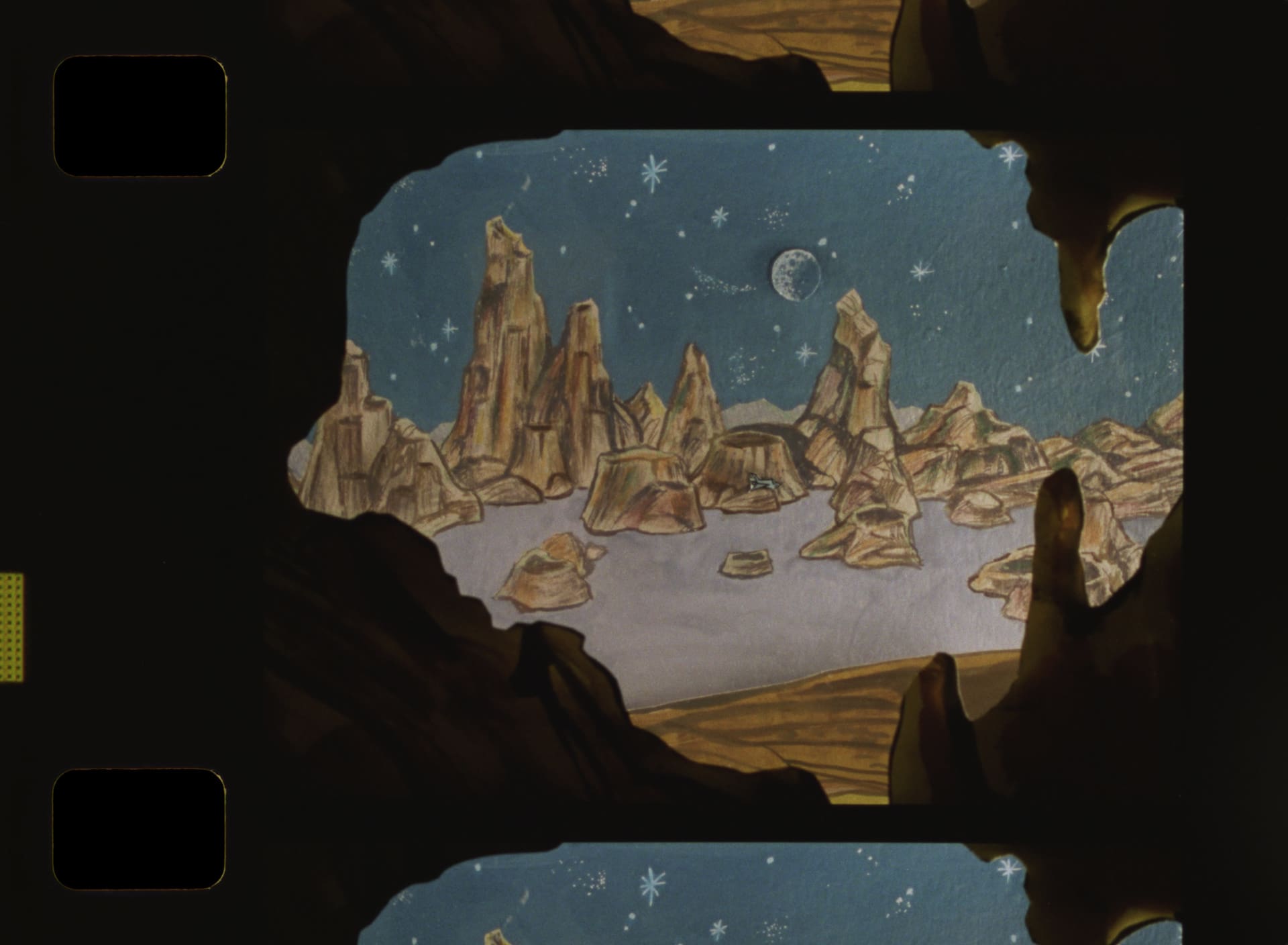
That was especially important because Roy has an inconsistent look and no clear house style. Its backgrounds and animation change as the movie progresses, reflecting different hands and, apparently, a patchwork production assembled over its three years.
“You have to look at the shots around it and be like, ‘Okay, whose background world or domain are we in?’” Aspin explained. “Some of them are really graphic and flat, and then some of them are kind of pastel drawings.”
Even the vast expanse of outer space is inconsistent. Aspin identified two principal approaches: an assured early version and a later attempt by another artist to reproduce it. Rather than reconcile those differences, she and Smee preserved them. A replacement had to match the movie’s visual style of the surrounding shots, not an idealized overall design.
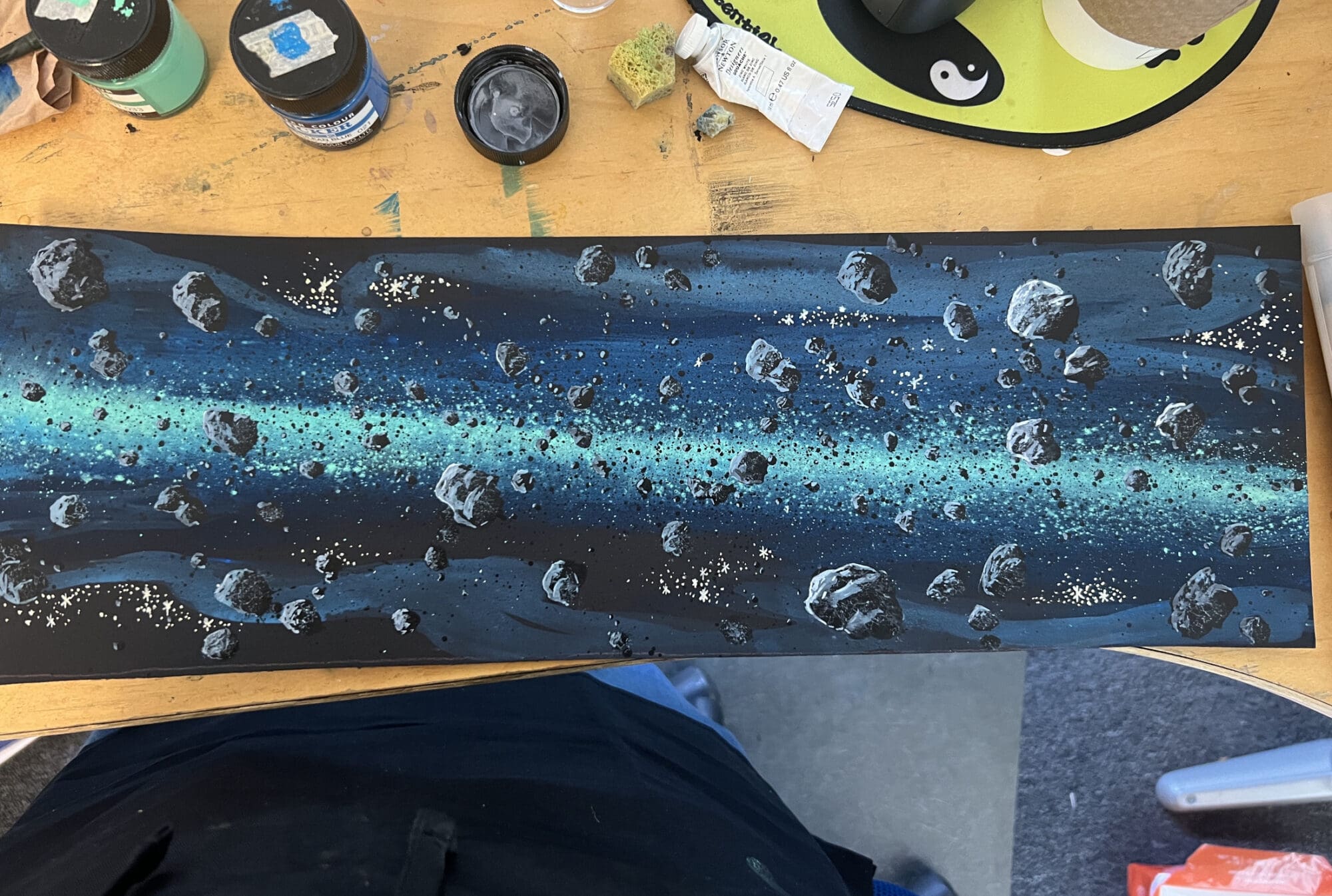
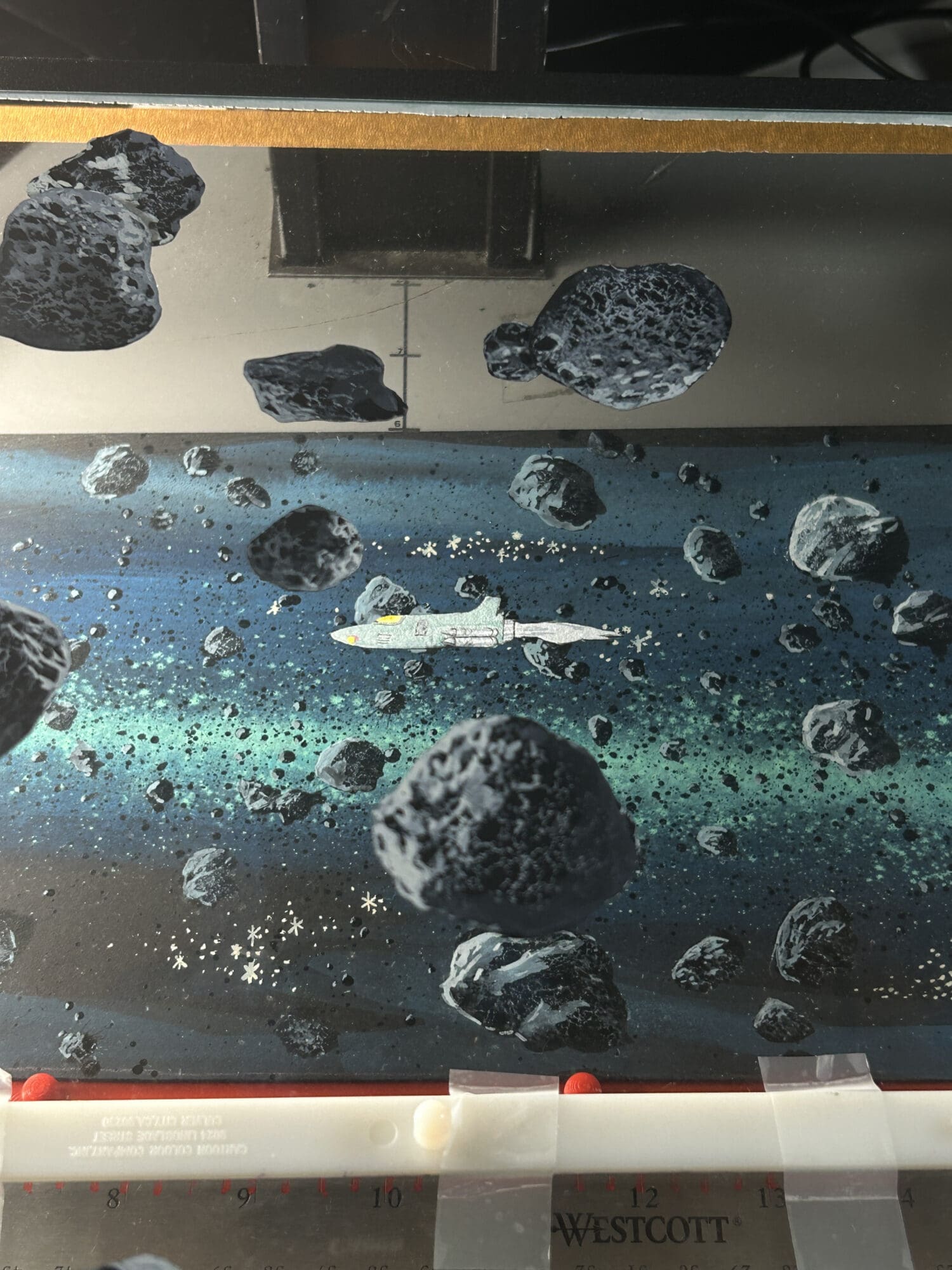
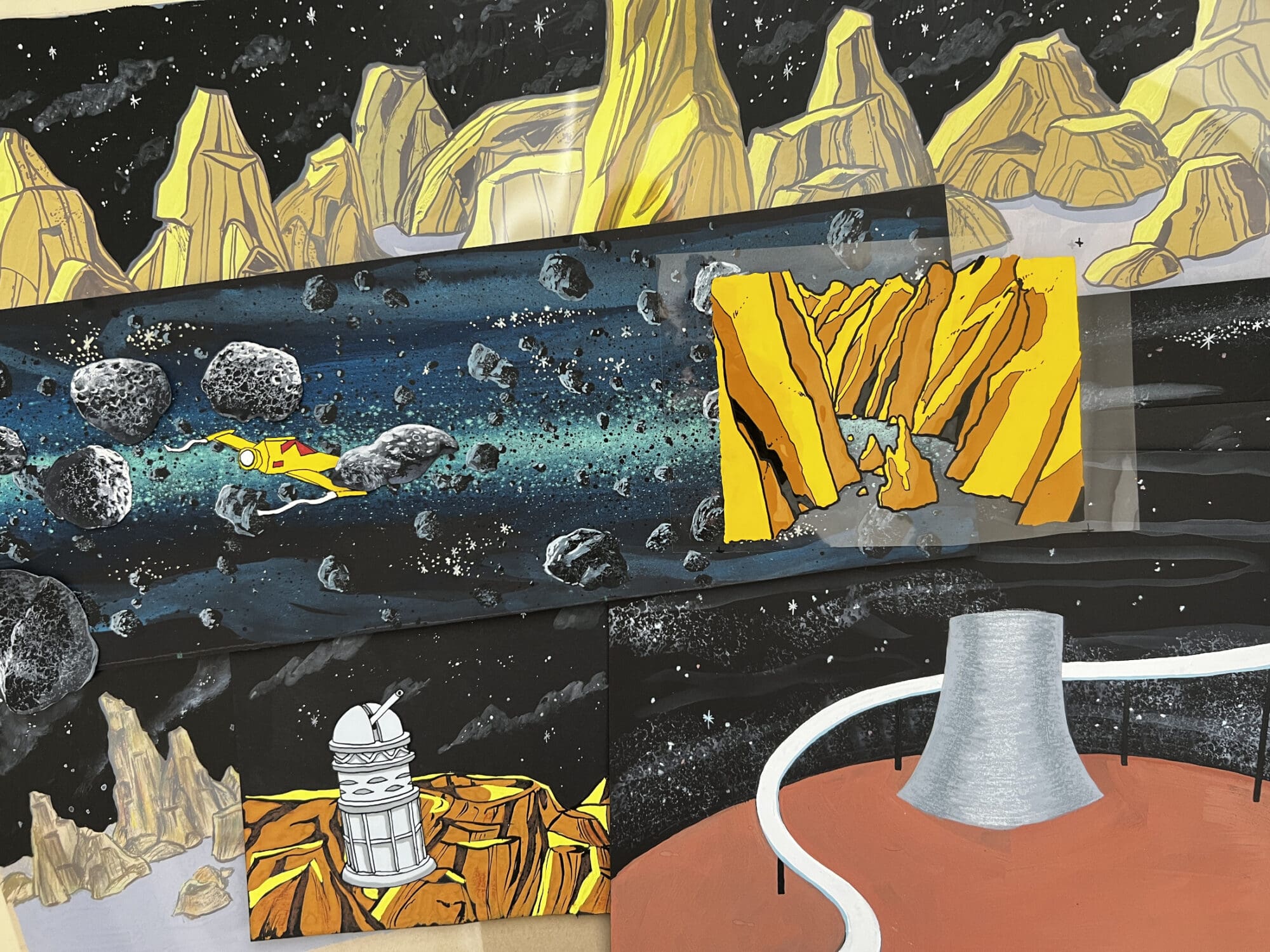
The same principle guided every technique they introduced.
“Every animation technique that we did, there was a precedent for it within the original footage,” Smee said. “We weren’t trying to invent anything or introduce new elements.”
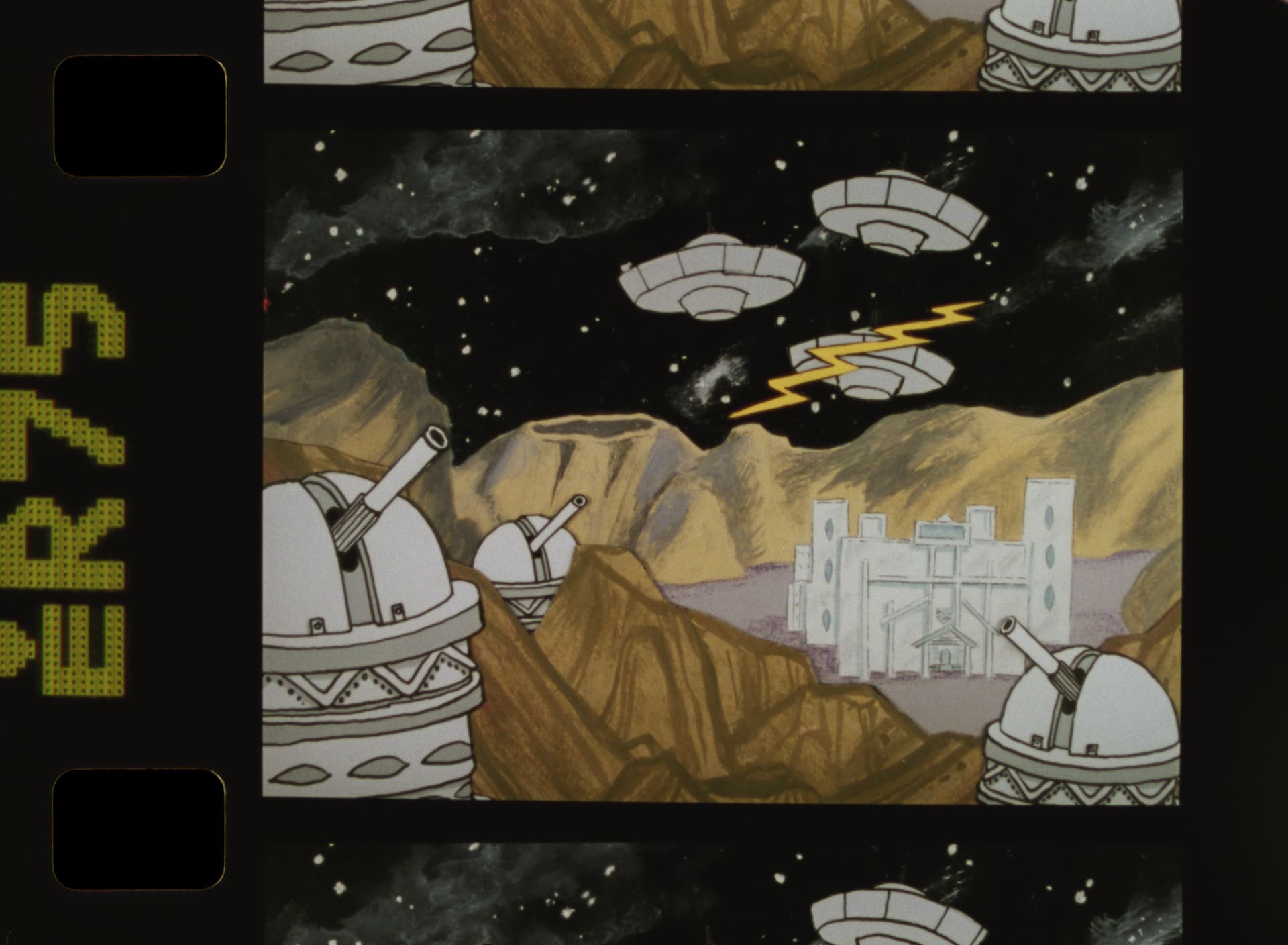
The borrowed live-action also depicted locations that had no equivalent elsewhere in the animated film. One sequence took place on a radioactive dome world that the original artists had never designed, leaving Aspin and Smee to create the setting from scratch.
“We had to think in a Flash Gordon-type design language, because that’s what they were really rotoscoping the rest of the animation off,” Aspin explained.
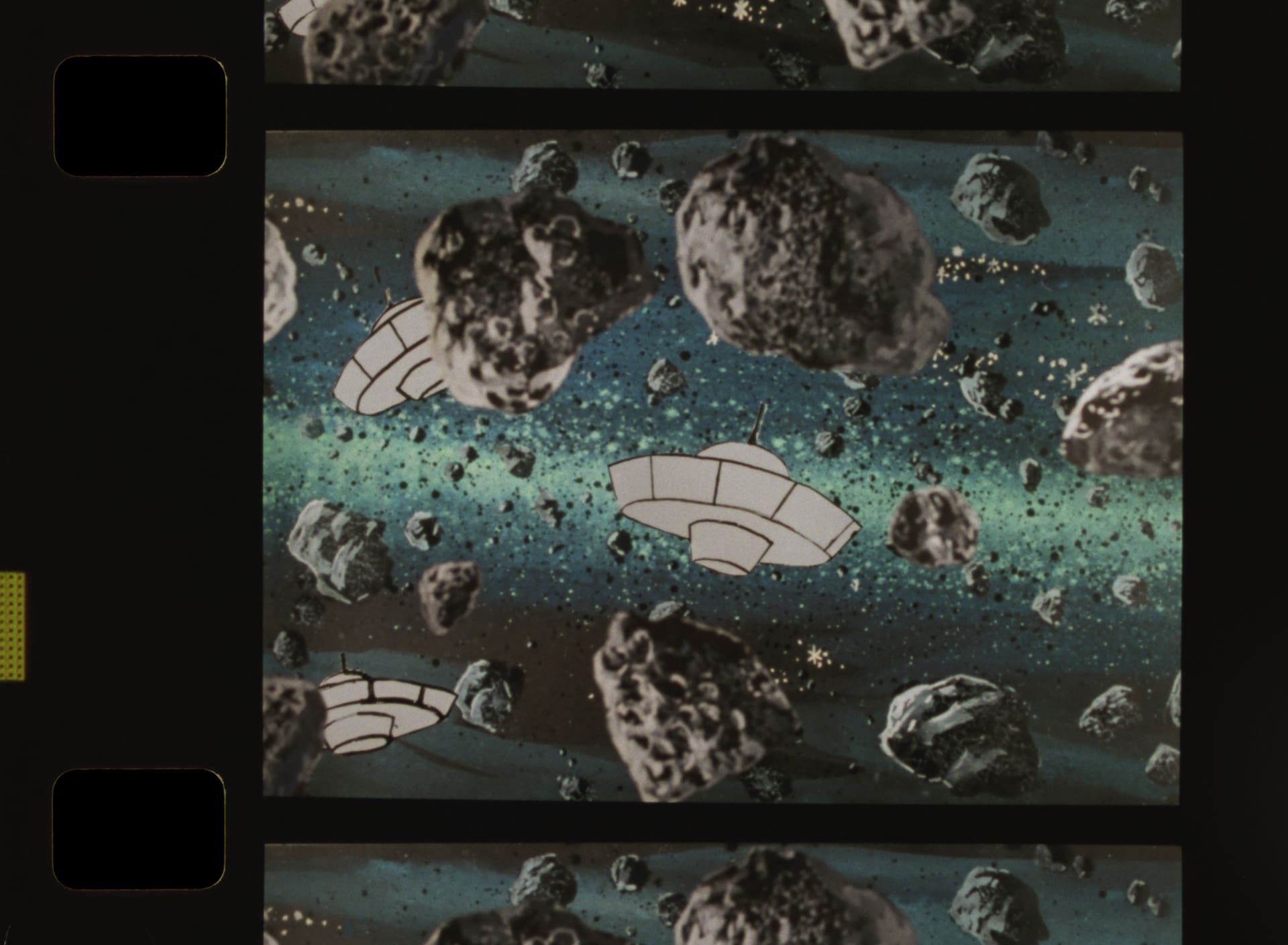
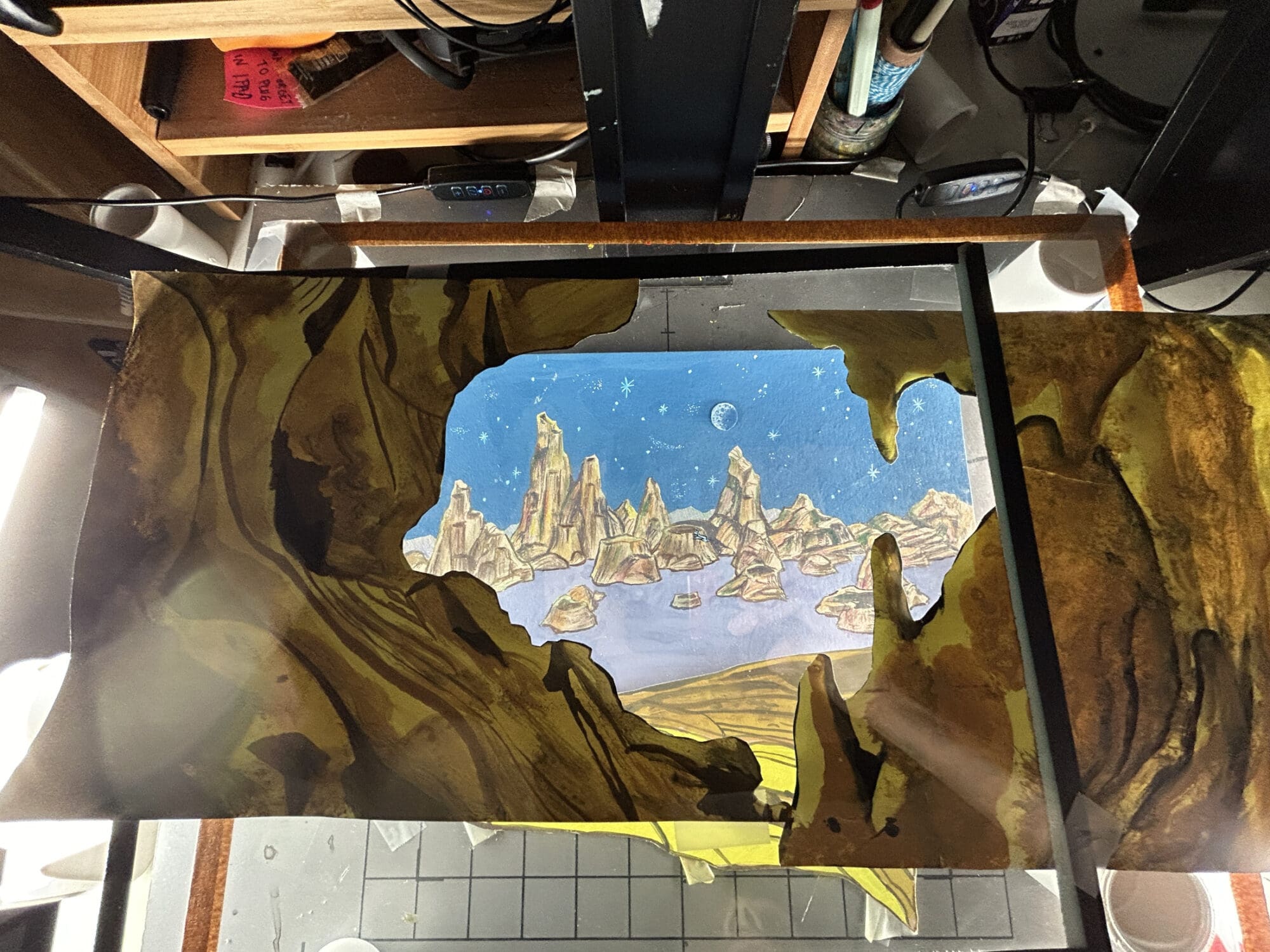
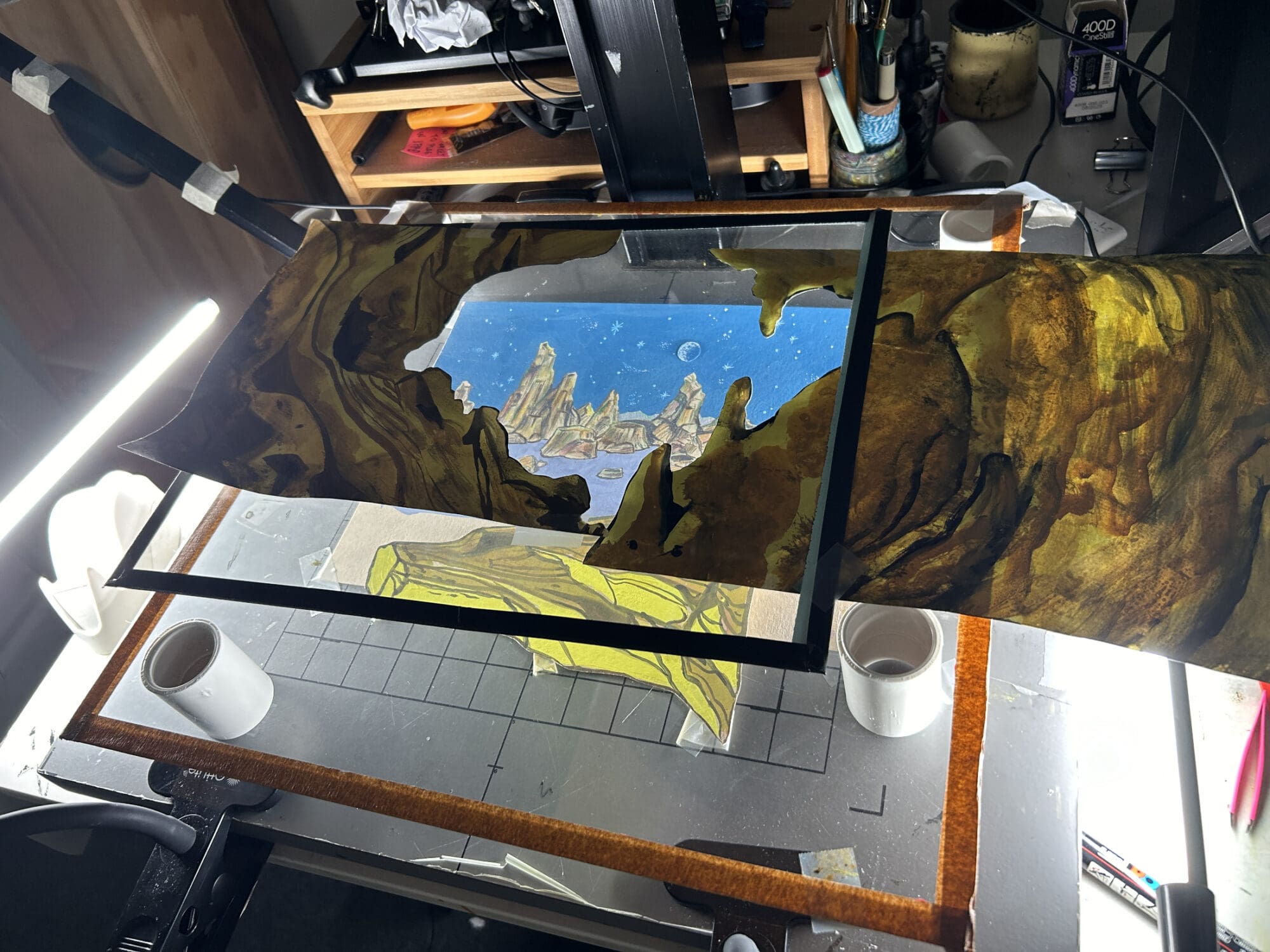
Several shots in which ships fly through a canyon proved particularly challenging. Their attempts to create the motion solely by manipulating paper pieces did not convince, so they animated one background passage and reused it in different crops.
“At least we weren’t creating three different animated backgrounds,” Aspin said. “They wouldn’t do that on the original footage.”
That decision captures the project’s peculiar discipline. Faithfulness sometimes meant accepting repetition, unevenness, and visible construction, the very things modern production pipelines are designed to eliminate.
Ink, Paint, Plastic, And A Stationary Camera
Aspin rejects the premise that old-school 2D animation has become technically impossible, a narrative common in an industry obsessed with mining older IPs but unable or unwilling to replicate their original aesthetics. At an industrial studio scale, she understands why a physical pipeline creates anxiety: executives expect every element to remain editable, separable, and open to revision. But two people working shot by shot can still make images the old way.
“On the scale of a studio with hundreds of people, it is impossible to do these things,” she said. “But on the scale of two people, it’s very much possible and doable.”
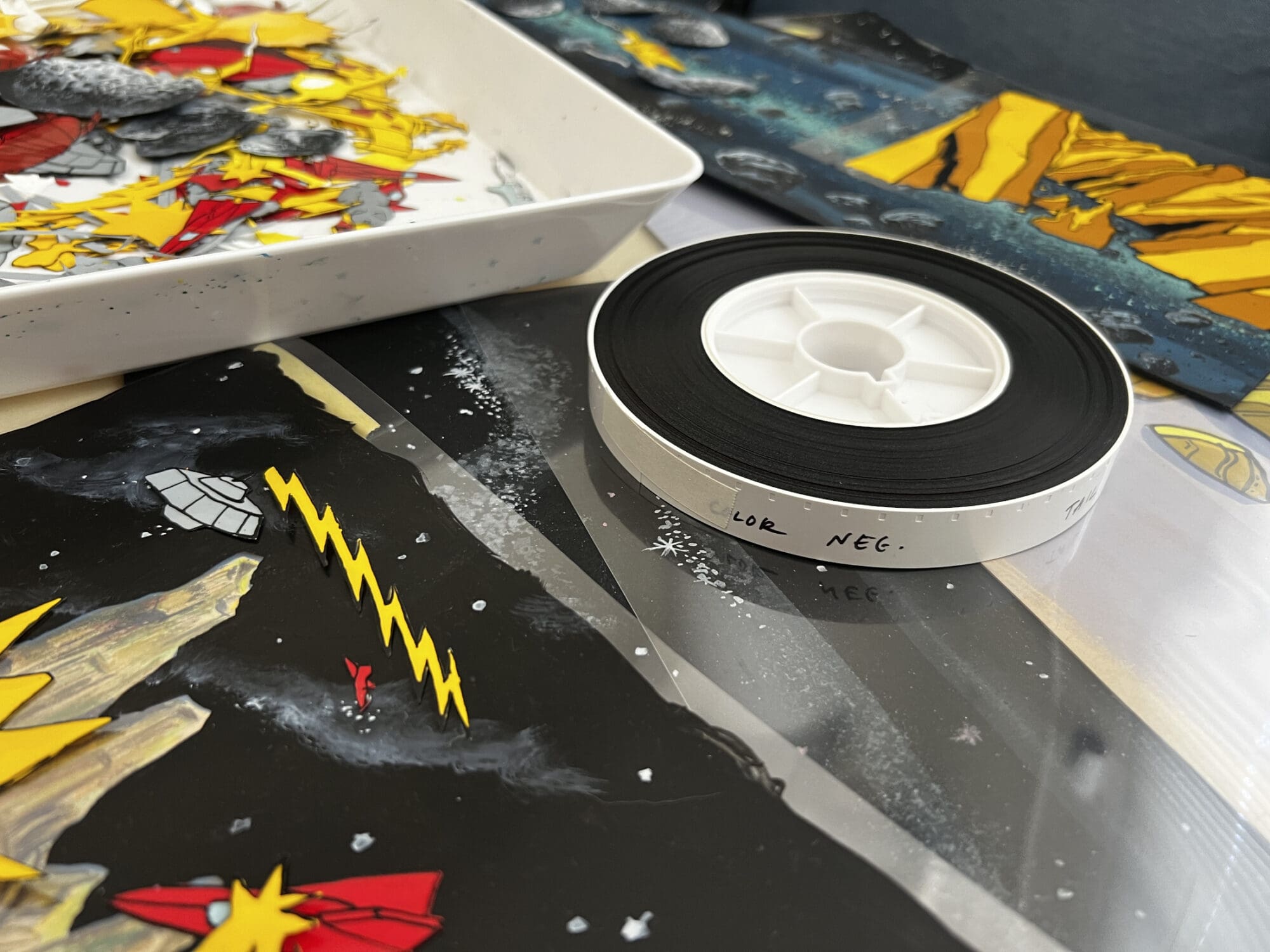
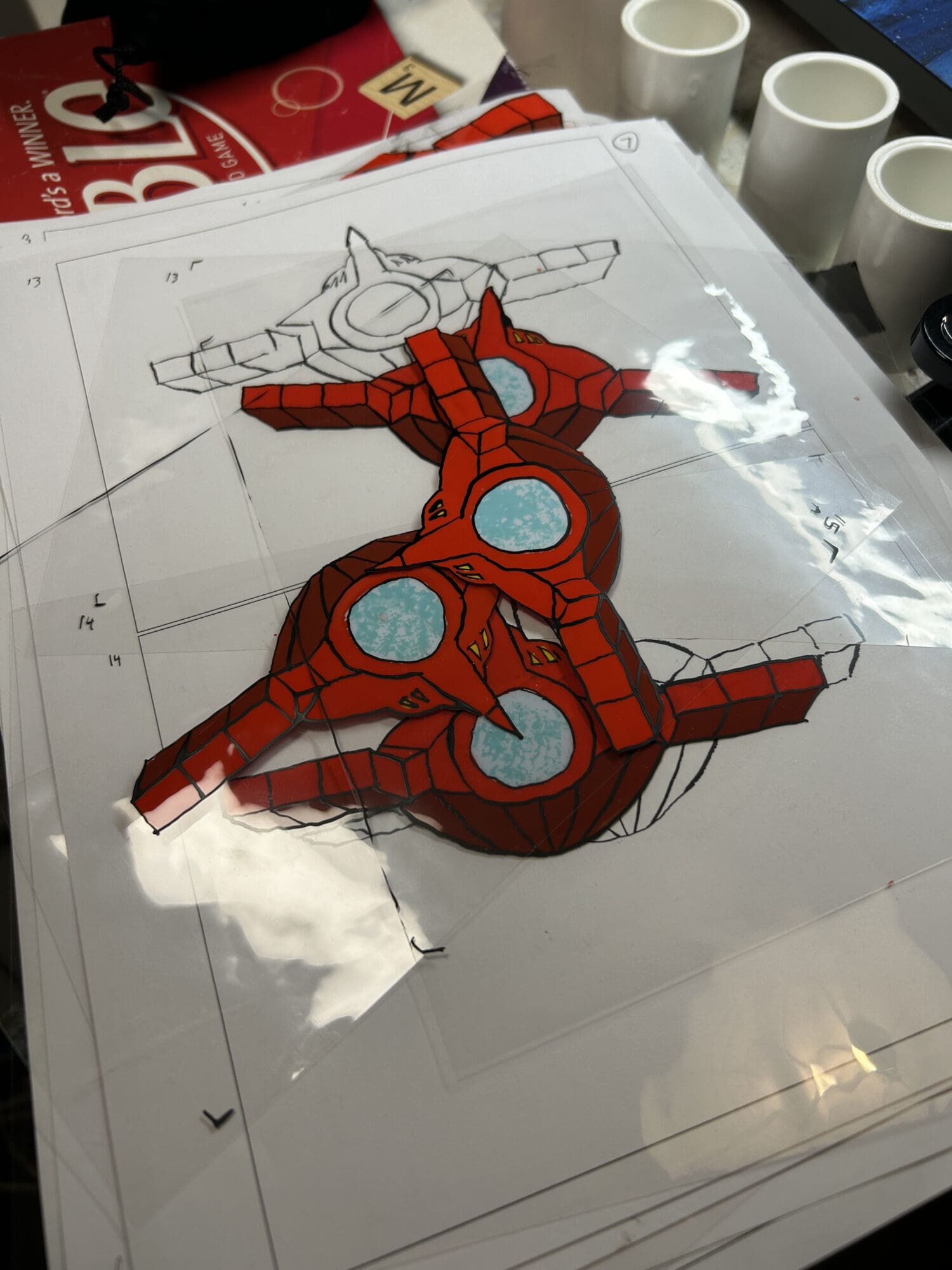
Every background in their new footage was painted on paper. They inked and painted characters and effects on cels. Spaceships became a hybrid of cel animation and cutout puppetry: outlined on one side of the plastic, painted on the other, then trimmed into pieces that could be moved under the camera rather than redrawn for every frame.
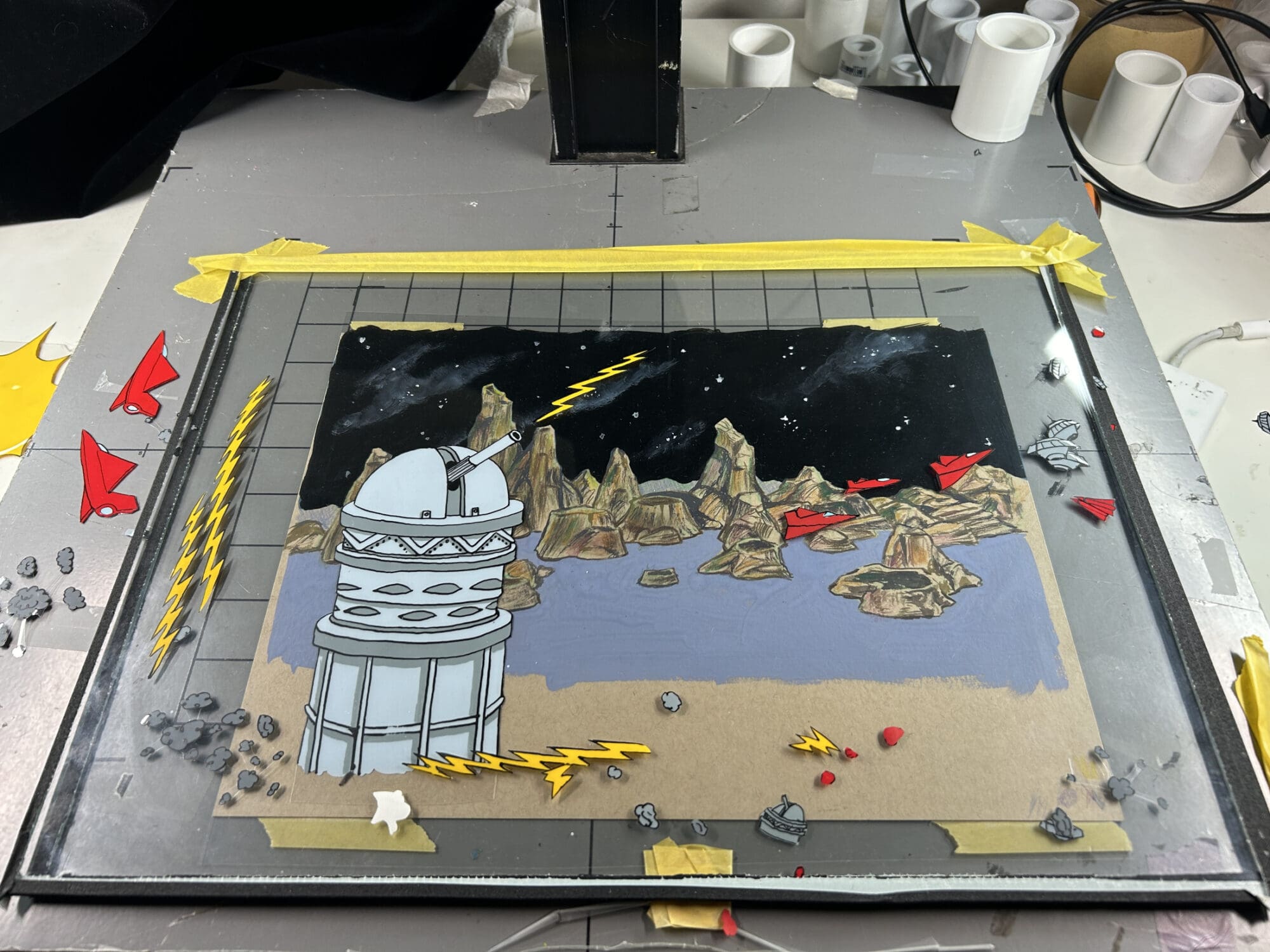
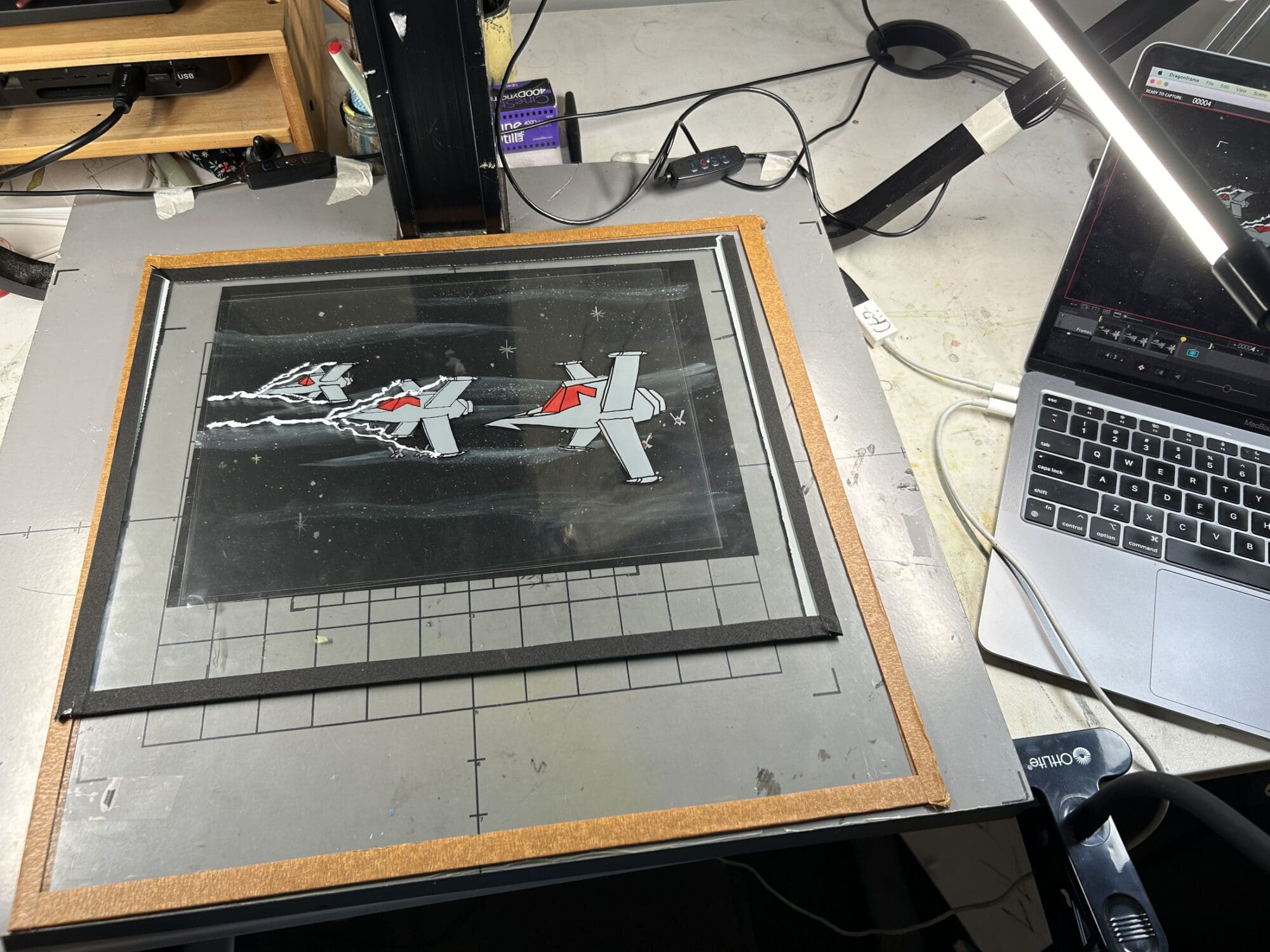
“The idea of using an entire sheet of cel for one tiny ship was just like, we can’t justify doing that,” Smee said. “But this was a good in-between workaround.”
There was also a practical constraint: cel paint is now a scarce specialty material. The pair had inherited a cache of old Cartoon Colour and Chroma Colour paint nearly a decade earlier and kept it while waiting for the right project.
“It really stinks,” Smee said. “We were just sitting on it forever, waiting for the perfect excuse to use it. We used the last remaining bits of that to color a lot of these cels.”
When a needed color was missing, Aspin searched for contemporary paint with enough opacity to cover clear plastic. Her solution came from a different analog craft community: Vallejo acrylics made for painting miniature models.
“The hardest paint color to find in an opaque form was yellow,” she said. “I was just Googling, ‘What is the most opaque yellow paint commercially available?’ Thank God for the mini community.”
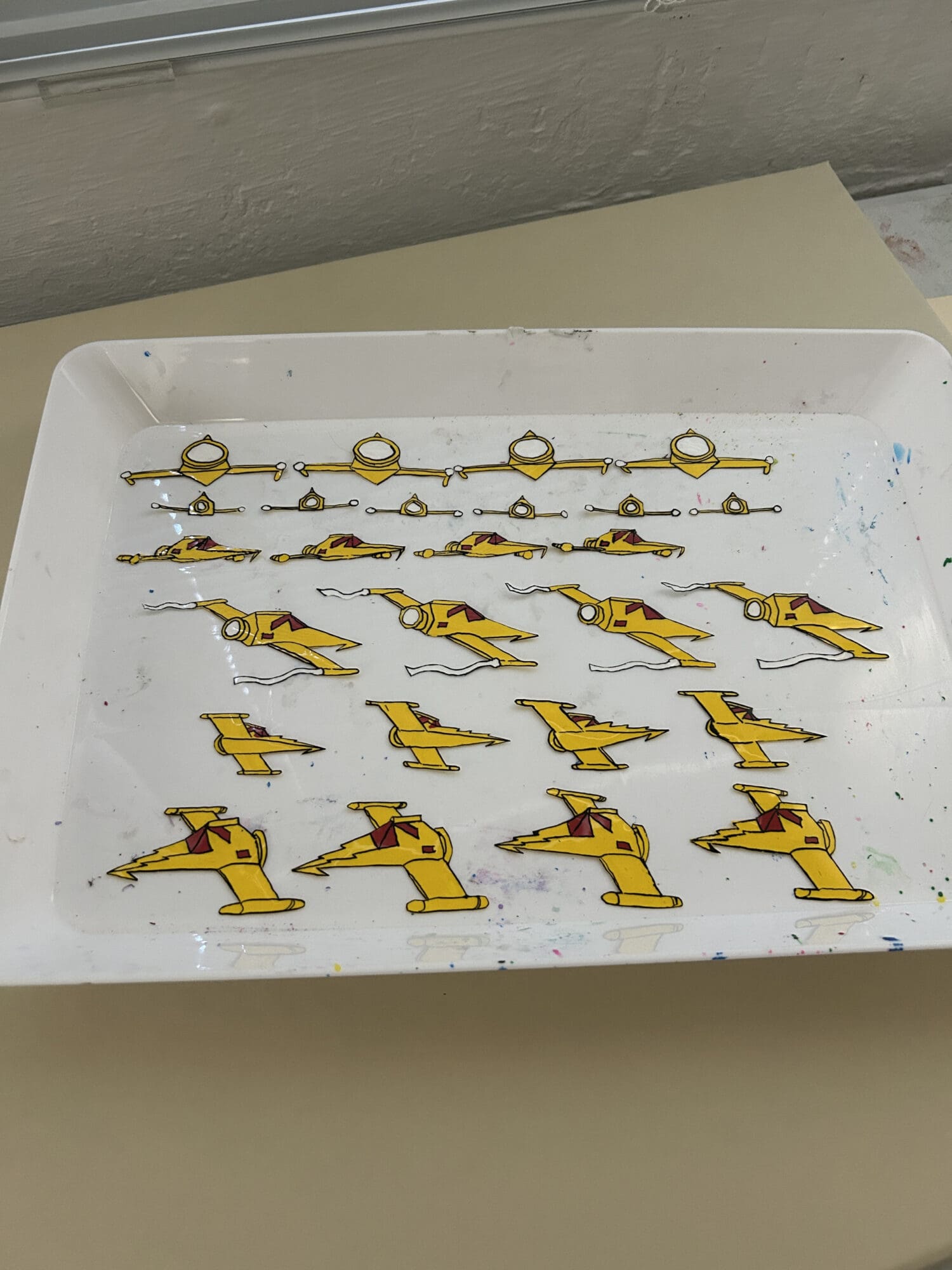
The finished animation was digitally photographed, then transferred to 16mm film and scanned back into the restoration. Rob Houllahan and CineLab in Massachusetts helped the animators use the intermediate film generation to bring the grain and texture of their new material closer to the original 35mm imagery.
“If we could have shot it on film, we would have,” Smee said. “We just didn’t have the time.”
The Benefit Of Not Knowing Better
For decades, almost every written description instructed audiences to see Roy del Espacio as a failure before they had any opportunity to see it at all. Aspin and Smee do not deny the film’s technical shortcomings. Instead, they value what those shortcomings reveal: a group of novices trying to will an animated space opera into existence outside an established studio system in a country with almost no animated feature tradition.
“It engages in the tradition of sci-fi in such a fun way,” Aspin said. “They’re taking these Flash Gordon cartoons, which are basically the raw materials of the sci-fi genre on film, and rearranging them in this new way.”
Aspin is drawn to the film’s unexpected beauty and outsider art spirit, particularly the unusual images its inexperienced artists created while clearly learning on the job.
“There are some sort of sublime shots in there where I’m just like, nobody could come up with this,” she said. “You get this juxtaposition of the spareness of that era of animation backgrounds and the simplicity of it with these really charming, beautiful cel drawings mashed together.”
The B-movie dialogue adds its own pleasures. Aspin’s favorite villainous threat translates roughly as: “Even if he doesn’t die, he won’t live.”
For Smee, the film’s value is inseparable from the harsh story of its first release. The production demanded years from López Carmona and his family, only to be dismissed and locked away after a few days in front of audiences.
“Its reputation was, ‘This is one of the worst things ever made,’” he said. “It’s the third feature-length animated film made in Mexico ever, and it’s not a religious epic. It’s a space movie. That is already so tantalizing.”
To the duo, Roy del Espacio was never some lost masterpiece in need of canonization. To them, Roy is a sincere act of creative bravery completed against overwhelming odds.
“It’s a testament to the power of animation and the fact that you can make something from a point of pure passion outside of a studio system,” Smee said. “It kept me charged throughout the entire production of making this new footage.”
Deaf Crocodile’s release includes interviews with Andrea Pérez Mata and Ulises Pérez Mata, children of producer Pérez Aguirre; their cousin Alejandro Mata; and López Carmona’s grandson, Héctor Ricardo López Reyes. Vidal Charris, whose research helped establish that the film still existed, contributes to the accompanying booklet.
“The whole time, we were just like: This is literally a one-of-one project, and we will never get to do this ever again,” Aspin reflected on her time spent with Roy. “It’s kind of sad, because it was so fun.”
And that may be the best argument for Roy’s return. The people who made it didn’t have the ideal tools, training, budget, or conditions, but they made it anyway. Four decades later, two more animators encountered a different set of limitations and answered in the same spirit, with paint, plastic, patience, and invention.
As Smee put it: “It is checking off those boxes of, yeah, this is a sci-fi movie with big battle sequences, and it’s sort of a Star Wars–Flash Gordon story, but it’s interpreted into something new. And isn’t that what we all want?”
Roy de Espacio is available for pre-order on Blu-ray now, and Deaf Crocodile is working to program more public and festival screenings of the film.