.png)
Opinion: When Is A Film Responsible For Its Country?
Stay informed with free updates
Sign up to get our news digest — delivered directly to your inbox twice a week.
I didn’t think all that seriously about film-festival boycotts until Russia’s full-scale invasion of Ukraine in 2022.
At the Ottawa International Animation Festival (OIAF), where I work, the initial position was clear: no Russian officials or state-supported works. No Ministry of Culture logos. No propaganda. No cultural diplomacy dolled up as art.
In practice, however, OIAF has not had to test the limits of that position. Virtually everything we have recently received from Russia or Israel has been state-funded, and none advanced far enough in the selection process to force a discussion about a broader boycott based on nationality alone.
That has left the harder cases hypothetical for us. What about a filmmaker who fled Russia in protest? A short funded before the invasion whose director opposed the war? An artist who lost the possibility of a future there because they refused to remain silent?
I leaned toward a case-by-case approach. If the work was not propaganda and the filmmaker opposed the regime, why exclude it? I would not want American independent animators punished for their government’s actions. The answer felt obvious: reject the state, not the artist.
Then I fell in love and moved to Ukraine.
Once you have lived through air-raid sirens, heard drones and explosions overhead, seen smoke rising from Lviv and watched funerals become part of the city’s rhythm, the question stops being abstract. It becomes harder to talk calmly about nuance when the country from which that “nuanced” culture emerges is destroying another people’s culture, cities, and bodies.
So another question began pushing back: why should Russians get to make culture, circulate culture, and be celebrated for culture while Russia is trying to erase Ukraine?
I began speaking with programmers and artists not to build a case for one answer, but to understand how others draw these lines — and to make a conversation often conducted privately more visible. What follows is not an OIAF policy or an attempt to establish a universal rule for festivals.
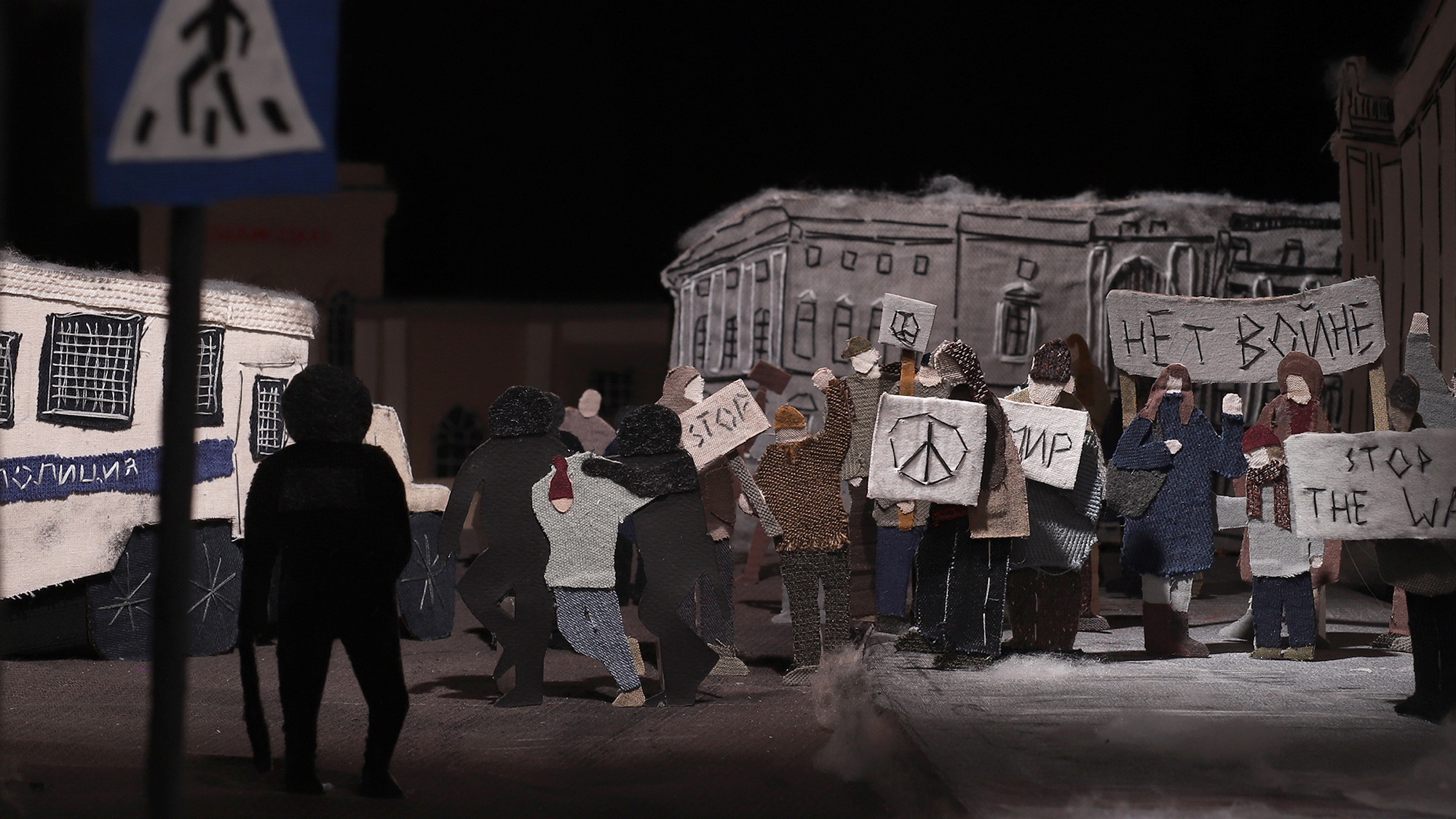
Animafest Zagreb is a useful and uncomfortable example of how quickly this gets messy. I know the festival does not support Russia’s invasion. But three of its last four Short Film Grand Prix winners were directed by filmmakers either born in Russia or long based there: Varya Yakovleva’s Oneluv (2023), Sasha Svirsky’s Dull Spots of Greenish Colours (2025) and Natalia Mirzoyan’s Winter in March (2026). In 2022 and 2023, Russian films screened without Russia listed as their country of origin. Animafest later commissioned Yakovleva, now living in France, to create its 2025 trailer and illustrations for the festival’s visual identity. It also retains its historic “Z is for Zagreb” slogan, which long predates the letter’s association with Russia’s invasion.
Each decision can be explained. A festival cannot control a jury. An artist living outside Russia may oppose the war. A decades-old slogan cannot be blamed for Putin’s use of the letter. I am not suggesting that these decisions formed a coordinated strategy. For me, however, the pattern remains difficult to ignore. Programming, country labels and branding carry meaning beyond the intentions behind them.
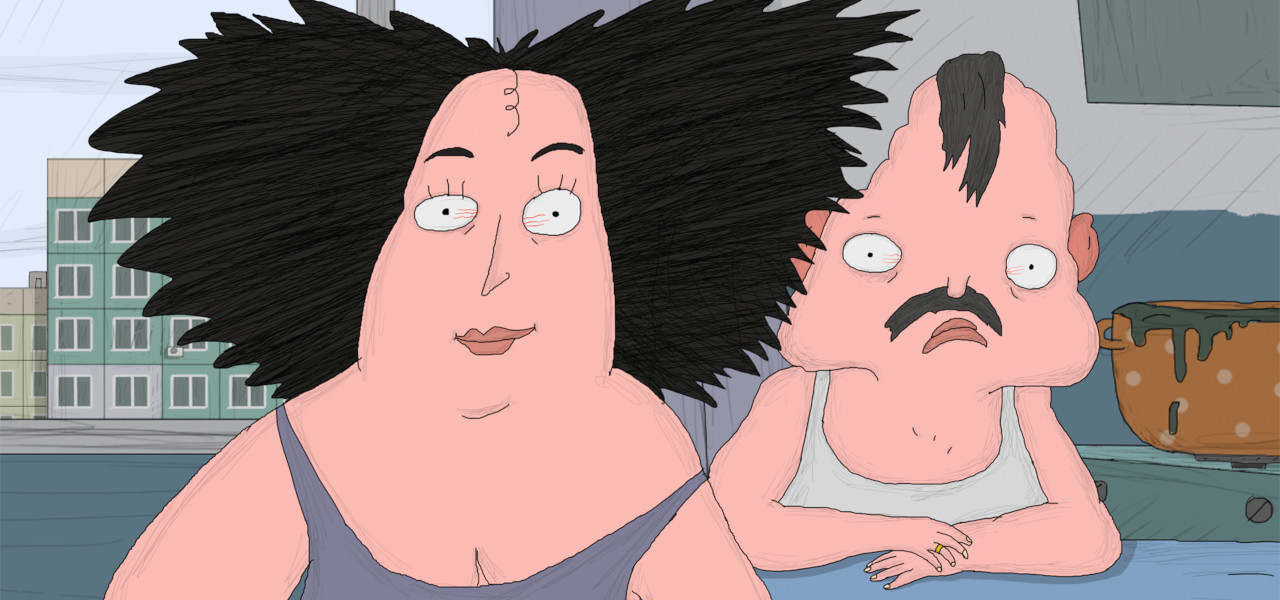
Ukrainian animator Mykyta Lyskov (Deep Love, Kyiv Cake) remains in Ukraine but is largely disconnected from the festival circuit. Even so, he notices Russian films in European competitions. “Whenever that happens, I remember the photo of Andrijana Ružić smiling on Red Square in Moscow — a picture shared on Facebook not long ago,” he told me. Ružić is an independent scholar and a member of Animafest Scanner’s selection committee. Lyskov wonders why some European curators continue cooperating with Russians and why this “seems to face so little condemnation from the European animation community.”
His strongest recent reaction was to The Three Sisters, the Oscar-nominated short by Konstantin Bronzit, which circulated as a Cyprus production directed by “Timur Kognov,” an invented filmmaker supplied with a partly fictional biography. When I interviewed Bronzit earlier this year, he said the false identity was an experiment: would festivals judge the film differently without his name and reputation? His explanation may have been sincere, but the timing was terrible. In the middle of this war, a Russian director using an invented identity and a Cyprus credit was bound to look like a wolf in sheep’s clothing.
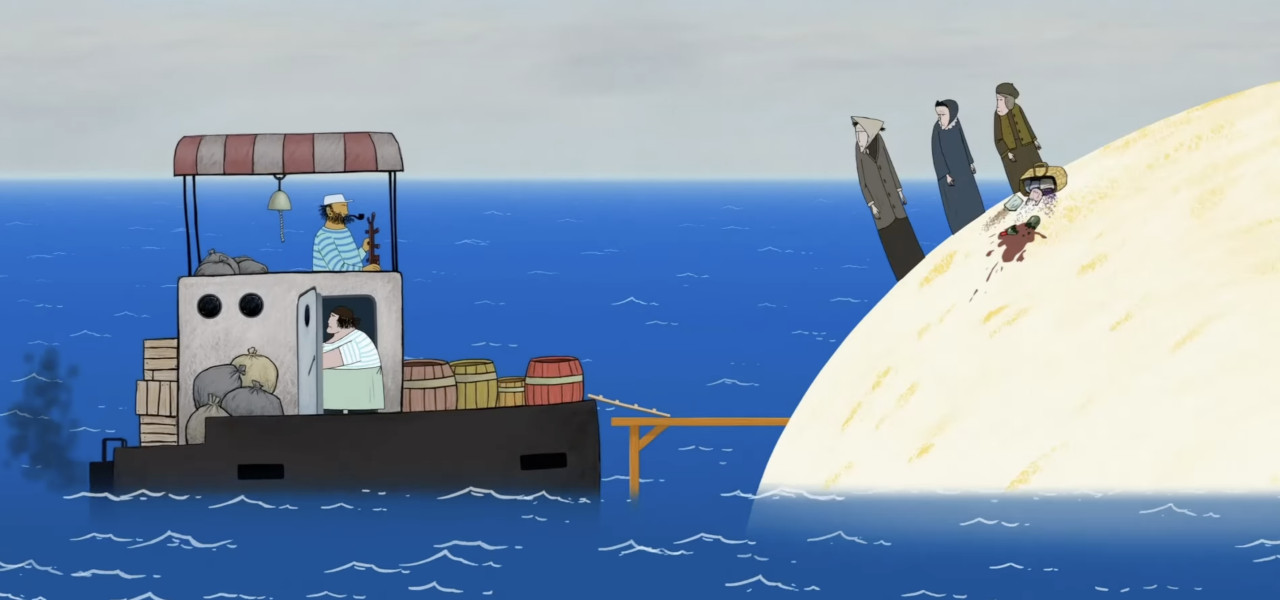
Lyskov didn’t see a politically innocent experiment. “Instead of taking a public stand, he chose to adapt to the circumstances,” he said. “International audiences framed him as a victim of [the] regime rather than asking what responsibility cultural figures should have during a war.” His conclusion was harsher: “In my opinion, Bronzit is an accomplice to terrorism. He pays taxes in Russia, and they go to [the] production of weapons. So in a rocket that is now flying through my city, it is his money also.”
Dina Goder, a Russian critic and festival programmer now living in Israel, approaches the question from the other direction. “If you don’t believe everyone who ever lived in Russia should be canceled,” she told me, “and you think a festival’s attitude toward a director should depend on his or her position, you can see that from their film.” Propaganda, she believes, is usually obvious; artists under pressure reveal themselves through their “fears, anxieties, doubts.”
Goder does not pretend Russian cultural institutions are separate from the regime. Speaking as the program director of a Moscow festival, she said: “Even when there is no state funding, today in Russia it’s impossible to be independent from the state.” Festivals require official approval, and their programs must pass censorship review. “Neither we nor other festivals in Russia can consider ourselves independent.” But should every artist, programmer and audience member there be abandoned to propaganda?
She also distinguishes Ukrainian anger from condemnation delivered at a safe distance. “People living under bombs have reason to hate,” she said, “and I have no right to argue with them.” But exiled directors “lost everything to be able to say what they think: they left their homes, friends, relatives, jobs, students, financial and professional stability.” Of critics in peaceful countries, she asked: “How can they be accused by people who have sacrificed nothing?”
My wife, Anastasiya Verlinska, directs the Linoleum Contemporary Animation and Media Art Festival in Kyiv. She argues that festivals do more than screen Russian films: they also ask Ukrainians to accept the language used to defend those films and filmmakers — independent, anti-war, exilic, wounded, misunderstood.
“I don’t think I feel anything anymore in general,” she said. “It happens every year somewhere. I feel a little ‘ouch’ when this happens at festivals headed by people I consider friends. But now I’m concentrating more on how to help our industry rather than thinking about what I feel towards people I openly and honestly don’t care about at all.”
International festivals do not merely misunderstand the Ukrainian response, she argues. “They just don’t understand at all. That’s it. How can you understand a war if you are not part of it? How can you understand what it is like to be colonized when you are a colonizer?”
For Verlinska, the issue belongs to a longer history of treating the Soviet Union as Russia and subsuming Ukrainian culture within it. She reminded me that I had once imagined the Soviet Union as “a huge Russia.” She was right. “And we only started narrating ourselves properly,” she said, “so it will take decades of slow long conversations with the outside world to put things into the right places.”
Nor does she accept the idea of merely indirect responsibility for “Putin’s Russia.” “That pisses me off,” she said. “Why? There’s only one Russia and only direct responsibility.” For her, “Russian antiwar films will work only in Russia.” What she wants from Russian artists abroad is a more honest confrontation with the society that produced the war: “Please make Russians finally do an honest film about themselves. About what their country and mentality is. That I can support.”
These competing views are difficult for festival programmers to translate into policy. Daniel Šuljić, an animator and Animafest Zagreb’s artistic director until this year, emphasized that he was speaking in a personal capacity, not on behalf of the festival. “Where do you draw the line?” he asked. People also invoke the United States, Iran, and other countries. “I think we cannot judge the artist for being born in the ‘wrong’ country,” he said. Some artists oppose their regimes and “risk their existence, life, and years in prisons.” His guiding instinct is humanist: “We look at people, not at countries or nations.”

Šuljić said Animafest’s decision after the invasion not to list Russia as the country of origin was intended solely as a symbolic protest against the Russian state and its invasion of Ukraine. When Yakovleva’s Oneluv won the 2023 Grand Prix, however, the festival was accused of concealing the Russian origins of the films it had screened. “Maybe it was clumsy or naïve thinking by us — festivals also make mistakes — but it was pure-hearted,” he said.
Marcel Jean, artistic director of the Annecy International Animation Film Festival, also believes these decisions “inevitably have to be case by case.” Human-rights abuses occur in many countries, and he does not see himself as an authority capable of drawing up a definitive list.
Annecy nevertheless rejected films bearing the Russian Ministry of Culture logo. The line was easier to draw, Jean said, because France had imposed economic sanctions on Russia. But he also identified “an elephant in the room”: “The USA are actually a real threat for many countries.” Questioning the legitimacy of the war against Iran, he observed: “You will not see a single festival boycotting American films.”
“What matters the most is probably the film by itself,” Jean said. A courageous LGBT film by a Russian filmmaker, he argued, would clearly not have Russian government support. “If the film seems good enough to be in selection, I don’t see why the origin of the film or of the filmmaker would be a problem.” Yet maintaining such distinctions is nearly impossible in practice. Jean cited protests against Israeli filmmaker Nadav Lapid’s appearance at FID Marseille despite Lapid’s criticism of Netanyahu’s government and his residence in France. “For the protesters, the problem with Lapid is his nationality. What he is saying or doing doesn’t matter.”
This is where I keep getting stuck. Festivals cannot invoke nationality when it suits them and dismiss it when it becomes uncomfortable. Films are funded by national agencies, promoted by national institutes and circulated through embassies. Festivals use countries to advertise diversity: an Iranian film, an Estonian retrospective, a Canadian focus. Nationality is never merely an incidental line in a catalog.
I have never been comfortable with nationalism: flags, anthems, patriotic pride, or the expectation that we should automatically stand by “our own.” National identities are easily used by those in power to divide us and turn us against one another. I am Canadian, but I feel no particular need to wave a Canadian flag. I was formed within that country and its institutions; so be it.
But indifference to nationalism is easier when your country’s existence is not being denied. Ukraine has only recently had sustained freedom to narrate its history on its own terms after centuries of imperial domination. Russia is now trying to take that freedom away. Palestinians face their own threatened erasure. Rejecting nationalism cannot mean pretending that an imperial power and a people struggling to retain their identity are in equivalent positions. I do not have to embrace flags to recognize that borders and national labels do not operate in the same way for everyone.
Yet those institutional ties do not define an individual artist’s politics. Goder, Šuljić and Jean make strong arguments for judging films and artists individually. Lyskov and Verlinska offer an equally powerful truth: from inside a country under attack, calls for nuance can feel like another demand that Ukrainians accommodate Russian voices.
The voices here do not produce a clean policy. They reveal what is at stake in attempting to make one.
After these conversations, I still come down on the side of considering films case by case. But the answer no longer feels obvious or morally clean. Case by case cannot mean pretending that a film exists outside politics. It requires examining the work, its funding, the artist’s actions and the political meaning its selection may acquire. It also means asking whose film will not be selected in its place and whether limited festival attention should instead be directed toward Ukrainian or Palestinian artists.
Even that qualified position can collapse under the pressure of lived experience. Living in Ukraine has changed me. After another attack, after seeing people who have lost limbs or watching another funeral procession, rage saturates every part of me. In those moments, my instinct is simply: out of sight, out of mind. No Russian films, no explanations, no appeals to nuance. That is not where I ultimately land as a programmer, but it is a feeling I would be dishonest to omit. War does not wait politely outside the screening room while selections are made.
My relationship to Gaza is different. I am not living through it and cannot speak for Palestinians. Nor do I pretend that Russia’s invasion of Ukraine and Israel’s assault on Gaza arise from identical histories. My response comes from solidarity rather than an experience I can claim as my own. Yet when considering Israeli films, I cannot pretend that the devastation of Gaza is merely a background detail.
None of this produces a satisfying formula. Other programmers will draw their lines elsewhere, as the voices here already have. Case-by-case consideration may be imperfect, but its alternatives are not free of moral cost.
A film may not be responsible for its country. A festival is still responsible for deciding where its light falls — and for being honest about why.