.png)
Remembering The Animated Universes Of Con Pederson (1934–2026)
Stay informed with free updates
Sign up to get our news digest — delivered directly to your inbox twice a week.
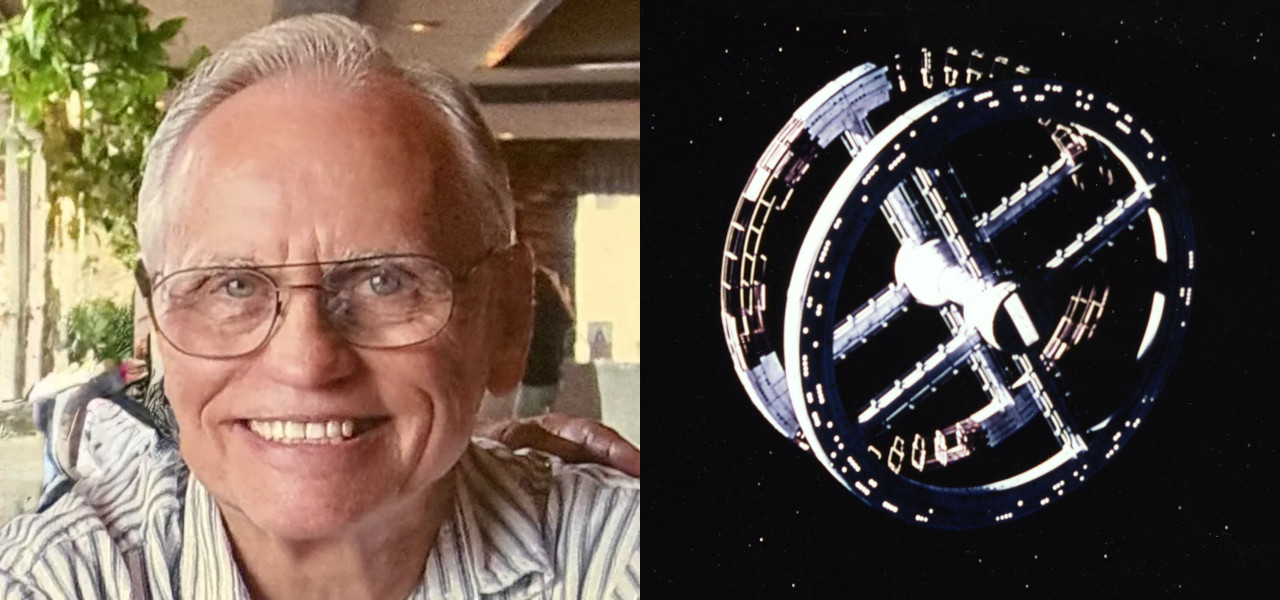
Hollywood press outlets recently announced the death of Con Pederson, the last of the four men credited as special photographic effects supervisor — alongside Wally Veevers, Douglas Trumbull, and Tom Howard — on Stanley Kubrick’s 1968 science-fiction epic 2001: A Space Odyssey.
The four supervisors’ names appeared at the close of Kubrick’s film following a card announcing, “Special Photographic Effects Designed and Directed by Stanley Kubrick.” Kubrick went on to claim his sole Oscar for Best Special Effects for the film and was a no-show at the Dorothy Chandler Pavilion ceremony in April 1969. Decades later, when the year 2001 dawned, and attention refocused on the film, Pederson remained reticent to speak to journalists on the topic, although his work with Kubrick remained close to his heart. “It was a couple of years of unprecedented moviemaking,” Pederson told an audience in Burbank, California, in 2018. “It couldn’t have been done here, and that’s too bad. It’ll never be done again.”
In a 1999 interview with CalArts film and animation professor William Moritz, Pederson expressed his affection for Kubrick as a deep thinker and a fellow maverick Hollywood outsider with whom he maintained a friendship through subsequent years. “[Stanley] was wonderful,” Pederson recalled. “A generous man. Brilliant guy and surprisingly folksy… He was always doing things where there was a high probability of failure, but he substituted something for fear. And I don’t know what it was.”
Pederson was born in rural Minnesota on April 15, 1934, and later moved with his parents and two sisters to Inglewood, California, in 1943, where he developed a fascination with aircraft and science fiction. He studied at Los Angeles City College and, in 1951, pursued art and anthropology at the University of California, Los Angeles.
Pederson’s restless imagination led to his first experiments in animation in UCLA’s Theatre Arts program, where he met his first mentor, tutor William Schull, a former Disney animator known for his work on Fantasia (1940), Dumbo (1941), and Bambi (1942). Pederson’s animation tastes, he confessed to Moritz, gravitated more toward the ’50s “avant-garde” of John Hubley’s Rooty Toot Toot UPA cartoons. Nevertheless, Schull recognized his talent and recommended Pederson to Disney, which led Pederson to meet rocket scientist Wernher von Braun, who was technical advisor on Disney’s animated space documentaries — Man in Space (1955), Man and the Moon (1955), and Mars and Beyond (1957) — with animation by Ward Kimball.
In 1956, the U.S. Army draft sent Pederson to the First Armored Division in Louisiana, until Disney nominated him to join von Braun to assist in the creation of classified rocketry animations at Redstone Arsenal Army Post and Missile Agency in Alabama. “Walt Disney personally brought me to the attention of Wernher von Braun because they had just gotten an animation camera there and didn’t know how to use it,” said Pederson. “The next thing you know, I was in a nice outfit of scientific and professional personnel… doing very short films to present ideas to Congress, to explain what they were doing—mostly secret undertakings of the Cold War, atomic testing in the Pacific for which we supplied short-range missiles. I got a look at what was going on in astronautics at that time, which was mainly propulsion systems.”
When Pederson returned to Los Angeles, he briefly worked as an animator at Disney and then returned to UCLA to complete his graduate studies. In 1959, he joined Graphic Films, a production company formed by former Disney animator and USC cinema professor Lester Novros. The appointment led Pederson to write and direct Graphic Films’ 15-minute short To the Moon and Beyond (1964) as a special presentation at the Transportation and Travel section of the New York World’s Fair in Flushing, Queens. Inside a domed theatre with a moon-textured roof, a fisheye lens magnified vertical strips of 70mm film, ten perforations wide, to fill an 80-foot curved screen. The hand-rendered images of swirling galaxies and balletic space stations caught the attention of Stanley Kubrick.
In July 1965, Pederson and Novros visited Kubrick’s production offices, which at the time were based in the director’s New York City apartment overlooking Central Park. In an unpublished 1984 interview with Cinefex publisher Don Shay, Novros revealed Kubrick’s early plans for his space-exploration picture and Graphic Films’ contributions. Working from a work-in-progress screenplay by Arthur C. Clarke and Kubrick and evolving production designs, Pederson shepherded the development of “design, hardware, storyboards, [and] general ideas.” Graphic Films funneled ideas to Kubrick via long-distance telephone “xerography” connections — a lugubrious precursor to fax — transmitting typewritten pages and illustrations to the director’s home in England near MGM Borehamwood Studios, where the film was shot. Topics included spacecraft propulsion, computer interfaces, orbital heights, lunar locales, spaceship flight trajectories, and extraterrestrial manifestations.
As ambassador for Graphic Films, Pederson twice visited Kubrick in the U.K. and then joined the production of 2001 full-time for the next two and a half years. Michael Benson’s 2018 book Space Odyssey described Pederson’s Borehamwood office as the “War Room,” borrowing a name from Kubrick’s 1964 Cold War satire Dr. Strangelove. The room was located down the corridor from Kubrick’s office and became a central hub for the film’s complex visual effects production. The experience was nerve-racking for many of its contributors, but in his 1999 interview, Pederson fondly recalled his collaboration with Kubrick, a month after the filmmaker’s death: “He made an effect on me and, oddly enough, I think I made an effect on him, too. I sometimes made sense to him, which I am surprised to say. He often needed somebody to bounce off; he was always asking questions about whether he was doing the right thing. People don’t know that about him, but he was not like most artists.”
After 2001, Pederson returned to Los Angeles and, in 1971, joined his former Graphic Films collaborator Robert Abel to co-found Robert Abel & Associates. The company quickly developed a reputation for its innovative work in emerging digital technology combined with computer-assisted motion control, animation, and optical effects for motion graphics and commercials.
In addition to the motion-control rostrum work that created the swirling, streaking light effects of the ABC studio graphic, Abel & Associates famously produced the Canned Foods Information Council’s “Brilliance” commercial, which stunned 1985 Super Bowl audiences with its chromium Sexy Robot. Inspired by the erotic robots of Japanese artist Hajime Sorayama, Abel, Pederson, and their team brought their gleaming female cyborg to life using motion sampled from a human performer, which they translated into computer-generated renderings using an interface derived from an Evans & Sutherland flight simulator.
“It was different than 2D rotoscoping,” Pederson told Graffiti magazine in 1986. “The computer was smoothing the motion from keyframes, keeping weight and mass consistent.” He added, “It’s nice to be able to do what reality does and then do it better, instead of not being able to do what you want because you haven’t been able to achieve realism.… Once you have the power to do reality, then you have a choice. I think then you begin to appreciate simplicity as an addition to reality.”
After his partnership with Abel, Pederson worked as creative lead with Tim McGovern at Metrolight Studios, producing visual effects for film and television, including his work as visual effects supervisor on two episodes of the Emmy Award–winning 1998 HBO series From the Earth to the Moon. In the early 2000s, at age 70, Pederson returned to his roots, working as an animator at Rhythm & Hues Studios on Scooby-Doo 2: Monsters Unleashed and Garfield: The Movie (both 2004).
“Con was working in the fishbowl or down on the stage with a bunch of 20-year-olds,” recalled Ryan Donoghue, animation director on Jurassic World: Chaos Theory (2024), who was another animator in the trenches at R&H. “It was a lot of people’s first jobs on animated films, and Con was pleased as punch to be there.”
Legend spread that the veteran had submitted a laminated letter of recommendation from Walt Disney with his R&H application. Pederson then embarked on training with the studio’s proprietary animation tools that, ironically, had grown from technology R&H co-founder John Hughes developed as Robert Abel’s former head of digital production. Donoghue recalled that Pederson retained an impish glee, sharing stories in the lunchroom: “He was super sharp, absolutely a delight, and so incredibly humble to sit there without any ego, working on a relatively low-budget film for kids. We’d ask him, ‘Why are you here? You don’t have to be doing this!’ And he’d say, ‘I just like to.’ He just liked to animate.”
Pederson also retained his love of writing science fiction, dating back to his membership in the Los Angeles Science Fantasy Society in the 1940s, as well as his creation of crossword puzzles for the New York Times, Wall Street Journal, and Washington Post. He passed away on January 2 at the Motion Picture & Television Country House and Hospital in Woodland Hills from complications of Alzheimer’s disease.