.png)
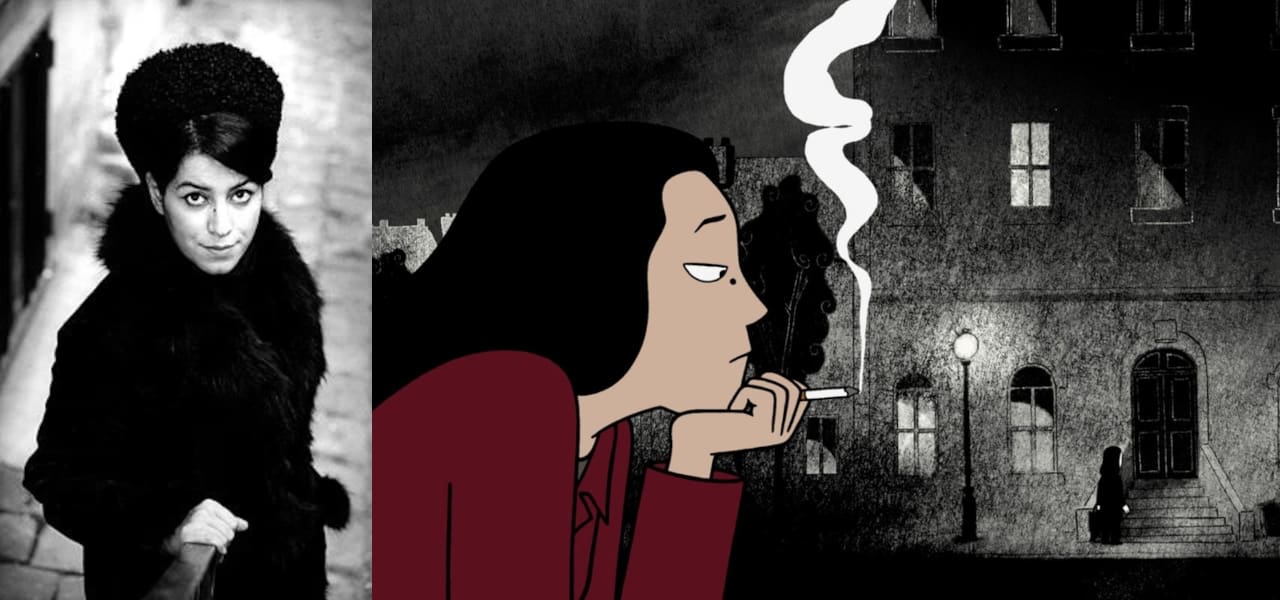
Marjane Satrapi, ‘Persepolis’ Author And Co-Director, Dies At 56
Stay informed with free updates
Sign up to get our news digest — delivered directly to your inbox twice a week.
Marjane Satrapi, the Iran-born and France-based cartoonist, filmmaker, and co-director of the Oscar-nominated animated feature Persepolis, has died at age 56.
“Marjane Satrapi died of sadness a little over a year after the death of Mattias Ripa, her husband and the love of her life,” members of her family said in a statement sent to AFP. Her husband, a Swedish producer, actor, and screenwriter, died on April 8 last year.
The office of French President Emmanuel Macron confirmed her passing in a statement, which read: “Her passing marks the loss of a leading figure in French culture and a freedom-loving artist whose work carried a universal message and earned her immense international acclaim.”
On April 21 of this year, Satrapi posted a series of images to Instagram that spell out, “For I lost the love of my life,” with a photo of Ripa with his date of birth and passing listed.
Satrapi arrived in animation through comics and focused mostly on live-action fare post-Persepolis, but she left an imprint on the animation art form that extended far beyond her single animated feature. Born in Rasht, Iran, in 1969, she grew up during the upheaval of the Iranian Revolution and the Iran-Iraq War, experiences that would later become the foundation of her autobiographical graphic novel and its acclaimed animated adaptation. After eventually migrating to France, she developed a body of work that combined political witness, personal memory, and a deceptively simple visual style. The thick linework and stark black-and-white drawings that became her signature carried the weight of history without ever losing a sharp sense of humor, intimacy, or humanity.
When Satrapi and filmmaker Vincent Paronnaud adapted Persepolis into an animated feature, they resisted many of the conventions that defined prestige animation at the time. Rather than expanding the source material into something more elaborate, they remained faithful to the graphic novel’s spare design. The film’s bold silhouettes, flattened spaces, and expressive linework created a shared feeling of memory that audiences need not have ever been to Iran to share. Animation gave Satrapi a way to move freely between autobiography, political history, dream imagery, and the faults, or benefits in some cases, of subjective recollection. In response, she gave animation one of this century’s most memorable and enduring works.
Debuted in 2007, Persepolis shared the Jury Prize at the Cannes Film Festival and earned an Oscar nomination for best animated feature, bringing the world’s attention to its creator’s personal, political, and deeply moving story. Persepolis stood as a reminder that animation could address exile, war, religious repression, adolescence, and cultural displacement with the same seriousness as any live-action production.
Her work preceded a period of growing international recognition for Iranian animation. In recent years, artists from the country have achieved an extraordinary level of international recognition despite limited public support and, in some cases, the threat of government intervention. Among the highlights were an Academy Award nomination for Yegane Moghaddam’s Our Uniform in 2024 and an Oscar win for Hossein Molayemi and Shirin Sohani’s In the Shadow of the Cypress in 2025, the first Academy Award ever awarded to an Iranian animated film.
Globally, Satrapi was many viewers’ introduction to the idea that animation was not simply a commercial endeavor to make money from kids and family audiences or a vehicle for fantasy, but also a powerful tool for documentary and memoir. Her work showed that deeply personal experiences could resonate across national and cultural boundaries when rendered with clarity and conviction. For many viewers outside Iran, Persepolis became an entry point into a history they knew little about. For animators, it has become a touchstone for the possibilities of personal filmmaking.
In later years, Satrapi’s influence extended well beyond comics and filmmaking. Having become one of the most recognizable Iranian voices in international popular culture, she used her platform to speak forcefully on behalf of human rights, freedom of expression, women’s rights, and the plight of people living under authoritarian rule. She remained an outspoken critic of the Iranian government while resisting simplistic narratives about her homeland, arguing for a more nuanced understanding of Iranian society and culture. The lone link on her Instagram profile leads to a 2024 open letter titled: “Statement by Victim Families and Human Rights Activists on the Death Sentence of Varishe Moradi, Pakhshan Azizi and the Wave of Executions in Iran.”
In 2023, Satrapi was invited to participate in the Nobel Peace Prize Forum. In 2024, she received Spain’s Princess of Asturias Award for Communication and Humanities, which cited both her artistic achievements and her role as a defender of human rights. By that point, Satrapi had become something larger than a celebrated cartoonist or filmmaker. She was a cultural ambassador, a witness to history, and an advocate whose voice resonated far beyond the worlds of comics or filmmaking.
Last year, she refused to accept France’s top honor, the Legion d’Honneur, in protest of France’s “hypocritical attitude toward Iran, which forged the other part of my identity,” criticizing the country’s relationship with wealthy Iranian oligarchs.
For animation audiences and an industry that will always look up to her, though, Satrapi’s legacy will always be largely defined by a film that will long remain a landmark of the art form. With it, she showed that an individual life, honestly presented, could reflect the experience of millions, and touch the lives of millions more.