.png)


Richard Williams’ Final Film ‘Lysistrata,’ Featuring More Than 9,000 Hand-Drawn Images, Debuts In L.A. This Weekend
Stay informed with free updates
Sign up to get our news digest — delivered directly to your inbox twice a week.
Seven years ago, the world and our industry lost Richard Williams, a legend of the craft. Today, the animation master’s final film hits American screens after making its world premiere at Annecy over the summer.
Lysistrata, an eight-minute hand-drawn short adapted from Aristophanes’ ancient Greek anti-war comedy, opens today at the Laemmle Glendale in Los Angeles.
Produced by Williams’ wife and longtime collaborator Imogen Sutton, Lysistrata is a sequel to his Oscar-nominated 2015 short Prologue. It is also the surviving final chapter of an extraordinarily ambitious project that occupied Williams in his final years: an animated adaptation of a play he had dreamed of filming since he was a teenager.
A Life And Career Defined By Possibility
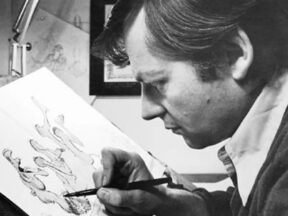
Williams was a towering figure in animation in the second half of the 20th century and the start of the 21st. His credits included the BAFTA-winning The Little Island, the Oscar-winning A Christmas Carol, and Who Framed Roger Rabbit, for which he received two more Academy Awards.
He also spent roughly 20 years making his unfinished passion project The Thief and the Cobbler and distilled decades of accumulated craft into the seminal The Animator’s Survival Kit, which can be found on a bookshelf in every animation studio in the world today.
In his later years, Williams returned to personal filmmaking as an artist in residence at Aardman in Bristol. Even in his 80s, he remained a student of the form. Writing about Disney legend Milt Kahl in 2015, he observed, “His work is perfect. What an intelligence. I always discover new things in his scenes.”
A Film Seven Decades In The Making
According to Williams and Sutton’s breathtaking 2024 book Adventures in Animation, he first encountered Lysistrata as a teenager while reading an edition illustrated with erotic drawings by Australian artist Norman Lindsay.
Aristophanes’ play is the story of women from opposing Greek city-states who organize a sex strike to force their men to end the Peloponnesian War. Williams had always wanted to animate it, Sutton wrote, but it was only in his late 70s that “he felt up to the task.”
The immediate visual inspiration came from a pub production of the play that Williams and Sutton saw before moving to Canada. Its opening featured four young men miming a battle between Athenians and Spartans. Williams asked to make life drawings of the actors’ movements so he could better understand how a man handled a spear, axe, sword, or bow. He continued those studies after moving to Salt Spring Island.
Once the couple later relocated to Wales, Williams began animating. He planned to do it alone with pencil and paper and conceived the film as one continuous shot, creating every apparent camera movement through the drawings themselves.
“This was to be the culmination of a lifetime of work and study,” Sutton wrote.
Williams later explained the deceptively simple principle behind the approach: “In Prologue it’s all in one shot, and I don’t move the camera — I just draw all the moves. In order to do this, I use my knowledge of movement. It’s all in the timing and the spacing — just like in character animation.”

At first, Sutton was worried about Williams’s plans. The couple attended the Giornate del Cinema Muto silent film festival in Pordenone, Italy, when she suggested dividing the larger project into three chapters that could be produced one at a time as shorts, giving Williams the satisfaction of finishing a film before starting the next one.
Under that plan, the first chapter became Prologue, a six-minute film depicting a battle to the death between two Athenians and two Spartans. Its final moments reveal that a young girl has witnessed the carnage; horrified, she runs to tell her grandmother.
Williams gave the larger project a mordant working title: Will I Live to Finish This?
“I had an idea for a big film when I was 15 years old and I wondered if I would ever get good enough to do this,” he recalled. “It’s something that nobody had done before.”
Decades of working, studying, and teaching had finally given him the confidence to attempt it.
“About eight years ago something happened to me,” Williams said while making Prologue. “I don’t know — with all this teaching, all this experience — it’s like yogurt, it finally just took, and I’m able to do exactly what I can imagine.”
He understood the scale of the challenge. “I really hope I can stretch this out because it’s an enormous amount of work,” he said, “and I’m into territory where people have tried to go before and haven’t brought it off.”
The First Completed Chapter
Prologue premiered at Annecy in 2015 and went on to receive Oscar and BAFTA nominations.
Williams, famously critical of his own work for much of his career, regarded the short as a major milestone. After its Oscar nomination, he wrote, “It’s the first film I’ve ever done that I’ve been happy with.”
He described the artistic ambition behind it in broader terms: “I don’t want to do stuff that just looks like cartoons, but to make drawings that walk and talk. You can put them anywhere, you can do anything.”
“A lot of animators can be very funny, but they do one kind of thing,” he went on. “I wanted the whole whammy. I’m artistically greedy, or at least artistically ambitious. That was my goal. I thought it doesn’t matter what I do — I’ve got to master this damn thing so I can do anything I want.”
The Final Chapter
Williams immediately began the next section, initially titled A Call to Arms. Where Prologue was silent, violent, and relentlessly physical, the sequel would introduce Lysistrata and the other women as they devised their plan to stop the war.
“In A Call to Arms there was to be a mix of serious political activism and comic, bawdy dialogue,” Sutton wrote.
Williams and Sutton recorded voices for the project with their daughter, actor Natasha Sutton Williams. Williams performed the comic character then called Neeki, while Sutton initially played Lysistrata and Natasha voiced Myrrhine.

Aardman again provided Williams with a large workspace, an animation desk, and a camera. As Williams finished each scene, Fernando Lechuga composited it into the growing film.
“The film was being built scene by scene,” Sutton recalled, “and at every viewing I couldn’t wait to see more.”
Williams fell ill in 2019. By that point, Sutton wrote, he had completed approximately six minutes of what was then intended to be a ten-minute short.
“He didn’t live to finish it.”
Williams died that August at age 86.
The material has now emerged as the eight-minute Lysistrata. The finished film credits Williams as director, screenwriter, and sole animator, with more than 9,000 of his hand-drawn animation drawings appearing onscreen.

Meera Syal voices Lysistrata, while Williams can be heard as her bawdy companion Kalonike. Natasha Sutton Williams voices Myrrhine, and Olivia Robinson plays Lampito.
Williams left behind approximately six minutes of a planned ten-minute film. In the years following his death, Sutton and her collaborators prepared that material for exhibition as the self-contained, eight-minute Lysistrata. The precise process has not been publicly detailed, although the finished film credits Williams as its sole animator. Fernando Lechuga, who had composited scenes during Williams’ lifetime, is credited for music, while Adrian Rhodes handled sound and music design.
A Final Return To Annecy
Annecy was an appropriate setting for the film’s world premiere. Williams and Sutton taught a masterclass there in 2000, and Prologue debuted at the festival 15 years later. Lysistrata screened during Annecy’s closing event on June 27, where a packed Bonlieu audience received it with tremendous enthusiasm.
The precise process by which Williams’ surviving work was prepared for release after his death has not been publicly detailed. The finished film nevertheless credits him as its sole animator, preserving more than 9,000 drawings from his final sustained act of filmmaking.
Its completion gives Williams’ later years a different shape and animation fans one last contribution from one of the medium’s most influential figures. The expansive adaptation he imagined as a teenager would never be completed, but Lysistrata carries the project one chapter further than Williams could in his lifetime.
“I’m never proud,” Williams wrote in 2017, “but recently pleased with The Thief, Prologue, The Animator’s Survival Kit book.”
Lysistrata now joins that final body of work: an eight-minute testament to an artist who, even in his 80s, believed there was always more to learn, and more that animation could do.
Pictured at top:
Myrrhina voiced by Natasha Sutton Williams
Neeki voiced by Richard Williams
Lysistrata voiced by Meera Syal