.png)
‘Sort Of A Miracle’: The Incredible Story Behind Prime Video’s Breakout Italian Adult Animated Series, ‘Il Baracchino’ (EXCLUSIVE)
Stay informed with free updates
Sign up to get our news digest — delivered directly to your inbox twice a week.
By the time Il Baracchino landed on Prime Video, even its creators weren’t entirely sure how it had come to exist at all.
“It’s an original IP. It’s a mockumentary. It’s black and white. It’s for adults,” co-creator and director Nicolò Cuccì says, laughing. “There’s a character made out of cum. So it’s like, what is going on with this show? How is it possible that it exists?”
That disbelief is genuine. In a European animation landscape still dominated by children’s programming and imported U.S. adult animation, Il Baracchino is a genuine outlier: a locally produced, adult animated series, made in Italy, in Italian, with an unapologetically regional sense of humor and a mixed-media visual language. The series’ existence owes less to strategic industry planning than to timing, stubbornness, and unlikely good fortune.
Or, as Cucci puts it more simply, “Everybody, including us, always considered Baracchino sort of a miracle.” Now, for a limited time, Prime Video has given everyone access to that miracle, making the show’s pilot free to watch on YouTube:
Cuccì and his co-creator Salvo Di Paola also made a behind-the-scenes video, which they’ve exclusively shared with us:
From a Garage Studio to a Comedy Club
Il Baracchino’s origin story is about as far from the traditional TV development pipeline as it gets. Cuccì and his creative partner, Salvo Di Paola, were scraping by on low-budget commercials, wine spots and similar jobs that barely paid, working out of what Cucci cheerfully describes as “the cheapest studio… a dirty garage.”
They were obsessed with stop-motion, building puppets, and multi-media experimentation after hours. One day, Di Paola animated the face of a stand-up comedian. “The concept was a comedian who consistently bombed,” Cuccì recalls. Cuccì added a stop-motion puppet body, and the seed of an idea was planted.
What changed everything was a moment of industry innocence. “We decided to add actual comedian voices,” Cuccì says. “And in the most naive way, we contacted them on Instagram.”
Against industry logic, a few answered.
“Italy’s stand-up scene is small, everyone knows one another,” Cuccì explains. A few impressed comedians shared the clips among themselves, and suddenly, a half-joking experiment began to resemble a project in development. Cuccì insists there was never a master plan. “We started working on it without having the exact idea of what it was. It was just for fun.”
Even the decision not to post the videos online was deliberate hesitation rather than confidence. “We were keeping them on hard drives,” he says, waiting to figure out the right moment.
That moment arrived sideways.
A Lunch Break Pitch
When Di Paola left for a short-term job on a live-action film in Rome, only days after securing their first round of financing, a modest €8,000 to get things off the ground, Il Baracchino could easily have stalled. Instead, it hit its first improbable turning point. During lunch breaks, Di Paola kept animating on his laptop, and one day the production’s main editor noticed his side work. Eventually, word about the charming project reached the film’s producers.
“One week later, we were pitching the project,” Cuccì says. The producer was Lucky Red, a company synonymous in Italy with quality animation thanks to its long history of distributing Studio Ghibli titles.
At that point, the project was still little more than a collection of clips with comedian voice-overs, but it arrived at a moment when Italian stand-up culture was experiencing a boom, a timing that worked in its favor. “I think the strange advantage is that nobody really understood it,” Cuccì says. “And that was very lucky for us.”
That partial misunderstanding created space for experimentation, risk, and, eventually, for something far stranger than a conventional animated sitcom.
Building a Studio, Building a Show
Once Il Baracchino was officially greenlit, Cuccì and Di Paola faced a second first-time challenge: building a studio from scratch. Megadrago, the studio behind the series, didn’t exist before the show. Suddenly, they were renting space, hiring artists, handling legal structures, all while simultaneously figuring out how to make an original adult animated series in a national industry that had never done that before. The only high-profile adult animated series in Italy before Il Baracchino was Netflix’s Tear Along the Dotted Line and its follow-up This World Can’t Tear Me Down, which was based on the work of one of Italy’s most popular comic book artists, Zerocalcare.
What emerged was a collective experiment between a group of young artists learning the process in real time. “We were all peers,” Cuccì says. “All the same age, between 20 and 30. For most people, it was their first proper animation job.”
The production process was as hybrid as the show itself. Stop-motion, 2D, 3D, documentary interviews, and jump cuts all collided. Scripts evolved mid-production. Storyboards for one episode were being developed while another was being animated on the other side of the same room.
“It was very stressful,” Cuccì admits. “But the chaos became productive.”
Ideas flowed laterally and improvisationally. A gag from the stop-motion team might reshape a plot being workshopped by the writers. According to Cuccì, the disorder started generating ideas. “We were writing the show while producing it, and life got into the script in many ways,” he recalls.
Cuccì’s father died during the show’s production, and Di Paola lost someone close to him as well. Their real-world losses didn’t just affect their daily work; they also became part of the show’s surprising gut-punch moments. According to Cuccì, going to work and collaborating with the artists gave structure to a difficult period.
That intimacy between creators, crew, and material is baked into Il Baracchino’s DNA. The series isn’t just about a struggling comedy club; it was made by people building something fragile together, in real time.
Why Il Baracchino Stands Apart
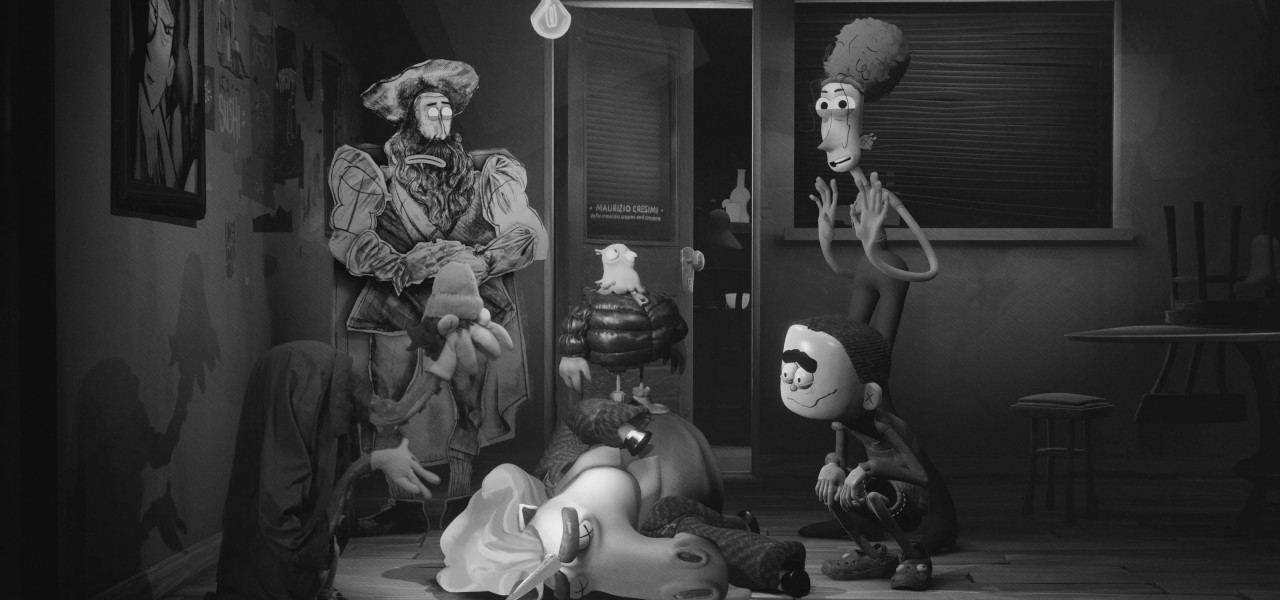
Visually, the series rejects polish in favor of texture. Black-and-white imagery, deliberately uneven animation styles, and mockumentary framing give it a handmade, almost rebellious sensibility. It deliberately avoids the look and rhythm of American studio adult animation.
Its creators believe that difference has been one of the show’s understated strengths. “When I pitched the project to animators,” Cuccì says, “some of them were working outside Italy, on shows like Rick and Morty. And they were like, ‘What? Someone is doing this in my country? I want to do it.’”
The reaction underscored something Italy’s industry rarely acknowledges: there is a domestic appetite for adult animation that isn’t imported, dubbed, or culturally distant.
Internationally, the series’ recent Annie Award nomination only reinforced that adult animation made in Italy can travel internationally. For the Italian animation community, it was a first, and potentially a signal.
Waiting, Watching, and What Comes Next
For now, Il Baracchino exists in a state familiar to many boundary-pushing projects: celebrated, popular, and stuck in stasis. Officially, the creators are waiting for news about what comes next. Unofficially, the show’s life continues through fandom, awards recognition, and small, deliberate signals, like the clip below that acknowledges its award attention while cheekily suggesting that the Megadrago crew is ready to return to work on a second season.
View this post on Instagram
Meanwhile, the studio hasn’t slowed down. Development is underway on multiple new projects, including two series and a feature film; the latter was pitched at Annecy’s MIFA last summer. “It feels like we finished the first lap,” Cuccì says, “and now we’re back at the start line. Same ambition. Different scale.”
That cyclical uncertainty is familiar, but so is the conviction. Il Baracchino didn’t prove that adult animation in Italy is easy. It proved something harder than success itself: that it’s possible, and that there is an audience for it.