editors
JERRY BECK (LA)
AMID AMIDI (NY)
VIEW POSTS BY
“amid”
Cartoon Brew's home for up-to-the-minute, unedited announcements and press releases direct from industry sources.
September 3, 2010 10:36 am


Young animator

Here’s a talkback post dedicated to all the students who have graduated from animation schools in 2010. Now that it’s been three to four months since graduation, I’m curious to hear who’s had success finding a job in the animation industry. Would love to hear from students all over about what the job situation is like in your part of the world. And with schools starting up again right now, this year’s juniors and seniors will find your experiences useful to hear too.

Here are some things you could address:

1.) What school did you graduate from and are you looking for full-time work in the industry, freelance work, or are you working on independent projects?

2.) What kind of work in the animation field have you been able to find?

3.) Is the job market what you expected it to be based on what you’d heard in school?

4.) Are you optimistic about the current state of the industry?

We’d appreciate it if only students who have graduated in ‘10 would respond to this post.

September 3, 2010 4:26 am


Marge Champion

Yesterday’s post about Marge Champion (née Belcher) reminded me of an article in the April 4, 1938 issue of Life about her role in Snow White. The two-page piece has some nice images of her acting alongside Louis Hightower, the movement model for Prince Charming. The article also mentions that “Miss Belcher’s Prince Charming in private life is Arthur Babbitt, one of the Disney animators, whom she married last summer.”

Here’s a reprint of the article:
Read the rest of this entry »

September 2, 2010 4:51 pm


Willis Pyle and Marge Champion

With all the RIP posts recently, it’s refreshing to hear some news about animation veterans who are alive. Today is the 91st birthday of Marge Champion. Tomorrow is the 96th birthday of Willis Pyle. If you don’t know who these talented individuals are (or even if you do), it’s worth heading over to John Canemaker’s blog for a very nice tribute to both of them.

September 2, 2010 8:40 am


How to Train Your Dragon

Animation historian Harvey Deneroff writes perceptively about animation past and present, and not so long ago, he wrote something about computer animation that caught my attention and which helps to explain the ever-increasing complexity of animation imagery. He calls it “Deneroff’s Law”:

In 1958, C. Northcote Parkinson, famously stated in Parkinson’s Law: The Pursuit of Progress, that, “Work expands so as to fill the time available for its completion.” And Deneroff’s Law basically states: Given more powerful and complex tools, filmmakers will inevitably use them to make more complex films.” This rather simplistic observation is by no means original and in fact was inspired by a comment John Lasseter made during a phone interview about Toy Story 2. If I remember correctly, he said something like when presented with a computer 10 times more powerful, rather than using the added power to produce animation 10 times quicker, animators will usually opt to make their animation 10 times more complex and expensive.

He explores “Deneroff’s Law” in much greater depth and gives it historical context on his blog which I recommend reading.

August 31, 2010 5:51 am


Flapjack

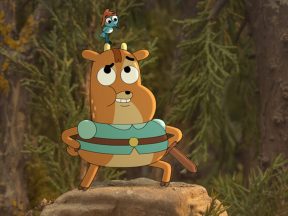
The Marvelous Misadventures of Flapjack ends its series run tonight on Cartoon Network after forty-six episodes. Chowder, which also ended its run earlier this year, lasted forty-nine episodes. The last eleven-minute episode of Flapjack titled “Fish Out of Water” will have live-action portions, and features an appearance by creator Thurop van Orman, and his son, Leif (pictured above), who portrays Flapjack.

(Thanks, Compn)

August 31, 2010 4:00 am


Aniboom

Animation video sharing website Aniboom has announced they’re launching a “virtual animation studio.” They’re unclear about how their business model works, but as I understand it, Aniboom intends to create productions for corporate clients by cherry-picking crew members from the large pool of animators who have uploaded videos to their site. On one of their pages, they advertise to potential clients that the 9,500 artists who have uploaded videos are ready to create animation of high-quality in a fast and cost efficient manner.

How can they do high-quality, fast AND cheap? A clue can be found in this section where they describe how animators who participate in their virtual productions will be compensated with “a variety of potential monetary benefits that include revenue share, employment offers and payment for series development with Aniboom.” Note that their ideas of compensation do not include any of those pesky line items that other studios have to contend with like salaries, health insurance, vacation time, retirement benefits, maternity leave, and learning and development opportunities.

Aniboom has been indoctrinating young artists for years through a savvy and systematic use of contests that encourages users to create work for corporations on spec and without any expectation of pay. We’ve warned readers about these contests on mutiple occasions. Now they appear to be pushing the exploitation of young artists to an entirely new (and more profitable) level, and for a company with millions of dollars in venture capital backing, that’s exactly what we’ve always expected them to do.

UPDATE: Aniboom’s rep has told us that everybody who works for them will be paid and they have updated their website, which now says, “We offer creators around the world the attractive opportunity to work from home, on their own schedule and get paid directly via PayPal or Payoneer.”

How much do they pay? Not much according to a couple readers in our comments. The most detailed comment is from Mike who quoted this response from Aniboom:

“Thank you for your response to our call for illustrators. We are gearing up to start production of the second season of a popular animated series for television. It’s a comedy-action show for children based on five heroes who travel to strange fantasy worlds, and fight innumerable foes to try and save their kingdom. We’re looking for character illustrators and background illustrators.

The major production will begin in September, but we’re starting in about 2 weeks to produce the assets and several sequences. Are you interested, and would you be available to work with us starting in around 2 weeks time?

We’re paying:

· $90 an average per sequence.

· $250 for a full character package with all positions and facial lipsync

· $100 for a character with only basic positions.

· $100 for background art

(Thanks, Chris Sokalofsky)

August 30, 2010 4:51 pm


Enjoy:

As best as I can make out, the animation combines a popular Japanese meme surrounding gay porn star Billy Herrington with a newer animation-loop meme called Fukkireta in which “anime characters dance with their hands on their hips and shaking side to side with cute background music,” like this:

A lot of the Fukkireta appear to be cycles edited from existing anime productions, but it’s all inspired by this piece of animation that first appeared online last May:

August 26, 2010 8:17 pm


It’s not a good week to be a Japanese animation legend. Stop motion animator and puppeteer Kihachiro Kawamoto, passed away last Monday at age 85. The cause of death was pneumonia.

From Wikipedia:

Born in 1925, from an early age Kihachiro Kawamoto was captivated by the art of doll and puppet making. After seeing the works of maestro Czech animator Jiri Trnka, he first became interested in stop motion puppet animation and during the 50s began working alongside Japan’s first stop motion animator, the legendary Tadahito Mochinaga.

In 1958, he co-founded Shiba Productions to make commercial animation for television, but it was not until 1963, when he traveled to Prague to study puppet animation under Jiri Trnka for a year, that his puppets truly began to take on a life of their own. Trnka encouraged Kawamoto to draw on his own country’s rich cultural heritage in his work, and so Kawamoto returned from Czechoslovakia to make a series of highly individual, independently-produced artistic short works, beginning with Breaking of Branches is Forbidden (Hana-Ori) in 1968.

Heavily influenced by the traditional aesthetics of Noh, Bunraku doll theatre and Kabuki, since the 70s his haunting puppet animations such as The Demon (Oni, 1972), Dojoji Temple (Dojoji, 1976) and House of Flame (Kataku, 1979) have won numerous prizes internationally. He has also produced cut out (kirigami) animations such as The Trip (Tabi, 1973) and A Poet’s Life (Shijin no Shogai, 1974). In 1990 he returned to Trnka’s studios in Prague to make Briar Rose, or The Sleeping Beauty.

In Japan, he is best known for designing the puppets used in the long-running TV series based on the Chinese literary classic Romance of the Three Kingdoms (Sangokushi, 1982-84), and later for The Story of Heike (Heike Monogatari, 1993-94). In 2003, he was responsible for overseeing the Winter Days (Fuyu no Hi) project, in which 35 of the world’s top animators each worked on a two-minute segment inspired by the renka couplets of celebrated haiku poet Matsuo Basho.

This is a link to a news story in Japanese about his death. Here’s an interview with Kawamoto that offers more details about his career. Also, be sure to check out the fantastic imagery in his short film The Trip.

(Thanks, Chris Robinson)

August 26, 2010 7:28 pm


Brew reader Topher writes, “I saw these on the Disney channel. They are called BLAM! and they are horrendous. Disney cartoons with America’s Funniest Home Videos style commentary and horrible music running over every second of footage. Why they don’t just show the cartoons I have no idea.”

Personally, I have no problem with remixing footage that might be too slow-paced for today’s media-saturated kiddies. The idea for Blam! is nothing new. Ward Kimball did the same thing in the 1970s with his TV series The Mouse Factory (watch an episode of the series with Don Knotts). The difference was that Ward edited and packaged the cartoons in a witty and fun way that enhanced an audience’s appreciation for the source material and made the viewer want to seek out the original shorts. These Blam! episodes, which are probably named so because the viewer wants to blam their head off after watching them, destroy the spirit of the Disney cartoons and over-explain every joke to the point where it becomes unfunny. I’ve included three in this post so you can judge for yourself.

UPDATE: Pixar’s Up has been “blammed”!

August 26, 2010 12:19 pm


My Dog Tulip

Paul Fierlinger’s animated feature My Dog Tulip opens an exclusive two-week run on September 1st at the Film Forum in New York. It opens later elsewhere in the US (complete list of cities here). Fierlinger is an exceptional and exceptionally devoted animation filmmaker (he made the artwork for his film with only one other person—his wife, Sandra), and I can’t wait to finally see the results. As this article from the Boston Globe makes clear, the film isn’t conventional animated fare; the book on which its based, by J.R. Ackerley, has been called the “[most] preeminently disgusting of all great dog books” and derided as “meaningless filth about dogs.”

This is a revealing quote from Fierlinger from an interview in The Bark magazine, which says a lot about where he’s coming from:

From a very young age, I disliked Disney and loved The Little Prince because the fox explains to the boy [in The Little Prince] what he must do to tame him, the fox. If the fox would know this, wasn’t he already tame? But instinctively—I was seven or eight at the time—I undersatnd that it shows Antoine de Saint-Exupéry’s understanding of nature. He wasn’t violating any rules, whereas Disney violated all the rules of nature. That’s what I want our film to be: the opposite of 101 Dalmatians. So that people would not want to buy a dog after they saw Tulip, like too many people do who watch Disney movies.

August 25, 2010 10:02 am


Illusionist

Bob Last, producer of Sylvain Chomet’s The Illusionist, sent a threatening email to one of the animators who worked on the movie because that animator had the temerity to promote the film on his blog. Animator Victor Ens posted a few pencil tests of HIS own work which prompted this ridiculous over-the-top letter from the producer:

Dear Victor

You have posted a number of linetests from The Illusionist on your blog and other web sites. These posts all infringe Django Films Illusionist
Ltd’s copyright and must be removed immediately. Please confirm that you have done so.

Please also note that to have these digital materials in your possession breaks the legal undertakings you gave Django Film Illusionist Ltd under the terms of your employment. You had no right whatsoever to remove these linetests from Django Films Illusionist Ltd’s studio and you should destroy them.

I look forward to your swift compliance with our requests above and meantime Django Films Illusionist Ltd reserves its right of further action against you to protect its copyright and enforce the contractual undertakings you have made.

Yours sincerely

Bob Last

It angers me to see a studio reprimanding an artist who was trying to promote a low-budget animation production with a limited marketing budget. It’s the type of corporate behavior that leaves a bad taste in the mouth and makes me NOT want to see The Illusionist. If anything, Victor should be commended for being so enthusiastic and doing what the studio itself should be doing in the first place, which is sharing pencil tests and other artwork on-line to promote their film.

UPDATE: Director and producer Patrick Smith wrote a brilliant comment below where he suggests how the producer could have handled the situation with a respectful tone that showed appreciation for the artist’s contribution to the film. With Pat’s permission, I’m reprinting his alternate letter as a service to anybody who wants to see a more productive way of communicating with artists:

Hi Victor, while we appreciate your enthusiasm for the film, and posting the clips, could you please please please take them down for the time being?? you see we’re trying to implement our promotional strategy, and don’t want anything out there at this time. in a few months, let’s talk! Thanks for your great work on the film btw! and I hope you are well. if you could confirm that you have taken the clips down that would be great.. mmm-kay? Cheers- Bob

(Thanks, Florian Satzinger)

August 25, 2010 7:06 am


For what certainly won’t be the last time, a successful iPhone game is attempting to make the leap into animated features and series. We’ve reported before about artists who have developed animation show pitches into iPhone games, but in this instance, the creators of the iPhone game Angry Birds already have a hit on their hands. Variety reports that they’re currently shopping the property for movies and TV shows.

The article doesn’t actually say that anybody in Hollywood is interested—just that they’re pitching the idea around—but they already have a toy deal in place. The game has sold over $7 million worth of downloads through the Apple store and the “cinematic trailer” above has topped 5.5 milllion views on YouTube. Mikael Hed, the CEO of Rovio Mobile, the Finnish company behind the game, isn’t being modest and thinks he just might be the next Pixar: “Time and time again, they take an unknown brand and make it big,” he said. Good luck with that.