About Amid Amidi

test

Obama Releases His Animated Birth Video

Tonight at the White House Correspondents’ Association dinner, President Barack Obama released his birth video, which turned out to be an animation-related joke. He then followed it by saying, “I want to make clear to the Fox News table — that was a joke. That was not my real birth video. That was a children’s cartoon. Call Disney if you don’t believe me. They have the original long-form version.”

DreamWorks Artist Accused of Shooting Puppy, Hammering it to Death

Young Song, a surfacer who has worked at DreamWorks Animation since 2003, is being accused of climbing into a neighbor’s yard and shooting a German Shepherd puppy with a pellet gun. Then he returned and hammered the dog into a “bloody, motionless pulp.” The dog is still missing but a surveillance video exists. “It’s one of the worst cases we’ve ever seen,” Hillary Gatlin of the the Pasadena Humane Society told the NY Daily News. Song is being held on bail, and faces up to four years in prison if convicted. Though his actions are unjustifiable, a neighbor has described Song in terms that make one wonder if there’s more to the story: “He’s a very nice and kind person. He has three dogs of his own and chickens in the backyard. It’s a total surprise.”

Here’s a news story about the incident:


(Thanks, Rob)

European Cartoon Network Pilots

Back in 2009, Cartoon Network Development Studio Europe in London created six 3-minute pilots under the creative direction of Timothy Björklund, who had previously directed American shows like Teacher’s Pet and Brandy & Mr. Whiskers. The studio finally posted them on-line yesterday. The nicest thing one can say is that there’s a lot of talent in that studio and the graphics are fun, but the uniformly obnoxious and aggressive tone of the shorts is an unpleasant reminder of the early-2000s US TV animation industry when nobody seemed able to shake off the combined Spumco/Spongebob influence.

The London studio recently produced its first original series The Amazing World of Gumball, and from the previews I’ve seen, it suffers from the same retrograde tone of these pilots. In a post-Adventure Time world that emphasizes individuality and personal style, generic wackiness doesn’t cut it anymore.

Judge the pilots for yourself:

Elliot’s Zoo by David Needham

The Furry Pals by Rikke Asbjorn

Verne on Vacation by Sylvain Marc

Pinky Malinky by Chris Garbutt

Mutant Moments by Alan Kerswell

Hamshanks and the Himalolly Mountain Railway by Tom Parkinson

(Thanks to everybody who emailed about these.)

How 3-D Animation Was Made Seventy Years Ago

Dave Fleischer

In 1941, the Fleischer Studio constructed this elaborate three-dimensional distorted perspective set for the feature Mr. Bug Goes to Town:

Built of balsa wood and plastics, it required architect-artists four months to construct. The entire set rests on a steel turntable which can both revolve and move up and down. Drawings will be photographed a full six feet in front of the set and the combination of the “set-back” photography and the “distorted perspective” of the set will provide the illusion of third dimension, according to director Dave Fleischer, who is seen moving the set.

Here is how the set appeared in the finished film:

(via Ryan and Stephanie’s Fleischer art collection)

A Response to Harry Partridge’s Silly Go! Animate Rant

“It’s not a gay lobster but still funny” – a response by “reddplague” to Harry Partridge’s anti-Go! Animate cartoon rant.

For the record, in spite of mixed feelings about automated animation software like Go! Animate, I am absolutely in favor of tools like this. As contemporary society extends itself beyond writing and still images, animation will continue its ascendancy as a vital communication form of the 21st century.

Nowadays, when a major event happens, more often than not I don’t read about it or see a photo, but rather I watch a video of the event on YouTube. We live in a video culture, and in tandem with these developments, younger generations are learning to express their opinions through the animation process. As the sophistication of easy-to-use animation tools increase, so will the ability of users to express themselves in unique ways.

To those who fear that these tools will replace the traditional role of animator, think about it this way. Today, a majority of the population knows how to write, but that hasn’t eliminated professional writers nor the specialized study of literature and writing. There is nothing wrong with a society in which writing is second nature to everybody, and it can be argued that a populace that knows how to write will be more receptive to quality writing by professional writers. That’s a good reason to look forward to a time in the future when everyone has a basic understanding of animation.

Animation at MOCA’s “Art in the Streets” Show

Art in the Streets

“Art in the Streets,” the first major museum survey of street art and graffiti, opened last week at the Museum of Contemporary Art in Los Angeles and I highly recommend it. It ranks among the most fun art exhibits I’ve ever attended, and features lots of eye candy in the form of large-scale installations that at times can feel more like an amusement park than a museum. As a first-of-its-kind exhibition, it’s also guaranteed to spark plenty of vigorous debate about what was chosen for inclusion and what wasn’t, not to mention all the controversy it’s already generated from the Blu mural debacle to irrational police fury.

Wild Style

Though minimal, animated works do have a presence in the show. A sequence of animation drawings from the opening of the influential early-1980s documentary Wild Style is displayed in one area. The sequence (watch it HERE) was designed by Charlie Ahearn, who directed the film, and graffiti writer Zephyr. In the “Battle Station”, a fantastic recreation of the Tribeca loft of the late Rammellzee, a mograph music video called “Alpha’s Bet” is screened on a television. The video, posted below, was directed by Celia Bullwinkel in 2002. (Disclosure: I am a personal friend of Celia and attended the show with her.)

Graffiti/street art has a complicated relationship with animation, which is a thread that the curators of the exhibit never explore. While the show features a handful of artists, like the aforementioned Rammellzee, who have the ability to express personal ideas beyond the confines of referential pop culture, many of the artists from Kenny Scharf to Banksy to the anonymous graffiti writers who painted on the sides of subway cars have relied on animated characters as their lingua franca for communicating with the general public. These cartoon characters, to my surprise, are rarely used to make any statement or to subvert the original intentions of the characters, a la Wally Wood’s infamous Disney “orgy” drawing. For graffiti and street artists, the act of recreating popular cartoon iconography is considered an accomplishment in and of itself.

If one looks only at the art displayed in the show, the conclusion could be drawn that things are beginning to change. More recent artists, like the Brazilian twins Os Gêmeos, have dispensed with drawing pre-existing animated characters and are creating libraries of new cartoon characters drawn in their personal styles. Like any vital art form, street art is evolving, and the evolution points in a positive direction that emphasizes personal creativity.

Below are a few of the cartoon references I saw in the show.

Will you take the Mickey or Woody train?
Art in the Streets

Kenny Scharf began doing Hanna-Barbera tributes in 1981, long before anybody else considered celebrating Hanna-Barbera’s cruddiness.
Art in the Streets

Only in the world of graffiti could Hanna-Barbera and DePatie-Freleng characters co-exist.
Art in the Streets

Ward Kimball would have totally appreciated this.
Art in the Streets

Donald and Franken Berry
Art in the Streets

Banksy-caliber wit
Art in the Streets

Airbrushed Felix
Art in the Streets

B”art”
Art in the Streets

“Bow Tie Duty for Squareheads” by Stephan Flint Müller

Bow Tie Duty for Squareheads

Berlin-based Stephan Flint Müller has made plenty of films in his young career, but my favorite remains his 2004 short Bow Tie Duty for Squareheads (or Fliegenpflicht für Quadratköpfe if you prefer the German). The film’s no-budget punk production style is teeming with creativity and humor, and with that comes the timeless lesson that effective visual ideas don’t require money, technology or huge crews, just imagination.

“Rio” Rocks US Box Office

Rio

In its second weekend, Carlos Saldanha’s Rio dropped a slim 32% to retain the top spot at the US box office. Its estimated $26.8 million weekend pushed the US gross to $81.3M. More impressive, its worldwide total stands at $283.9M, pushing it ahead of Rango‘s $235.1M worldwide take as the top grossing movie of 2011. The other animated film in the US top ten was llumination’s Hop which benefited from a 16% Easter Weekend boost to place fourth. Its estimated weekend take of $12.5M pushed its domestic total to $100.5M.

For those keeping track, this is the fourth straight week that an animated movie has topped the US box office. Through the first four months of 2011, four of the top seven films at the worldwide box office have been animated. Even more noteworthy, only one of those films was released by Disney or DreamWorks. In a year when fewer people in the US are attending the movies than any year since 1995, animation is coming into its own and dominating Hollywood as never before. With any luck, these successes will encourage greater experimentation and diversity within the medium.

“Apache” by Ned Wenlock

Apache

Circular continuity is one of animation’s oldest concepts — think phenakistoscopes and zoetropes — so it takes a certain amount of creativity to build on the idea. Ned Wenlock, from Wellington, New Zealand, offers a fresh approach in his music video “Apache” for Danger Beach. The digital “paper-roll” concept isn’t used to fulfill any particular demand of the story, and as such, it comes across as a bit of a gimmick, but the appeal and novelty of Wenlock’s approach is worthy of recognition. I fully anticipate seeing his technique ripped off by multiple ad agencies within the next few months. Rodney Selby did character animation on the piece. Wenlock speaks about some of his ideas for the video on his blog.

CBeebies Shorts by Matthias Hoegg

CBeebies by Matthias Hoegg

Matthias Hoegg, whose graduation short Thursday appeared on the Brew recently, just completed two delightful mini-shorts — “Ollie” and “George” — for CBeebies, the BBC’s channel for preschoolers.

A few details on the production from Matthias:

We had 3-4 weeks for each of them and were working with a small team (in fact just myself for most of it) in the London based studio Beakus. The production process was all-digital using After Effects, Flash, Photoshop and a tiny bit of Maya.

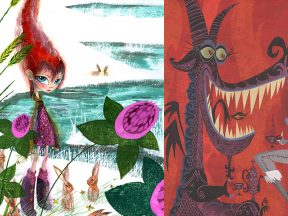
Cbeebies provided us with the edited voice recordings of the kids and gave me pretty much free reign over how I interpreted their narrative. They were really a perfect client and got on board with my direction from an early stage. Working for preschool kids meant an emphasis on characterisation and bold, colourful designs, which were definitely part-inspired by Mary Blair. I wanted to create the impression of discovering the world with child’s eyes and frame everything from a low angle, so you’re in with the flowers and rabbits.


Full credits after the jump:
Continue reading

Hyundai Advertises Car with Wall-Projected Animation

Hyundai created this ‘live’ performance piece to promote their 2012 Accent. They suspended a real car sideways against a building wall, and a real human walks into the car, but everything else is projected animation. The piece debuted in Kuala Lumpur, Malaysia last February, and is scheduled to be shown at the New York International Auto Show beginning this weekend.

Some have described it as projection mapping, and indeed, it does appear to be showing on three separate surfaces, but there’s not a whole lot of mapping since the projection is onto flat surfaces. Regardless of how it’s described, it’s a novel site-specific installation, and it would be interesting to see more companies explore advertising in this direction.

This video gives some clues about how the show was installed:

(Thank, Mike Rauch)

Mike Smith’s Website

Mike Smith

The website of director and animator Mike Smith — RealMikeSmith.com — is a model for how an artist’s website should function. It’s an easy-to-navigate site packed with rare films, storyboards, line tests, commercials and music videos dating back to his earliest days, and materials from unproduced projects. I spent half an hour on the site and didn’t even come close to scratching the surface of everything that’s posted. Of course, it also helps that Mike has produced some excellent work throughout his career that’s well worth a view.