editors
JERRY BECK (LA)
AMID AMIDI (NY)
VIEW POSTS BY
“amid”
Cartoon Brew's home for up-to-the-minute, unedited announcements and press releases direct from industry sources.
April 22, 2011 3:57 pm


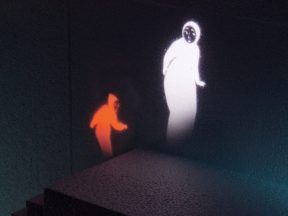
Hyundai created this ‘live’ performance piece to promote their 2012 Accent. They suspended a real car sideways against a building wall, and a real human walks into the car, but everything else is projected animation. The piece debuted in Kuala Lumpur, Malaysia last February, and is scheduled to be shown at the New York International Auto Show beginning this weekend.

Some have described it as projection mapping, and indeed, it does appear to be showing on three separate surfaces, but there’s not a whole lot of mapping since the projection is onto flat surfaces. Regardless of how it’s described, it’s a novel site-specific installation, and it would be interesting to see more companies explore advertising in this direction.

This video gives some clues about how the show was installed:

(Thank, Mike Rauch)

April 22, 2011 1:08 pm


Mike Smith

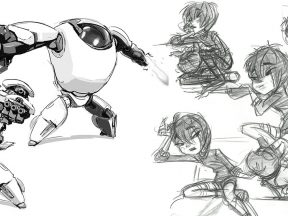
The website of director and animator Mike Smith — RealMikeSmith.com — is a model for how an artist’s website should function. It’s an easy-to-navigate site packed with rare films, storyboards, line tests, commercials and music videos dating back to his earliest days, and materials from unproduced projects. I spent half an hour on the site and didn’t even come close to scratching the surface of everything that’s posted. Of course, it also helps that Mike has produced some excellent work throughout his career that’s well worth a view.

April 21, 2011 6:31 am


Historian Harvey Deneroff has posted a fascinating interview with Fleischer Studios veteran Don Figlozzi that he conducted in 1979. In it, Figlozzi (1909-1981) speaks about working as a “television artist” at WPIX in the late-1940s. If he wasn’t the first regular animator working in television, he was certainly among the first:

“They asked to see some samples, and I realized I wasn’t dealing with anybody that had been used to looking at art samples before. I was dealing with laymen, so to speak, engineers and people like that, and Hank Ross, who was a director, didn’t know anything about the art end of it. So I figured I’d make the stuff as close to TV as possible. I made their call letters and a call background — just like an announcement background. And then I made a series of things like the Twentieth Century-Fox heading that they have now; I originated that for WPIX, where letters come over a skyline; and worked up several different things: maps, little tiny maps — I thought everything had to be drawn small, so I did them small. I worked with a magnifying glass.”

April 20, 2011 2:24 am


Rauch Brothers

Rauch Brothers Animation, operated by Brooklyn-based Mike and Tim Rauch, epitomizes all that is good about New York animation. A couple years ago, they started producing self-funded animated shorts based on audio recorded by the StoryCorps oral history project. These films inspired an entire series of shorts commissioned by the PBS documentary program POV. The Rauch Brothers are now producing their second season of StoryCorps shorts for POV.

I conducted an interview via e-mail with Mike and Tim to learn more about their unconventional background and how their passion project evolved into a full-time job. They will also be presenting their work TONIGHT (4/20) in New York at an ASIFA-East program. In addition to previewing some unaired shorts, they’ll be discussing the process of producing these shorts. The screening begins 7pm at the School of Visual Arts (209 East 23rd Street, 5th Floor, Rm 502). Admission is FREE.

——————————————————

CARTOON BREW: Tell me a little bit about your backgrounds. Neither of you studied animation in school, right?

MIKE RAUCH: We both drew voraciously in grade school, and studied animation and drawing on our own throughout grade school, junior high, and high school. Our teenage brother knew we were into cartoons, and in 1992 he took us to see Beauty and the Beast at a dollar cinema that showed movies after their initial run. When we left the theater, we were both convinced that animation was our future. 

TIM RAUCH: The more we got to know about Disney animation, the more we came to respect the role of traditional draftsmanship skills in creating hand-drawn animation. Eventually, we discovered the work of Aardman Animations and the film Going Equipped in particular. Seeing an ex-convict tell his life story through quiet, carefully observed acting was very powerful for us and we began to think about using animation to tell stories about the human condition.

MIKE: I had dreamed about going to a school like CalArts since the age of 12. However, with six kids to send off, our parents sent us to whatever school offered the most scholarship money. For both me and Tim that turned out to be St. John’s University in Queens.  
 
TIM: St. John’s didn’t have any animation courses and the focus was very much on traditional visual arts training. By the time I finally got back around to trying my hand at animation in my senior year, I had spent a good deal of time studying master drawings and sketching people in the subway. As when I was a kid, I was more interested in using small adjustments in posture or little facial ticks to act out a story than bigger, louder movements. With our current work, I am still very interested in these subtleties but we are also beginning to embrace clearer staging and broader acting when it can enhance the story.

MIKE: Self-study and self-directed work has always been a major part of our lives, so we never considered not having a formal training in animation as a limitation. In fact, I think the reverse can sometimes be true. I studied graphic design in college and enjoyed it, but after four years of school I found that all the rules and practices I learned were holding me back. When I sat down to a blank page, there was a war in my head. I found myself overly concerned with the “right way” to do things.

I eventually landed at StoryCorps, where I helped record interviews with everyday people and edit them for radio broadcast. It was a really exciting time for me because I was learning how to shape stories in a much more organic, experiential way than I had learned design. I learned a lot by simply using my ears, my intuition, and then getting feedback from my editor. While I was working for StoryCorps, Tim and I started to work collaboratively, returning to our long-running interest in animation.
Read the rest of this entry »

April 15, 2011 4:46 pm


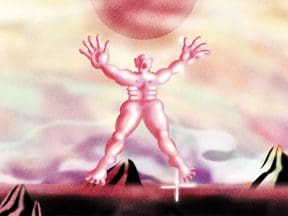
Sao Paulo, Brazil-based Animatorio created this stunning piece of stop motion animation. There’s some CG effects thrown into the mix too. I’ve posted the description of their short below, but honestly, it’s such a visceral feast for the eyes that no written description will do it justice:

Transformation trough mutations stages. Evolution as a function gain is called neo-morphic. Imaginary creatures adapt into an Ecosystem and the transformation of these habitats for these creatures generates a fantastic cycle. The mutation symbolism is part of our experiences in that trajectory, changing places, finding a new spectrum, a new phase, evolving.

UPDATE: A ‘making-of’ vid posted by the Animatorio crew:

April 15, 2011 12:31 pm


Watch the Birdie

Last year I wrote about how the family of British animation legend Bob Godfrey was uploading his films to YouTube. Now they’ve removed the films and are selling them on demand at Godfrey’s official website. A handful of his films are currently available including Do It Yourself Cartoon Kit, Henry 9 ’til 5, Instant Sex, and the super-rare Watch the Birdie. Films cost around a buck, but purchasers can only view the films and do not receive a permanent digital copy.

Godfrey’s family explains the reasons for switching from free YouTube videos to pay-per-view: “The answer is very simple. Digitising the videos, cleaning-up the soundtrack and picture and encoding for the web and then hosting the videos all costs money. Unfortunately the ad-funded videos on YouTube only generated £11 in 9 months, nowhere near enough.”

Some thoughts and questions:

1. Should the public be expected to pay for animated shorts today that were available to view for free when they first debuted fifty years ago?

2. Isn’t there more value to keeping Bob Godfrey’s name relevant on major sites like YouTube than the few extra bucks that could be earned by hiding his work behind a paywall? On the Internet, indie filmmakers can compete with the big boys, but hiding one’s films isn’t a competitive plan when studios like the National Film Board of Canada give away their shorts for free through mobile apps and websites.

3. What are other ways that a classic filmmaker could earn money from shorts? Why not make them available in the highest quality possible on an ad-free site like Vimeo, and then sell original art from the shorts? Or how about a Bob Godfrey iPad app with his films as well as interviews, photos and supplementary materials — the contemporary version of a coffeetable book.

Historically, shorts have never been an easy way for filmmakers to earn money, and filmmakers who make a living from shorts hardly represent the majority. In the case of a still-living animation legend like Godfrey, cementing his legacy within the pantheon of animation greats would be a more effective plan in the long run than attempting to exploit his work for nickels and dimes.