About Amid Amidi

test

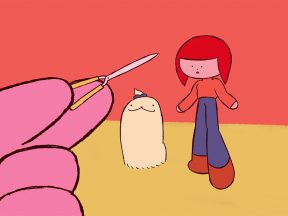
Kirsten Lepore Talks about “Bottle”

I wrote about Kirsten Lepore’s short Bottle last month, and enjoyed it so much, that I asked her to answer a few questions about her work. The interview, conducted via email is below. For more about her work, visit KirstenLepore.com.

CARTOON BREW: The idea of a relationship between two natural elements seems so obvious in retrospect, but I’ve never seen it before. Where did the spark for the idea come from?

KIRSTEN LEPORE: I had the initial spark about two winters ago while I was home in New Jersey.  I think I was just looking at all the snow in the backyard and thinking how cool it would be to animate a snowman.  I’d never seen it done, and it was definitely something I knew I had to try at some point — it was just a matter of having the time and coming up with the right story.

CARTOON BREW: Did you really animate all that snow? Last year, my hands froze just trying to build a still snowman. I can’t imagine doing animation with snow, and it not looking something like THIS.

KIRSTEN LEPORE: Yep! It was all real snow, moved frame by frame.  Every time I got out there to shoot, I had to rebuild the character (which was about 3 feet tall).  It was also pretty physically grueling pushing around massive snowballs (that probably weighed more than me), running back and forth between the camera and the character every frame, and dealing with wet gloves, boots, and pants.  There were too many obstacles to even name!  My brain hurts just thinking about it.

CARTOON BREW: Were you building and moving these characters by yourself or did you have help? Did you build rigs underneath? Were you able to review your animation as you were shooting? In other words, how’d you do it?

KIRSTEN LEPORE: It probably would have been much easier with a crew, but I’m stubborn so I did the whole thing by myself.  I also would have felt really guilty making someone else stand out in the snow for 8 hours a day.  In terms of the technique, there were no rigs needed for the snow as most things stuck together pretty well (or would freeze together if it was cold enough).  I wanted so badly for the beach character to be pure sand, but after countless tests, I couldn’t get him tall enough without crumbling, so I had to build a trompe l’oeil foam puppet covered with a mixture of sand and vegetable shortening. 

The puppet also wasn’t constructed very well so I ended up needing a ton of small rigs to hold up the arms and some of the objects.  I wouldn’t dare bring my beloved compy on the beach, so I had no frame grabbing software either.  I could only see an approximate review of what I shot by using the turning wheel on the back of the 7D to “flip” through the frames.  I even tried to skip this when I could (simply to avoid touching the camera) because my hands were usually either soaking wet or totally greasy with sand and Crisco.  Yum.  I just posted a micro making-of that shows other parts of the process as well:


CARTOON BREW: After this, do you prefer to animate outside where all of nature is your set or the controlled environment of a studio?

KIRSTEN LEPORE: I definitely prefer a controlled studio, but it was nice not having to build any sets for the piece.  It’ll probably be a few years before I can consider shooting outdoors again; I’d need time to forget how nightmarish the process was.

CARTOON BREW: You graduated from Maryland Institute College of Art a few years ago, and then decided to pursue a graduate degree in Experimental Animation at CalArts, which is where you made Bottle. Why did you decide to continue school instead of jumping straight into the industry?

After I graduated from MICA I wasn’t sure if I wanted to pursue a graduate degree, so I actually did freelance in animation for two years before coming to CalArts. I needed some time after undergrad to prove to myself that I could make a living doing animation. That “real life” experience was invaluable upon enrolling at CalArts as I already felt much more prepared and confident than if I had enrolled while I was fresh out of MICA. My decision to go to grad school was mainly fueled by the desire to make my own films again, the prospect of connecting with other animators, and to have the option of eventually teaching at a collegiate level. Also, I knew it would force me to move out to California, which is where I felt I needed to be.
 
CARTOON BREW: What are you working on right now and where do you hope you end up after graduating again?

KIRSTEN LEPORE: Right now I’m doing a few freelance projects and developing my thesis, which I’ll be working on for the next two years.  After graduation it’d be great to continue freelancing and directing.

CARTOON BREW: What are some of the things that are currently inspiring you, both within and outside of animation?

KIRSTEN LEPORE: There’s so much!  I just got back from the Vimeo Awards where I had the opportunity to meet so many creators that I respect and admire, which was totally amazing and inspiring.  So many of the films and speakers got me pumped and eager to get back into the studio to produce new work.  Outside of animation, I’ve taken up drumming again which I’m pretty excited about.  I’m also usually in the kitchen cooking up some weird concoction.  I’m proud to report I recently got over my fear of preparing eggplant, and (unrelated to the eggplant) may have mastered the art of the Vietnamese summer roll.

The Rent is Too Damn “Up”

Those who watched the New York state gubernatorial debate a few nights ago were treated to the awesomeness of candidate Jimmy McMillan (aka Papa Smurf) of the “Rent is Too Damn High” Party. That alone has little to do with animation, but remix Jimmy’s words with Pixar’s Up, like Joe Sabia did, and you get something magnificent.

(via Boing Boing)

The End of the Creator-Driven Era in TV Animation

The Hub, a network owned partly by toy company Hasbro, launched a little over a week ago with new animated series including Strawberry Shortcake’s Berry Bitty Adventures, G.I. Joe: Renegades, and My Little Pony Friendship is Magic. The network’s debut closes the curtain on what has commonly been referred to as the creator-driven era of TV animation, which lasted from approximately the early-1990s through the late-2000s. During this two-decade span, the balance of creative control in TV animation favored artists for the first time since the early-1960s, and artists exercised vast influence over the visual style, writing, and overall direction of TV shows. It was a fertile period that spawned dozens of lasting cartoon stars and series, many of which are still as popular today as when they first debuted ten or twenty years ago.

What clearer death knell for creator-driven animation than the reemergence of Margaret Loesch. After running Hanna-Barbera and Marvel Productions in the 1980s, and Fox Kids through the mid-1990s, her influenced waned in animation during the height of the creator-driven movement, but now she is back in the driver’s seat as president and CEO of the Hub.

Watching names like Rob Renzetti and Lauren Faust pop up in the credits of a toy-based animated series like My Little Pony is an admission of defeat for the entire movement, a white flag-waving moment for the TV animation industry. The signs have been there for a long time, however, and the Hub is but one indicator in the precipitous decline of creator-driven content, whose demise was hurried along by Cartoon Network and its decision to relaunch with large amounts of live-action programming. The erosion of support for creator-driven animation happened gradually but surely, and today networks clearly prefer established properties over original ideas, and dislike dealing with individual artists who have a clear creative vision.

Nobody denies that the Hub’s shows will perform well and fulfill the programming needs of the network. But then again, nobody suggested that Smurfs, Snorks and Pound Puppies wouldn’t do well in the 1980s either. The reason that creators like John Kricfalusi, Matt Groening, Mike Judge, John Dilworth, Craig McCracken, Genndy Tartakovsky, Danny Antonucci, Bruce Timm, Trey Parker, and Matt Stone stepped up to the plate originally wasn’t because animation was performing poorly. It was because these artists had a vision for the art form that was more inspired, more vital and more consistently creative than those of executives like Loesch; they aspired to create BETTER cartoons instead of simply acquiescing to committee-driven mandates that underutilized their skill and talent.

The creator-driven mentality stubbornly exists among a group of hold-outs and idealists (Pen Ward’s Adventure Time, Devin Clark’s Ugly Americans, Christy Karacas’ Superjail! to name a few), but their numbers will continue to shrink in the coming years. As TV audiences become more fragmented, and advertisers shift ad dollars away from TV, networks will increasingly rely on worn but reliable formulas. They will demand only the surest bets–Looney Tunes revivals, TV series based on feature film characters (The Penguins of Madagascar is already on Nick and Kung Fu Panda: Legends of Awesomeness is coming soon), shows based on live-action films (Napoleon Dynamite is headed to Fox), and the toy-based ideas that comprise the largest portion of the Hub’s animation programming.

This paint-by-numbers approach to executive management guarantees consistency, but eliminates the rich rewards stemming from the breakout animation hits that defined the creator-driven era. It also explains why so many networks are still coasting on the fumes of their earlier creator-driven successes: this month, the eleven-year-old show SpongeBob Squarepants ranked as Nickelodeon’s top-rated program, thirteen-year-old South Park is still Comedy Central’s best known animation product, MTV is reviving its 1992 creation Beavis and Butt-head, and Fox would not have a Sunday evening if not for its two vintage juggernauts, The Simpsons and Family Guy, which have existed for a combined thirty years. To be totally clear too, these are not retro-fads–these shows have been successful since they first debuted, just as theatrical cartoon stars during animation’s Golden Age often enjoyed popularity over multiple generations.

Do networks and producers deserve to shoulder the blame entirely? That thought was on my mind as I read this quote recently by Trent Reznor of Nine Inch Nails describing his approach to creativity: “I really try to put myself in uncomfortable situations. Complacency is my enemy.” From my perspective, complacency and creative stagnation amongst creators of TV animation has been at the root of the problem.

During the past decade, too many creators compromised their vision to get shows onto air, and too many creators didn’t take advantage of the opportunity once they had shows. In the early-’90s, creators held the attitude that they had been given a once-in-a-lifetime chance to write their own ticket, and they were going to use the moment to make the most amazing cartoon series possible. That vision turned blurrier in recent years. Selling a show became in and of itself a symbol of accomplishment among a subsequent generation of self-satisfied artists whose shows consistently failed to entertain audiences.

There’s an upside to all of this. As one era wraps up, I believe we are entering a new (and even more exciting) period–that of the independent, multi-platform artist. The entire concept of creator-driven is redundant at a time when digital technology has made animation production accessible to all. Everybody creates equally today; for something to not be creator-driven is the anomaly. People make entire Web animated series from the comfort of their bedroom and become famous for it.

As more artists choose animation as a career, they will find themselves unattached to specific distribution formats as in the past. Fewer artists in the future will say, “I want to work in TV animation,” or “My goal is features.” These mindsets belong to a bygone time when television and theaters held a disproportionate sway over other modes of content distribution.

Today’s artist has become as fluid and fragmented as the art form itself. An artist might work on a commercial one month, a TV show another, a Web cartoon series the next. And then comes an animated series for cell phones, a music video, a theatrical short, background visuals for a live performance, and an insert for a live-action documentary. The scene I’m describing is one that is undoubtedly familiar to East Coast animators and many artists working in Europe, and it is spreading.

This new breed of animation artist will pounce at an invitation to work on a TV series should it present itself, but they will not commit themself to a specific format at the expense of their artistic integrity. While everybody loves a steady paycheck, today’s artist can afford to be adventurous because there is more animation being produced than ever before and opportunities lie around every corner.

At the end of the day, TV animation isn’t going anywhere, and future Margaret Loesches will still find plenty of willing peons to fulfill their orders for extended toy commercials. But the overall trends are becoming more clear every day. Current market conditions and general conservatism in TV animation continue to erode the quality of series animation, especially content-wise. The creator-driven movement has all but flamed out, and few hit shows or perennial cartoon stars have emerged in the last five years. Most importantly, talented young artists are deserting TV as a full-time career option, not only because there are fewer promising opportunities for creators, but because the animation ecosystem beyond television is healthier and more diverse than ever before.

Toronto Cop Sues YouTube Because He Doesn’t Like Animation

Constable Adam Josephs, whose nickname has become “Officer Bubbles” after he was filmed harassing and threatening a woman for blowing bubbles (see video above), is now suing YouTube claiming that he’s the victim. What’s the cause of harassment? Animation.

Apparently, a filmmaker posted animated videos on YouTube that satirically depict Josephs abusing his power in other ways besides blowing up over bubbles. According to an article in the Globe and Mail:

In his statement of claim, Constable Josephs alleges the cartoons have subjected him to ridicule, and have resulted in threats against himself and his family. He also seeks to compel YouTube to reveal the identities of the person who created and posted the cartoon — identified by the moniker “ThePMOCanada” — and the identities of several people who posted comments in response.

The animations in question depict a policeman identified as “A. Josephs” arresting various people — including Barack Obama and Santa Claus — and beating up a news photographer while funk music plays in the background.

The YouTube account has already been shut down and the videos have been removed from their site. Whether YouTube or the maker of the films removed them, I find the situation to be unfortunate. The type of social commentary in those animated films should never be silenced under threat, and YouTube’s decision to cave in to an irrational lawsuit sends a chilling message to animators and political cartoonists who post their work onto the site.

In the 1800s, cartoonists like Honoré Daumier in France and José Guadalupe Posada in Mexico were jailed for lampooning political figures. Those days were supposed to be long gone in civilized countries, but one police officer in Canada wants to keep persecuting artists and stifling artistic expression by threats of financial harm and judicial intimidation.

Constable Adam Josephs works in Toronto’s 52 Division. You can place a complaint over his bullying behavior with the 52′s Community Relations Officer Constable Michael Moffatt at (416) 808-5291.

UPDATE: Somebody posted all of the Officer Bubbles videos onto YouTube again. They were all created with a free on-line animation program called Go! Animate. Go Animate! has also removed all the Officer Bubbles videos from their site. Crude as the cartoons are, they are quite effective works of satire. We’ve previously reported about easy-to-use web animation software, and an incident like this will only bring more attention to the potential of such products and the continuing democratization of the animation process.

More cartoons after the jump:
Continue reading

“The Big Winner” by Greg Sharp

Last month I wrote about a new studio in Melbourne called Rubber House which I thought was doing some fun and creative drawn character animation. The studio is run by Ivan Dixon and Gregory Sharp, and one of their former colleagues, Gavin MouldeyA, alerted me to a new piece they just completed called The Big Winner.

Directed by Sharp, and animated by both Sharp and Dixon, the film is barely more than a conceptual gag, but one that is done extremely well. I particularly like the character’s design transformation from sharp angles to bulbous, rounded forms.

CREDITS
Director: Gregory Sharp
Animators: Ivan Dixon and Gregory Sharp
Sound Design: James Brown
Producer: Ivan Dixon

Superb Episode of “Adventure Time” Leads Off 2nd Season

“It Came from the Nightosphere!” is an exceptional episode of Cartoon Network’s Adventure Time that combines inventive drawing and animation with funny, heartfelt storytelling. It aired last Monday, which was the show’s second season premiere. Writing and storyboarding duties belonged to Adam Muto and Rebecca Sugar, while the story is credited to Merriwether Williams, Steve Little, Patrick McHale, Pendleton Ward, and Thurop van Orman.

Rebecca, who created the student film Singles and first appeared on Cartoon Brew in October 2007 at the precocious age of twenty, also composed Marceline’s song which is heard in the episode. You can listen to the original version on her blog. Also, be sure and see these incredible drawings of Marceline made by her. She provided a few details about the episode on her blog:

I wrote a song for this episode, Marceline sings it at the beginning while Finn beatboxes. When Pen pitched this storyboard to CN, he beatboxed as Finn and I played the music on a uke and sang as Marceline. It was super terrifying, my first network pitch.

I also did all the monster stuff at the end! Adam Muto did all the meat in the middle! Generally, in our episodes, anything that is actually witty was done by Adam. I’m usually responsible for sex jokes and violence.

Also, just for fun, here’s Sneezy, a short animation piece that Adam created with Pen Ward a few years back. The stylistic evolution and growth from Sneezy to Adventure Time is fascinating to watch:

The Artists of “Tangled”

“I had the great experience of working as an animator on Tangled,” writes Claudio de Oliveira, “and by the end of the production I found some time to put together this homage to keep some memories of the ‘people’ behind this amazing project. It would be great if you could pass it along and put some faces out, not only our work.” Just be careful guys, if people don’t like the film, they know what you look like now.

“Awesome Reach” by Arin Hanson

Awesome Reach

The anonymous Brew reader who submitted Awesome Reach wrote, “I thought the animation here was wonderfully grotesque and over-the-top,” and I agree. The one-minute short, celebrating the release of the video game Halo: Reach, was created by Arin “Egoraptor” Hanson.

There are a lot of wildly talented, self-taught animators who post work on Newgrounds, and while they sometimes achieve micro-celebrity status on the site, their work remains completely unknown to the animation community, and moreover, the general public. A lot of that has to do with Newgrounds itself; the signal-to-noise ratio on the site makes it impossible for an outsider to discover anything worthwhile. Hopefully, artists with as much talent as Arin can break out and achieve the broader recognition (and financial rewards) they deserve.

“I Want Your Money” trailer

This is the trailer for I Want Your Money, an anti-Obama political documentary that opens in theaters this Friday. Like countless documentaries nowadays, it uses animation to help communicate its message. The film’s director Ray Griggs made no secret about why he inserted animation into the film, explaining in an article that, “I promised myself if I was going to make a documentary, it would be one that I’d want to watch and hold my interest, which is a big reason why we have the animation.”

I’m not sure who did the CG animation, but the bobble head-style politicians, who include Reagan, Obama, Clinton, Schwarzenegger, and Sarah Palin, are based on designs by Tom Richmond of MAD Magazine. Richmond apparently isn’t overly impressed with the results. He posted images of his original designs on his blog and commented, “Unfortunately Ray [Griggs] had a lot of trouble with the animation companies that did the CGI and frankly the final results leave a lot to be desired. I think the modeling and basic characters look fine, but the talking animation part is rough.”

“Sun” by Celine and Yann

A cute short made by Celine & Yann, a directing duo repped by Passion Pictures and comprised of Yann Benedi and Celine Desrumaux. A great example of how to tell a story in one minute. Student filmmakers could learn a lot from this, including the importance of having strong personality animation even when using an illustrative design style.

Sun is the second short in Celine & Yann’s self-produced “Giants” series; the first was Army. Sound design provided by David Kamp.

Chris Robinson Talks about the Ottawa Animation Festival

Ottawa

The Ottawa International Animation Festival takes place next week. If you’ve never been, GO! It’s a wonderful event to catch up with what’s new and fresh in the world of animation.

The festival is big, but not so big that the focus ever shifts from filmmakers and their films. The low-key vibe feels just right, and plenty of filmmakers attend which keeps things from getting boring. The all-you-can-watch buffet of special screenings and competition selections are impeccably programmed, and much of that can be attributed to the festival’s artistic director, Chris Robinson, who is also the author of many fine books on the subject of animation. He spoke with Cartoon Brew about this year’s festival:

CARTOON BREW: Having to watch so many films for preselection every year, you have a better perspective on indie animation than most. I’m curious what are the emerging trends you’ve seen in short films this year? Have you seen any broad changes in animation–stylistically, technique, or content-wise–over the past few years of directing the festival?

CHRIS ROBINSON: I dunno. I never have an answer to that question. Every year the films are diverse in terms of content and technique….so it’s hard for me to say that there are any specific trends. If there’s one thing I noticed this year it’s the length of the films. We’ve got at least a handful of 15 minute plus films in competition. All are strong works and it’s likely just one of those years, but I wonder if this is leading more animators towards features.

I guess if there’s a content trend at all it’s films dealing with social issues. A few films deal with war, environment and consumption. Normally not my cup of tea (cause they tend to be preachy) but these works were quite different, more mature and informed.

It’s very difficult for me to really be blown away by a film after all these years. I see some fantastic films (and a lot of crud) but few that are really ground-breaking. But that’s my problem. I’m disappointed by the quality of features and adult TV shows, but, again, this changes from year to year. Last year there were some great features. This year their ain’t. So it goes.

CARTOON BREW: I’m looking forward to checking out the four-part Japanese animation series you’ve prepared this year. Tell us about how you designed these programs and how it ties in with your new book? It seems like we don’t hear about a lot of the independent animation coming out of Japan because the mainstream anime industry is so overwhelmingly dominant. Is it the same in Japan or do they carve out space for independent creators within the country?

CHRIS ROBINSON: The programs feature pretty much features of all of the artists I visit in the book. There’s a focus specifically on Tezuka whose short films are miles away from his Anime work. The other two are overviews of indie animation from about the 1950s onward. Very eclectic mix including more known animators (Yamamura, Kawamoto, Kuri etc…) and lesser knowns. The fourth screening showcases work by two brilliant newish animators, Atsushi Wada and Kei Oyama. They’re not all that well known in the indie animation community but both have been making incredibly unique works. 

Nobuaki Doi is curating the two indie programs. He went beyond the book and added a number of works that I don’t cover in the book. So combined, the book and screenings really offer an extensive and well rounded intro to this lesser known side of Japanese animation.

And yes… like every other bloody country, the indie are pretty much ignored and overshadowed by mainstream animation (in this case, Anime)

CARTOON BREW: What are some of the special events, workshops and guests that you think attendees should look for especially?

CHRIS ROBINSON: Aside from Pixar and Disney presentations (sort of an annual thing now), there’s three exhibitions with two of them focusing on non-animation artists (including our poster creator Andrea Stokes). The other is connected with Lipsett Diaries. Theo Ushev is creating a series of new works inspired by Lipsett.

There are a trio of masterclasses and one that stands out features Caroline Leaf. You don’t hear a lot about her these days so it’ll be a rare opportunity for people to meet her and get an inside scoop on her work. The NFB is also releasing a dvd of her works.

One other presentation that I find interesting is Kenk: Animating a Graphic Novel. Kenk is a graphic novel (with Toronto and Ottawa creators) that follows the true life of story of a Toronto bike store owner who is apparently the world’s biggest bike thief. His views on the world and what he’s doing with the bikes is quite fascinating. Anyway…they’re turning this into an animation film so the creators will be on hand to talk about the process.

There will also be a lecture about Tezuka given by one of the big chiefs at the Tezuka studio. So….it’s a pretty good balance again. Something for the artsy fartsy crowd and more mainstream youngsters. Oh…and parties too.

Banksy directs “Simpsons” show intro

British street artist/prankster Banksy “directed” the intro to tonight’s episode of The Simpsons. It’s provocative, but the statement lacks potency because it was created by the same mass production infrastructure that he’s protesting. A reader on Gawker who goes by the handle “ReelMissing” stated this most eloquently:

“You don’t protest something by indulging in it. That’s the opposite of the point. Banksy was in part protesting Fox animation’s brutal treatment of its animators, but guess who animated the sequence? Fox animators did.

“It’s like killing a kitten and writing ‘ANIMAL CRUELTY IS WRONG’ next to the corpse in the dead animals’ blood. Maybe not on that scale of evil, but you get the point.”

UPDATE: The New York Times talks to Simpsons producer Al Jean about the Banksy intro.

UPDATE: Fox made a copyright claim and forced YouTube to remove the video from Banksy’s personal YouTube channel:
Nelson Muntz

UPDATE: Credits for the sequence VIA:
Character layout by Greg Checketts, Manny DeGuzman, and Jeff Johnson
BG layout by John Liu
Effects animation by Brice Mallier
Timing by Larry Smith
Color design by Dima Malanitchev
Digital magic by Steve Mills
Storyboard by Luis Escobar
Designs by Eric Keyes, Ricky Manginsay, Kevin Moore, Debbie Peterson, Hugh MacDonald, and Jefferson Weekley
Animation by a buncha nameless Koreans

“Red Head Speedskater” and “Spaceman Stu” by Oliver Conrad

Terrific photo-collage style and overall art direction in “Red Head Speedskater,” a music video for Airpushers directed and animated by Oliver Conrad at the New York studio Kompost. I love the movement of the titular character, which has a video game influence. Sophisticated design choices abound in this video; note how the director maintains interest by varying the timing of the skater’s movement and also by cutting the camera frequently while maintaining the illusion of a smooth ride.

I’m ashamed to say that I was unfamiliar with Kompost’s work until now. In fact, the video is from two years ago and I only learned about it because it was featured on Vimeo’s front page over the weekend. Here’s a more recent spot that Kompost recently completed for McDonald’s. It’s also directed by Conrad, and it’s one of the most genial and artistic spots I’ve ever seen selling hamburgers:

“One Minute Racist” by Caveh Zahedi

Indie filmmaker Caveh Zahedi has incorporated animation into his features and also made a couple animated shorts, including One Minute Racist, a film whose message is as timely as ever. It was made in collaboration with Ian Danskin and Alan Peterson, who animated the film. The animation is crude as could be imagined, but I’ll choose crudity with a point of view over a slick, aimless display of nothing any day.