

Per-Minute Production Rates Are Climbing on Kickstarter [UPDATED]
Transparency in the crowdfunding community is highly valued, and animators tend to be most successful when they are upfront about the length of the animation they plan to produce with the monies raised. The unintended result of this openness is that the opaque world of animation budgets has begun to fade away.

When Cartoon Brew published a crowdfunding report last month, we cataloged the per-minute costs of various high-profile animation projects on Kickstarter. The costs ranged from $3,333 to 13,750 per minute of completed animation.

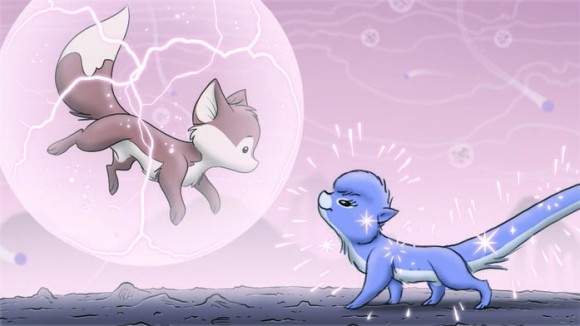
Now, we look at two more recent Kickstarter projects that have recently achieved their goals: Michel Gagné’s short The Saga of Rex and Masaaki Yuasa’s short Kick-Heart. At first glance, the two projects could not be more different: Gagné is a former feature film animator who works largely by himself from a home studio, while Yuasa is producing his short using a full crew and traditional production pipeline at Tokyo-based Production I.G..

However, both films share one thing in common: they have budgeted their animation at $15,000 per minute. Gagné set his goal at $15,000 to produce one-minute of film, with each additional minute produced at a $15K increment. Yuasa asked for $150,000 to produce a 10-minute short. This is not a particularly high per-minute production rate for the type of animation that they’re creating, but it is on the upper end of rates for Kickstarter animation campaigns.

The takeaway: not only are more projects being successfully crowdfunded nowadays, but the per-minute rate for A-list animators is growing alongside it. Even with the aid of digitial technology, animation like the kind that Gagné and Yuasa produce remains a laborious, hand-crafted process. It’s encouraging that the backers of their campaigns recognize this since a decent per-minute production rate is essential for crowdfunding to make a sizable impact in the world of animation production.

UPDATE: Michael Gagné has written an insightful blog post on Kickstarter explaining the complex production process for full animation. He also explains that though he’s asking for $15,000 per minute, after Kickstarter/Amazon fees and rewards, he only gets to apply about half of that amount to animation production:

When I worked at Don Bluth Studios, we were expected to create roughly 3.5 seconds (5 feet of 35mm film) of rough character animation a week. And that was only the rough keys. Some of the star animators produced up to 10 seconds a week. To be completed, the animation still had to pass through several hands. No wonder feature quality traditional animation typically cost between $80,000 and $1,000,000 per minute to produce within the studio system.

Although the goals on my Kickstarter project are set at $15K per minute, this won’t be the amount I’ll be getting for the production. Kickstarter and its partner, Amazon.com, keep 10% of the proceeds. Then, around 40% of the budget is applied towards the rewards and shipping cost. So roughly, I am left with around $7.5k per minute.

Now, to produce the film with the quality I want to achieve, I estimate that I will be working roughly 50 hours a week over a 10-week period, for each minute I create. Add to this, 7 weeks building and designing the campaign (that includes doing the animation test), running the campaign (which is turning out to be nearly a full time job), and a full month of work, fulfilling the rewards (packaging, printing, shipping, drawing, etc)—an estimate based on talking with several people who are dealing with their own successful campaigns—and you will see why I’m calling this a labor of love.

  • Julian

    How is it a ten minute animated short (even if it’s really good quality) can cost more than a house? What do these funds specifically go to? Voice acting, advanced computer systems? I’m just so baffled it can be that expensive in the age of flash and toon boom.

    • http://rauchbrothers.com Mike Rauch

      Even in the age of Flash and Toon Boom, you need a team of artists to make the thing. And if you’re working with professionals, they’ll want to be paid. Even a production with a limited budget and modest rates for the crew gets costly fast. And no, it’s not likely that most of the money is going to “voice actors and advanced computer systems”. In all likelihood, the majority of Kickstarter funds go to production costs for artistic talent.

      • Julian

        Yes, I can see that adding up, but I guess my real question is, if he did it all by himself, no team, maybe just a few friends for voices, would the cost then be so drastically high? I know that would take years, so is speed what they’re going for with this? Aaron Long and a few other various Youtube flash stars have shown that it is do-able without even spending $1,000. You just have to be patient.

        • Rezz

          I can’t say where the money will be going ; however, I can say that you can never have enough.

          esp if you want to apply to film festivals (the cost of shipping, printing it on film , submission cost etc.) it adds up REAL freakin fast.

          I don’t think it’s just going to be him working on it, chances are he’s going to want help to maintain that quality. Patience really has nothing to do with it.

          • http://www.studiomiguel.com studioMiguel

            You’ve obviously never created animation. Art takes time. A LOT of it. Michel has to keep the lights on, the water running, gas in his car. This isn’t a project he can produce on weekends and at night. This will be his full time job until it’s complete. So, whether the money goes to pay for a seat in Toon Boom Harmony ($1200 +?) or by twinkies, the point is, the money enables the project to go forward. Time is money.

    • akira

      most animators have to live in places where houses cost way more than 150 K, and thus need to be paid to work and survive.

      • UH

        Well, technically, animators don’t have to live anywhere, they choose to for the most part.

        Unless you’re referencing all the aspiring animators stuck in Africa but even the South Africa has a burgeoning market right? But if you’re referencing Glendale, San Francisco or NY uh… take it down a notch.

        BTW, I’m creating a kickstarter, directing it, animating it and we’re about 600 a minute. I’ll be utilizing 3D and flash to keep it down but yea… let’s all relax.

  • http://rauchbrothers.com Mike Rauch

    Of course, for several projects, I’m sure that Kickstarter funds are not covering the full production costs. So this doesn’t necessarily tell us the true cost of the productions. But you’re right to say that the per minute funding raised through Kickstarter has to increase to make a sizable impact on the world of animation production. Otherwise, to produce high quality work, people will still be relying significantly on old models of funding.

    That said, for an indie production, even raising several thousand dollars makes a big difference. That already beats the prospects for the sale of an indie short to distributors for instance, which can have the side effect of limiting what the filmmaker is able to do with their film when it’s completed.

    • http://www.amidamidi.com Amid Amidi

      Definitely true that the budgets may not reflect the absolute cost of production. For example, Phil Tippett’s short film MAD GOD worked out to a little over $3,000 per minute, which sounds quite cheap. But then you have to take into account that artists at his studio were working on the film after-hours so labor was free. If labor had been included, the cost would have been much higher.

      On top of that, others have pointed out in the comments that Kickstarter/Amazon take approx. 10% so a $15,000/per minute-rate is automatically $13,500 per minute. That doesn’t even factor in the cost of rewards.

      Having said that, it doesn’t diminish the point I was making which is that animators are asking for higher per-minute production rates and they’re successfully meeting those goals. I think we’re all in agreement that that’s a good sign.

  • http://mattmaners.blogspot.com Matt Maners

    Kickstarter takes 10% of what you make off the top. Also the rewards that are given out for sponsoring a project are not free and do cost money. Now factor in that one must live and buy or update software and equipment in order to churn out a piece the costs do add up. $15,000 per minute is pretty cheap if you ask me.

  • http://www.powerhouseanimation.com Brad Graeber
    • http://www.amidamidi.com Amid Amidi

      Thanks for reminding me about this! I’m glad to see your chart is still online!

  • http://www.toasterguy.com Aaron

    With Kickstarter, the funds tend to be just that – enough to kick start the project. At least, in my case they were. I raised $1,200 and put that much of my own money into it as well. So even though the per minute cost is going up, a lot of these projects – Michael Gagne’s in particular – are raising just enough to get the ball rolling. Which I think is cool.

    What I don’t like to see are projects trying to cover every cent of their costs thru crowd funding, or projects that look like the creators are trying to live off of the goodwill (and monetary donations) of their donors. Not sure why but something about it strikes me as disingenuous.

    Also regarding crowd funding – has anyone seen projects where attempts are being made to fund what amounts to elaborate “fan projects?” Those, to me, feel completely wrong, and not at all what Kickstarter and IndieGoGo and the like were created for, but I’ve seen some of them hit their goal and then some. Have intellectual property owners taken notice?

    • David Bokser

      The whole point of Kickstarter’s method of only giving funding if the goal is met is to ensure that the product has enough money for the project in order to finish it. It’s not disingenuous to cover the costs of the full production, it’s how it should be done. Otherwise, there will be tons of projects that get the bare minimum to get started, get partway there, and quit or spend years continuing the project. The contributors end up getting ripped off because there is no product to show for it.

  • http://www.AnimationPhysics.com Alej Garcia

    For the sake of comparison, a feature-length film (say 90 minutes) with a budget of $135 million (which is typical for Pixar, Disney, or Dreamworks) would be $1.5 million per minute. That’s 100 times the Kickstarter rate mentioned in the article.

    • http://www.dudegurlz.com Kris Kail

      That doesn’t account for production of the animation alone, though. When you talk budgets you gotta take into account EVERY little detail. Yes, you have the animation, but then you also have voice actors, original music, licensed music, sound effects (if you don’t already own a library), all the little things you see/hear on screen. After you take all of that into account, you gotta think about the directer, producers, writers, everyone associated with the production who isn’t directly involved with the visual/audio sides.

      While the animation is a HUGE factor, it’s not the only thing that accounts for a $135 million budget.

  • http://www.youtube.com/floydbishop Floyd Bishop

    Different production processes have different costs associated. Geographic location and number of people working on a project has an affect on cost. Sometimes people are just really bad at estimating how much something will cost. I think this last point has a lot to do with why we’re seeing such a wide variety of per minute rates (which in my opinion is a horrible way to bid out anything).