.png)
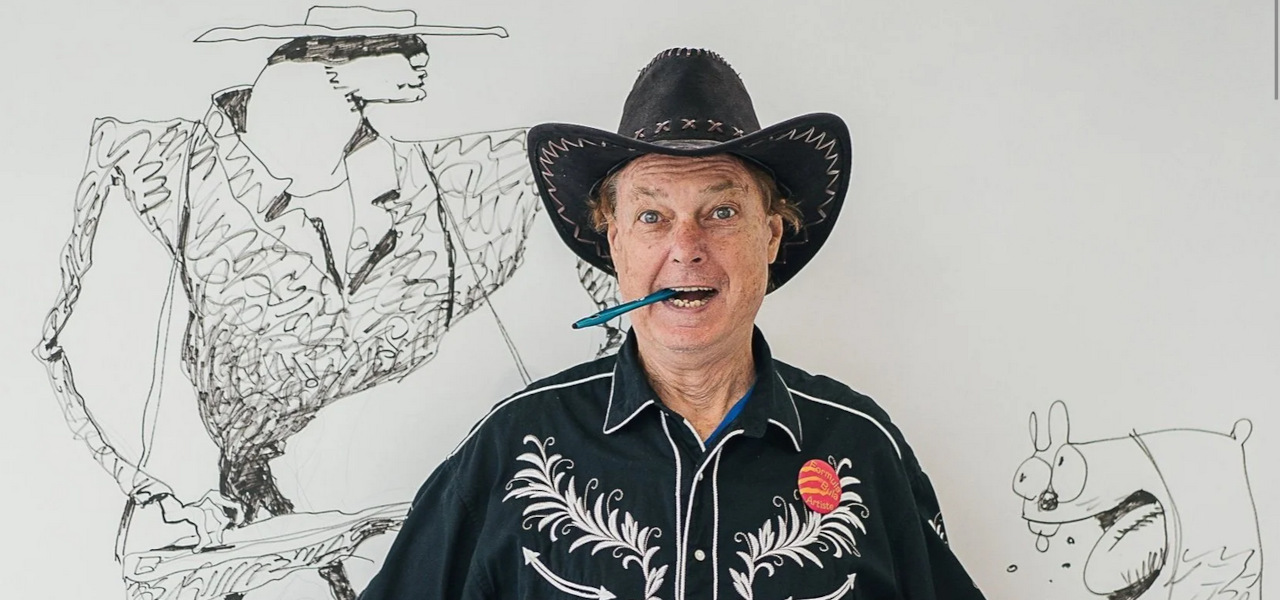
Keep It In Motion: Bill Plympton At 80
Stay informed with free updates
Sign up to get our news digest — delivered directly to your inbox twice a week.
When I recently came across the news that Bill Plympton was turning 80, I was a little floored. I had no idea he had, well, how shall I say this: ascended such heights of annual existence. In my mind, he is still the middle-aged guy in shorts and a polo shirt, moving through festivals, chatting with fans, signing drawings, and selling whatever Plymptoons goods he has packed for the trip.
It got me thinking about Plympton and his impact on indie animation. Now, it’s no big secret that not all of his films are my cup of tea, but that doesn’t mean I don’t respect what he has done across nearly 50 years in animation.
Off-screen alone, Plympton helped redefine what an independent animator could do. He did not simply make films outside the studio system. He built a working structure around them: distribution, self-promotion, merchandise, festival appearances, books, drawings, DVDs, crowdfunding, and direct contact with audiences. He turned the independent animator into something close to a one-person company, or maybe a traveling cottage industry. His influence can be seen in artists such as Don Hertzfeldt, Signe Baumane, and Patrick Smith, all of whom have found unconventional ways to make and circulate their work outside the usual channels.
Plympton remembers the turning point clearly. “The first time I realized I could make money was when I took Your Face to Annecy, and after the screening — and large applause — I was surrounded by acquisition people from the big channels, MTV, BBC, Canal Plus, and Arte, handing me checks. I thought, ‘Hey, I can make a living on my weird cartoon shorts, wow!’”
Timing was key, too. Plympton landed at a good moment. “Those days, the late ’80s and early ’90s, were great,” Plympton says. “I’d sell my shorts to Spike and Mike, The Tournee of Animation, MTV, Sick and Twisted. It seemed like I could sell my films everywhere.”
At festivals, Plympton is never just an attending filmmaker, there to take an on-stage bow. He is always working his tail off. He’s the guy at the table with drawings, books, discs, posters, sketches, stories, and whatever else can travel in a suitcase:
It just made sense as a way to supplement my budgets. All these fans were at my appearances and wanted to buy more of my work, so I began to bring my suitcase to the event to sell my merch.
There is something in this that reminds me, oddly enough, of seeing country music legend George Jones in concert years ago. Between songs, Jones would remind the audience of the merchandise table while people moved through the stands, selling whatever was on offer. At the time, I remember finding it a little uncomfortable. But the older I get, the more I understand it. Nobody else was going to do the work for him.
In a field where independent animators often have an endless list of excuses for why they cannot get started — no funding, no proper space, no institutional support, no distributor, no this, no that — Plympton has rarely had time for excuses. He just does the work. He draws, travels, sells, promotes, makes the next film, and then starts the cycle again. You do not have to love every film to respect that kind of stamina.
Animator Patrick Smith sees that clearly:
When I first started pursuing independent animation full time in the first decade of the 2000s, I didn’t fully realize how unique Bill Plympton actually is. Looking back, he represented — and represents — a very specific model of independence, one that’s easy to admire, but much harder to sustain.
For Smith, the key was not only Plympton’s style but the way he made the work possible. “At the core of that model is the process of subsidizing independent films with commercial work, and then, in turn, those films bringing in income themselves,” Smith says. “As far as I know, he never tried for any grants or government assistance. This self-sufficiency was a major lesson: that his independence is linked not only to his aesthetic, but also to his business model, from production through distribution.”
The balance of that model has shifted over the years. “Less sales to TV, more to DVDs, commercials, and people who collect artwork,” Plympton says.
That part of Plympton’s career can get overlooked when the conversation stays only on the films. The drawing style, the jokes, the sex, the transformations, the absurdity — all of that is visible on screen. Less visible is the structure underneath: how to keep making personal work without waiting for permission, how to move from production to distribution, and how to make the work generate enough momentum to keep the next project alive.
“Bill is a clear example that it’s actually possible to make a living creating personal animated films,” Smith adds. “I never pursued features, but seeing someone sustain a career through unconditional personal work was incredibly important.”
Plympton’s move into features was another part of that model. Animated features largely belonged to Disney and the major studios, while independent animation was mostly associated with shorts, festival screenings, touring programs, and late-night discoveries. Plympton pushed his way into that space with The Tune, then moved into more fully conceived narrative features like I Married a Strange Person!, Mutant Aliens, Hair High, Idiots and Angels, and later Cheatin’.
According to Plympton:
Feature animation has a much larger audience. As a short filmmaker I never got the attention like the feature filmmakers received. This may sound egotistical, but I’m now working on my 10th animated feature and I can’t remember any filmmaker ever making 10 animated features by themselves. Not Disney, Tex Avery, Norman McLaren, Miyazaki, Chuck Jones, or anyone.
He helped prove that independent animation did not have to stop at the short film. A single artist, or a small team built around one artist’s vision, could attempt the feature form without waiting for a studio to approve it. Whether those films reached large audiences or not, they opened up a different path. They suggested that feature animation could be handmade, strange, personal, rude, uneven, funny, excessive, and still fully independent.
Smith also points to Plympton’s off-screen role in New York animation:
Even though I have never worked with him directly, his off-screen impact in New York is undeniable. He has consistently hired young, often inexperienced artists and invested in them, not just as labor, but as creatives.
Smith recently attended a screening organized by current and former Plympton collaborators, and what struck him was the gratitude in the room. “That kind of legacy doesn’t come from films alone,” he says.
The same directness carries into Plympton’s approach to distribution and merchandise. “Bill is very much a boots-on-the-ground filmmaker,” Smith says. “He sells his work directly, especially his drawings, without pretense and without distancing himself from the audience. There’s no illusion of scale or polish for its own sake. It’s direct and unapologetic. And this direct marketing to his fans has gotten him out of a few tight spots.”
Signe Baumane sees Plympton’s example in larger, almost spiritual terms:
When I look at Bill Plympton’s impact on my life and career, and his impact on thousands of other animators’ careers, I see a spiritual leader — a guide. Yes, Bill Plympton is a spiritual leader because he believes in the thing larger than himself: animation and the animation community.
Plympton’s impact on Baumane had less to do with visual style or storytelling than with something more concrete. “Bill had a huge impact on my determination to make films,” Baumane says. “He inspired me to keep making films, and he showed that just making films is not enough — you have to promote them to bring them to an audience.”
That, in Baumane’s view, is where Plympton’s example becomes larger than his own films:
He inspires thousands of animators to aspire to do the impossible — to make films independently from the studio system or government grants. Can you be an indie animator like Bill Plympton? It’s hard, but you have to die trying because the journey is worth it.
Plympton even has what Baumane calls a gospel: “Bill Plympton Dogma: make your films short, fast, cheap, and funny.” It sounds like a joke, but it also carries a working method inside it. Keep the films moving. Keep them possible. Don’t build a production model that crumbles from being overly ambitious.
Baumane and other artists who have worked with Plympton recently organized a roast for him called Behind the Magic of Bill Plympton: A Roast, in which they tried to pin down “the magic behind Bill Plympton — the magic of his productivity and creative longevity.”
“It was different things for each of us,” she says. “His childlike spirit, his obsessiveness and commitment to drawing, his craft, his openness to other people and their ideas, his loyalty to his collaborators, his ability to change, his astounding imagination, and yes, his magic includes the people behind the scenes who are willing to help him paint his drawings and put them together, and do many other things that an artist needs to make films and promote them.”
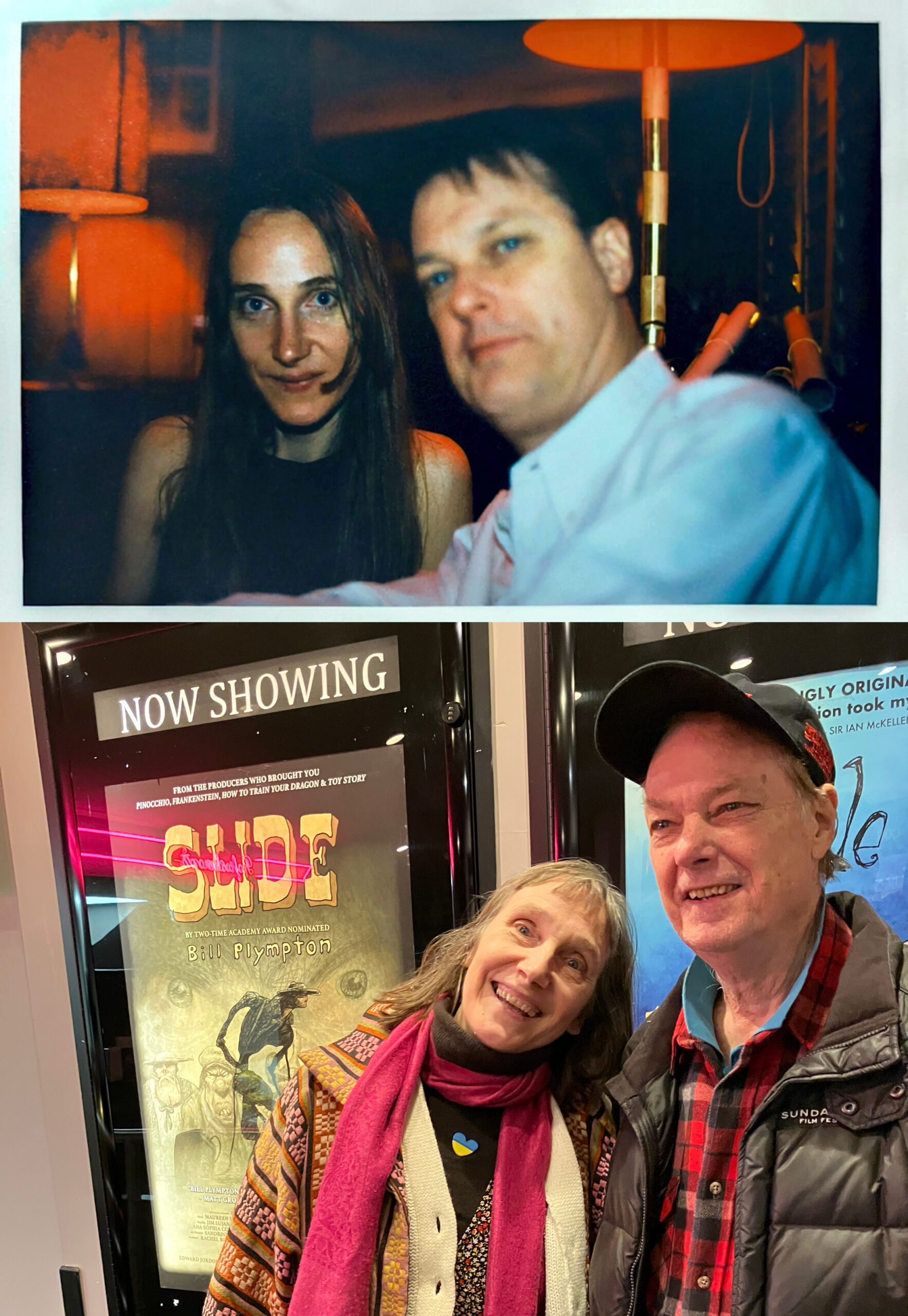
She does not sentimentalize him. “Artists are notoriously selfish,” Baumane says. “Bill is no exception. But he is also very supportive of his animation community, and goes out of his way to help anyone who is willing to take the path of an indie animator.”
Baumane also points to the brutal side of that path:
Bill has been making animated films for over 40 years. He has gone through at least two or more near-bankruptcies, gone deep into debt to make his films, and experienced rejection, refusal, betrayal, and outright malice. Each time he has sprung back, like a phoenix from the ashes.
After the roast, Baumane asked one of her young assistants what lesson she took from it. The answer was simple: “Just keep going.”
“And that nails it,” Baumane says. “Bill Plympton, despite disappointments and failure, just continues on. His journey is larger than the daily grind and minute upsets. He believes in his work, and he believes in animation and expressing the human creative spirit through it. That is the source of his resilience.”
Baumane also sees that resilience in the way Plympton adapted to the digital age. “Without even knowing how to turn a computer on,” she says, “starting in 2002, he started making his films digitally and promoting them in a new way, in sync with the digital age.”
Plympton himself admits that online promotion came later. “Being digitally ignorant, I was very late in promoting my website,” he says. “Now I’m building up my digital presence, and I soon hope to be selling a lot more in the future online.”
That said, the shifts in animation and the parade of new technologies have not dampened the physical pleasure of drawing. “I really enjoy the act of putting pencil or pen to paper,” he says. “It has a texture that’s similar to paintings in a museum. And I like that. I want all the mistakes and accidents to show that it was made by a human hand.”
Baumane connects that persistence not only to how Plympton works, but to how he survives the daily aggravations that come with working independently:
He is a much kinder and better person than I am — more forgiving than I can ever be. I learned not to zoom into daily upsets too deeply, and just keep going when it gets really bad, like when financing falls through or when employees cause trouble.
Plympton’s cycle can sound almost comically straightforward: make the film, take it out into the world, sell some drawings, meet the audience, make another film. But Baumane knows better:
He makes it look so easy — just make a film, and people will love it. And now I know what he does is nearly impossible for everyone else. But the initial impact — to just try to do what he does — keeps us all going, and we find our own ways to make it happen.
Smith arrives at a similar place from a different perspective. In an industry that seems to talk endlessly about instability, burnout, and collapse, Plympton just keeps working. “The output alone is staggering,” Smith says. “More than strategy, it’s his persistence. He is just always working, and truly loves the process.”
“It’s a great pleasure for me to put a pencil in my hand and create another reality — a world of fantasy,” Plympton says. “You could say I’m totally addicted to the act of creating cartoons. Plus, I’m addicted to hearing a large amount of laughter from gobs of people.”
For younger animators, that may be the most useful part of his example. Independence is not only an artistic position. It’s logistics, financing, travel, and sales. It’s storage boxes, festival badges, mailing lists, rights, repetition, and the willingness to keep showing up.
One might assume that, with the animation industry teetering and tottering of late, it’s time to put aside those animation dreams and consider a more stable career in, say, the military-industrial complex. Instead, Plympton is surprisingly optimistic:
I believe that now is an opportune time for young artists to get into animation. When I was in college there were no animation schools, nobody cared. Now everyone wants to be an animator. The art schools are packed. Of course my masterclass fully answers that question — but briefly I suggest they make a short film that follows my Plympton Dogma and get that film into festivals and in the hands of business folks in the film industry, and hopefully that will lead to sales to the media.
You don’t copy Plympton by drawing like him, making jokes like him, or chasing his exact path. The real lesson is that no one else is going to build the road for you. You’ve got to pave your own damn path, then keep taking care of it.
At 80, that may be Plympton’s real legacy: not simply that he keeps making independent animated films, but that he shows how independent animators can keep making them.