.png)
Ryuya Suzuki Taught Himself Animation During Lockdown And In Just Five Years Premiered ‘Jinsei’ At Annecy
Stay informed with free updates
Sign up to get our news digest — delivered directly to your inbox twice a week.
The COVID-19 lockdowns of 2020 pushed many filmmakers into major career pivots out of necessity. After graduating from Tohoku University of Art and Design, Japanese filmmaker Ryuya Suzuki intended to make live-action films. But early burnout, combined with the pandemic, led him to “borrow” an iPad from his retail job, load Procreate software onto it, and teach himself animation while creating two original short films, Mahoroba and Lawless Love.
The positive reception to both shorts prompted him to crowdfund an original feature film, Jinsei, which he wrote, animated, edited, production designed, character designed, color designed, and composed himself. Aside from recording sessions with actors including rapper Ace Cool, Remi Chon, Kanji Tsuda, and Ayumu Nakajima, Suzuki was effectively a one-man band throughout the film’s 18-month production schedule.
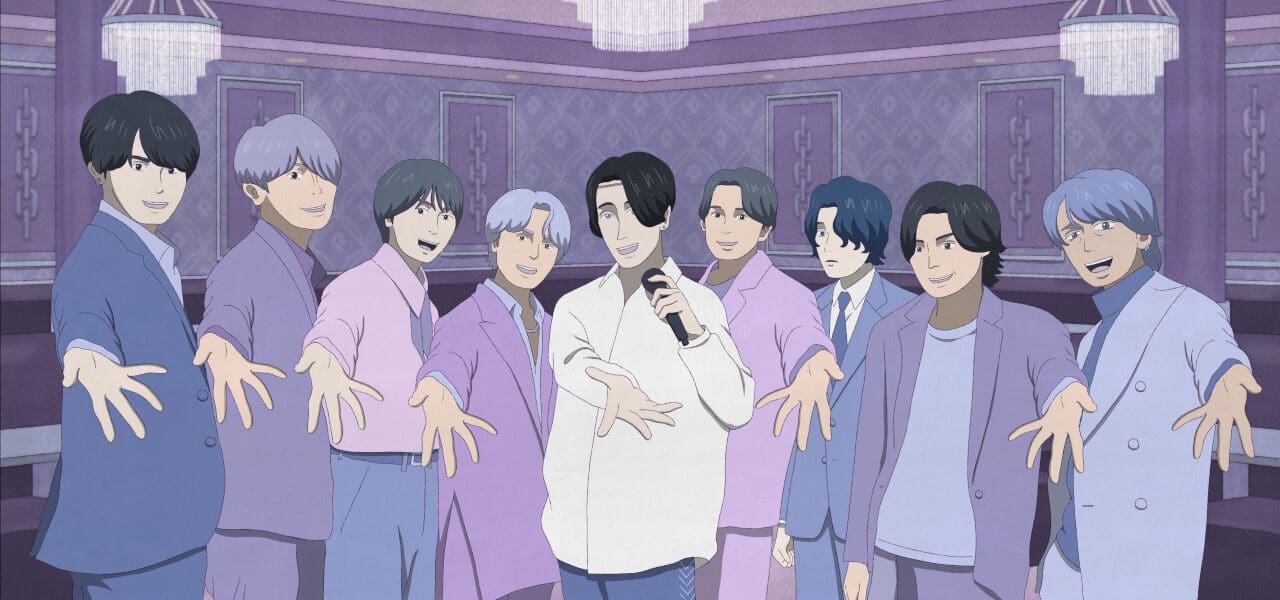
The film tells the remarkable and often tragic century-long life story of Se-Chen (Ace Cool). Initially fixated on becoming a pop idol, life gifts him with many different names and personas that take him in unexpected directions.
Jinsei opened in Japan in May 2025, screened at Annecy in 2025, and opens wide in U.S. theaters on June 12, 2026, distributed by Greenwich Media. Cartoon Brew recently spoke with Suzuki-san from Japan to discuss his animation process.
Cartoon Brew: Essentially, you went from learning Procreate on an iPad in 2020 to completing a feature film in five years. You were the entire pipeline. How many minutes or seconds of animation were you completing per day?
Ryuya Suzuki: I would get those weekly reports showing how much time I spent on my iPad, which was the device I worked on, and it usually said around 13 hours per day. At that pace, I completed about five minutes per month.

You mentioned in prior interviews that you built out the chapters of Jinsei organically as you animated the film. Did you at least start with the first and last scenes in mind so you had emotional anchor points?
The things I had decided before I started were that it would span 100 years, that it would be divided into 10 chapters, that it would be a story about an idol, and that 2025, which was going to be the release year, would fall halfway through the story. Aside from that, I didn’t have much planned.
The Jinsei art style reminded me of indie graphic novels like Craig Thompson’s Blankets or the Tamakis’ This One Summer. Did you craft those 10 chapters linearly like a book, or did you work on them out of order?
I worked chronologically from the beginning.
There are large sections of this film with no dialogue, yet we get a lot of exposition through the visual presentation. Did you study any particular anime or live-action films with minimal dialogue to hone your storytelling?
Actually, it was a Crayon Shin-chan movie from around 2000. There’s a five-minute sequence with absolutely no dialogue that tells the story of an entire life, and that was a major influence on me.
Jinsei’s aspect ratio evolves from square to widescreen. When did that idea come to you, and did it complicate the animation process?
I had made two shorts before this film that also changed aspect ratios. That was influenced by Mommy [2014]. I also wanted to avoid tiring myself out by drawing within the same frame the entire time, so working in a wider frame felt different. I also thought it would surprise audiences in the theater to see the aspect ratio change. Because my animation style doesn’t move very much, I can still create movement through the composition and framing.
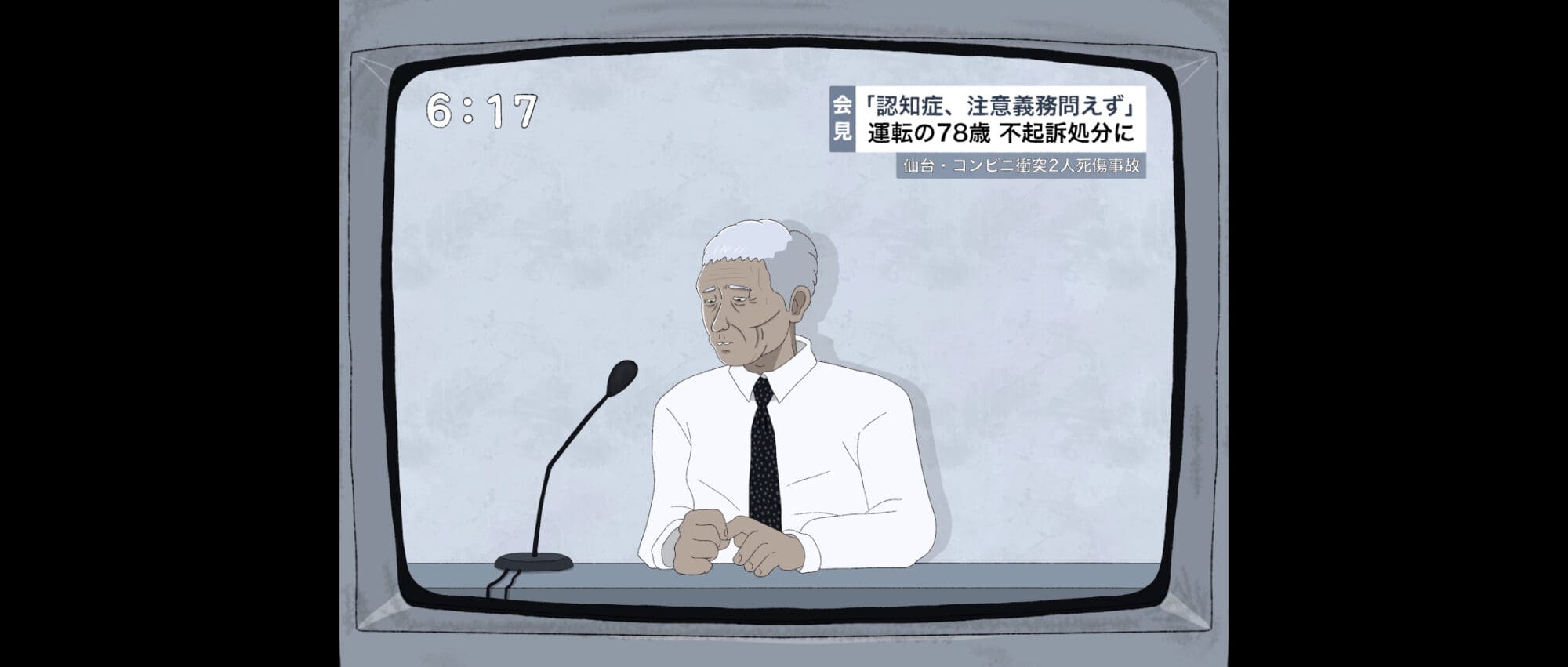
Speaking of Jinsei’s minimalist animation style, your choices about what moves within a frame often create the illusion of much more movement. Was that intentional because you were making the film alone, or did it feel organic to the story?
It was completely intentional. When characters don’t speak very much and then suddenly do, it carries a different weight. Movement works the same way. When things stay still for a long time, and then suddenly there’s a lot of movement, it creates a strong impression. Part of the decision was also about conserving my energy, which I decided from the very beginning.
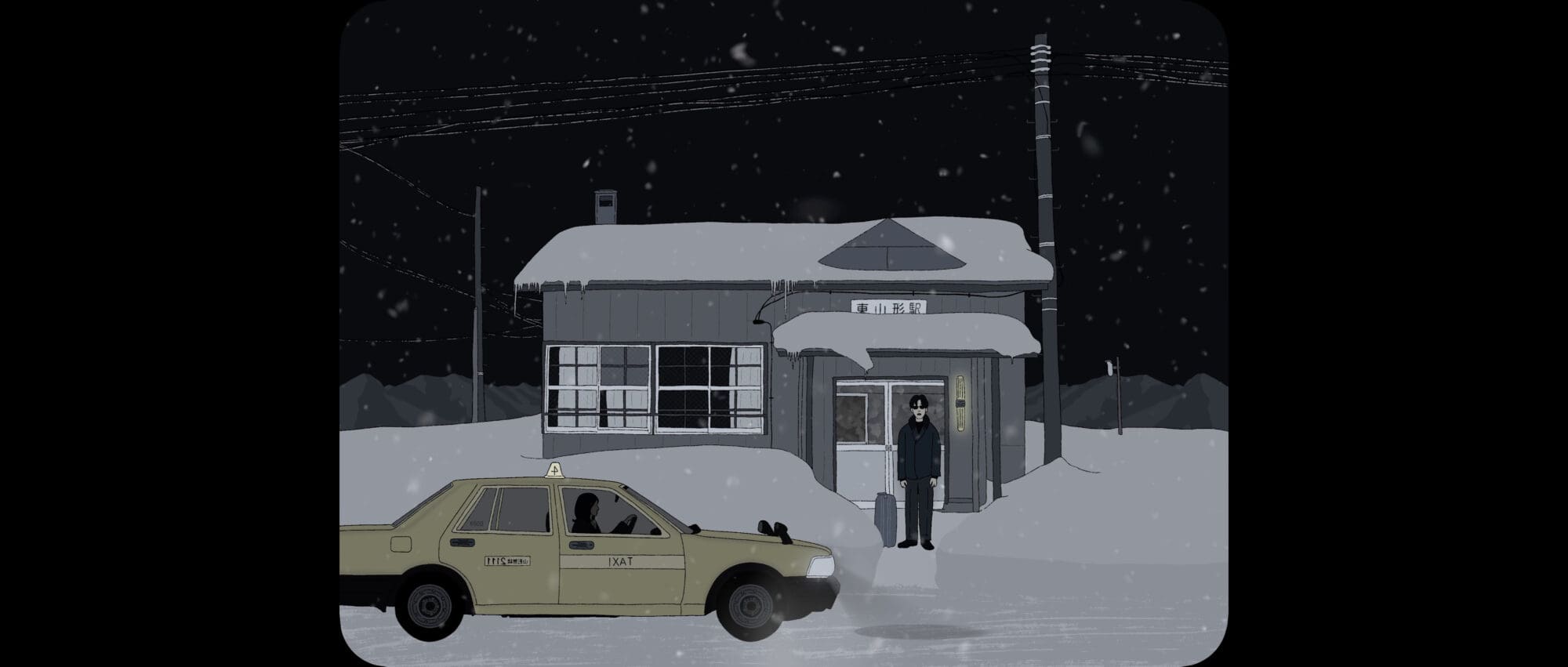
Jinsei shifts from grayscale and muted colors to black-and-white segments and eventually full color in the final chapters. Did that evolve as you made the film?
It was planned exactly as it appears in the film. I knew I wanted to use black and white at one point. It really felt like I was creating 10 different short films, so I developed thematic color palettes for each one. That also helped keep me from getting bored drawing the same thing over and over.
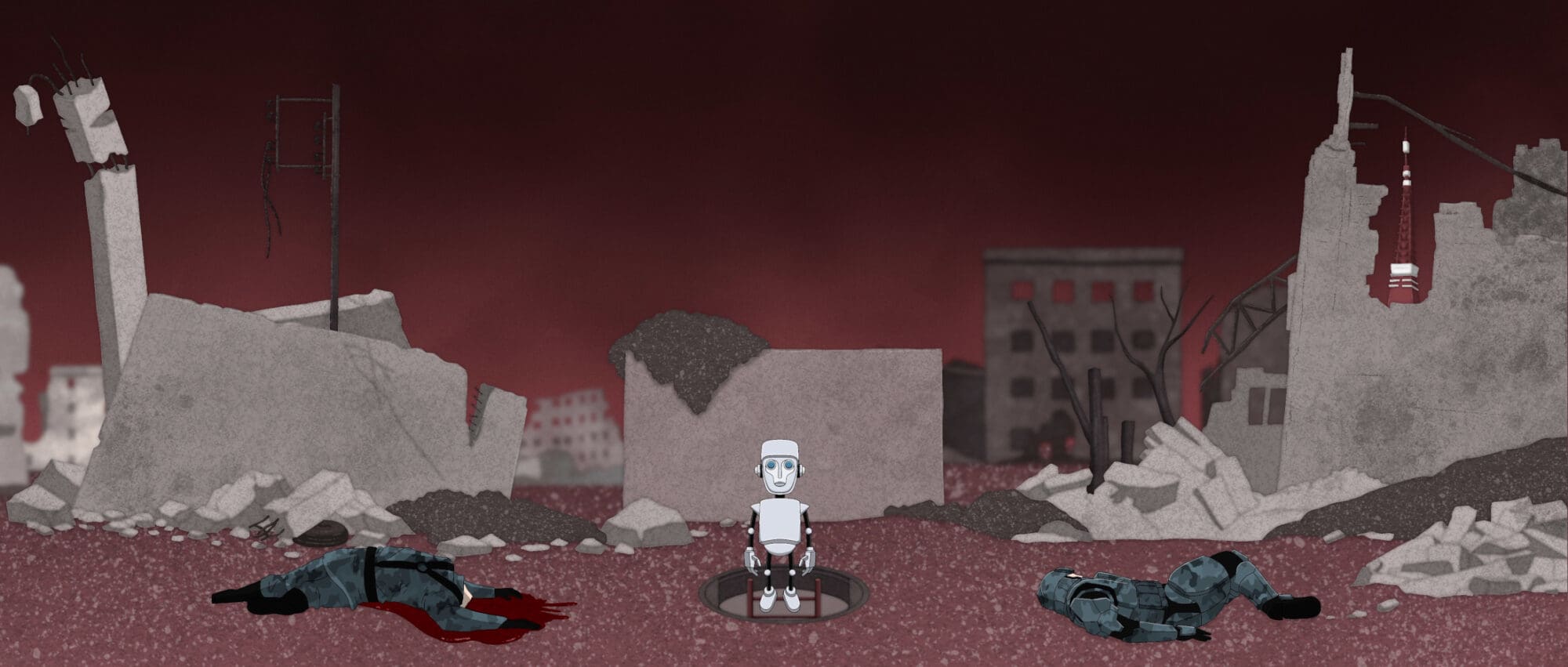
The final chapters, set in the future, feel like miniature speculative science fiction films within the broader movie, echoing the surrealism of 2001: A Space Odyssey. Were there specific cinematic inspirations that helped you build those sections?
I love Kubrick. I had a DVD box set of 2001: A Space Odyssey, but a friend borrowed it and never gave it back, so I’ve actually never seen it. Some people have also mentioned Fantastic Planet, but that wasn’t an influence either. I was really thinking about how to create distance from daily life, and outer space felt like the furthest possible distance. There’s a lot of meaning in how I came up with those ideas and what they mean to me, but I’d rather leave that interpretation to the audience.
You were trained in live action. Do you see yourself leaving animation to explore that next, or could you see yourself staying in animation while delegating to a more traditional staff of animators?
I don’t want to make another feature film alone. I’m 31 years old, and I don’t want to still be stuck in a room at this age, spending all that time sitting down. Maybe later in life, when I’m older, I’ll return to making something like this again. But right now, my dream is to work on a larger scale, making proper anime with a proper staff that already has the technical skills and experience.