.png)
Computer Animation Before ‘Toy Story’: The Wild, Brilliant Experiments That Built CGI Animation
Stay informed with free updates
Sign up to get our news digest — delivered directly to your inbox twice a week.
In honor of the 30th anniversary of the John Lasseter film Toy Story, the first fully computer-animated feature film, we’re taking a look at early CGI milestones in the days before Toy Story.
But before we get into that, let’s start off with the Toy Story test film that convinced the executives at Disney that a CGI animated feature could work. Note that it features the earlier, meaner version of Woody that Disney CEO Jeffrey Katzenberg insisted on before he was finally talked out of it.
— Cartoon Study (@CartoonStudy) November 21, 2025
You might be surprised to learn that the origins of computer animation trace back to the Alfred Hitchcock classic Vertigo (1958). For the opening credits sequence, designed by Saul Bass, artist and inventor John Whitney created the spirographs using an analog computer he had fashioned out of a World War II M-5 anti-aircraft gun director, which was intended to aim cannons at moving targets. He was able to reprogram the target positioning devices to create mathematically controlled movements he dubbed “incremental drift.” Whitney’s goal for the future of computer animation was the union of space and time, concluding, “Time has become visual.”
— Cartoon Study (@CartoonStudy) November 21, 2025
Some of the earliest computer animation was created in research facilities like Bell Labs, frequently by people with backgrounds in engineering and mathematics. These predate more artsy uses of the medium like Lillian Schwartz’s Pixillation (1970), John Whitney’s Arabesque (1975), and Ed Emshwiller’s Sunstone (1979). Here are a few of those early experiments in computer animation from the 1960s.
— Cartoon Study (@CartoonStudy) November 21, 2025
In 1969, scientist Nestor Burtnyk of National Research Council Canada attended a conference where Disney artists demonstrated the process of making hand-drawn animation. Burtnyk, despite claiming to have no artistic bent, collaborated with Marceli Wein to create a Key Frame animation software that would allow animators to draw extreme poses on a computer, and the system would fill the inbetweens through interpolation (or, in modern-day lingo, “motion tweening”). Here are some clips from a 1971 documentary on how the system worked, along with examples of animator Peter Foldes’ usage of the software in films like Metadata (1971) and Hunger (1974). Fascinating to see a film about computer animation from an era when you still had to explain to the audience what a mouse was.
— Cartoon Study (@CartoonStudy) November 21, 2025
One of the major landmarks in CGI is the test film A Computer Animated Hand (1972), created by Ed Catmull and Fred Parke at the University of Utah. In order to make it, 350 interlocking triangles and polygons were manually drawn onto a plaster cast of Catmull’s hand, and the measurements of those coordinates were programmed into the computer to create a digital wireframe. Then the model was detailed and smoothed out through a process later called texture mapping. This test formed the basis of 3D animation going forward, and Ed Catmull went on to become the co-founder of Pixar.
— Cartoon Study (@CartoonStudy) November 21, 2025
In 1982, there was actually a full-length computer-animated feature in the works – appropriately titled The Works – to be directed by Lance Williams at the Computer Graphics Lab of the New York Institute of Technology. The plot would’ve concerned a supercomputer that wipes out the planet Earth by triggering a world war but, realizing what it had done, attempts to repopulate the world with robots. A human pilot named T-Square and her robot companion Ipso Facto would fight the robots to make Earth safe again for fellow space-traveling earthlings. The project proved to be too ambitious for the time – apparently, even if they had completed the animation, it would’ve taken seven years just to output the rendered frames – but they did manage to produce a trailer, which you can see here.
— Cartoon Study (@CartoonStudy) November 21, 2025
Computers were used to create visual effects in live-action movies as early as 1973’s Westworld (in the shots where we see the pixelated POV of the robot), and basic wireframe models appeared in late ‘70s features like Star Wars, Alien, and The Black Hole. Still, the major breakthrough for computer-animated effects was the 1982 sci-fi feature Tron – set in the world of arcade games – which boasted nearly twenty minutes of CG effects shots. Given the technological limitations of the time, what director Steven Lisberger and his team were able to pull off is incredible; one frame could take up to six hours to render, and, because there was no way to digitally print the footage onto film at the time, a camera was placed in front of the computer screen to photograph each frame! Tron was nominated for several Academy Awards, but was disqualified from the visual effects category because the Academy felt that using a computer was “cheating.”
— Cartoon Study (@CartoonStudy) November 21, 2025
A young Disney animator named John Lasseter was blown away by Tron and was eager to incorporate this new technology into his own work. So he and fellow Disney artist Glen Keane collaborated on a Where the Wild Things Are test film to demonstrate the possibility of combining hand-drawn characters with computer-generated backgrounds, in hopes that this method could be applied to The Brave Little Toaster. Lasseter pitched the idea to studio head Ron Miller and administrator Ed Hansen, who immediately rejected it for not being cost-efficient. A few minutes after the meeting, Hansen summoned Lasseter into his office and said, “Well, John, your project is now complete, so your employment with Disney Studios is now terminated.” Here’s the test that got Lasseter sacked. (Looks pretty good to me!)
Lasseter managed to bounce back by joining up with the Lucasfilm Computer Graphics Project, later to be rechristened Pixar, and he worked as the lead animator on Alvy Ray Smith’s short The Adventures of André & Wally B (1984). Up to that point, CGI models had been stiff and inflexible as a rule, but Lasseter looked at Ub Iwerks’ early Mickey Mouse drawings for inspiration in creating appealing characters out of circular shapes. The use of motion blur and realistic lighting gives the film a naturalism lacking in earlier CG projects, but even more importantly, the film was a huge step forward in applying classic cartoon principles like squash & stretch into the previously rigid world of CGI.
— Cartoon Study (@CartoonStudy) November 21, 2025
Films like André & Wally B weren’t shown on TV or in movie theaters at the time they were made. Instead, they were screened at computer graphics conferences like SIGGRAPH and appeared on VHS tapes like The Mind’s Eye, which compiled computer-animated shorts, ads, and demo reels, played electronic music behind them, and were sold to a niche audience of tech enthusiasts. Here are a few of the films that were staples of CG compilations and festivals back in the 1980s.
— Cartoon Study (@CartoonStudy) November 21, 2025
One of the earliest computer-animated projects to reach a wide audience was a commercial known as Brilliance, which was shown during the 1985 Super Bowl. The ad, inspired by the works of Hajime Sorayama, was created by Randy Roberts at Robert Abel & Associates, who vowed that it would be a “quantum leap” for commercials. If the sexy robot lady in this ad doesn’t make you crave some delicious canned food, I don’t know what will.
— Cartoon Study (@CartoonStudy) November 21, 2025
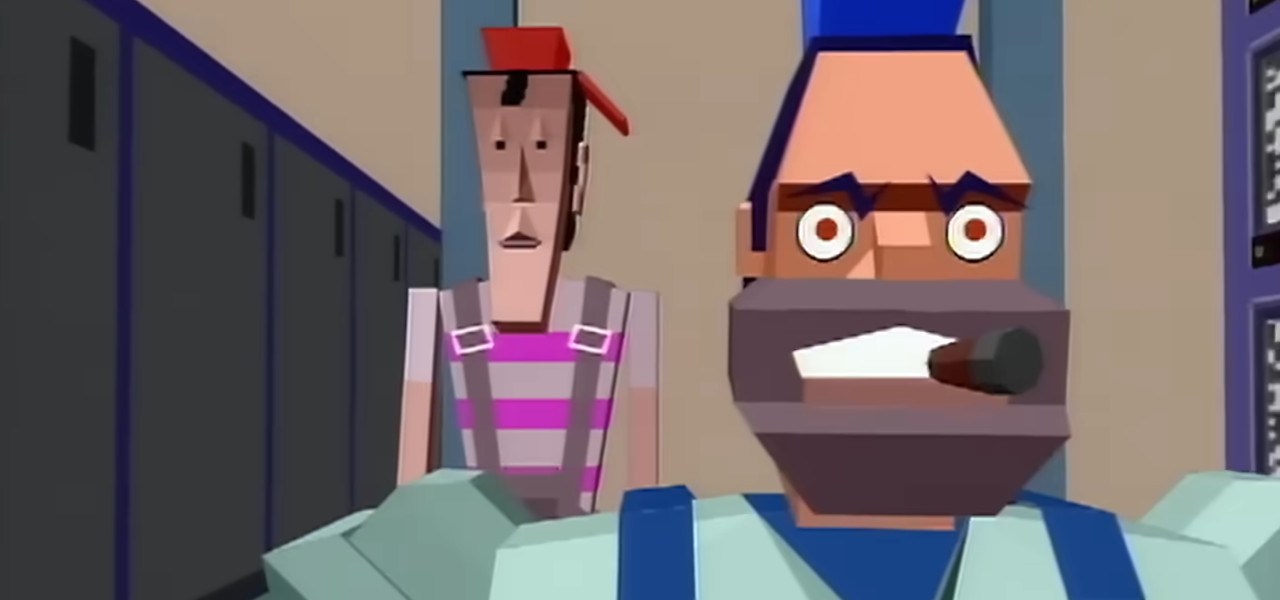
An early attempt to animate human characters on a computer – albeit heavily abstracted, blocky humans – was in the music video for the Dire Straits song “Money for Nothing,” which won Video of the Year at the 1986 MTV Video Music Awards. Ian Pearson and Gavin Blair animated the video using a Bosch FGS-4000 CGI system. Blair said in 2010, “These days, you’d be better off using your cellphone to animate.”
— Cartoon Study (@CartoonStudy) November 21, 2025
For the climax of the Disney animated feature The Great Mouse Detective (1986), the artists used computers to create backgrounds… the same concept that got John Lasseter fired a few years earlier. The computer animation was photocopied onto cels so that it could be traditionally traced and painted, and then hand-drawn characters were added on top. To create the scene, 3D animator Ted Gielow and 2D animator Phil Nibbelink spent months together in a boiling hot room with a giant, overheating computer. Nibbelink recalled, “At one point, we left the computer running overnight because we were in such a production crunch. Some janitor thought he was doing us a favor and closed the door. In the morning, it was like a thousand degrees in this hot box. The computer had completely self-destructed.” Despite these difficulties, animating on a computer allowed for sweeping camera movements across complex mechanical gears, which would require Richard Williams-level madness to animate traditionally.
— Cartoon Study (@CartoonStudy) November 21, 2025
Meanwhile, John Lasseter was busy working on the film that would truly establish computer animation as an exciting new art form: Luxo Jr. (1986). Much in the same way that Gertie the Dinosaur proved moving drawings could express recognizable human traits back in 1914, the lamps in Luxo display genuine feelings and personalities purely through their movements. When the film debuted at SIGGRAPH, the audience rose to applaud before it even finished playing. Artist Craig Good recalled, “As soon as the lamp moved, people started going crazy. And then the ball came in, and they were going nuts. Poor Gary Rydstrom, his wonderful sound work was never heard at that screening because the crowd was just literally screaming their heads off.”
— Cartoon Study (@CartoonStudy) November 21, 2025
Despite the accolades Lasseter’s shorts were receiving, they weren’t making any money. At that time, Pixar was not primarily a film studio; the company’s core business was selling the Pixar Image Computer, and the animated films were meant to demonstrate the product’s capabilities. Ed Catmull had to convince Steve Jobs not to shut down Pixar’s animation division several times. Thankfully, the team was able to push through a film called Tin Toy (1988), which became the first CGI film to win the Academy Award for Best Animated Short and piqued the interest of Disney, who approached Pixar about producing a computer-animated feature. The animation of Tinny the soldier holds up quite well (the terrifying hell-baby less so).
— Cartoon Study (@CartoonStudy) November 21, 2025
During production of Tin Toy, Lasseter went to see Who Framed Roger Rabbit and was enthralled by it. He recalled, “The opening in Roger Rabbit was phenomenal and a throwback to the cartoons that I love: the Chuck Jones and Tex Avery cartoons. I came back (to the studio) and I was looking at what I was working on at the time, Tin Toy. And I kind of got depressed, thinking, ‘Man, our characters are just standing still. Where is that cartoony animation that I’ve always known?” So he created his own tribute to classic cartoon slapstick: Knick Knack (1989), in which a snowman attempts to escape from his snow globe, and it once again went over big at SIGGRAPH (the Guardian declared that it was “probably the closest thing to God that has ever graced the electronic images community”). It’s worth remembering that these early Pixar shorts were aimed at an adult audience of animation aficionados and tech nerds, and so when the film was attached to the release of the kid-friendly feature Finding Nemo fourteen years later, the sunbather’s bust size had to be deemphasized. The official word from Pixar was that she reduced her breast size because she wanted to be taken more seriously as an actress.
— Cartoon Study (@CartoonStudy) November 21, 2025
Pixar wasn’t the only studio making strides in computer animation in the late 1980s. Pacific Data Images, the studio that would later be purchased by Dreamworks and produce films like Shrek and Madagascar, made a short called Locomotion in 1989 that pushed cartoony squash & stretch beyond what had been done before with computers. The film was directed by Steve Goldberg, who later animated the Cave of Wonders in Aladdin and served as effects supervisor on Tangled and Frozen.
— Cartoon Study (@CartoonStudy) November 21, 2025
One of the earliest computer-generated characters created for a TV series was Waldo C. Graphic, who appeared on The Jim Henson Hour in the late ‘80s and early ‘90s. Here’s a look at Jim Henson doing some real-time digital puppeteering, which is still a wild concept.
— Cartoon Study (@CartoonStudy) November 21, 2025
And one of the first fully computer-animated series was Phil Vischer and Mike Nawrocki’s VeggieTales, a Christian series produced for home video by Big Idea Entertainment. The first episode, released in 1993, was animated by three men figuring out the Softimage 3D software as they went along. Vischer was unsatisfied with the way lots of CG characters at the time had soulless, circular eyes, so he designed his vegetable characters with expressive, oval-shaped “Daffy Duck eyes.” The animation in this first video is rudimentary compared to the same studio’s Jonah feature less than a decade later, but rhyming “Babylon” with “a table to play Scrabble on” is still as amusing as ever.
— Cartoon Study (@CartoonStudy) November 21, 2025
You can even see an early form of motion-capture in the 1993 video for the Peter Gabriel song “Steam,” animated by Francesco Chiarini and Umberto Lazzari at Superfluo. The video is like a digital version of Gabriel’s earlier “Sledgehammer,” indulging in any kind of visual weirdness the artists can dream up.
— Cartoon Study (@CartoonStudy) November 21, 2025
The first movie to include a fully computer-generated character was Young Sherlock Holmes (1986), which featured a stained glass window knight created by the artists at Industrial Light & Magic. Films like The Abyss, Terminator 2, and Jurassic Park further pushed the boundaries of what could be achieved through digital effects. Here are some of the most notable uses of CGI effects in the years before Toy Story.
A lot of those early effects still look good, but the idea of making an entirely computer-animated feature was still a crazy hurdle. Just a few years before Toy Story, the French studio Medialab attempted to make a movie called Starwatcher based on the artwork of Mœbius. The project was scuttled when executive producer Alan Guiot passed away, but the crew was able to create a demo film. The characters have that uncanny valley effect common in early 3D films, but it’s interesting to think about what the animation landscape might look like today if a CG-animated cyberpunk action film had been a hit in the early ‘90s.
— Cartoon Study (@CartoonStudy) November 21, 2025
For me personally, computer animation doesn’t tend to age as well as hand-drawn animation, and I say this with the utmost respect for the artists and technicians who broke new ground against unimaginable odds with these early 3D films. Classic shorts like Steamboat Willie (1928) and Minnie the Moocher (1932) look as good today as they did nearly a century ago; just like an old jazz or doo-wop record, the style might evoke a past era, but that doesn’t make it any less enjoyable or effective. With computer animation, on the other hand, technical advancements can make early CG films look, well, outdated.
So why does Toy Story still work? Certainly, the texturing and robotic human characters are primitive when put up against today’s films. Still, the Pixar team was smart to primarily focus on toys, turning the limitations of early CGI – plasticky textures, jerky movements – into assets. Even more importantly, the artists approached Toy Story as a real movie rather than a tech demo, crafting a story full of humor, frustration, and characters you genuinely care about. This approach extends to the way the characters are animated; the old adage is that an animator is an actor with a pencil, or in this case, a mouse, and the acting choices the animators make in the film are well-thought-out and recognizably human, and that makes the performances ring true 30 years later. We’ll finish things off with a behind-the-scenes look at the making of Toy Story.
— Cartoon Study (@CartoonStudy) November 21, 2025
Pictured at top: Dire Strait’s “Money for Nothing”