.png)
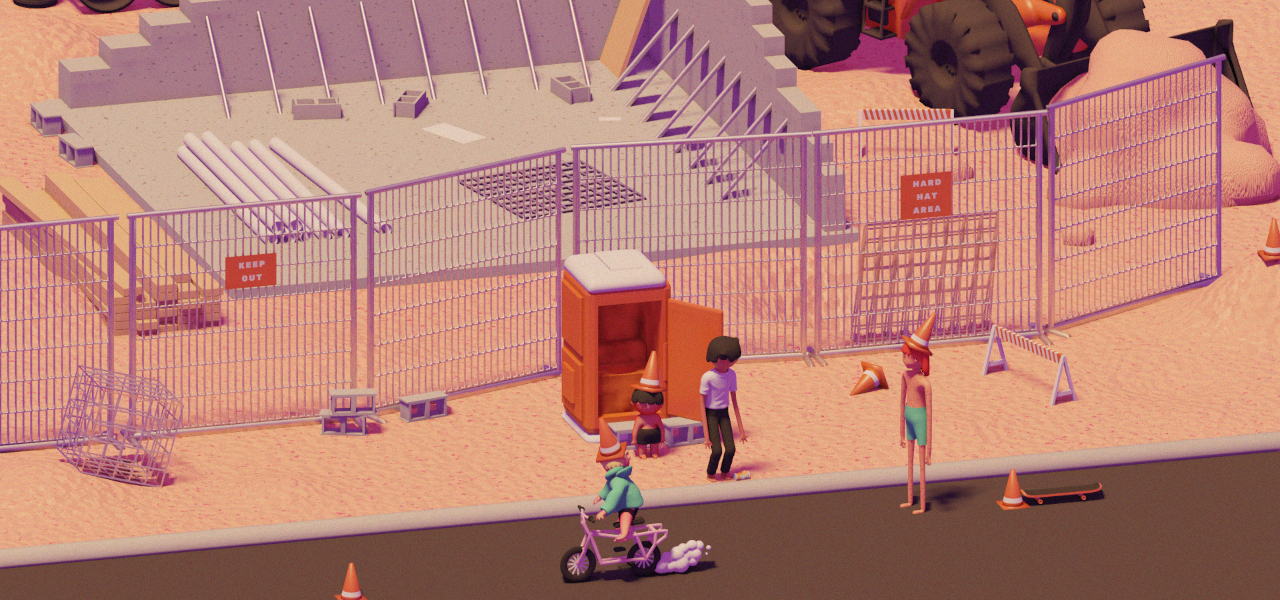

‘What If These Uber Eats Characters Had Internal Lives?’: Julian Glander On ‘Boys Go To Jupiter’
Stay informed with free updates
Sign up to get our news digest — delivered directly to your inbox twice a week.
Anyone acquainted with Julian Glander’s candy-colored graphics, games, and animated shorts will find themselves in familiar territory in Boys Go to Jupiter. The whimsical 90-minute fantasia marks Glander’s feature debut—working with executive producer Peisin Yang Lazo and two supporting animators, Nate Die and Jordan Speer—and opens in New York City on August 8, going wider August 15, from Cartuna and Irony Point.
After the film’s 2024 Tribeca Film Festival debut, Variety pegged it as a “surreal coming-of-age” story, but the narrative lands very far from most contemporary teen dramas. Four boys—Freckles (Grace Kuhlenschmidt), Beatbox (Elsie Fisher), Peanut (J.R. Philips), and brainy, hoverboard-riding high-school dropout Billy 5000 (Jack Corbett)—live in a limbo between Christmas and New Year in a Florida coastal town. They mope about in a droll, sometimes musical fashion and encounter science fiction subplots involving secret genetic experiments in a nearby orange juice factory and a race of bleeping, wormy beings washed up in the surf.
Glander designed his sun-dappled plastic world in Blender and leveraged his graphic talents—combined with aspects of his personal life in Michigan, Tampa, and Lawrenceville, PA—to attract a cast of comedy and music talent, including Sarah Sherman (SNL), Janeane Garofalo (Reality Bites), Chris Fleming (Bigtop Burger), and singer Miya Folick. The film that emerged, with Glander’s synth-pop songs, is a dreamy rumination on the Gen Z zeitgeist and its “ghostly techno-utopian” existence.
Cartoon Brew probed the film’s creation and Billy 5000’s vibes in a conversation with Glander in his home studio, which he shares with two pet ducks, Sleepy and Sneezy.
Cartoon Brew: What’s the inspiration for your visual style?

Julian Glander: That’s something that developed over more than 10 years of using Blender. In some ways, it feels like a series of shortcuts and hacks that compounded into a visual language. When I first got into animation, my touchstone was Rankin/Bass animation in terms of the way I approach movement. Gumby was a big one. And then, working in 3D, there was an early-2000s video game look. It’s funny — as our trailer started playing outside the animation community, a lot of people commented on how the movie resembled corporate startup art that developed in the 2010s. I was a part of that, working with a lot of brands when I started my career. In some ways, this movie is like, “What if these characters from an Uber Eats commercial had internal lives?”
Where did your four protagonists spring from?
I grew up in suburban Florida, outside Tampa, and the movie is centered around the relationship between these four boys. They’re different ages, and they’re neighborhood kids growing up together and growing apart from each other. One thing that was always real in my life that I didn’t see much in movies was this age difference in a group of kids. In Stand by Me, it’s four best friends who are all the same age. I was also inspired by a group of kids who live around the corner from me here in Pittsburgh. Same deal. They’re a roving group of eight. If something in your yard gets ruined or if a sign gets knocked over, you kind of know who did it. But they’re charming kids who have nothing to do all day except throw rocks and climb walls. I have two pet ducks, and this group was in my backyard one day looking at the ducks, and they were so funny. And then, one of them rode away on a Swagway—that’s where the inspiration for Billy’s Swagway came from.
Are you Billy?
No! Billy started out as me trying to process my own adolescence. When Jack Corbett came into the project, I wrote Billy for him. I’d seen his TikTok videos for NPR as Planet Money, where he breaks down economic concepts in a way that’s so funny and thoughtful. That slacker-teen-economist thing came from him. My favorite passage in the movie is when Billy reads a bogus economic theory text from the 1800s. I didn’t have that in the script. I asked Jack, “Do you have something off the top of your head from the early industrial age that’s a convoluted metaphor [for capitalism]?” And he brought up this idea from [economist John Maynard] Keynes: “Man is a fish who will pull himself from the mud because market forces make it so.” We turned that into a passage about a snail and an ant.
How did you land your cast?
My producer and I first tried the traditional way of going through people’s agents. We were getting nowhere. So, I made a 45-second pitch of little shots set to a demo of one of our songs, and I sent it out in Instagram DMs. I’d worked with Elsie [Fisher] before on [Cartoon Network’s] Summer Camp Island. Others were friends of friends, or friends of friends of friends. The proof of concept helped them understand this wasn’t just a script. And it also helped me start work. That kickoff can be daunting.
Your songs are beautiful—how did you create them?
As I was writing the script, I’d leave parts in brackets, “musical moment here.” I’d then write the most literal lyrics, “He’s tired, he needs to sleep.” I refined that, put chords under it in GarageBand. And then we recorded the songs at the same time we recorded the voice actors. The fact that everyone showed up and was able to do it was a miracle. We had Miya Folick for three hours. We asked her if she wanted to do her song first. She was a total pro. She said, “I think I can do the song in 20 minutes. Let’s do the lines first.” She did that, and she got the song on the first take.

You recorded them all separately, in LA and New York?
Yes. And we did some by Zoom. We recorded our last session with Jack the day before the SAG strike was due to start at midnight. We were with him for eight hours — four hours for all his lines, and four for all five of his songs. Philosophically, my approach to voice acting was to tell the actors, “I don’t want you to do a ‘voice’ at all. I want you to be yourself.” That made it a lot easier. It was an approach of naturalism for all the sound. Then, when we came home from LA, we had 40 hours of recordings.
How did you turn 40 hours into 90 minutes?
My producer and I met in college working on a late-night talk show, and I loved the three-camera setup, shooting “in the wide” and then getting closeups. We approached the movie the same way. Our first cut was 75 “postcards”—75 wide-shot scenes — and if a scene could live in a wide, I tried to stay there. I saw a Taiwanese movie [by Edward Yang] called Yi Yi (2000), where each scene plays wide and it’s perfect. I wanted a little bit of that. We recorded the wides, and then, if I felt the camera needed to get in closer, we cut in. There was not a ton of wasted work.
Your characters had a Playmobil feel, the way they glide about like toys. How did you arrive at that style?
That was mostly efficiency-driven. We avoided walk cycles whenever we could, putting characters behind fences or showing them from the waist up. The one that I’m most kind of proud of, efficiency-wise, is Billy’s character riding his little hoverboard. In our first iteration of the movie, he was on a bike. That’s the hardest thing to animate because of all the moving pieces of the bike and the human body. When I put Billy on a hoverboard, that cut probably two months off production. It was also one of those miraculous details that spoke to Billy’s place in the world, and also to his motivation, floating through life in this ghostly, techno-utopian way.


Some of your funniest scenes are held takes, like the “World’s Largest Hot Dog” shack—that’s two minutes, and all you have is a little service door sliding back and forth over the vendor, Weenie (Chris Fleming). It’s hilarious.
That was the first scene I animated. I was so happy with Chris’s performance. He came in like a tornado. He had the script in front of him, but he hardly looked at it while he riffed on what this guy would say. I must give credit to Chris and to our whole cast. I think the reason anyone will go and see this movie is because of them. I was working in service of what they did with the material.


There are some interesting ideas under the humor. What’s driving Billy? And how do these creatures—Glarba and Donut—affect his malaise?
Billy is outgrowing his friends who want to slack off all day. He’s the first one of his group who has this realization that the future is coming at them, and he needs to get himself in better shape. At the start of the movie, we see him watching these “Mr. Moolah” YouTube videos. He’s clearly in a place that I think a lot of young men are in, which is that he believes in hustle culture and the idea that the only way to have any security in life is to get rich quick and to outmaneuver everyone within capitalism. As the movie develops and he meets Tavi Gevinson’s character, Glarba, he meets this cast of characters who each fit within capitalism in their own special way.
Billy’s big choice that he has to make is whether he wants to be economically successful or if he wants to be a compassionate, nurturing, fully developed person. My take, that I have come to believe in the last few years, is that you do have to choose. You cannot be extremely wealthy and also be a good person. Most people don’t choose, or really ever get to choose. That’s where the story takes Billy.

Before we wrap this up, can you clarify: it took 90 days to create this?
The rough animation stage was a minute a day for 90 days. That was the phase of making “postcards.” That was brutal. After that, it was six months’ work.
What are your hopes for the film?
When we started out, the best-case scenario I had for the movie was that it would get finished, we would maybe show at one good festival, and then it would go on YouTube. It’s outpacing my wildest expectations. Cartuna has come in to distribute it [in North America]. As of today [July 14, 2025], we have 28 theaters committed to the limited release and I think we’ll end up with a few more. I hope the same thing that I think any filmmaker hopes: that a lot of people see it. And then, as for the next one, I am writing something, but I’m tight-lipped on that.
How do you feel about Blender as a resource?
This film would not have been possible without Blender. It’s hard to imagine having done this any other way. If I had to make a prediction, I think over the next few years, we’re going to see a lot of these. After Flow won the Academy Award, that emboldened people. I go to film festivals, read Cartoon Brew, and go on Vimeo all the time, and I see the most beautiful short films that have the most personality, and they’re always done with scrappy teams, on no budget. I wondered what it would take to extend that to 90 minutes. I now know it’s possible, and I’m nothing special. I’d like to see a couple more people give it a try.