.png)
Lewis Klahr’s ‘Fable By The Door’ Explores “The Pastness Of The Present”
Stay informed with free updates
Sign up to get our news digest — delivered directly to your inbox twice a week.
For my money, Lewis Klahr is one of the finest collage animators working today. His meticulous choices of imagery, music, materials, and textures create dense, multilayered films that lure you in with inviting colors and sounds before you realize you’re not in Kansas anymore. There is rarely a stable narrative to hold on to. You navigate Klahr’s dream worlds on your own, following one strand until it vanishes beneath something altogether new.
His latest feature-length work, Fable by the Door (2026), brings together ten collage films made between 2022 and 2026. It is Part 1 of Klahr’s larger From 45 to 33 project, although it is actually the second part to be completed. Part 2, The Blue Rose of Forgetfulness (2022), appeared four years earlier. Fable by the Door premiered at Los Angeles Filmforum on September 13, 2026, with Klahr in attendance.
The title offers a clue to how the feature should be approached. The numbers refer to the playback speeds of analog records: the 45 rpm single and 33 rpm long-playing record.
“This title I thought up way back in 1983,” says Klahr, “and I was going to use it as part of the title of my Super 8 collage film series Picture Books for Adults (1983–85), until I changed my mind.”
More than four decades later, the title finally found a home. The fact that Part 2 arrived first is less complicated than it sounds.
“When I created Part 2, The Blue Rose of Forgetfulness, I didn’t know I was making a series!” Klahr says. “Only after I’d screened The Blue Rose publicly did it occur to me that it was a section of a much longer series.”
Klahr describes the project as a “media autobiography,” although he is quick to distinguish that from memoir.
“It sounds like a memoir, doesn’t it? But it’s not personally descriptive in that sense. It is instead a personalized repurposing of my diverse and voluminous source materials into a cinematic collage that explores ‘the pastness of the present.’ Just like the first completed section, The Blue Rose of Forgetfulness, this new series is a cinema of shifting moods and engagements that offers a tactile exploration of elliptical narrative and poetic montage. Like a waking dream, what can be clearly described in words is less significant than what can be felt.”
The record reference extends beyond the title. Klahr’s features are structured more like albums than conventional narrative films: collections of individual pieces connected through recurring images, rhythms and moods.
“Storytelling is only one type of audience engagement I’m interested in pursuing in my collage features,” he says. “The structure of a long-playing record is much more adaptable to my goal of continually shifting audience engagement.”
That makes sequencing essential.
“It’s a very challenging and time-consuming process,” Klahr says. “For me, it’s the final stage of editing: to sequence these individual films into an order that is larger than the sum of its parts.”
Finding that order for Fable by the Door took nearly two years.
“It happened through much trial and error, and through living with different orders that I would view over and over again. I thought I had the final sequence at least twice before continuing to revise and resequence, eventually arriving at Fable by the Door’s present—and hopefully final—form.”
Several films were left out, including two substantial works, one approximately 18 minutes long and the other 20. “These, I realized, belong in another section of From 45 to 33,” Klahr says.
The placement of the remaining films was not always obvious.
“I had ideas about how certain films should go together which, when viewed, weren’t effective. I found that there were more submerged and less obvious reasons as to how and why the films went together. This past summer, I had time to try out many orders and then create three new short films that filled in transitions between the films I already knew I wanted to include.”
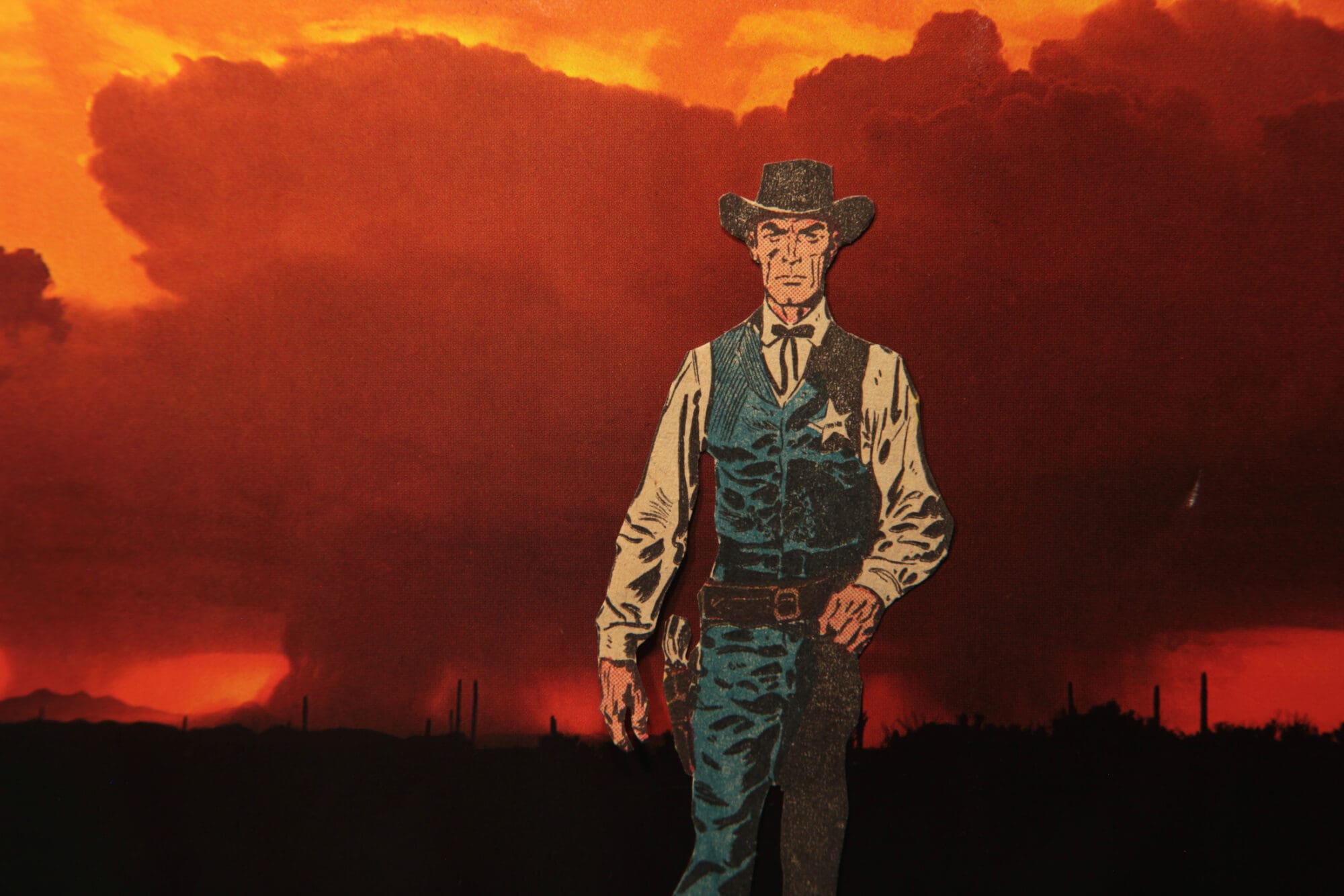
The finished—or “hopefully final”—sequence begins with Three Friends of the Cold Season. Set to three songs by Dick Connette and Last Forever, it follows three isolated men living in distinct historical periods.
The first is a sailor inspired by the legend of Alexander Selkirk. Stranded on an island, he must accept that he will remain there for the rest of his life. An outlaw named Lazarus then senses that his time is running out and decides that death is preferable to imprisonment. Finally, a man who abandoned his former life in his youth dreams of returning to a home preserved exactly as he remembers it, untouched by age. That return, of course, is impossible.
The stories never intersect, but they arrive at much the same place. Adventure has curdled into entrapment, freedom into exile, and youthful choices into irreversible consequences. Whatever paths carried these men to their separate destinations, each must ultimately face his ending alone.
I felt that these drifting figures suggested a kind of masculinity in crisis. They are forever in motion—traveling by boat, train, plane, automobile or on foot—yet it is rarely clear whether they are trying to reach something or get away.
“Yes, especially in Three Friends of the Cold Season, we see men in crisis in three different and distinct historical eras,” Klahr says. “Throughout the subsequent films in the feature-length sequence, there’s also a lot of travel imagery—boats, trains, planes and cars. And wherever they travel, there’s the duality you describe: both seeking and escaping.”
That motion continues through the brief, silent March 20, 1960 and Rain Once Fallen Rises to Heaven Again, with its sepia-toned images of trees and graves. They pass like fragments of memory before Railroad Bill returns us more explicitly to trains, wandering, and the question of where, exactly, everyone is trying to go.
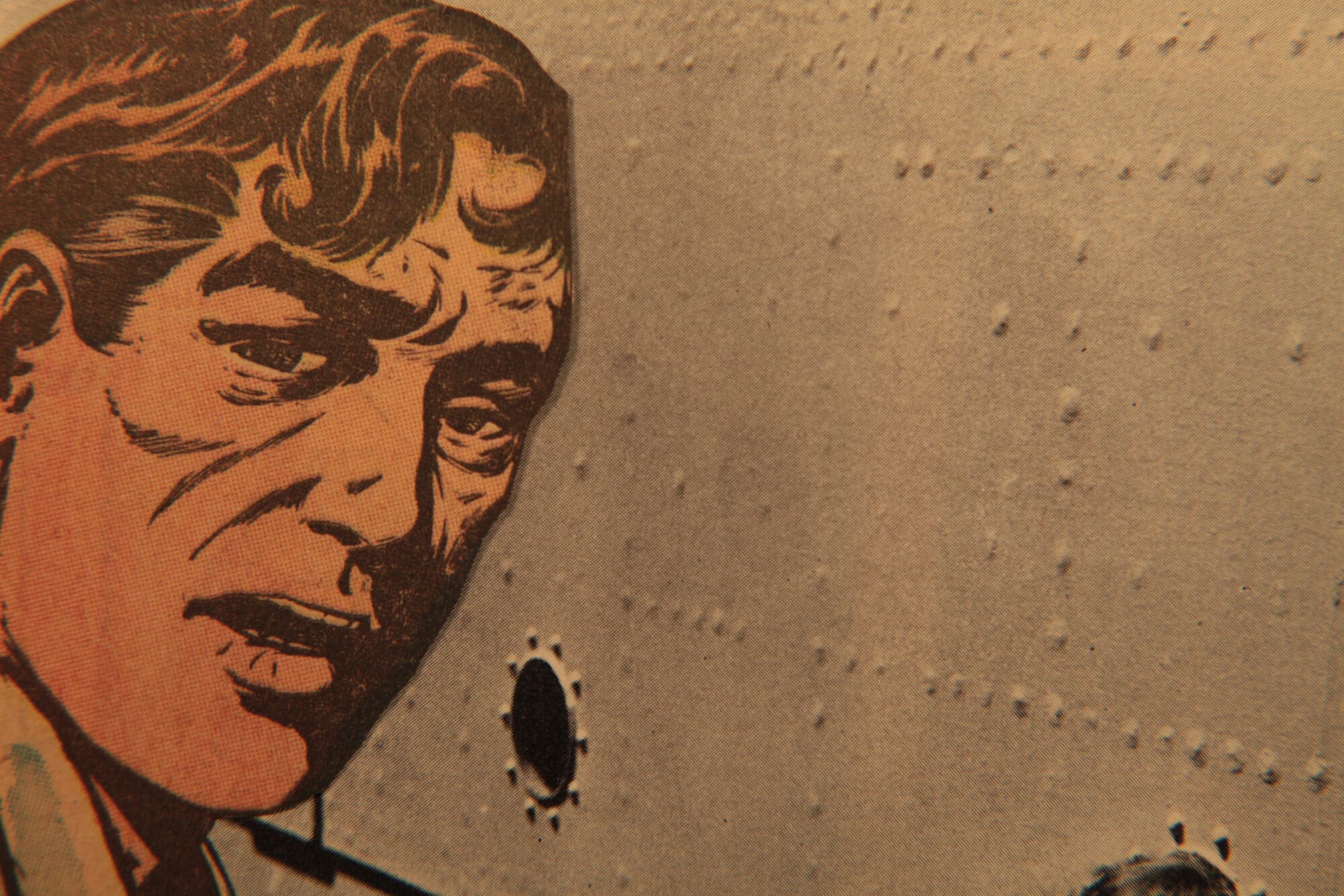
A man bearing some resemblance to Clark Kent wanders across a barren landscape toward an unknown destination. Mystifying yet hypnotic, Klahr’s films do not suddenly become straightforward simply because he is working with a song. Dick Connette’s cryptic lyrics summon card games, guns, railway travel and revenge. Klahr responds with comic-book fragments, playing cards, textiles and assorted objects that operate like a private set of hieroglyphics.
“Railroad Bill was actually created as a music video for Dick’s most recent LP, Too Sad for the Public, Vol. 2: Yet and Still, on StorySound Records,” Klahr says. “I’m always interested in letting the lyrics guide me. I know a lot of people don’t listen to, or care about, song lyrics, but I always have. I’m deeply interested in the type of story compression song lyrics convey, which has inspired my own explorations of story compression in my films.”
Connette’s music also shaped Three Friends of the Cold Season.
“Dick’s three songs are the soundtrack to Three Friends, and sequencing them chronologically inspired me to create that film,” Klahr says. “Dick’s music is a type of collaging that brings classic folk songs into the present. I think his process has direct connection points to the way I work with my source materials.”
In Railroad Bill, kings, crowns, and railway cars—symbols of power and movement—recur within a world that seems to be going nowhere. You can’t quite piece together what the hell is happening, but the emptiness and longing are unmistakable.
The urge to travel surfaces in more compressed forms in the films that follow. Four Wheel Gods presents an assortment of vintage automobiles against flashing colored backgrounds. These are sexy images: cars as life, desire, possibility, and escape. In Dilated Moment, still images of an airplane suggest another attempt to escape—or perhaps to find some kind of connection. Los Angeles, seen from above, “sparkles like cheap jewelry.” The images hint at someone arriving, but no one appears to be waiting for him.
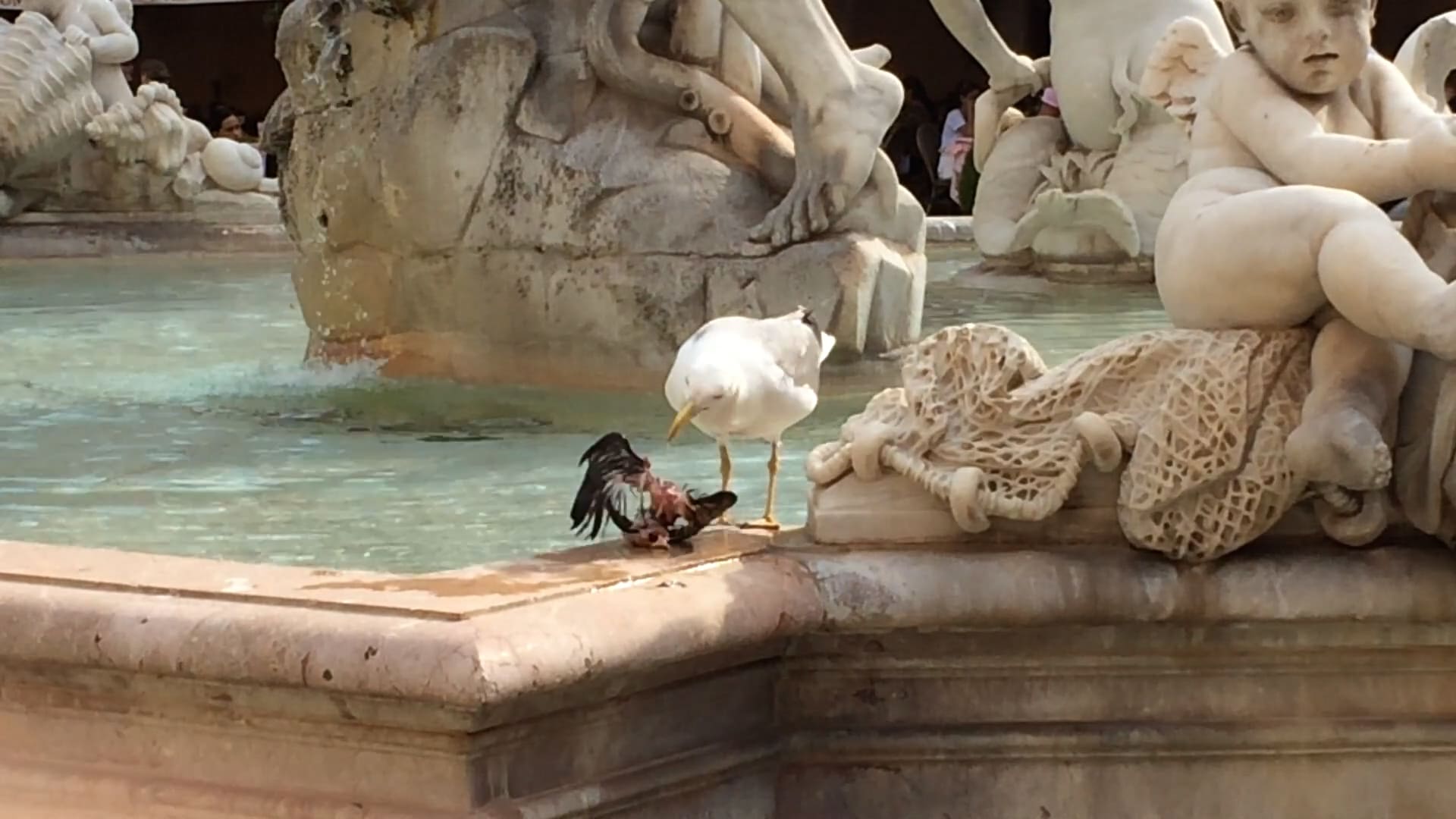
Then comes Repast, and the texture abruptly changes. Instead of cutout animation, Klahr gives us a live-action document of a seagull devouring a dead bird beside a fountain while tourists circulate nearby. The scene is mundane and brutal at the same time. Its sudden appearance is startling precisely because of everything that has preceded it.
“Repast was shot in Rome,” Klahr says. “Obviously, it is surprising when it comes up in Fable by the Door’s sequence because it’s not cutout animation like everything else that has preceded it. It’s a good example of the power of sequencing and the expectations that it can create.”
From this brief spectacle of appetite and death, the sequence turns to Interstitial Romance (Warm Novelette), which compresses its emotional drama onto the two sides of a comic-book page. Its fragments suggest serious conversations, embraces and kisses—but are these romantic gestures or farewells? It remains unclear by design.
Klahr’s characters shift without warning from tenderness to rejection. Love is blind. Love hurts. Love is a battlefield. Even our most shopworn clichés cannot decide whether romance saves or destroys us. Klahr suspends his lovers inside that contradiction, somewhere between intimacy and departure.
He then removes the visible image almost entirely. At the beginning of Orpheus, the audience is instructed to close their eyes when the music begins and open them only when it ends—which is also the end of the film. This must surely be a first in animation, I thought. Klahr is less concerned with that question.
“Orpheus is a flicker film—and flicker films still create imagery in your closed eyes,” he says. “As to whether this is the first closed-eye flicker film ever made, I have no idea. And its being a first is not nearly as important to me as whether its experiential storytelling is successful.”
The instruction places the audience inside the myth rather than merely asking us to watch it.
“By having the audience close their eyes, I am asking them to step into Orpheus’s shoes during that crucial moment of his myth where he is trying to bring his great love Eurydice back to life while traveling from the underworld. Orpheus is instructed to keep his eyes closed and not look at Eurydice, because if he does, he will lose her for the rest of his lifetime.”
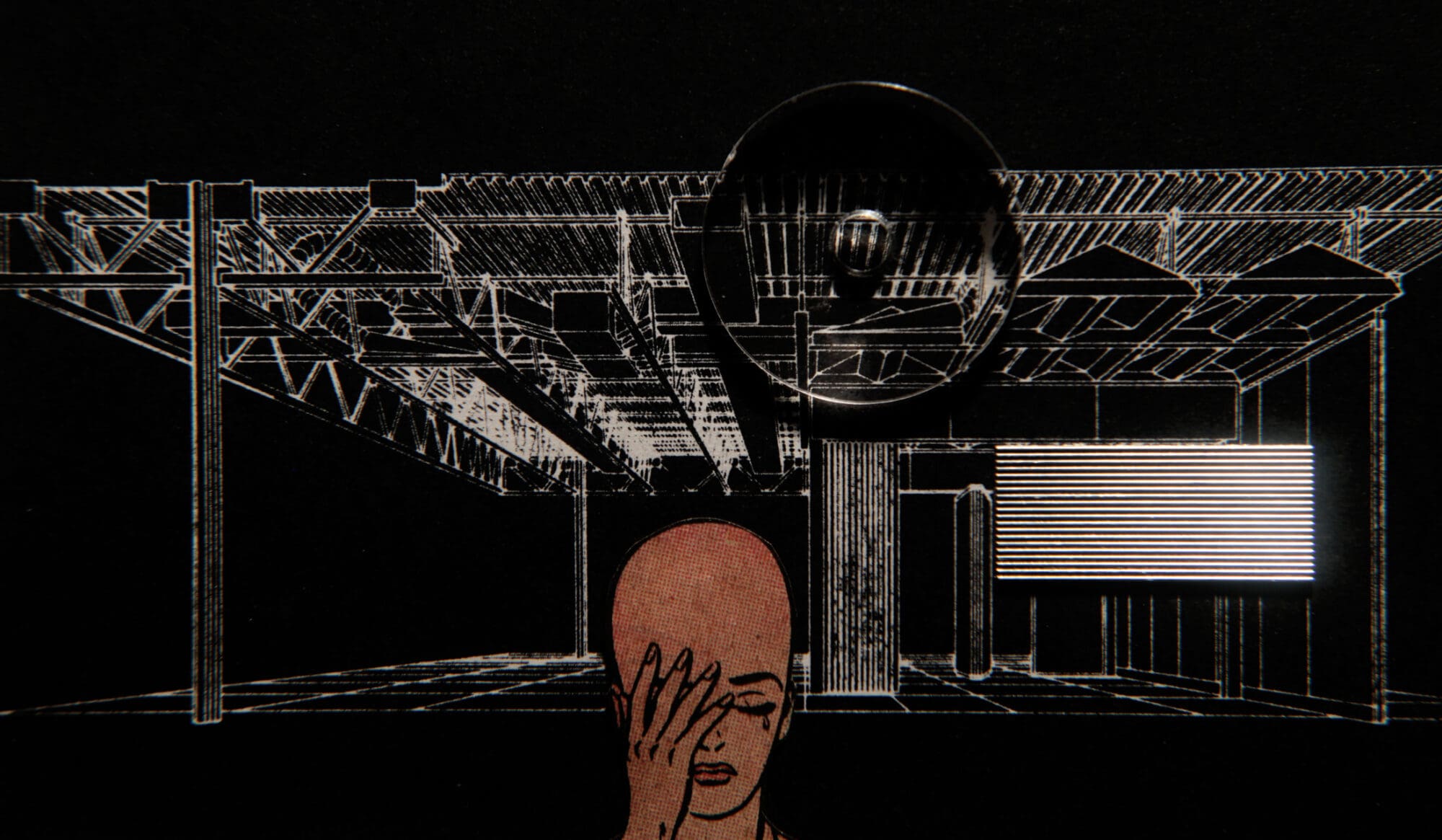
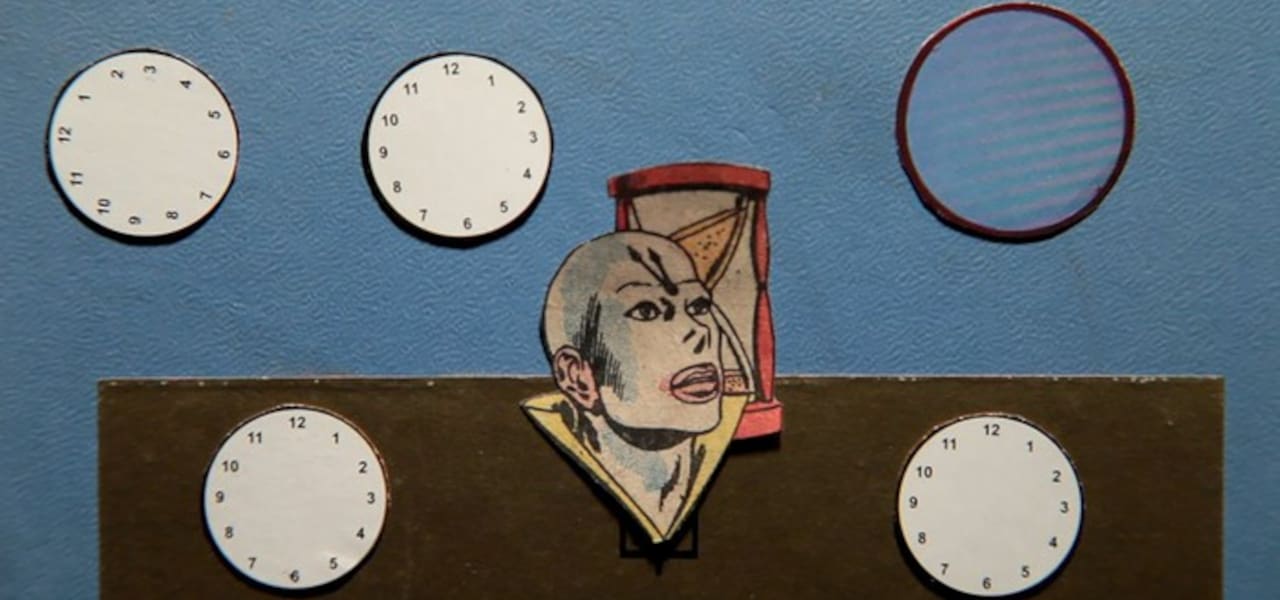
When the audience opens its eyes again, Five Days Till Tomorrow begins. After all the boats, trains, planes, and automobiles, the world now seems almost immobilized. Set to Michael Pisaro-Liu’s sparse, unsettling music, its title evokes the countdowns and planetary threats of classic Hollywood science fiction. Handless clocks suggest both that time is running out and that it may already have stopped.
Skeletal figures and suffering characters populate a barren landscape. People clutch their foreheads as if afflicted by an environmental menace or invisible illness. A bald woman appears alongside an empty bottle that might once have contained a virus. Has some catastrophe already occurred, or is it still approaching?
The superhero Hourman lies helplessly on a sofa. He is an especially appropriate figure for Klahr. The scientist-turned-superhero invented Miraclo, a substance that granted him extraordinary powers—but only for one hour. Even invincibility comes with an expiration date.
I read Five Days Till Tomorrow as the feature’s bleakest film, permeated by illness, isolation, and impending doom. The pandemic seemed like an obvious reference, but its origins are more complicated.
“I began to create Five Days in 2015, long before the pandemic, obviously,” Klahr says. “But I completed the film after the pandemic had happened and then came to understand Five Days as descriptive of the pandemic.”
He does not, however, regard that as the film’s only possible meaning.
“In terms of interpretation, I do believe Five Days is multivalent and open to accommodating many other interpretations as well. Nor do I think that what you experienced as the film’s bleakness is the only or predominant way it can be emotionally experienced.”
Fair enough. Still, my own experience of the film is difficult to shake. Humans and superheroes appear equally vulnerable. A distorted, partly animal face suggests further stages of transformation as communication breaks down and an ending draws closer. There are no saviors here—perhaps there never were.
Seen as a long-playing record, the abrupt shifts within Fable by the Door are not diversions from the main work; they are the work. Klahr moves from historical tales of male crisis through travel, desire, memory, predation, romance, myth, and illness. The individual films retain their identities, but their meanings change according to what surrounds them.
Fable by the Door does not tell us who Klahr is. Instead, it shows us the cultural debris through which a life has been imagined. You keep reaching for a story, only for it to recede and be replaced by another image, texture or half-remembered sensation. The narratives vanish, but the feeling stays.
Pictured at top: Five Days Til Tomorrow