.png)
Toei Animation Eyes Its Next Big Franchise With Japan-U.S. Film ‘Monkey Quest’ – Annecy WIP
Stay informed with free updates
Sign up to get our news digest — delivered directly to your inbox twice a week.
Toei Animation is one of the biggest, oldest, and most celebrated anime studios of all time, responsible for such seminal works as Dragon Ball, Saint Seiya, Sailor Moon, and One Piece. Now, the studio is looking to expand its list of major franchises by looking beyond Japan. The answer? Monkey Quest, a new sci-fi take on Journey to the West, held a Work in Progress session at the 2026 Annecy Festival.
Producer Yoshi Ikezawa presented the project, saying the goal was to “create something similar in scale” to shows like Knights of the Zodiac and Mazinger Z, both hugely popular in France. Aiming for something with international appeal that could achieve the level of mainstream awareness enjoyed by major U.S. animated films, Ikezawa and his team approached Naoto Oshima, the character designer of the iconic video game character Sonic the Hedgehog.
Oshima came back with an idea inspired by Journey to the West, the Chinese epic that has inspired countless retellings, reimaginings, adaptations, and one Dragon Ball. “He didn’t want to just repeat the story, but to bring something new,” Ikezawa said of Oshima’s concept, explaining that he quickly came up with character sketches and designs for a new adventure inspired by the classic characters of Journey to the West, but with a sci-fi twist.
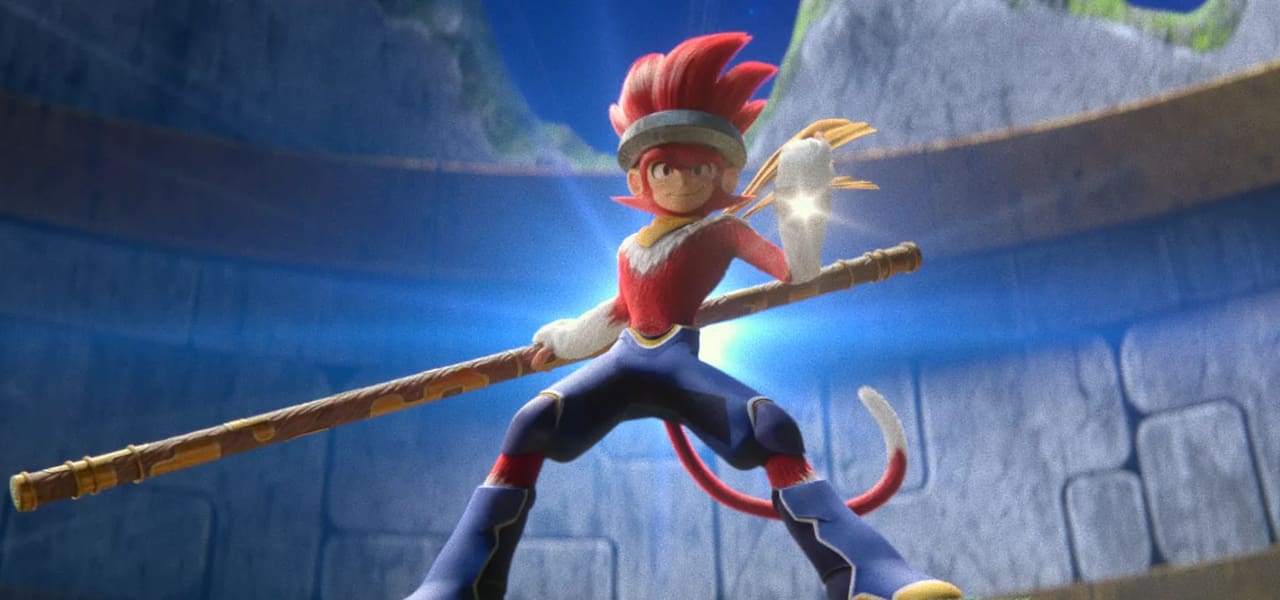
The film, currently in post-production and aiming for a 2027 release with distribution from Charades, focuses on 12-year-old Elle and her one-year-old brother Adam as they meet Okon (voiced by Adam Devine), a legendary guardian of Earth and a powerful monkey who has been imprisoned for eons. Together, the trio must fight all sorts of aliens and sci-fi creatures while on the run from the villainous Vex (J.K. Simmons, continuing his quest to voice every villain in animation).
Instead of gods and demons like in the original story, this movie focuses on aliens and extradimensional beings. “I’ve read multiple translations of the novel and was struck by not just the adventure, but by the humor, satire, and emotional depth that’s made the story so beloved for centuries,” said director and screenwriter David N. Weiss.
The film is a co-production between Japan and the U.S., with an international crew of animators. We wrote earlier this year about Toei Animation wanting to challenge the idea of anime as an exclusively Japanese product. According to Ikezawa, the film could only be made through collaboration between the two countries.
“The Japanese side brought the history, craft, and discipline of anime,” the producer said. “The U.S. side brought a strong sense of story structure, character emotion, and global family entertainment. And the international artists brought their own passion and point of view.”
Perhaps the most interesting aspect of Monkey Quest from a design standpoint was the decision to blend 2D and 3D animation, not out of a desire to appear more textured or resemble a comic book. Instead, the team originally planned to make the entire film in CG, but started to run out of time and money, leading them to turn to 2D as a cost-saving measure.
Footage shown at Annecy featured layers of hand-drawn 2D animation overlaid on 3D CG animation. But it wasn’t enough to simply combine the two techniques. There also had to be a story reason. Since Okon is from another dimension, the team decided to reserve 2D for the ethereal world he comes from, whether in objects or characters. The result looks quite interesting and gives the film a distinctive visual identity.
Still, there were complications. According to Weiss, the production pipelines for 2D and 3D projects are fundamentally different, so it took the team considerable time and effort to find a way to blend the two. It didn’t help that, in keeping with the international nature of the production, the team reached out to a wide range of animators for help, including Sunghoo Park, the renowned director of the first season of Jujutsu Kaisen and The God of High School.
Park came in to help with the action sequences, even drawing storyboards on napkins, which co-director Stephanie Ma Stine (Kung Fu Panda 4) said created its own unexpected complications. “The problem was that his storyboards didn’t always work in 3D, so we had to work to translate them.” Still, Stine praised those sequences as some of the best parts of the film.
It remains to be seen whether Monkey Quest can reach the level of success enjoyed by Toei’s biggest franchises, but it is clear that the film is a celebration of different animation methods, bringing together styles, ideas, and cultures around one of the oldest and most enduring adventure stories ever told.