.png)

Five Indie Animated Features, Five Very Different Paths: Welcome To Cartoon Brew’s Awards Season Rogue Roundtable
Stay informed with free updates
Sign up to get our news digest — delivered directly to your inbox twice a week.
Awards-season roundtables tend to follow a familiar script: studio-backed films, rehearsed talking points, and careers recaps that move along well-lit, well-funded paths. Our Oscars chat did not.
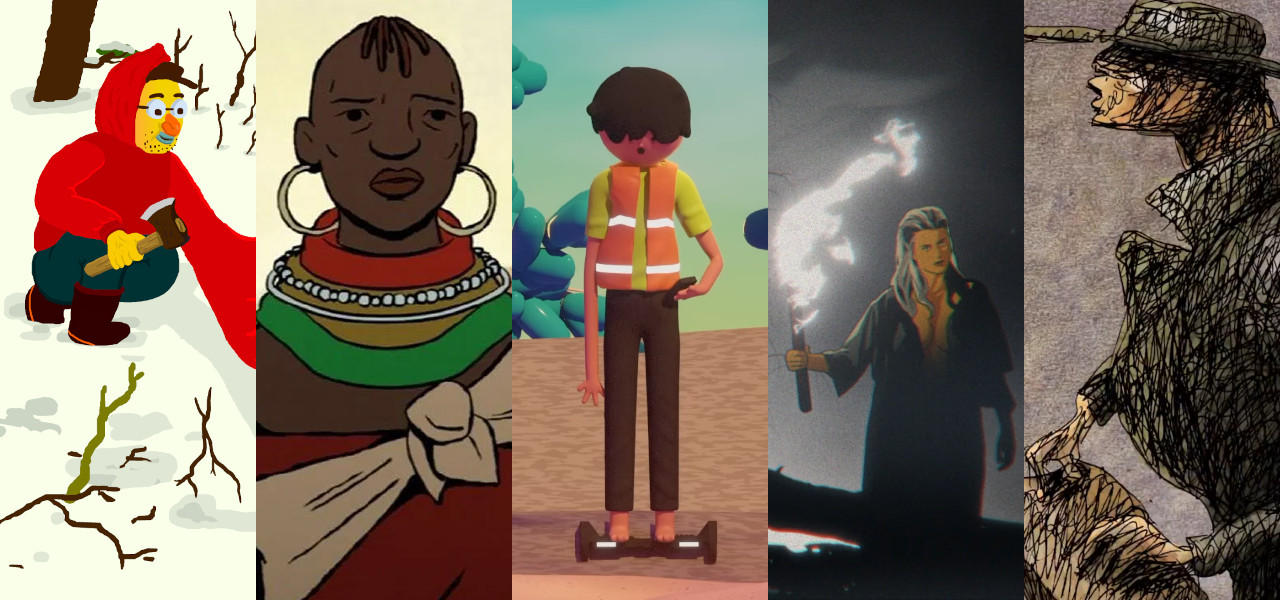
Instead, we gathered five filmmakers whose animated features were made independently, on shoestring budgets, and with no established pipelines to guide them. Their films span documentary, rotoscoped historical drama, DIY CG musical, autobiographical family portrait, and hand-drawn Western fantasia — and in some cases took more than a decade to complete.
This is Cartoon Brew’s Rogue Roundtable.
The directors behind Endless Cookie (Seth and Peter Scriver), Boys Go to Jupiter (Julian Glander), Dog of God (Lauris and Raitis Ābele), Black Butterflies (David Baute), and Slide (Bill Plympton), joined Cartoon Brew for a candid, wide-ranging conversation about how these films were developed and produced, how they found their unique looks, and what the directors learned along the way.
The roundtable brings together filmmakers working in radically different styles – hand-drawn, CG, rotoscoped, documentary – and at vastly different stages in their animation careers. In the end, the filmmakers behind all five films share a common reality: they each made their films without studio infrastructure, without guaranteed marketing, and with no promise of wide distribution.
For David Baute, director of Black Butterflies, the journey began in 2013, and in live action. “I consider myself a documentary filmmaker,” Baute said. “I’ve always worked in social, political, and environmental documentary.” Living in Spain’s Canary Islands, Baute has long been immersed in the realities of migration and climate displacement. “My grandparents emigrated to Cuba. My parents emigrated to Venezuela. Migration has always been part of my life.”
Baute and his team filmed climate migrants across the Caribbean, northern Kenya, and India, but eventually reached a point where parts of the story could no longer be captured with a camera. “There were experiences — exploitation, homelessness, violence — that we could not ethically or practically film,” he said. “But they were essential to understanding what happens after migration.”
Animation became a way forward. “I still believe Black Butterflies is a documentary,” Baute explained. “It simply uses animation as a tool to tell the truth.” Every visual and sound detail in the film is rooted in real documentation. “When the women sing at night in the film, that is their real singing. We recorded it during production.”
That blurring of documentary and animation resonates strongly in Endless Cookie, an autobiographical animated documentary directed by Canadian brothers Seth Scriver and Pete Scriver. The film took nearly a decade to complete, following Pete’s family in real time as their lives, and the film itself, expanded. “One advantage of animation is that you can exaggerate and make fun of things,” Seth said. “You can draw your family in funny ways and still be honest.”
But the long timeline came with its own challenges. “We started animating when the kids were really young,” Seth added. “And then suddenly they’re older, their voices are changing, and you’re like, ‘This is insane.’” Still, animation allowed the film to evolve naturally. “The story kept interrupting itself,” he said. “And eventually we realized that was the movie.”
For Julian Glander, director of Boys Go to Jupiter, the leap from shorts to feature was less a strategic move than an act of curiosity. “I genuinely didn’t think it would play theaters,” Glander said. “My goal was just to finish it. Maybe screen it at one festival and put it online.”
Instead, the film went on to screen at more than 50 festivals and in cinemas across the country, driven by its distinctive CG style, DIY score, and deeply personal tone. “I came from illustration and DIY music,” Glander said. “So the question was, what if a feature film could be like a novel — where one person’s fingerprints are on everything?”
That philosophy extended to the film’s music, animation, and design. “I wanted to do it myself because I wanted to,” he said plainly, calling himself selfish. “We brought that ‘figure it out yourself’ mentality from being broke musicians. If no one’s doing sound, you do sound.”
Latvian brothers Lauris and Raitis Ābele brought a different perspective with Dog of God, a rotoscoped historical horror-drama rooted in real events from near their own hometown. Initially conceived as live action, the film pivoted when animation opened new possibilities. “With live action, you are limited by what exists,” Lauris said. “With animation, you can go anywhere — a medieval castle, hell itself — it’s all possible.”
Rotoscoping, however, came with its own hard lessons. “We only truly learned how to make a rotoscope film after we finished it,” Raitis laughed. “Only then did we understand what movements work, what breaks, and where you need to limit yourself.” The result is a film that balances realism with R-rated abstraction, never straying too far from its physical roots.
Rounding out the group is animation legend and two-time Oscar nominee Bill Plympton, whose hand-drawn Western-inspired feature Slide continues his decades-long commitment to independent animation. “I just love drawing,” Plympton said. “Especially bad guys. They’re so much fun to draw.” In fact, he estimates there are “about 200 bad guys” in the film.
Despite his long resume, Plympton emphasized that his motivation hasn’t changed, and it’s never been money. “I barely get by,” he admitted. “But it’s magical to see your drawings move on a big screen with music and voices. That pleasure is what keeps me going.”
Together, these five filmmakers represent a side of animation that never gets the attention it deserves.
Our full Rogue Roundtable expands far beyond what we could have covered in a single article — conversations about craft, failure, sound design, funding gaps, and creative freedom — and we’re thrilled to share it. We hope you enjoy watching it as much as we enjoyed making it.