.png)
‘Everybody Identifies With One Of The Characters’: The ‘Snoopy Unleashed’ Team On Why Peanuts Endures
Stay informed with free updates
Sign up to get our news digest — delivered directly to your inbox twice a week.
The Peanuts Movie, released in 2015, came into the world just before animation audiences began to crave stylized CG animation. Now, in an environment shaped by more experimental forms of 3D, Steve Martino returns to the Peanuts universe to bring us Apple TV’s Snoopy Unleashed, a film that looks to build on the identity of the Blue Sky Studios title.
During this year’s Annecy festival, Martino was joined by producer Bonnie Arnold, executive producer Paige Braddock, head of animation Scott Carroll, and production designer Tom Cardone to present a Work in Progress on Snoopy and Charlie Brown’s latest adventure.
Martino started the presentation with an explanation of how he got back into the Peanuts groove:
Five years ago, I got a call from Craig Schultz, Charles Schulz’s son, and he pitched me a couple of ideas. I wasn’t looking to direct another Peanuts movie, but when I heard this simple logline, Snoopy and Charlie Brown in the big city, I got excited because this idea felt like a feature story. It was way bigger than the last movie with great scope, adventure, heartfelt emotion, which I personally love in Peanuts, and plenty of opportunity for humor.
With credits like How to Train Your Dragon and Disney’s Tarzan under her belt, Arnold was the perfect person to steer the project, which is being produced by WildBrain Studios.
“WildBrain produces a lot of terrific children’s programs, but had never produced a CG feature,” Arnold explained. “The situation reminded me of my early days working at Pixar on the first Toy Story. Many of the challenges were similar.”
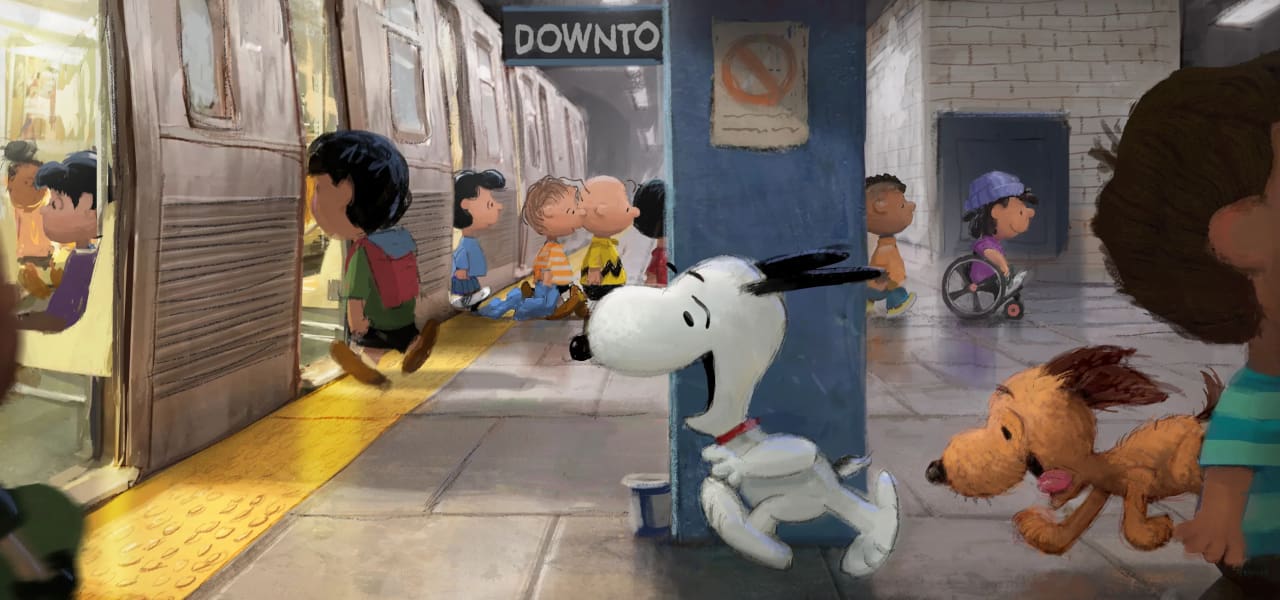
Snoopy Unleashed revolves around two new characters: Mia, one of Charlie Brown’s pen pals who visits, and The Stray, an overenthusiastic dog who gets Snoopy into trouble.
When crafting Mia, the only pen pal of Charlie Brown’s whom audiences actually get to see, the team decided to make her a foil to Charlie Brown.
“We wanted this new pen pal to be a contrast to Charlie Brown, someone with a different perspective,” stated Martino. “Charlie Brown is a boy, so we decided his pen pal would be a girl. He has a dog; she has never had a pet. He lives in the suburbs, she lives in London. We also wanted Mia to move differently through the world than Charlie Brown, so Mia is a wheelchair user.”
Arnold added, “Our first step with Mia was to contact an organization called Disability Belongs. They worked with us over months, advising us on how to best represent characters like Mia on screen.”
“As a wheelchair user, it was important to get Mia’s physicality right,” explained Carroll. “This started with a lot of research and observation. We decided to keep Mia’s body on twos but the wheelchair on ones. This helped keep smoother coasting mechanics on the wheelchair while preserving the Peanuts style in Mia’s movement.”
After Mia’s design was locked in, attention turned to The Stray. For Braddock, the first step was to look into the history of Schulz’s work.
“Unless you have read a lot of the Peanuts strip library, you may not know that Schulz drew a lot of dogs. They were all Snoopy’s brothers and sisters, and they all share his basic anatomy.”
Cardone later found that The Stray needed to move further away from Snoopy’s design.
“Snoopy has a lot of human characteristics. The Stray needed to be more dog-like to counter this. He’s smaller overall with a larger head-to-body proportion, which makes him cuter and more stylized. His fur is shaggier and more unkempt.”
Developing the scope of a big city was another challenge laid at Cardone’s feet, and he found some tricks to help viewers believe that the world beyond the characters was alive.
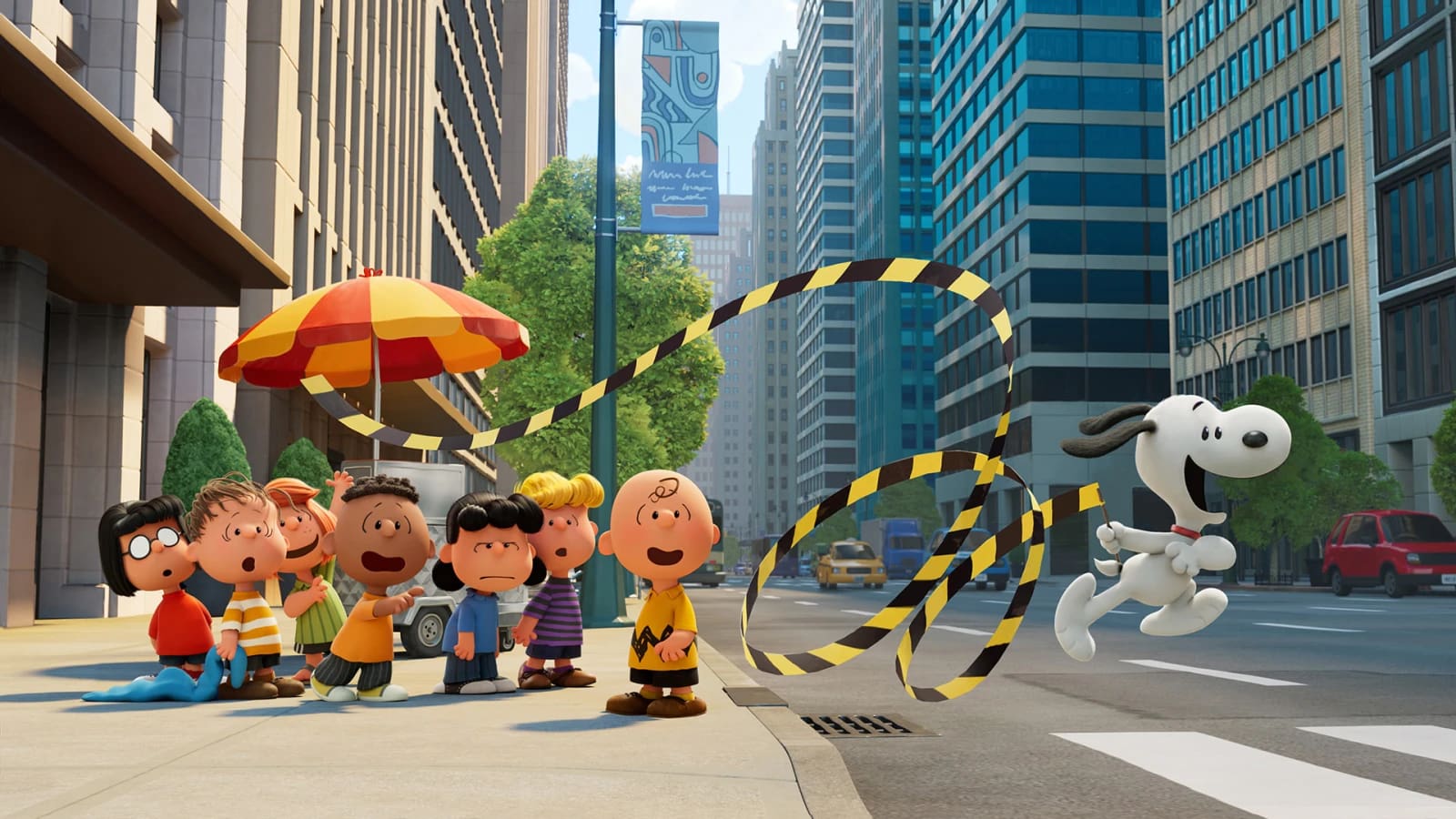
“We went with a very limited palette of classic buildings you’d expect to see in a major city, and we purposefully limited the number of unique designs, always trying to find the right balance of scope with Peanuts charm. We had only a handful of skyscrapers and walk-up buildings to populate the city. We created the illusion of a larger palette of buildings by varying materials and adding accessories like fire escapes. We use a lot of dramatic light and shadow to control the details and suggest more going on beyond the edges of the frame.”
Because of the work done on the previous film to determine which poses the Peanuts characters could hold without their models breaking apart, the pipeline was somewhat simpler this time around.
Talking to Cartoon Brew after the panel, Martino noted:
We didn’t need to take a year and a half to figure out how to animate in this style, but there were a lot of things that Tom Cardone brought, things like grass, trees, and environments, to bring some of the technology and thinking that DNEG had at their disposal to go a little more painterly. Utilizing light, shadow, shape, and texture work was all part of the new pipeline.
The crew started the panel by asking the audience to shout out their favorite character from the Peanuts roster. Speaking with us afterward, Arnold said that this was the key to the Peanuts’ staying power.
“Everybody identifies with one of the characters. It doesn’t matter what age you are or the language you speak, there’s something about the dynamic of these characters that people relate to. When we do audience tests, it’s not just kids that relate. These strips depict the tribulations of daily life.”