.png)
‘Documentary Can Be More’: Director William David Caballero On Sundance Player ‘TheyDream’ (EXCLUSIVE CLIP)
Stay informed with free updates
Sign up to get our news digest — delivered directly to your inbox twice a week.
Director William David Caballero has spent the past twenty years of his life and career documenting his Puerto Rican family — their lives, their struggles, their connection, and kindred qualities — through hybrid documentary works that fuse live-action footage, 2D and 3D animation, and physical miniature models.
The first of these projects to hit the festival circuit, the short Victor & Isolina, documented his grandparents’ separation through recorded duologue and screened at the 2017 Sundance Film Festival. Caballero returned to Sundance in 2022 with the follow-up short Chilly and Milly, which explored the impact of his father’s kidney failure on his parents.
This year, Caballero brings his feature debut, TheyDream, to Sundance. Produced by Colibri Creative Media, the film will world premiere on Friday, January 23. Working in collaboration with his mother, the filmmaker recreates, reconstructs, and rotoscopes key experiences and moments of family members who are no longer with them. A testament spoken in the language that comes most naturally to its artist, the film is a poignant portrait of remembering, healing, self-discovery, and self-acceptance.
The director also gave us access to an exclusive clip from the film, seen below:
Ahead of the film’s premiere, Cartoon Brew sat down with Caballero to discuss the many techniques, tools, and memories at play in his intrinsically singular film.
Cartoon Brew: What’s it like to share something so deeply personal in the form of this artistic document, which will be seen by thousands of people? Why is it your personal impulse to share your personal histories with people far beyond your own family, and what does that artistic act mean to you?
William David Caballero: It’s difficult growing up as a Puerto Rican in the United States, especially when I did, in the ’80s and ’90s. Puerto Rico is an island that’s been dominated and, in many ways, disrespected by the United States. And beyond that, I grew up in the South. That was really a culture shock for my family, who grew up in New York City. We were somewhat poor. My parents were disabled, and I lived in a trailer in my grandmother’s backyard. So by American societal standards, it kind of seemed like our stories weren’t meant to be important or relevant, and that we were deemed to be living in the shadows. When I turned on the TV, I never saw authentic representations of people who looked like me. I remember feeling there was something very wrong about that. As time went on, I decided I could be someone who creates work in opposition to that.
It all started with me making a short film, and then a short series, about my grandfather, featuring 3D-printed miniatures of him. I was so incredibly moved when people who saw the film — who were White, Black, Arabic, Asian, Jewish, people from other ethnicities — would say, “Wow, your grandfather is just like my grandfather.” I realised that our family resonates with the universality of familial archetypes, and the more I presented them in their true humanity, the more I realised this film could be a bridge that connects different audiences who may not even know what a Puerto Rican familial dynamic is like. And that’s how you build acceptance. I’ve always felt that diversity is an incredibly beautiful word, even though a certain president of ours thinks it’s evil.
Having made those short films, what made you decide to develop this concept into a feature?
I felt it was a natural evolution of doing these shorts, and that a feature would challenge me to tell a story that could grow and evolve, with different arcs within it. I think it’s easier to make a short, because there’s less payoff to think about. With a feature, you can set something up in the first five minutes that gets paid off 60 minutes later, so it’s a lot to think about. This film would encompass all of the short films that came before it and speak to the nature of craft. It enabled us to go back and forth in time a lot; we’ll be in the present one moment, then in 1987, then in 1994. It gave me more time to tell a story that unfolds over many different periods in the history of our family.
Could you outline for us the different animation styles, materials, and software you used to create this film?
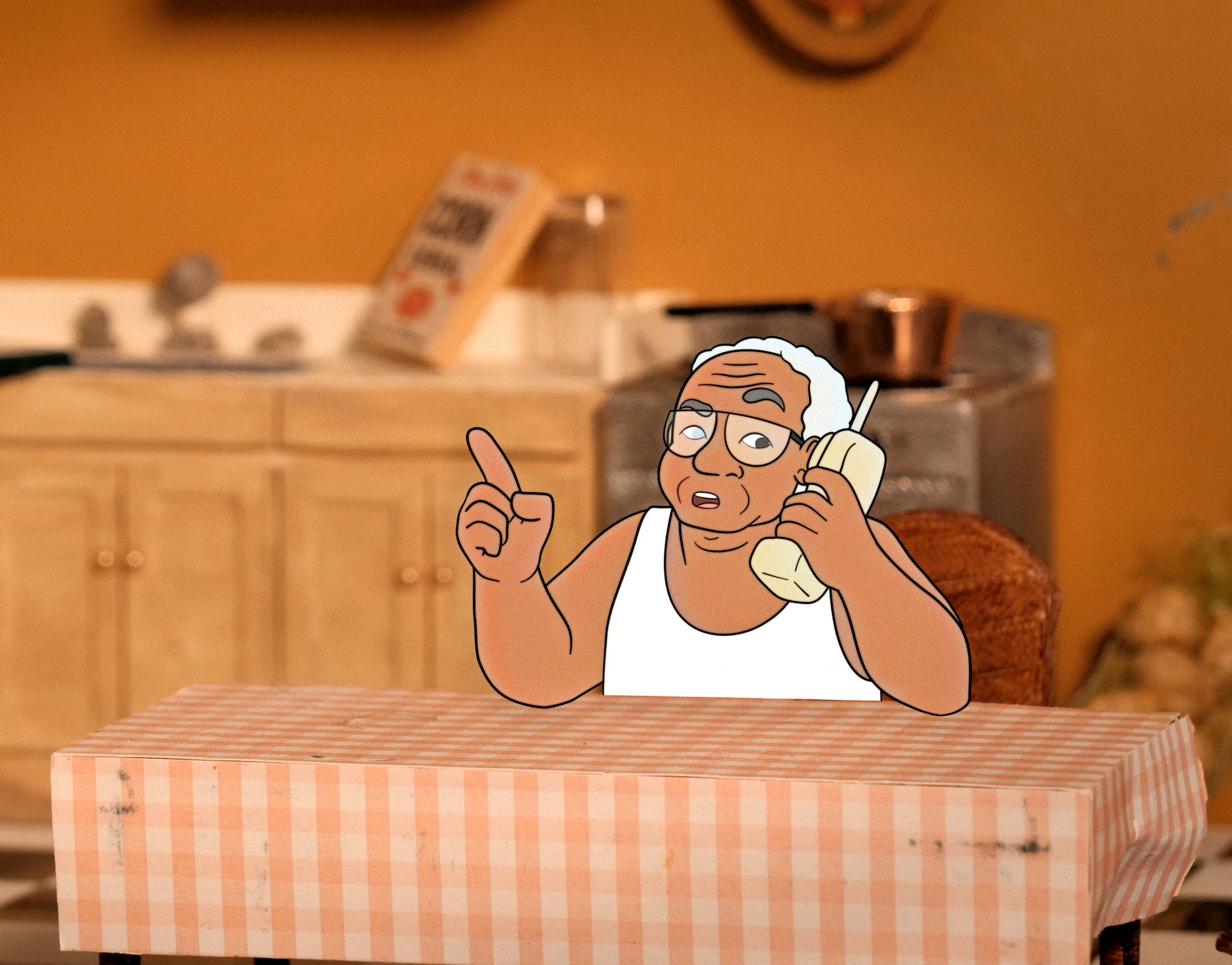
I used Adobe Creative Suite for much of the editing, and After Effects for compositing. I have a strong team of animators who use a variety of different programs. The 3D animators use Blender and Unreal. We used EbSynth extensively for rotoscoping.
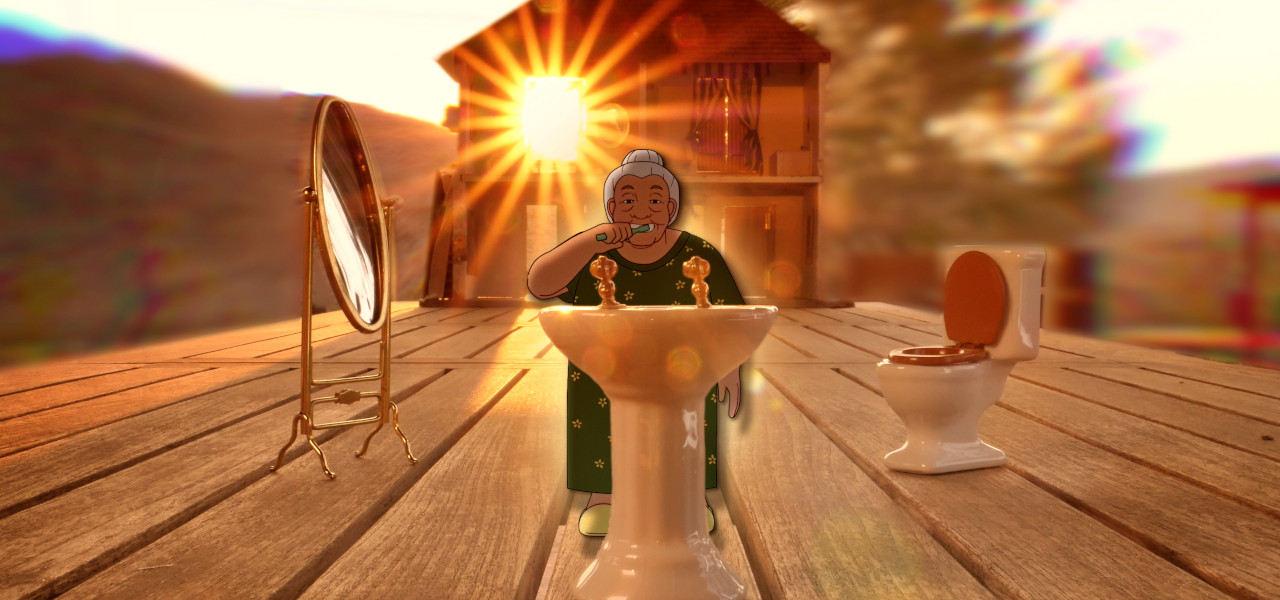
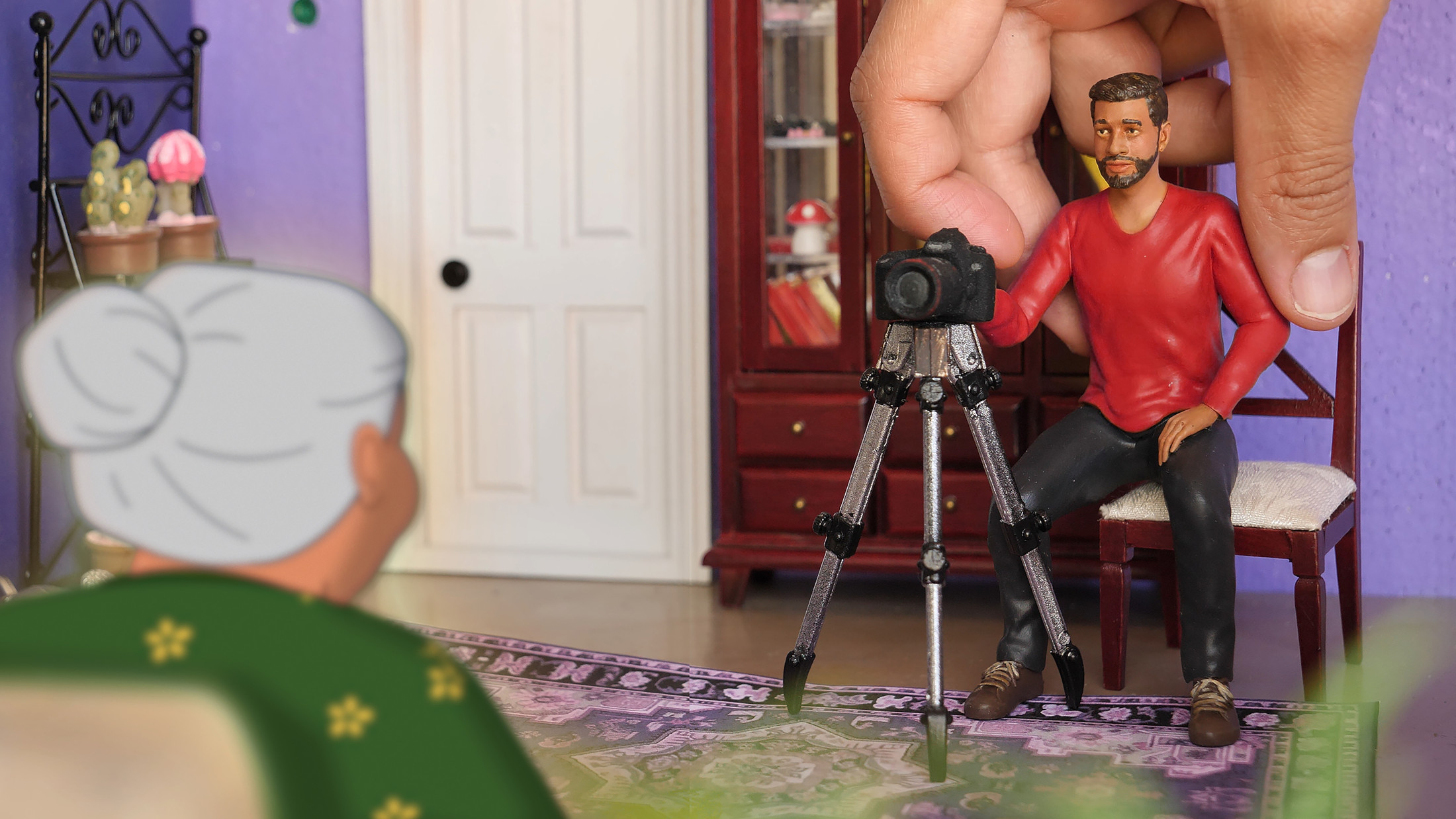
The sets are all physically built in miniature. I like that this project combines sleek 3D and 2D animation with more tactile miniature filmmaking, because I think the miniature work makes people really want to peer deeply into it. You want to pick up the couch. You want to pick up the characters. It makes them feel alive. So I think it’s a nice hybrid of both.
How long did the process take in total?
In pre-production, I had a lot of anxiety because I’d gotten funding for a story about myself, and I kept thinking, “How do I start this project? What framing device do I use?” It was really nerve-wracking. I kept saying, “I’ll figure it out tomorrow.” It wasn’t procrastination. Nothing really made sense yet. Then life happened, and we lost a member of our family. A few months later, another family member passed away. And I realised that, no matter what, this film is about grief. It’s a creative exploration of grief.
I storyboarded almost everything in this film. It involved working with a very small but passionate team, making sure they had everything they needed, and ensuring that everything fell into place. We did production and post-production simultaneously because I also edited the film. They would send me materials, and I was usually the one in After Effects putting everything together. Pre-production started in late 2021, and all the way up to January of this year, we were still finalising the film about two weeks before Sundance started.
How did it feel to recreate yourself, your family, and your home in miniature form? What was that like for you emotionally?
I was stunned when our miniature set designer created a 1/12-scale version of our kitchen and living room in the trailer. There’s something incredibly realistic but also playful about miniatures. It’s my favourite thing about them. It reminds me of playing with toys as a kid, but in a way where I can tell stories. It felt like combining my childhood hobby with my adult passion.
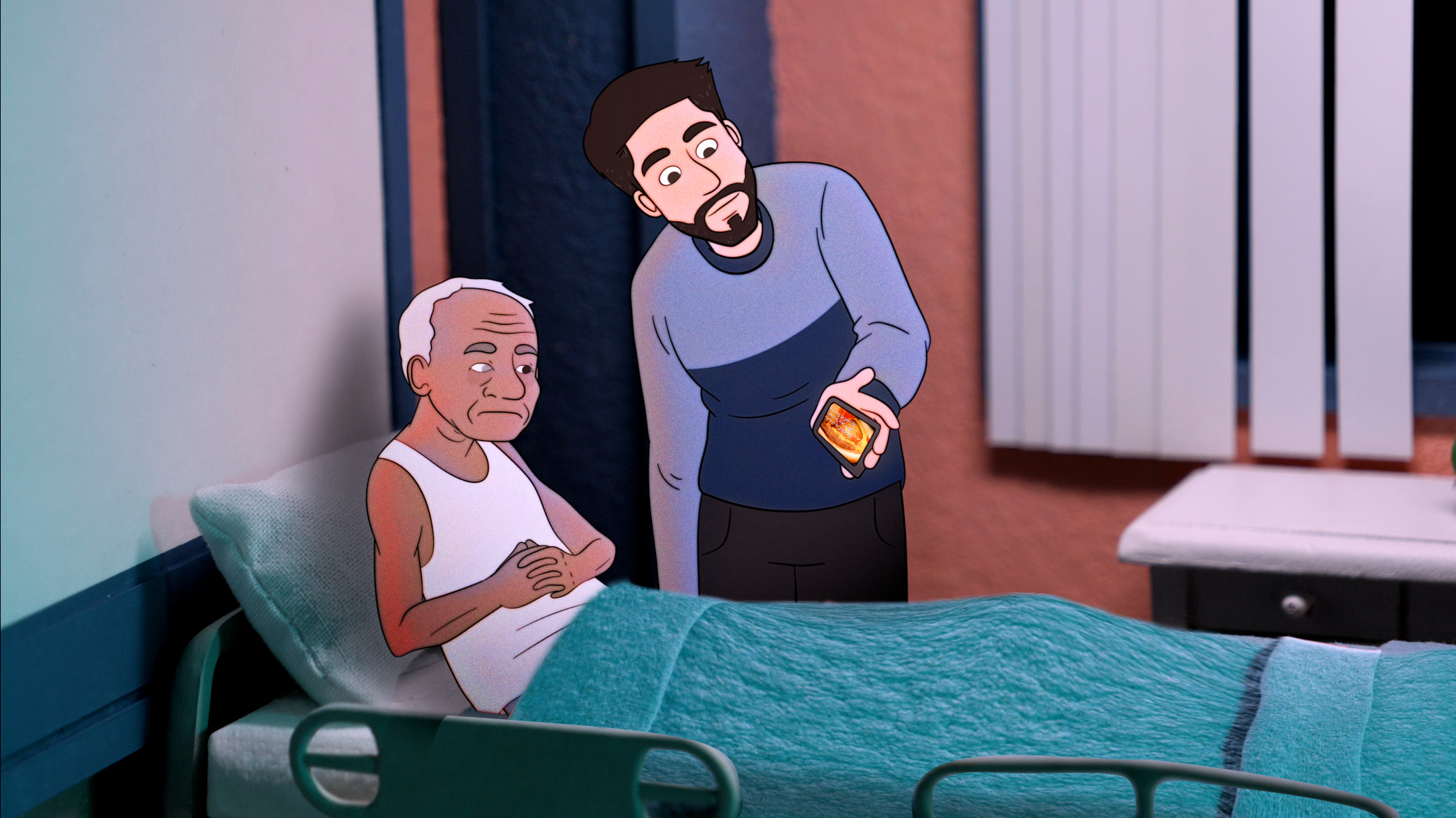
I was able to reframe my family’s stories and bring conversations back to life in the places where they actually happened. There’s a scene of my dad having a low blood sugar attack, and I put him sitting in a chair that’s just like the one he uses at home. That’s his chair when he eats dinner; that’s where he sits. It’s using animation to show positions and presence, and to recreate moments from the past.
What do you feel is the power of recreating reality in animation?
I love telling big stories using small figures and small sets. Documentary can be more than something told with a camera, an interview shot from the front, then from the side, properly lit. I think most Americans, if you ask, “Do you want to see an action movie or a documentary?” assume the action movie will have more suspense and momentum, while documentaries have a reputation for being slow or lacklustre. I want to change that and attract more people, especially younger audiences, who are drawn in by strong visuals.
The visuals only work if the story is there. I think this film succeeds because it tells a story that is both very personal and universal. That combination creates something truly unique. That’s what I constantly strive for: to tell stories that resonate with warmth and truth.
Was it instinctual knowing which animation style to use for each person, memory, or moment? At what point did you decide, “This moment is this style, that moment is that style”?
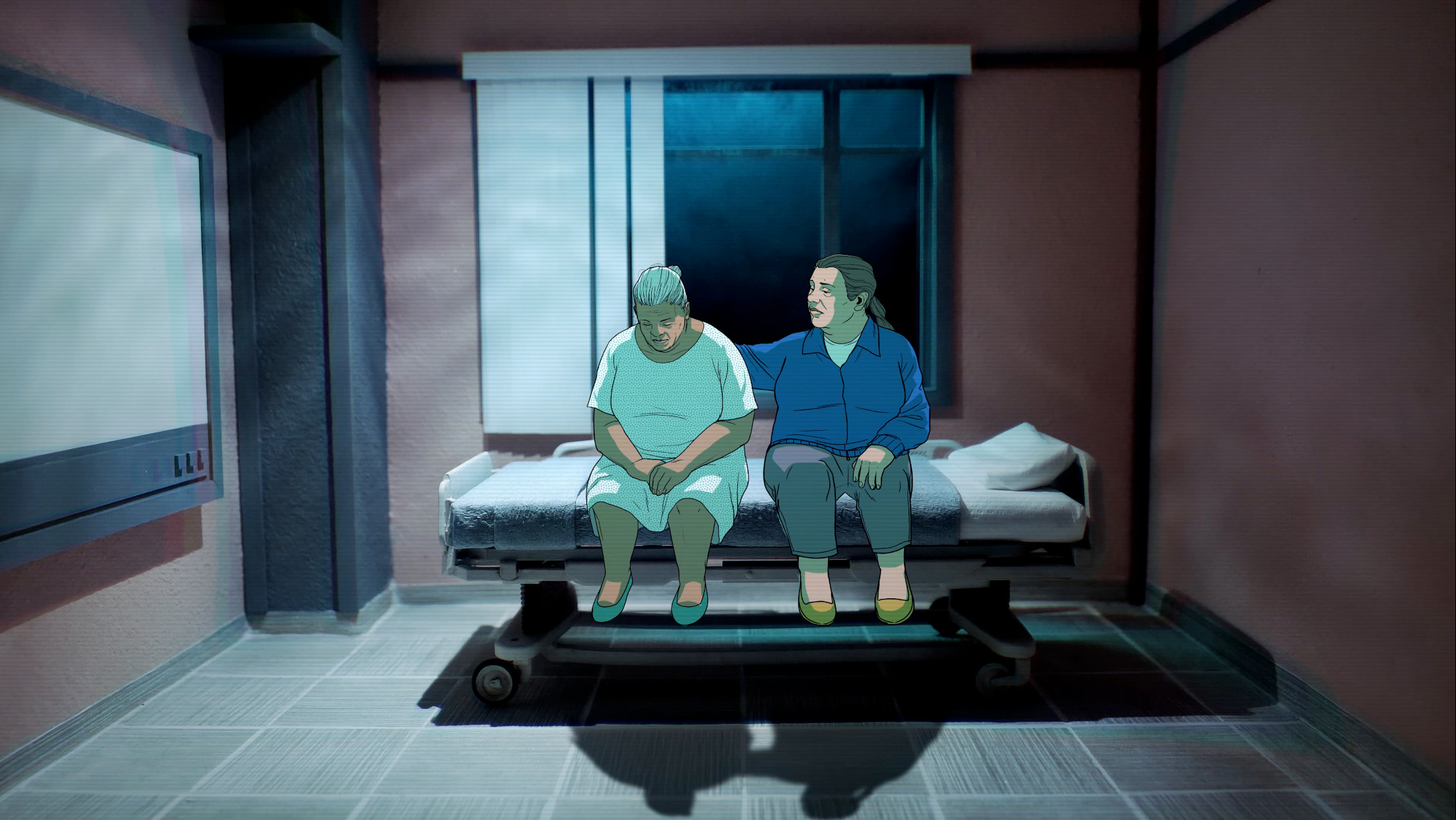
We didn’t get all the funding up front; it came in over many years, and the initial funding was small. My original idea was to have everything 3D-printed, but that takes an enormous amount of time to print and paint, and I knew it wouldn’t be practical. So I thought, what if I hire artists and animators who work in their own unique styles? I was fortunate to work with two Puerto Rican animators, one with a more cartoony style, the other with a more graphic-novel realism. Another collaborator animates in 3D felt. I realised I should play to their strengths and allow the film to embrace multiple styles.
I worried it might be problematic, but the feedback showed otherwise. People loved how it moved from one style to another. It’s a powerful way of pushing the medium, mixing things up, and showing how flexible animation can be in telling a story filled with love, creativity, and exploration.
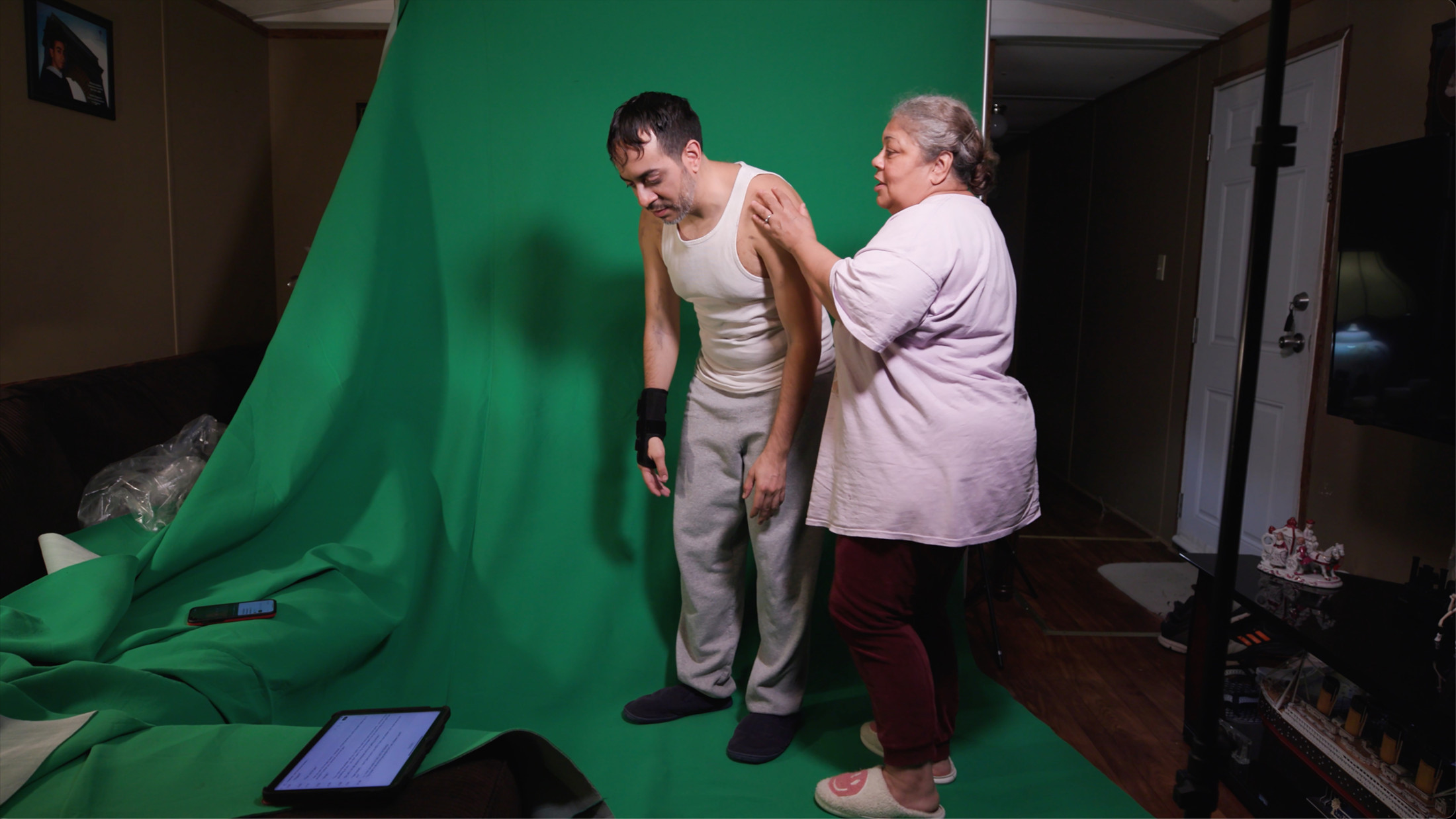
How does it feel to rotoscope yourselves performing as your own relatives? There’s such a detailed study of mannerisms involved.
One of the major aspects of the film is that my mother and I perform and rotoscope members of our family who are no longer with us. There’s something fascinating about lip-syncing as these people are trying to capture their mannerisms. My mother rotoscopes as my grandmother, something she’d never done before. I was worried she might be stiff or unable to capture her essence. But after just an hour and a half of rehearsals, she got it. Once we drew over her, I knew it was Grandma. Exactly.
I do the same with my father. We grew up adopting their mannerisms, the way they moved and spoke. In many ways, we’re the best custodians of that body language. I hope this approach can be extended to other projects, allowing people to recreate their loved ones in similar ways.
When a project is this personal and formally ambitious, how do you know when it’s finished?
I live by a quote from Antoine de Saint-Exupéry, author of The Little Prince: an artist achieves perfection not when there’s nothing left to add, but when there’s nothing left to take away. There are four fully animated scenes we spent months on that didn’t make the final cut, which was painful. With narrative films, you know the ending from the script. With documentaries, especially personal ones, you don’t. In some ways, the story only truly ends when you die.
I found an ending that felt right and discussed it with my team. Someone suggested it could go on for another year, but I felt this was the right moment to stop. This is the story I wanted to tell for now. I can always make another film later.
Learning to trim and edit is an art in itself. Younger filmmakers often struggle with letting go, “killing our babies,” as the saying goes. We get attached to scenes because of the time we spent on them. But if they don’t serve the narrative, they have to go. The film as a whole matters more than any single beautiful moment.
What has making this film done for you as an artist and as a person?
It feels like a blur. I remember getting the initial funding and thinking, “I have to make a 90-minute film with this much money? How?” I didn’t think anyone else would fund it. And then suddenly I’m here, at Sundance, talking to you.
I’m filled with love, knowing this journey brought me closer to my mother. This film will resonate with people on many levels. In my twenties, no one was interested in my work. I had to believe in myself and push forward, even when projects went nowhere. But I learned. I strengthened my voice. Telling big stories with small figures and sets has become my calling card. Three of my projects have screened at Sundance since 2017. That’s a huge creative confidence booster.
What do you hope the film does for audiences?
I hope it helps people connect to their families and loved ones. I’ll be 43 next month. This is the period of life when you start losing elders and thinking about your own mortality. One day you realise you’re suddenly growing a grey beard and wonder when that happened.
Beyond that, given the political climate in the United States, I hope people remember our shared humanity. If audiences can see themselves in my family, maybe it helps build bridges. As an American, I’m horrified by stories of ICE deportations based on skin colour or accents. It’s abhorrent. My duty as an artist is to create work that says: we’re just like you. Maybe you’ve never met a Puerto Rican and only know stereotypes; this film can challenge that. That’s the power and beauty of documentary filmmaking.
TheyDream premieres at the Sundance Film Festival on January 23.