.png)
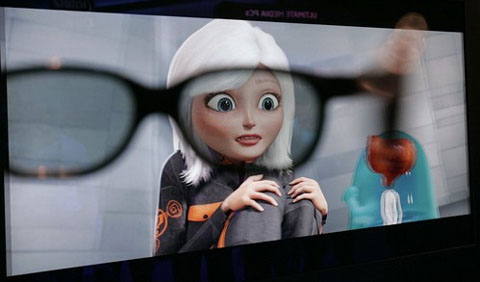
3-D is a Fad
Stay informed with free updates
Sign up to get our news digest — delivered directly to your inbox twice a week.
I love 3D movies.
Thanks to a pair of 3-D film festivals held in L.A. several years ago, I’ve been lucky enough to see perhaps 95% of all 3-D films ever made. On top of that, I think the use of 3-D in recent motion pictures (Coraline for example) is perhaps the best application of the format in film history. Digital technology has -at last- perfected the technique. I’m not crazy about having to wear the extra set of glasses… nevertheless, it’s a wonderful way to experience a movie.
But it ain’t gonna last.
The current preponderance of 3-D films that Hollywood is perpetuating is simply a business trend. The medium is not being revolutionized. It is not the second coming of The Jazz Singer.
A front page article in Monday’s L.A. Times (“Taking Filmmaking To Another Dimension” 04/06/09) repeated all the hype, reported all the grosses and played up all the coming attractions that have been reported everywhere – from Variety to The Wall Street Journal – in recent weeks. It’s almost overkill. Yeah, yeah, we know… Katzenberg, Lasseter, Cameron, Zemeckis, everyone in Hollywood is on board. And they’ve declared Monsters Vs. Aliens as the watershed picture. Its opening grosses, in 3D venues, justify a sea change in production, distribution and exhibition.
But it’s all B.S.
First off, all this nonsense about how all the “old” 3D movies used red/blue anaglyph is a lie. Yes, prior to 1952 there were a few releases (like Pete Smith’s MGM “Metroscopiks” shorts) that used the technique (and don’t miss Albert Brooks’ hilarious faux anaglyph trailer for Real Life (1979) which perpetuates the myth), but all features made since the 50s use essentially the same polaroid system used today. The big difference, thanks to digital projection, is today’s 3D movies are easier to show and have perfect registration between the two images projected.
Next, the current hype about the studios’ expectations of 3-D is a 55-year old rerun. As Leonard Maltin said in this Wall Street Journal article, it’s “an absolute replica of the pronouncements and interviews that came out in 1953.” This time, however, the pronouncements are bigger and louder. Director Patrick Lussier (of the recent 3-D slasher flick, My Bloody Valentine) is quoted in the L.A. Times piece saying, “You could do My Dinner With Andre in 3-D and it would be incredibly compelling.” Maybe so, but it would be because of the script and acting, not the “immersive 3D experience”. Lussier also claims that the 3-D format is “more than a fad.”
Sorry… it’s a fad. A fad concocted and controlled by the major studios. The question is “why”? Here’s the answer: the studios are promoting 3-D films right now in an effort to convince the theaters to convert to digital projection. Once all theatres go digital, there will be no need for the studios to create expensive 35mm prints, they’ll be no more costs for reels and cans; the cost of transporting 100 pound film canisters coast to coast, the cost of storing prints in film depots and later, the cost of destroying worn prints will be eliminated. The savings to the studios will be enormous.
The theaters have resisted the move to digital because it costs tens of thousands of dollars to replace the 35mm projectors and install the new equipment. Theaters contend there’s nothing wrong with 35mm film; that audiences can’t tell the difference, so why bother to convert. Thus the studios are gung-ho for 3-D in an effort to provide something that digital can do more effectively than traditional film equipment.
There are other reasons as well: Digital distribution will cut down (or hopefully eliminate) film piracy; and 3-D films can attract people to theatres to experience a visual show they cannot (as of yet) get on cable TV, blu-ray discs or over the internet.
BUT as soon as all theaters (or a majority of them) eliminate film and go completely digital, I predict the current 3-D fad will end.
The recent 3-D propaganda, aimed at the general public and national movie chains, is really a push for digital conversion sooner rather than later. This is all well and good, but it has nothing to do with storytelling or good filmmaking.
The 3-D gimmick didn’t last in the 1950s, nor the 80s. It wasn’t because the process was more primitive – it wasn’t. Animated films (or any films) today are going to be successful in 2D or 3D, hand drawn or CGI, due to one thing: story – not special effects or 3-D. Cinemas will all go digital eventually. 3-D itself is pretty cool. It just bothers me how it’s being sold to public. Wearing glasses to the movies is not the future.