.png)
The Rules For Drawing ‘Futurama,’ From Fry’s Teeth To Bender’s 40% Problem (EXCLUSIVE)
Stay informed with free updates
Sign up to get our news digest — delivered directly to your inbox twice a week.
For nearly 30 years, Futurama artists have had to answer some uniquely specific questions with surprising frequency. Exactly how tall is Fry? Where should Bender’s shoulder sockets sit? What happens when he opens his chest door? And why should an artist never draw a straight horizontal line across Fry’s teeth?
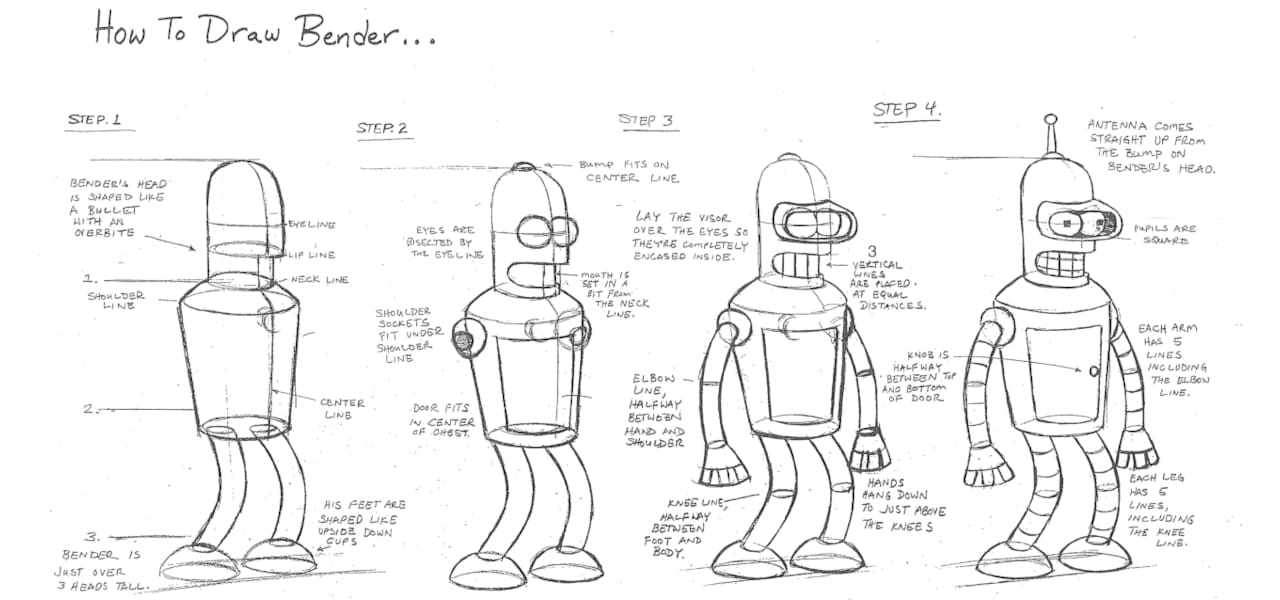
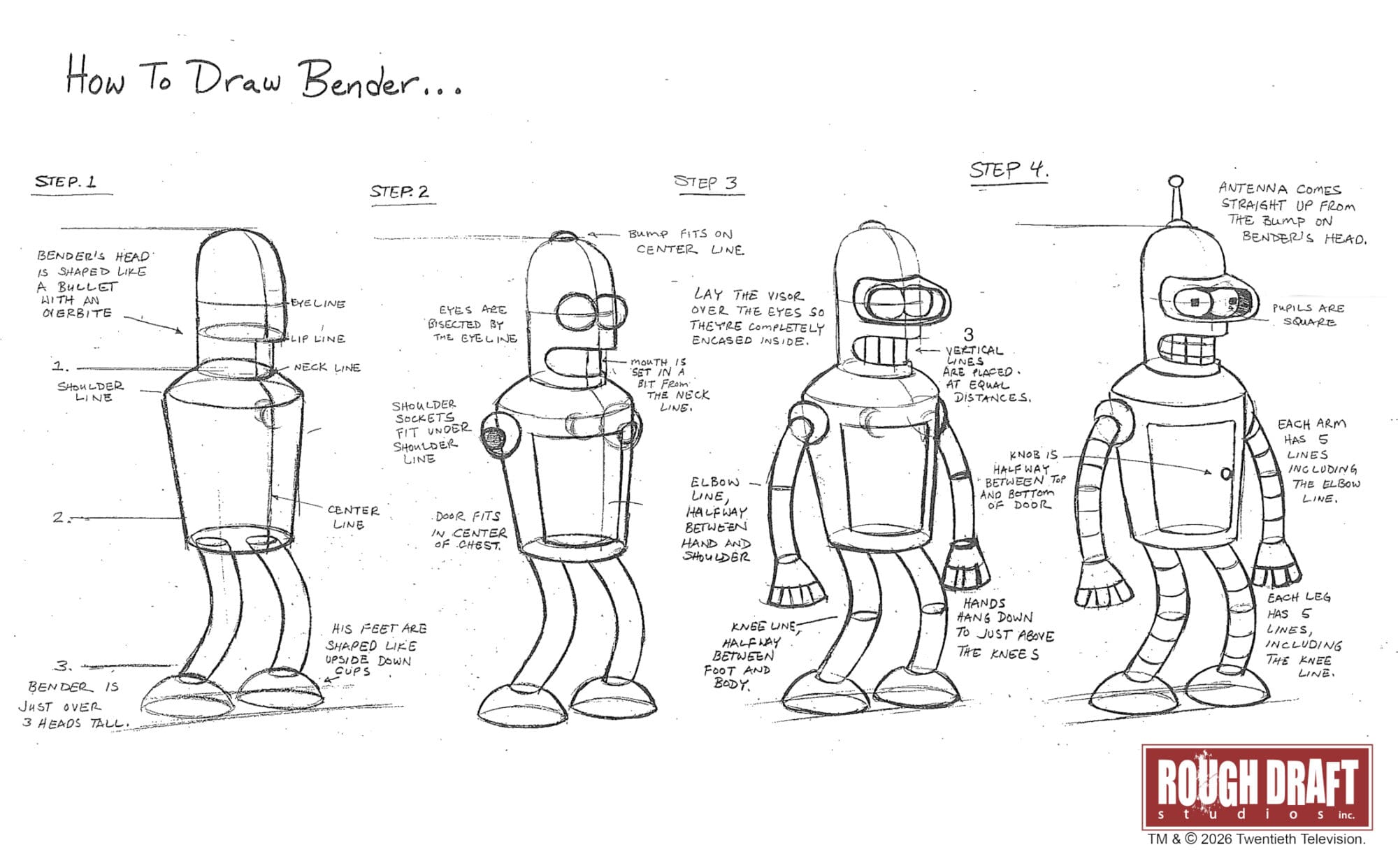
The answers are in the show’s internal drawing guides, which break Fry, Leela, Bender, and the rest of the Futurama universe down into a collection of visual rules meant to keep the characters consistent from artist to artist and season to season. We got an exclusive look at several of those guides, including character construction sheets, anatomical notes, and instructions for handling some of Bender’s stranger physical properties.
We also spoke with Futurama co-creator David X. Cohen and supervising director Peter Avanzino about how those rules developed, how they have survived enormous changes in animation production over the show’s long history, and how much freedom artists have to break them when a performance or joke calls for it.
“Most of the rules on Futurama are about how to draw characters in the Matt Groening style, which is basically the same as drawing characters in The Simpsons style,” Avanzino explained. “These rules, or guidelines, were developed mostly by the animators as they attempted to maintain the feel of Matt’s cartoons, but solidify that feel into a form that many different artists could repeat reliably.”
That process continued when Futurama went into production in the late 1990s.
“We furthered this development when we started Futurama 10 years later, but the basic goal is to make the characters look good, so the guidelines have not changed that much over the years.”
The WORLD OF TOMORROW
One remarkable thing is how much else has changed around those characters. Cohen pointed out that Futurama’s various lives have coincided almost perfectly with changes in how people watch television.
“Futurama gets resurrected every time there’s a change in technology,” he said. “We were on broadcast TV, went off the air, then we’re like, ‘Oh, DVDs are big. We’re back on DVD.’ Then as those go off, we’re like, ‘Oh, cable TV has become a big market. We’re on cable TV.’ Now we’re back on streaming. So Futurama’s history is just tied exactly into the recent history of these media.”
The show also arrived at an interesting moment in animation production. Earlier series such as The Simpsons had begun with physical cels, creating a look that later had to be adapted to digital production. Futurama started late enough to skip that step.
“We started animating in 1998, 1999 and we’re like, okay, it’s expensive, and it’s the edge of cutting-edge technology now, but we’re going to skip cels,” Cohen recalled. “So we didn’t have to make that particular leap.”
Plenty of production changes have still happened, though. The show began in standard definition before moving to higher resolutions and widescreen, for instance. But the basic approach to the characters has remained remarkably familiar.
“The animators are still drawing,” Cohen said. “They drew by hand then, they’re drawing by hand now.”
As there always has been, some CG is involved. It was one of the show’s early standout features when it launched in 1999. Cohen clarified that these days, production uses CG models for most characters, which can be used when a shot calls for something complicated, such as a rotation. The Planet Express ship and buildings are also frequently handled in CG.
“A lot of the animators’ work in those situations is just sort of to tone down the CG, so we don’t really notice,” Cohen said. “The ship and the buildings are prime examples of that, where those usually are in our CG, but they color them flat and get the outlines on there. So it’s blended in very nicely.”
When it comes to character acting, though, Cohen said, “For the most part, to get the acting we want, it’s still hand-drawn.”
Bender’s 40% Problem
Bender offers a particularly good example of why a simple-looking character can require a surprisingly detailed set of instructions. His drawing guide starts with basic construction: his head is shaped like a bullet with an overbite, is door sits in the center of his chest, his shoulder sockets fit underneath the shoulder line, his feet resemble upside-down cups, and his antenna comes straight out of the bump on his head.
Once Bender starts moving, however, things get considerably less straightforward.
“There’s a lot of freedom,” Cohen said. “His arm can stretch out like a tape measure, or he can, you know, twist his head around or fall apart and go back together.”
For all that freedom, Bender also has some inconvenient physical limitations.
“His neck is fixed,” Cohen explained. “So if Bender wants to look down at his cabinet door, he can’t really.”
That detail apparently does not always occur to the writers while they’re writing an episode.
“We often write stuff when we’re in the writers’ room where we’re not really thinking about these limitations,” Cohen said. “And then I have to have conversations with the directors where they’re like, ‘Well, you know, he can’t actually bend over to do that.’”
Cohen’s response is generally some variation of: “No, just do something.”
“So we put the animators in a lot of impossible situations because of these limitations where we ignore them,” Cohen said. “And they have to come up with a way to, you know, cut to a close-up of Bender’s eyes looking down or something.”
Bender’s chest door gets its own guide, and the rules depend heavily on what a scene needs.
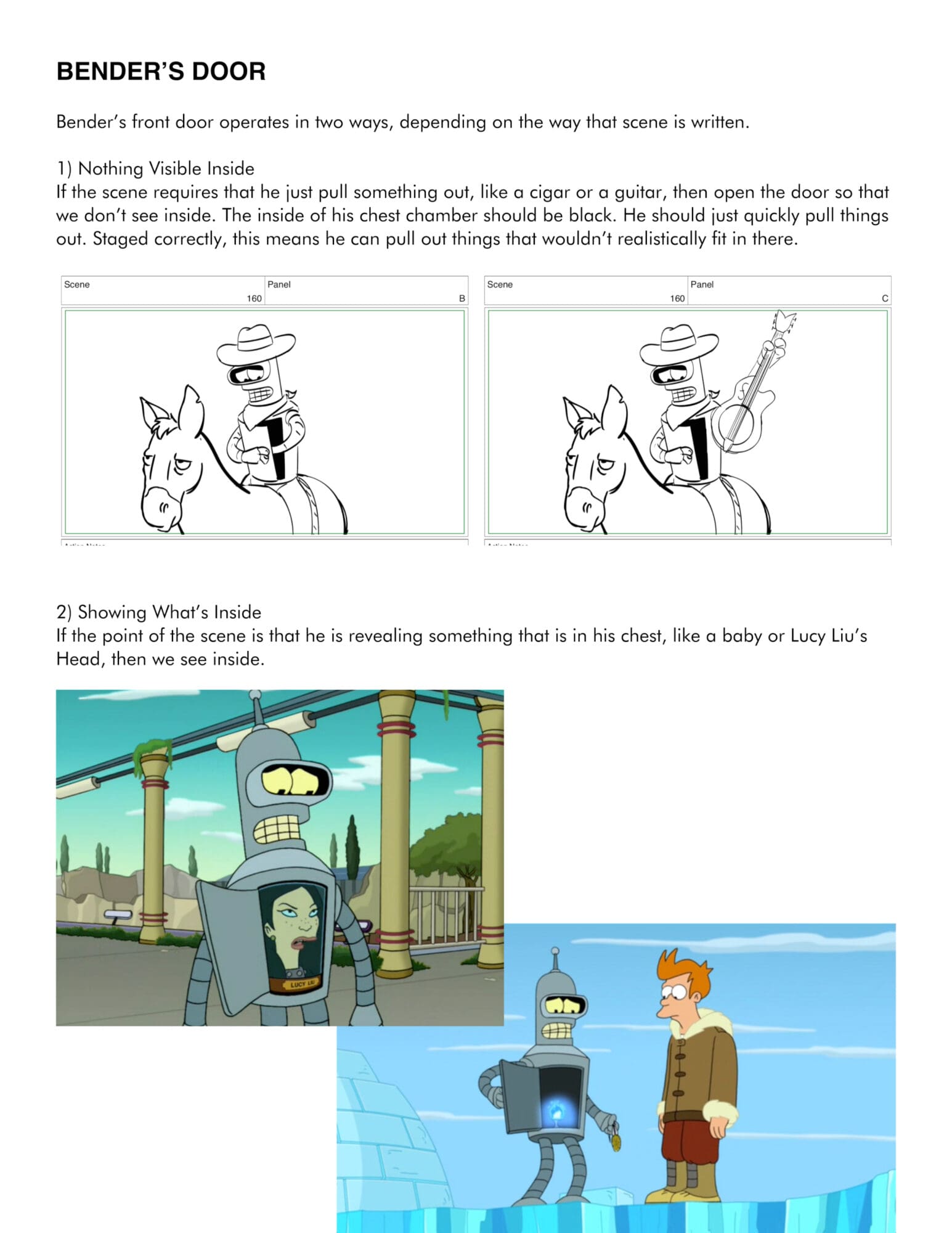
If Bender is simply retrieving something, the audience shouldn’t see inside. The interior remains black and Bender quickly pulls out whatever he needs. As the guide points out, the right staging also lets him produce objects that could never realistically fit inside his body. One example has him pulling out an entire guitar.
When the scene focuses on the contents of Bender’s chest, the audience can see inside. That flexibility runs through the production.
“Of course” there is room to bend the rules, Avanzino said. “The rules and guidelines are there to get a consistent look to the show, but too much of that can also lead to a boring show.”
“The writers bend the rules often to make things new, and if an artist can come up with a new idea for acting or staging, we encourage it. Not everything works, but trying new things is always encouraged.”
Comedy ultimately gets the last word.
“We’re usually trying to surprise the audience with something they aren’t expecting to get a laugh,” Avanzino said. “That can be a line of dialogue, but visually it could be an unexpected camera shot, or a facial expression. Ultimate goal: Gotta make ’em laugh.”
The Why of Fry
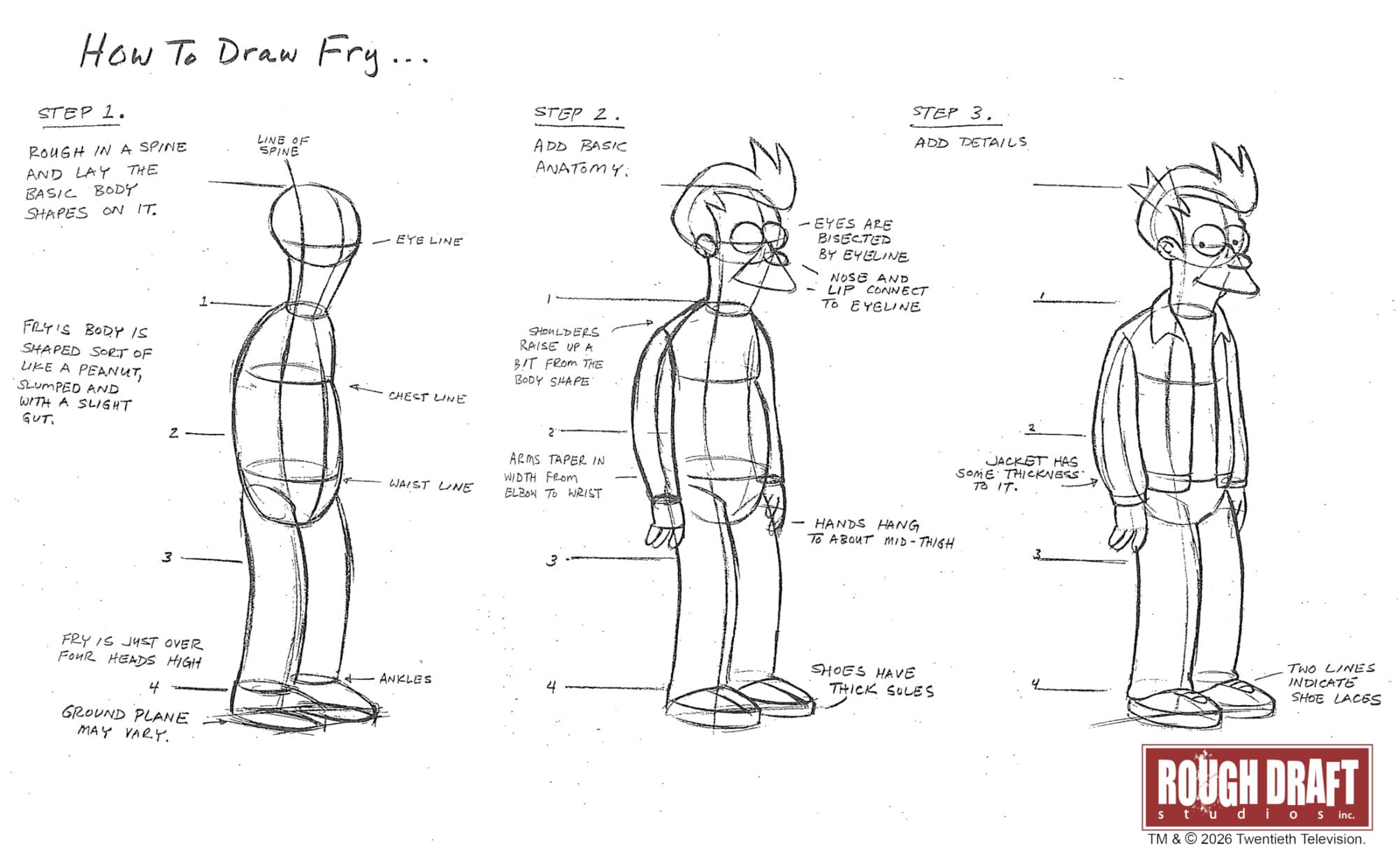
The guides show how much information hides inside character designs audiences have spent decades looking at.
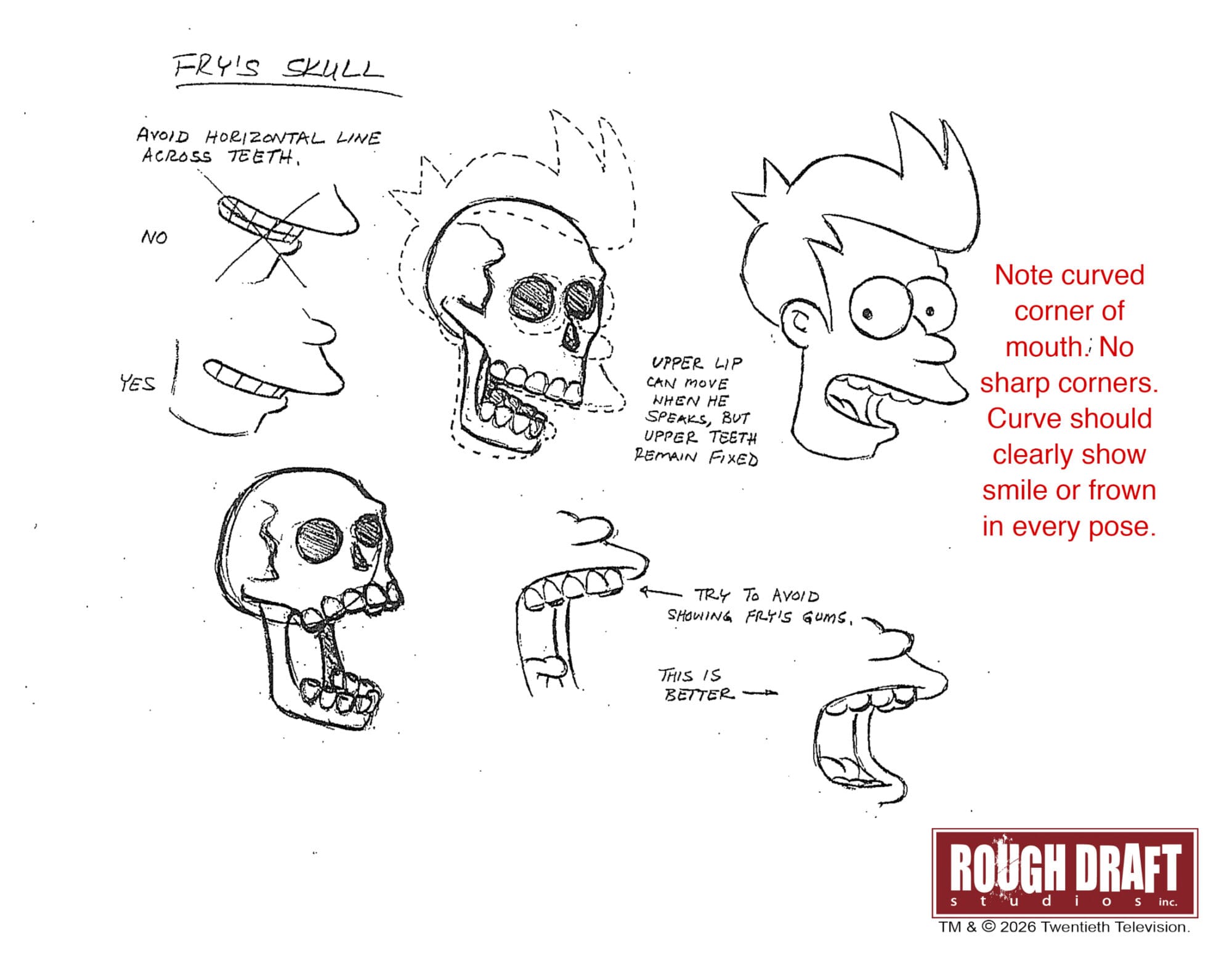
Fry’s construction starts with his spine. His body is described as “sort of like a peanut, slumped and with a slight gut.” He stands a little over four heads tall. His shoulders rise slightly from the body shape, his arms taper between the elbow and wrist, and his hands hang around mid-thigh. Even his jacket should have some visible thickness.
Another sheet goes inside Fry’s head. Literally.
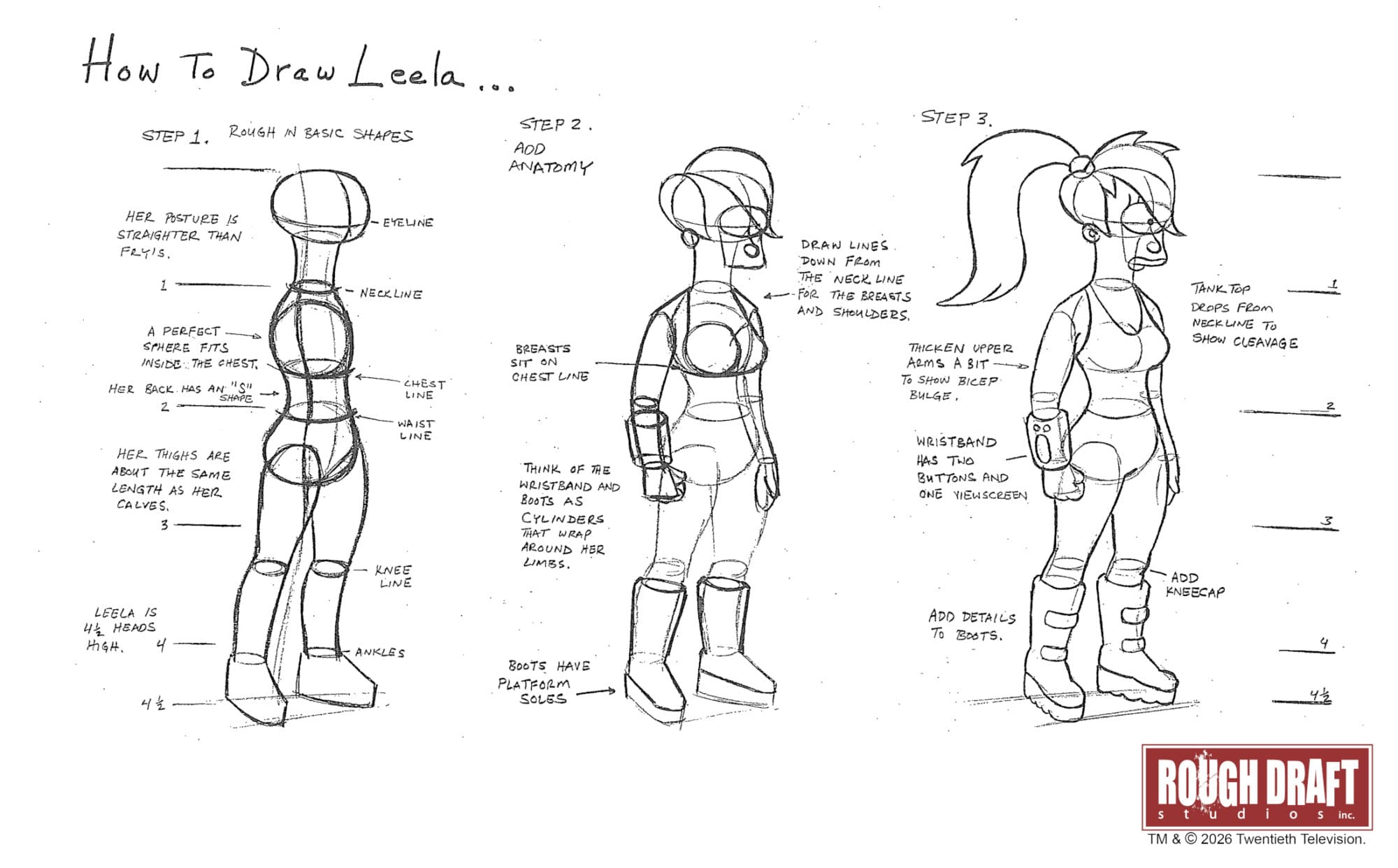
Leela has her own set of rules. Her posture is straighter than Fry’s, with an S-shaped curve through her back. She stands four-and-a-half heads tall, and her thighs are roughly the same length as her calves. The guide also breaks down how her boots and wrist device wrap around her limbs and gives artists specific instructions for constructing her torso and clothing.
These details help keep the characters recognizable from artist to artist, but Avanzino said staying on model is only part of the job.
“Aside from trying to keep the characters on model, keeping the show visually interesting requires constant attention,” he said. “It’s easy to fall into basic acting and staging norms, so we all work hard to keep pushing things to keep them interesting and exciting.”
The realities of television production can make that difficult.
“We are on a TV schedule, and it is a lot of work, so the effort to just get things done can often lead to using shortcuts, but we do what we can to get our artists to push themselves a little harder.”
And those guidelines extend beyond the characters.
“We also have guidelines on how we like our filmmaking,” Avanzino said. “Some of these are based on what Matt and the producers like or don’t like, but mostly they are about getting good cinematic staging rather than flat, simple, cartoony staging.”
“We’ve tried to make Futurama visually interesting, cinematic, and exciting. The show still has a lot of scenes of people talking at a table or on a couch, but it has a lot of opportunity for great filmmaking and visual storytelling.”
For Avanzino, part of the job is helping artists find those opportunities.
“We work with our artists to develop their skills at drawing and staging the episodes, so the characters look great and the visual storytelling and acting adds to great scripts and voice performances we work with,” he said. “Ultimately, our guides are really an invitation to broaden their staging and acting skills and put something interesting on the page.”
“I Communicate In Emotions”
Cohen approaches those questions from the writers’ side, and he readily admits he does not speak the same technical language as the artists.
“Matt Groening likes to say great animation is a combination of great animation, great writing, great acting, and great music,” Cohen said. “And really, there’s virtually no one who does all of those things. And we’re all pretty much laser focused on our piece of this puzzle.”
Cohen knows which part of the puzzle belongs to somebody else.
“You don’t want me drawing, let me put it that way. You don’t want me drawing or doing the music.”
Once the writers finish a script, they hand it over to the animation team. Cohen said the two sides interact at key stages, but the writers give the artists room to do their work.
“They’re doing their thing. They run stuff by us. We say, ‘Does this look like what you’re picturing?’ Ninety percent of the time I’ll say yes. Ten percent of the time I’ll say, ‘No, we wanted this to be scarier. We wanted this expression to be sadder.’”
That is particularly true in Cohen’s conversations with Avanzino.
“I don’t have all the language of the artists who technically do the work,” Cohen said. “I like to think that I communicate in emotions with them. So it’s like, ‘I want this to feel sad,’ or, ‘I want this to be livelier.’ I have to use adjectives and emotions to describe what we’re looking for and then count on Rough Draft and the animators there to deliver the feeling that we’re trying to create.”
The artist then has to turn that feeling into something an audience can see.
“It still has to go through that human being,” Cohen said. “I do like to think that we’re still a show of all human beings in Futurama, that they take what’s on the page and have their vision and bring it to life.”
“I don’t think entirely in pictures,” he continued. “That’s not the way I think so much. I think about the feel of it and how the characters are feeling.”
“What I have in mind is that feeling more than exactly what it looks like. So yeah, I can’t do that. It’s entirely dependent on them to pull through in that category for us.”
Cohen sees the voice cast as another crucial part of that performance.
“Even our acting as an animated show, that’s split in half because we have the acting you’re talking about, which is what do the characters look like, what are they physically doing, what do their faces look like?” he said. “But we have our voice cast, who are just the best. And a lot of the emotion is coming out of their humanity as well.”
“They’re voice actors, but they are actors. They’re delivering a lot of what makes these crazy characters believable as people and as characters, even when they’re in these insane situations.”
Cashing In On Being Animated
Sometimes the production throws the usual drawings away and starts over.
“I mean, we try once in a while to go like, ‘Right, we’re an animated show. We should fully cash in on this,’” Cohen said.
The series has repeatedly redesigned its cast for anthology episodes, sending Fry, Leela, Bender, and the rest of the crew through anime, Saturday-morning cartoons, and other styles.
For Cohen and the writers, those episodes offer a freedom that comes with animation. For the artists at Rough Draft Studios, they also create an enormous amount of work.
“A lot of times the way we do this is we do these three-part episodes where we say like, ‘Okay, they’re a Saturday morning cartoon. They’re an old action, you know, G.I. Joe-type cartoon. They’re an anime.’”
“When we throw it at them, we throw it at them really hard and say, ‘Okay, in 20 minutes you have to redesign every character three different ways.’”
Cohen suspects the challenge is part of the fun for the artists.
“I think the animators love it because that’s why they got into that business,” he said. “But when it hits them, it’s all hands on deck to redo it. Because again, yeah, it’s not just redesign 10, 15 different characters, but do it three different ways in one episode.”
After all the cancellations, revivals, format changes, and technological shifts, Cohen said the process behind Futurama remains surprisingly recognizable.
“Things have not changed that much, honestly, behind the scenes, even though, as we say, the technology has changed, the medium has changed, but how we make the show and how we think about it has not changed that much,” Cohen said. “I think that’s one of the things that people like about it, that that’s Futurama, that’s philosophically sort of the same thing despite all these oscillations along the way.”