.png)
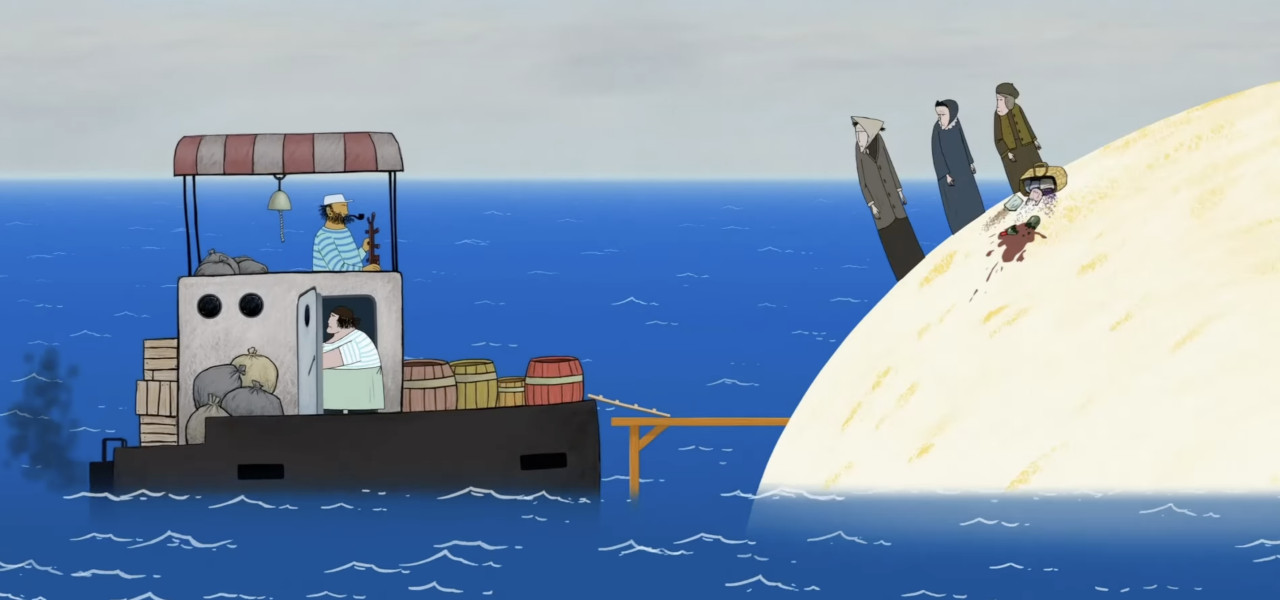
Social Experiment Or Hoax? – The Curious Case Of ‘The Three Sisters’ According To Director Konstantin Bronzit
Stay informed with free updates
Sign up to get our news digest — delivered directly to your inbox twice a week.
When the Oscars shortlist for Animated Short Film was unveiled, I remember Ukrainians [I’m currently residing in Lviv, Ukraine] being ecstatic to see I Died in Irpin and The Shyness of Trees (co-directed by Ukrainian, Sofia Chuikovksa) included. One person in a Ukrainian animation Telegram channel even commented that they were also happy there were no Russians on the list.
Meanwhile, a colleague in Cyprus messaged me to say he didn’t understand (or even know about) this “Cypriot” shortlisted film, The Three Sisters, which is now nominated as one of the year’s five finalists for the upcoming Academy Awards. We’d previously discussed some questionable entries labeled as Cyprus productions that nevertheless had entirely Russian names attached. Cyprus is, of course, a popular destination for Russians (and Brits and Israelis), but it still felt odd that there seemed to be a sudden spike in Cypriot animation films made by Russians (mostly via the studio Rymanco) after the full-scale invasion of Ukraine in 2022.
So, I looked back at the submission information for The Three Sisters in the OIAF database. It was submitted in 2024, and the director was listed as Timur Kognov, along with a photo and biography:
He was born on April 19, 1969, in Georgia. He also graduated from art school there. In 1997, he graduated from the directing courses at the Bezalel Academy of Arts and Design in Israel. After that, he actively worked as a storyboard artist and director of episodes in the field of commercial animation, on TV series and feature films. In collaboration with the independent studio Polidont has created several original films that participated in various film festivals. He currently lives in Haifa, Israel, where he continues his professional career.
On the Film Freeway site, the biography was a bit different:
He was born on April 19, 1969 in Georgia. He also graduated from art school there. In 1997, he graduated from the directing courses at Film school in Tbilisi. After that, he actively worked as a storyboard artist and director of episodes in the field of commercial animation, on TV series and feature films. In collaboration with the independent studio Polidont has created several original films that participated in various film festivals. He currently lives in Canada in Toronto, where he continues his professional career.
Initially, I was focused on the Cyprus/Russia relationship. It was hard to see any connection to Cyprus at all. Even the credits are loaded with Russian names. My initial assumption was simple: this was a case of Russians hiding behind another country, a wolf in sheepskin.
But… then it was revealed that former Oscar nominee, Konstantin Bronzit (Switchcraft, At the ends of the Earth, We Can’t Live Without Cosmos), was actually the director, nd that this had been a long-running plan, a “social experiment,” as he called it.
Artists using pseudonyms is nothing new. There are endless examples of writers and artists creating under different names for various reasons, yet in all my years in animation… well, I’ve seen some shit, but this was a new one.
Rather than continue pondering the various motives behind this, I decided to reach out directly to Bronzit to find out just what the hell he was up to.
How far back does this idea go? Was there a specific incident that made you want to do this ‘social experiment’?
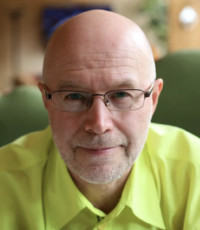
I’m not fond of the word “experiment,” though I may have been the first to use it. It’s a test. A test of my own creative abilities. But as it turns out, when you test yourself, you end up testing the system too. The idea came to me 12 years ago, when I was finishing We Can’t Live Without Cosmos. Unfortunately, when I started making the second film, He Can’t Live Without Cosmos, a few years later, I had to put this idea on the back burner, since these two films are too closely intertwined. I needed to wait for a project that would be totally different. That turned out to be The Three Sisters.
But there’s also a backstory. Many years ago, a great director told me personally of a case at a festival – it could have been in Varna, or maybe somewhere else – when another famous director sat on the festival jury and sank his film. Obviously, that jury member naively assumed the filmmaker would never find out. I could have questioned this story, since after all, it was told from the perspective of someone who’d been wronged. But years passed, and that same jury member sank my film, too, at another festival. And after that, I heard about such cases many more times from other filmmakers, at other festivals, about other films.
I’ve been in this profession a long time and have seen a lot – as a competitor, as a selection committee member, and as a jury member. I’m talking about things we can’t change. They’re an unavoidable fact of life. But one day I thought: what if a jury member knew nothing about the film except the film itself? Could I overcome any barriers sheerly by virtue of the qualities of the film itself? I decided to find out.
Is this Timur person real?
He is, partly. He’s a relative of mine. And yes, he’s actually Georgian, I didn’t make that up. I just changed his last name a little. He has nothing to do with cinema. Pretty much everything in my “cover story” is based on truth. As a director, I pay close attention to details. You can see it in The Three Sisters. I thought the whole thing through very carefully, down to the smallest details. But I also knew that The Three Sisters couldn’t be Timur Kognov’s debut, that would have been terribly unfair to all the other filmmakers. So I gave him a filmography. And it’s also loosely based on the truth. I didn’t put Citizen Kane or Zootopia on the list in order to not raise suspicions, but the films there are real, ones that I made as academic exercises and were seen only by my students. So it wasn’t just making a film anymore; I was directing a piece of my own life. And that’s way more fun than cinema!
Why did you decide on Cyprus?
If you’re making things up anyway, why not? But Cyprus is also a partial truth. There’s a distribution company there, and also many good freelance animators. It would have worked just as well to write “Canada,” and that would have been equally true, because my friends in Canada helped me out with the film. Actually, I should have.
In this sense, as a film academy member, I’m genuinely glad, even proud, that the Academy simply watches films, without making footnotes about names, let alone the country of origin. The Academy is still about the art of cinema, not about something else.
How was this film funded?
The money situation with The Three Sisters is as simple as it gets. Precisely because of my desire to release the film under a pseudonym, there was no way to get state funding. The system of financing we have is extremely transparent. The film is submitted for review, followed by an official pitch that is broadcast online, where everyone can view it. Afterwards, they announce to the world which director got money and for which film. So there was no way for this to work with my idea – the whole animation community would have immediately found out that Bronzit is making a new film called The Three Sisters. Then a private studio appeared on my horizon.
It seems you submitted the film to the Academy with your real name on it. Why did you decide to finally include your real name?
Because that was the plan from the very start. Because what’s interesting is taking a risk with the trickiest part, which is the festival selection process. The Academy website screening room, where the films are available for viewing, has a great setup. Film previews do not show the country of origin and director names. All you see is the film’s title and length. To view the director’s name, you need to at least start viewing the film.
International festivals let a director submit their film in just a few clicks with not a lot of paperwork involved, and a huge thank-you to the festivals for that! The processes are very strict at the Academy, like at any large and longstanding entity, and there are rules for everything. I had not the foggiest idea of how I would get myself out of that situation later on a sheer technical level. Why make things more complicated for myself?
What did this experiment prove in the end? Was it that Timur’s film wasn’t loved by festivals, but the moment Konstantin’s name was added, the Academy immediately loved it?
That is the main question.
Very few films make it to the competition stage at major international festivals. Sometimes this number is 80, but often it is just 12 to 15! And there can be up to 5,000 submissions. That’s more than 300 films for every slot! I’ve been on selection committees plenty of times. Even just physically, it’s hard to view everything with 100 percent of your attention!
One more important thing. Despite numerous rejections, my film still managed to make it into about two dozen festivals. And imagine that – at half of them, it received very significant prizes. Even the Audience prize at one of them. Which is incredibly pleasant, since at the same festival many years back, my film We Can’t Live Without Cosmos also won the Audience prize. When a film gets prizes at every other festival, that means that the film isn’t a lost cause!
But then we have to make the clear and obvious conclusion that today, the hardest part about festivals for a film isn’t even getting a prize, it’s getting into the competition at all!
This was a discovery for me. And with all the AI and accelerated content creation going on, the situation will only get worse. Neither the festivals nor the directors are to blame for that. But that will be the flow of things.
Now imagine selecting from this flow, and before you is a film by Yuri Norstein, Miyazaki, or someone else (put whoever you personally happen to prefer). The attention of the people making the selection is heightened and focused. That’s completely normal. Honestly, I can’t even imagine how else it could be! Is that person doing something criminal? Of course not! It’s NOT their fault, and it might not even affect whether the film ultimately makes the cut. Our brain is simply reacting to the directors we love or don’t love. Films from less-famous directors will also get watched, but with different eyes, so to speak, in energy-saving mode. For them, getting selected is like winning the lottery. I understood all this perfectly and consciously decided to put my film through this gauntlet. And I know I can now go to my many fellow directors, who have for whatever reason not yet earned themselves a name, and tell them, brothers and sisters, don’t despair when you regularly have to open letters informing you that your film has been rejected, again, from some festival’s competition! I purposefully became a nobody, walked a mile in your shoes, and used a simple little test to show that these rejections aren’t always a sign that something is wrong with your film. Don’t give up, and if you truly love animation or short-form live action, just keep working at it. If your film is worthwhile, you always have a chance to get noticed. That is what my test showed. It offers hope to many directors. That’s the takeaway!
Do you really think animation festivals behave this way? As I said, I can’t speak for other festivals, but in Ottawa, we’ve sometimes accepted Bronzit films, sometimes haven’t accepted them. Names in the credits don’t really matter to me.
I know this about you, Chris, and respect your approach very much. But it’s not about you personally. I’m sure that most festivals, too, are also run honestly and selflessly, which is commendable. To make my point clear, I’ll run the risk of simplifying.
In one Facebook discussion on this topic, one director whom I’ll call N had been selecting films for the competition at a festival, and she wrote something to the effect of: “I’ve blocked this film. It’s old-fashioned…” Bingo! That’s precisely what I was going for. Pure, uninhibited objectivity. There’s some no-name auteur – and director N, who is simply watching that person’s film. That is the ideal. But if she had known it was a Bronzit film, her perception would not have been unclouded. It would have created bias. The content of her comment is beside the point, but in that case, we could then judge her to the effect that director N just can’t stand Bronzit personally. Or if she wrote something nice, then the opposite. But now we definitely know that she was sharing her honest view of the film, and not something else.
Additional information would change our perception. When someone is just watching a film, it doesn’t matter at all. But if this person is judging it, then ideally they shouldn’t know anything about it! The film’s success then depends entirely on the actual quality of the film itself, and not things external to it!
Set aside the whole selection process. Things are very different with jury members. The problem is we don’t control our own minds. We depend on our mind, and not vice versa, contrary to widespread opinion. This is easy to prove – close your eyes and try to not think of anything for one minute. Just one minute! You won’t make it even ten seconds. Your head will be filled with so many random disconnected thoughts that you can’t get rid of, unless you’re the Buddha, of course. After that, how can you think that we control our own minds? So, try to imagine some juror who is watching a competition film. If they don’t know anything about the director, they just watch the movie. But if this director has owed a lot of money to this juror for a long time and doesn’t want to pay up, the head of this juror will be clouded… This is simple psychology, and it’s not something any of us control.
Also, debts should be paid. Especially before New Year’s!
Did you consider the timing of this? There are people – including me – who felt that maybe this was a Russian animator trying to sneak into a festival/awards in disguise. It’s a pretty sensitive time right now, and many people might think this was your motivation.
Chris, we know that if that had been my goal, it would have been enough to just change the production country and leave my name the same. And there are numerous examples of this.
In different times, the two of us could just sit down together, sip some wine, and have a good laugh at my little caper. You know what’s the funniest gag in my film At the Ends of the Earth? When the poor cat is squashed by the house. I know this because I’ve heard, dozens of times, how people laugh the hardest precisely at that moment. But it’s a dumb gag. What makes it so funny? The answer’s simple: context. Filmmaking is different from lifemaking because a director can shape the context, which you can’t do in real life. You can shape only your own selection, but not the world context.
My problem is that it takes me a very long time to make a film. After starting the film in 2018, I finished it only in 2024. I look out the window, and it’s still winter in March out there… and I’m already 60. Considering how long I take to bring about films, it might be my last one. The context that has been so unfortunate for all of us is not going to change in my lifetime. So I don’t have any time to lose, and I’m hurrying to do something useful. I knew I’d be sticking my neck out, and there would be some pushback, but I had no choice. So my scheme did not turn out quite as beautifully as it could have, which is a shame. My timing inside my films is much better, so at least there is that.
Do you worry now that maybe festivals will feel tricked and might not even consider your films anymore? Maybe you will have to keep using fake names?!
You’re going to hunt for my name in the credits now every time? With questions like that, I kinda feel like I’m the defendant taking the stand. And now it’s time for the sentence to be pronounced. Just a week ago, in my interview for Animation Magazine, I was saying: judge the film, not its author!
Which was, to my joy, the case at the Santa Barbara festival, where my film qualified. The jurors and those making the selection didn’t care whether this film was by Kognov or Bronzit. I think they didn’t know either of those names; it’s a rather large festival that covers more than just animation. They watched the film, and they liked it. There was nothing more to it. It’s the most honestly earned prize that I’ve won! And I extend my special thanks to Santa Barbara for that. I wave to them with gratitude! I wrote to them later to personally come clean. And you know what response I got? “What an exciting twist, Konstantin, and what an interesting journey you and your film have been on this time around. Thank you for letting our festival be a part of it.” I am so glad that they saw a little humor in what I did. This always makes us happy.
To sum up, I’m afraid you’re confusing me with Don Quixote. I may be an idiot, but I’m definitely not Don Quixote. I’m more of an idiot, in the Dostoyevskian sense. An idealist, that is. I created the ideal situation for discussing cinema, and I get judged for that. Even though I know for a fact that I did not break any festival rules. My test isn’t about you, or festivals, or anyone else; it’s about me and seeing whether my personal creative powers are up to snuff. I put just my own film at risk, and nobody else’s. I freed the judges from name recognition. It’s the height of fair play, striving for objectivity. I don’t know, maybe someone sees that as a crime, but for me it‘s exquisite. As in chess: a queen’s sacrifice with unclear consequences. Do you like chess? I do!
You mentioned being locked out, like I already have been for the last two years anyway. Here’s my counterproposal. Let’s have all festivals, from now on, accept submissions from directors totally incognito? It’s hard to imagine a fairer situation from a competitive point of view! Plus, it exactly fits how you go about it yourself. Then you shouldn’t have anything to worry about. I bet that many festivals might support the idea. And young directors might like it too. Art would win.
You know, when we all live in dark times, we unwillingly start to look for enemies in every corner. But in doing so, we ourselves create more darkness. We end up aiding it. But how does that benefit us? Let’s turn our efforts in the opposite direction, I say.
This article focuses on the short film The Three Sisters, its festival submissions, and its promotion. That said, it’s also part of a much larger story that has been in the headlines for almost three years now.
For the sake of disclosure, it should be noted that Bronzit has established and recent ties to the Russian state, which Ukrainian media has criticized. The photo being shared by Ukrainian sources, embedded below, is from 2016, when Bronzit was awarded for contributions to cultural development.
At the same time, he is also among more than 700 artists who have signed an open letter opposing Russia’s war in Ukraine.
View this post on Instagram

