.png)

Yevhen Syvokin, Ukrainian Director, Artist, Writer, And Teacher, Dies At 88
Stay informed with free updates
Sign up to get our news digest — delivered directly to your inbox twice a week.
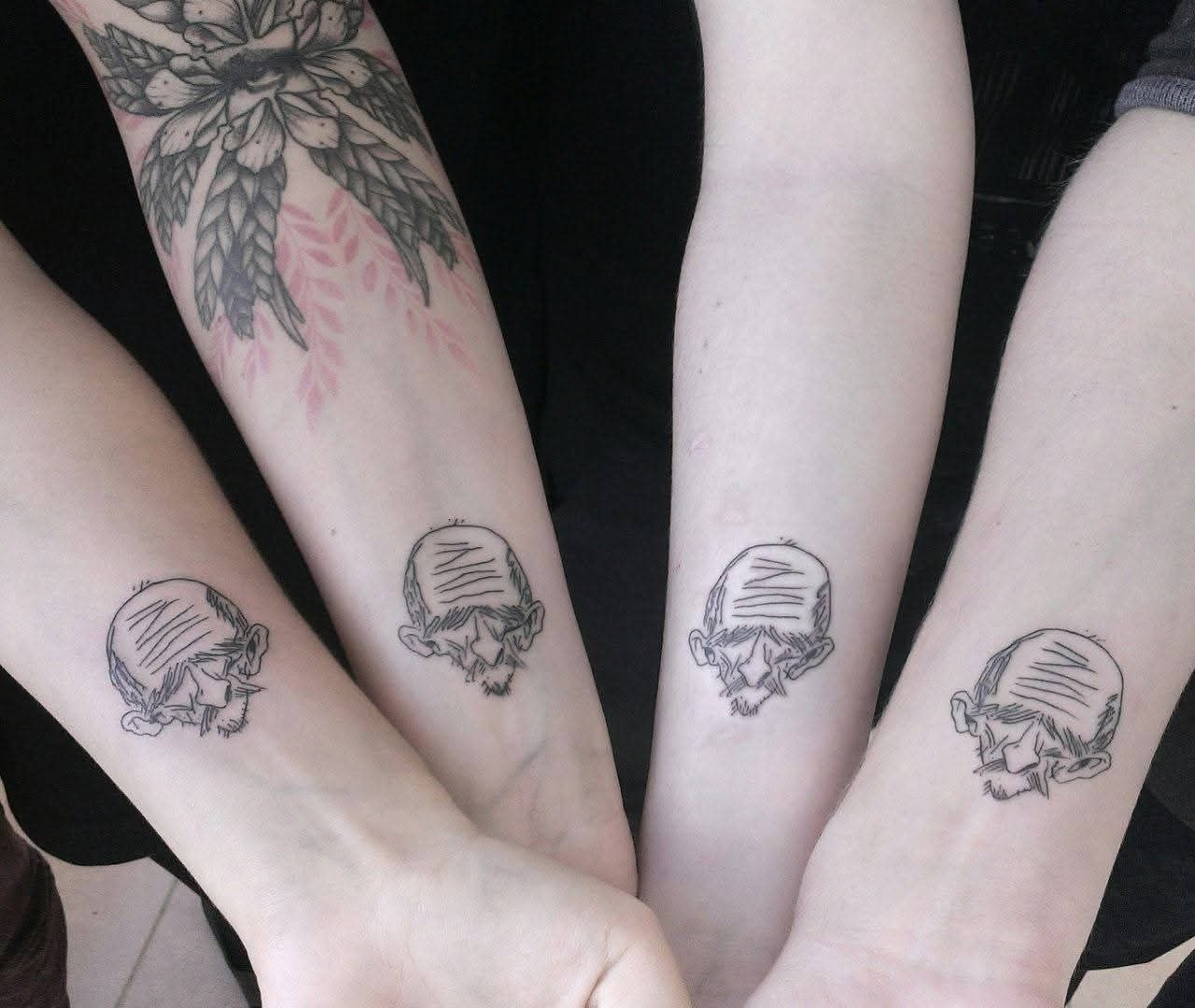
You’re pretty damn special when people get a tattoo of a drawing of you. I’m not talking about movie stars, rock gods, or athletes either. I’m talking about the Ukrainian director, artist, writer, and teacher Yevhen Syvokin, who died on May 5, two days short of his 89th birthday.
It turns out that some of his former students decided to pay tribute to their teacher with matching tattoos of his likeness. It’s a funny, strange, and touching tribute to a Ukrainian animator who spent much of his later life teaching students not to imitate him.
As a director, Syvokin brought a fresh, modern sensibility to Ukrainian animation during the Soviet period. At a time when many studio films were still aimed at children or working through the influence of Disney, his films leaned toward satire, caricature, graphic simplicity, and European animation.
Born in Kyiv on May 7, 1937, Syvokin studied at the Shevchenko Art School and later at the graphic arts faculty of the Kyiv State Art Institute, graduating in 1965. By then, he was already working at Kyivnaukfilm, the popular-science studio where Ukrainian animation was rebuilt in the 1960s by artists who had often begun with technical diagrams, educational films, and handmade animated inserts. Syvokin arrived as part of the next wave: a trained artist entering a studio still searching, as he later put it, for “its own face, its own style.”
His first studio work was a small animated sequence in The Adventures of Perets (1961), directed by Ippolit Lazarchuk, one of the pioneers of Ukrainian animation. The film remains a landmark: it was the first Ukrainian animated film made after animation production resumed in Kyiv in 1959.
Syvokin then worked as an artist on several more Lazarchuk films, including Drunken Wolves (1962), The Golden Egg (1963), and Mishka and Mashka (1964).
On Mishka and Mashka, he brought a flatter, more economical design influenced by Khitruk’s The Story of a Crime (1962). Around the same time, films from Poland, Czechoslovakia, Romania, Hungary, and the Zagreb School began reaching Kyiv. “We watched those films as a whole studio,” Syvokin said, “just as at the very beginning we had learned from Disney.” Ukrainian animation, as he remembered it, became “a symbiosis of different styles.”
Those early credits placed him inside the working circle that would define Kyiv animation for decades: Radna Sakhaltuyev, Eduard Kyrych, Mykola Churylov, Alla Hrachova, Iryna Hurvych, Davyd Cherkaskyi, Volodymyr Dakhno, and others, moving between one another’s films, arguing over projects, and absorbing each other’s habits. Syvokin later remembered the studio as a collective in the fullest sense. People played football and cards together, visited one another, married, divorced, watched films, and compared work. “Back then at the studio, we were all in the same boat,” he said.
He made his directorial debut with Shards (1966), with Lazarchuk as artistic supervisor. Shards was made up of three satirical stories set in prehistoric times. A man approaches a cave with a big rock. At the first narrow passage into the cave, the rock gets stuck, so he chips a piece from it to make it fit. He continues on, gets stuck again, and chips away more. Each checkpoint demands another cut. By the end, he finally reaches another man and hands over his now-approved rock, only for it to be tossed onto a pile with other rocks that look exactly the same.
While no one in Moscow objected, surprisingly, to the story, the studio director in Kyiv wasn’t thrilled about the use of Beatles music and insisted it be removed, until the next day, when he changed his mind after reading somewhere that the band had donated part of its fee to the Communist Party of England. The music could stay.
In those days, a short film under ten minutes was usually allotted nine months of production, not counting the screenplay. One month went to the director’s script, followed by a preparatory period for sketches and the film’s visual solution. But the hardest stage, Syvokin said, was approval. A finished film had to be shown 21 times to different authorities, first in Kyiv and finally in Moscow. “Everywhere they forced you to make one kind of correction or another,” he said.
After Shards, Syvokin was officially classified as a director, and directing assignments began coming his way. “At that time you couldn’t work the way you wanted; everything had to follow prescribed rules.”
That feeling seeped into his next film, The Man Who Could Fly (1968). A man dreams he can fly, then discovers that he really can. Instead of being welcomed, his gift is examined, tested, criticized, and corrected until he loses both the ability and the desire to fly. For Syvokin, it was a parable about what happens when professionals and officials start teaching artists how to create.
Throughout his career, Syvokin kept changing direction. The Man and the Word (1973) was a minimalist satire made up of five miniatures about the power of language: how words can stain, exalt, wound, reconcile, and shape human relations. In The Tale of the White Ice Floe (1974), he turned toward ecological satire, following a Penguin and a Whale trying to keep their ice home clean while visitors praise order and cleanliness, then leave garbage behind. Beware — Nerves! (1975), about an ordinary man worn down by the accumulated strain of daily life, uses a collage technique combining photographs and short live-action fragments, and has a Jan Lenica flavor in its background design and central figure.
“I always wanted to try something new,” he said. “Not getting fixated on one thing. Each story dictated its own solution.”
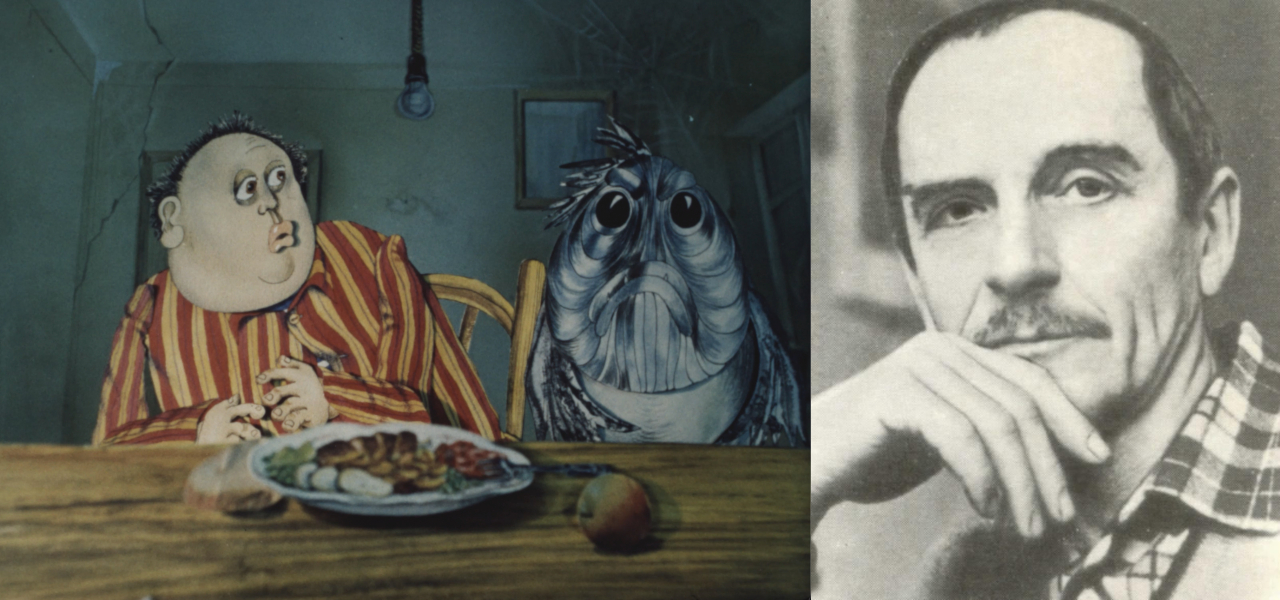
One of his strongest films was Laziness (1979), a sharp comic critique of passivity and accommodation. A man sits in front of his aquarium watching as one fish begins eating all the others. He knows he should intervene, but he does nothing. The fish grows stronger, devours everything around it, and eventually throws the man into the aquarium, where he begins turning into a fish himself. Instead of resisting, he adjusts. It is warm, he is fed, and he decides that perhaps nothing needs to be done after all.
That bleak little joke was enough to make the film politically suspicious. In his own view, the film was about a man who did not care what happened as long as he was left alone. The authorities disliked that, he said, because they saw in it the image of an “un-Soviet person.” The film was accepted only on the third attempt, after a persistent studio editor kept taking it back to Moscow.
Film expert Oleg Olifer of the Dovzhenko Centre first saw Laziness as a child. “It scared me incredibly,” he said. “It was perceived as a horror film. Even as an adult, I was impressed, as Syvokin was so bold in depicting conformism in the stagnant waters of the aquarium.”
Laziness also has a small but revealing place in animation history because the young Alexander Tatarsky and Igor Kovalyov, later major figures in Soviet and post-Soviet animation, worked on it as animators. “Syvokin was my first animation teacher,” Kovalyov recalled. “He was a very intelligent person, a very ironic person. He knew very well the history of live-action cinema.”
Syvokin continued working after independence in 1991, though the system around him had changed drastically. Where Kyivnaukfilm had once produced a large number of films and employed hundreds of artists, Ukranimafilm (as Kyivnaukfilm became known after independence) was making only a few state-funded films a year. Many artists left, and many of the old collective habits disappeared. People who had once worked side by side now worked separately, often at home, on computers.
His later films became more stripped-down and tactile. Among the highlights, and a personal favorite of Syvokin’s, was Snow Will Cover the Roads… (2004), a touching tale of a man looking back over his life. The film was made with salt, roasted semolina, and coal.
In 1993, Syvokin opened an animation directing workshop at the Karpenko-Karyi University in Kyiv. It was the first group of students in Ukraine’s history to study animation film directing. Stepan Koval, later the director of The Tram Number 9 Went, was one of the seven students selected.
For Koval, Syvokin’s teaching was not theoretical. The workshop was led by active directors, artists, and animators from Ukranimafilm, practitioners passing on practical experience. “The profession of director is more like a way of life, a special way of seeing the world around you,” Koval said. “That is exactly what Yevhen Syvokin taught us.”
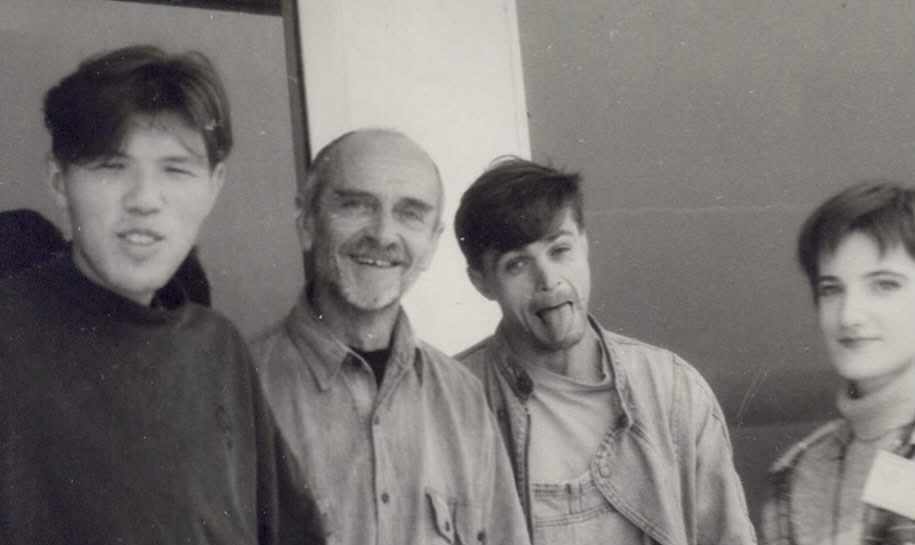
He remembered Syvokin teaching students to “anticipate, invent endings for stories, see the structure of films, think originally, and connect the artistic solution with the plot and theme.” It was not something he had found in books. It was, Koval said, a “transmission of knowledge and skills in a calm, intelligent manner.”
Animator and former student Rodion Shub remembered the same gentleness. Syvokin, he said, was “always incredibly well-mannered — refined, kind, and remarkably gentle as a teacher.” When he disagreed with a student, he did not insist on being right. He would simply say, “Let the screen decide.” He also resisted turning students into copies of himself. “I don’t need fifteen little Syvokins,” he told them. “I need personalities.”
For Olifer, Syvokin’s career formed a bridge across Ukrainian animation history. He called him “a living legend, the last of the outstanding Ukrainian animators who were creating in the 1960s” and who then “trained and educated several generations of animators in independent Ukraine.” Since Syvokin had started with Lazarchuk, one of the pioneers of Ukrainian animation in the 1930s, Olifer said that “by studying just Syvokin’s filmography, one can cover the entire history of Ukrainian animation.”
“For my generation,” added animator Mykyta Liskov (Kyiv Cake), “Syvokin was the link to the legendary Kyivnaukfilm. I was fortunate to speak with him extensively about this period in cinema history, and I was struck by his honesty and modesty in his assessments of his films; there was not an ounce of pathos or arrogance in him.”
“Oh, with what incredible respect his students speak about him!” added Alona Penzii, an animation critic and head of the archive department at the Dovzhenko Centre. “It was he who founded the Department of Animation Film Directing at the I. K. Karpenko-Kary National University of Theatre, Cinema and Television in Kyiv in the 1990s. And in general, while working at the studio, he actively encouraged young people to get involved in film production. He was professional and responsible in everything he undertook. Such people inspire me enormously.”
Olifer also remembered Syvokin’s help in a more immediate context. After Olifer was mobilized into the Ukrainian Defence Forces in 2024, Syvokin helped raise funds for his battalion, Forpost, during what Olifer recalled as Syvokin’s last exhibition at the Dovzhenko Centre.
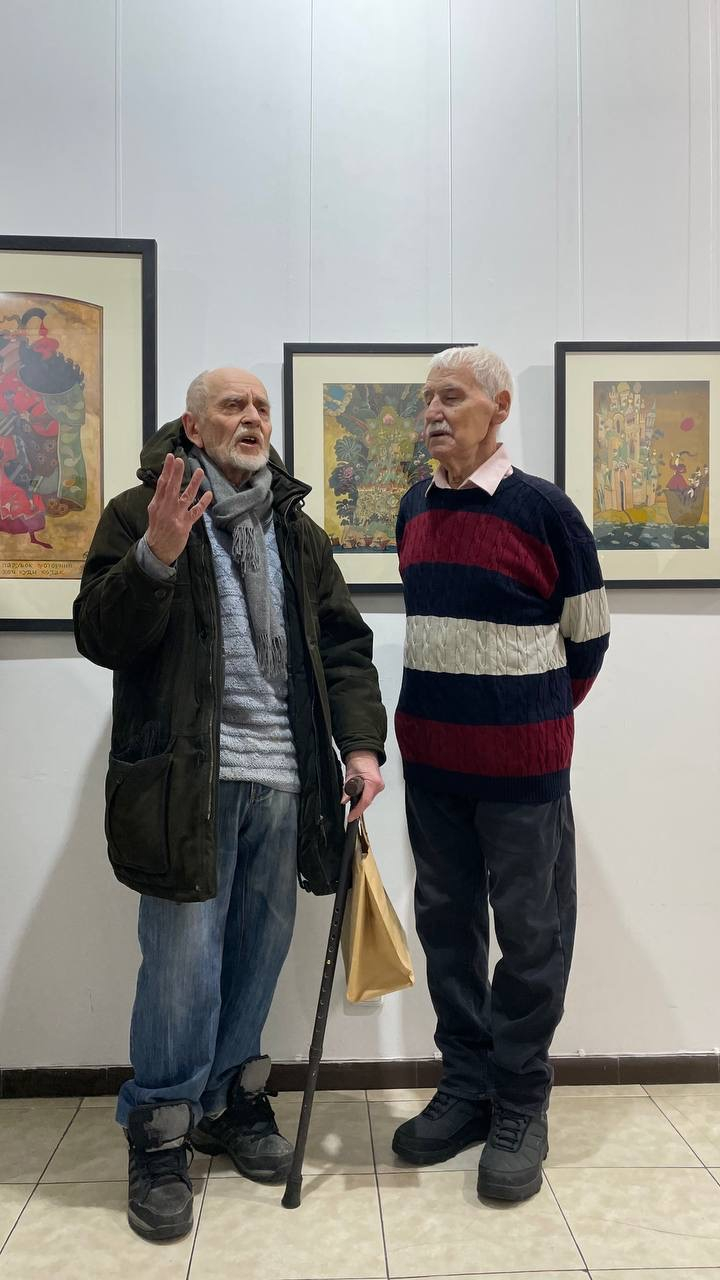
Syvokin kept working right until the end. Retirement was nowhere in his timeline. “He was very active and alive, not an old man,” said Shub. “He kept himself strong by playing tennis and making movies until the end. Lately, as far as I know, Stepan Koval helped him install a stop-motion studio in his kitchen, where he continued to create.”
“Animation is a distillation,” Syvokin said in 2021. What live-action cinema might need half an hour to say, animation could say in three minutes. Animation, for him, was “working with time.”
And he knew all about working with every manner of time: the strict time of the Soviet production schedule, the wasted time of approvals, the comic timing of satire, the slow time of teaching, and the handmade time of images built one frame at a time.
Yevhen Syvokin’s legacy itself carries Ukrainian animation’s long, chaotic time: its technical beginnings, its humor, its compromises, its arguments with authority, its collective energy, and its search for a voice of its own.
Thanks to Mykyta Liskov for sharing his interviews with Syvokin from 2021. Liskov and I are co-authoring the book Crawlspace of Perseverance: Exploring Ukrainian Animation, due out in 2027 to coincide with the centenary of Ukrainian animation.