.png)
BTS Of Disney’s Latest ‘Short Circuit’ Films, And Why It’s One Of The Studio’s Most Interesting Initiatives
Stay informed with free updates
Sign up to get our news digest — delivered directly to your inbox twice a week.
Walt Disney Animation Studios added two new entries to its ongoing Short Circuit short film program on Disney+ this week: Heather M. Roberts Russell’s Maddie and the Test and Larry Wu’s Life Drawings.
Established as the studio’s “experimental” short-form program, Short Circuit gives blind submission opportunities to anyone in-house with an idea. Once selected, they are officially appointed director, assigned a veteran mentor, and eventually staffed with a volunteer team of animators to complete the short.
These two shorts are the 21st and 22nd entries in the series, and both were born out of very personal stories for their creators. At a recent press day, Cartoon Brew sat down with the new directors, longtime members of the Disney animation team, to discuss the evolution of their stories within the Disney Burbank pipeline.
MADDIE AND THE TEST
With Maddie and the Test, Russell said the idea came from a conversation she was having with her then-12-year-old dyslexic niece, Amanda. She said the short developed into a way for those with the learning disability “to feel seen,” and, on a broader scale, for everyone who has learned to face difficult moments to “draw from the tools we’ve developed over time to handle those tough moments.”
As a department manager at Walt Disney Animation Studios for the last eight years, Russell has spearheaded this first personal project at work, so she was paired with Trent Correy, the director of the Short Circuit film Drop.
In her concept, the CG animated setting focuses on a little girl named Maddie who is preparing for a math test featuring word problems. With her kind of dyslexia, she starts to panic as the words morph on the page, creating confusion and self-doubt. What she sees on the exam is a 2D animated purple stick figure racing around the test page, wreaking further visual havoc.
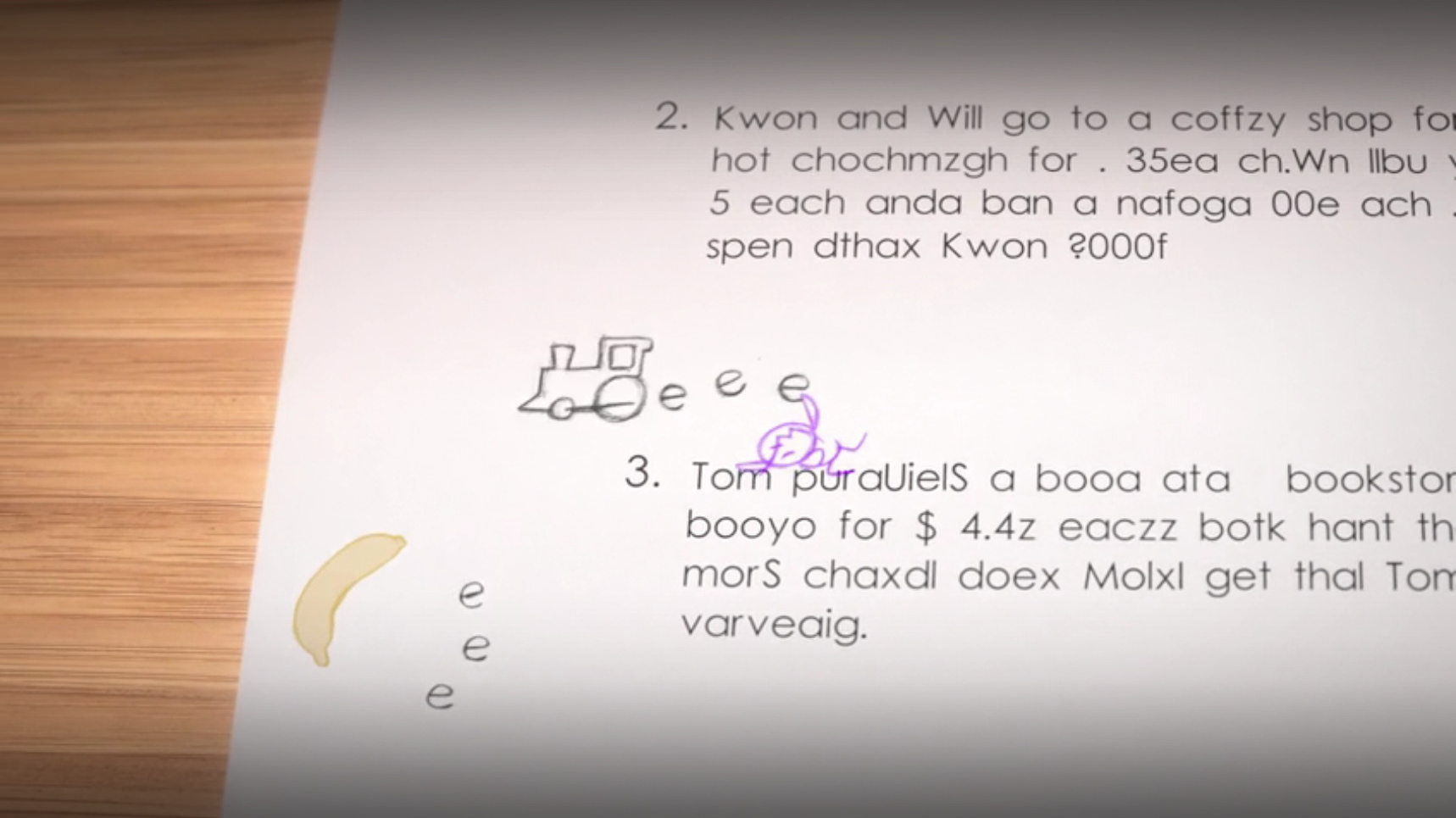
Coming from a theater background in New York City, Russell said she began by creating a rough set of storyboards to share with Correy.
“It started off with the idea of what it could look like,” she said of her process. “In some of the earlier versions, the little purple character actually came from Trent playing with the squash and stretch of the character. Not only was he there supporting me as a director, but he was helping me find those visual aspects of the film, which was really cool.
“And then early on, I had a visual development artist, Joe Pitt, who did the design for Maddie and named her Maddie,” Russell continued. “He was part of the early development process, and he had a few extra hours and actually boarded the whole short. And then Rachel Bibb, who came from TD [Technical Direction], took those as inspiration and wound up boarding the short. It was all of us collaborating together, looking at these three different versions of the short itself, and just tapping people and not being afraid to show stuff that was rough.”
For the 2D work, Russell said she was floored when veteran Disney animator Mark Henn offered to animate the character. “A lot of our artists express an interest in wanting to work on projects, and that’s something as a department manager that I deal with all the time, trying to get people on things they want to work on,” she explained. “In this case, his department manager heard that he wanted to work on it. He happened to be free. It was a little bit of kismet, if I’m being honest. I honestly lucked out more than anything else on that.”
Why she wanted to use 2D animation in her short wasn’t just due to the legacy of the studio. “There was a creative choice behind it because there was so much on the paper that we wanted to create that had a sense of dynamism,” she said. “And some of the comedic joy that you get from hand-drawn animation just lent itself to that medium. That’s why we chose to go down that path of having all the hand-drawn animation on the paper, and then the CG around it, which was technically very challenging. It has happened in some of our other films, but every time you do it, it’s a little different and a little more of a challenge.”
LIFE DRAWINGS
As for Larry Wu’s pitch for Life Drawings, he said he was looking at his own family in parallel with the evolution of his artistic journey from childhood through his now 11-year career at Walt Disney Animation as a lead visual development artist.
“The idea popped into my head to go through all the different stages of life, but capture it through all the different art forms,” Wu explained. “For me, it was really important to tell the story in a way that makes sense at every stage of life. Some stages tended to benefit from hand-drawn and some from all CG. And there were a few where you needed to blend them and have the perfect composition of both.”
Wu said once he was notified that his idea was selected, he was paired with mentor and director Don Hall (who has since moved to Skydance Animation). He then took his idea on an internal roadshow to every department to get individual collaborator interest.
“From there, people just come up to you and say, ‘Yeah, I want to work on it.’ But there is a scheduling aspect,” he explained. “Some people who want to work on it don’t get to. And then some people who still want to work on it get assigned because they’re available at that time. It is a bit of chance as to who gets to work on these shorts. But every person who jumped on, from artists to managers, once they realized what I was trying to say, volunteered ideas. The fact that they were willing to share their thoughts was a huge surprise, but it really made my short better because I used a lot of their ideas.”
Wu also cites the impact of Disney animation legend Burny Mattinson’s contributions before his passing in 2023. “I just pitched it with a stick on the board, and he said a few words, but they had a really huge impact on the rest of my development.”
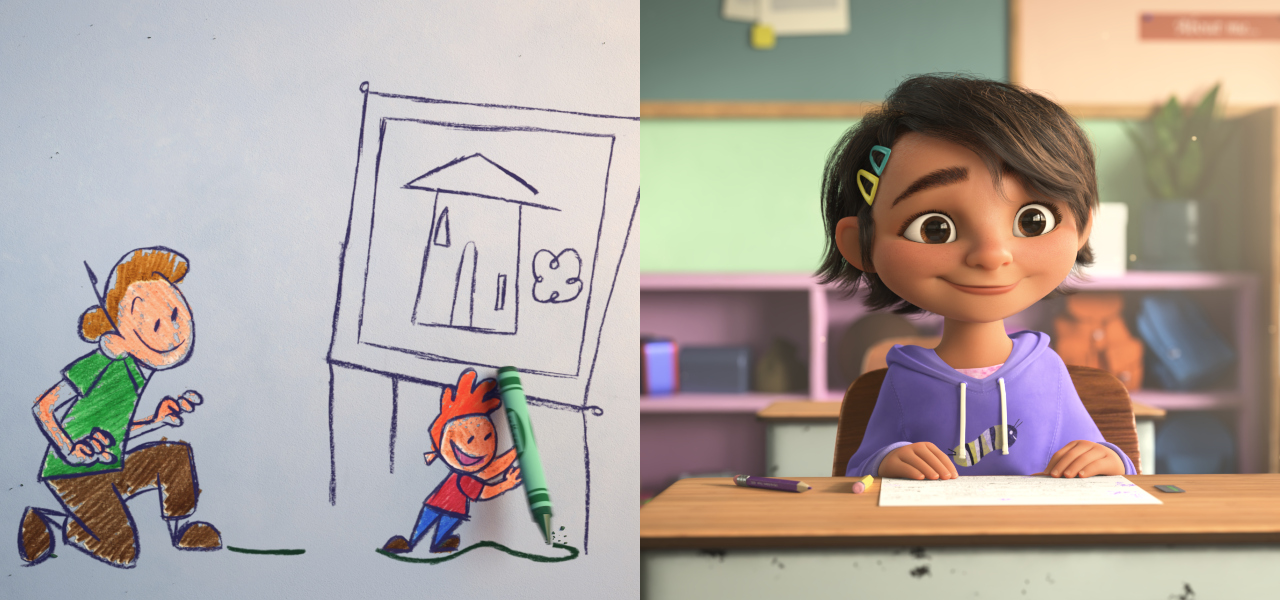
In the final short, Wu and his team tell the story of a child artist inspired by his painter father. As they develop their skills over the years with crayons, pencils, oils, and digital tools, each medium is expressed visually in the short through different animation techniques.
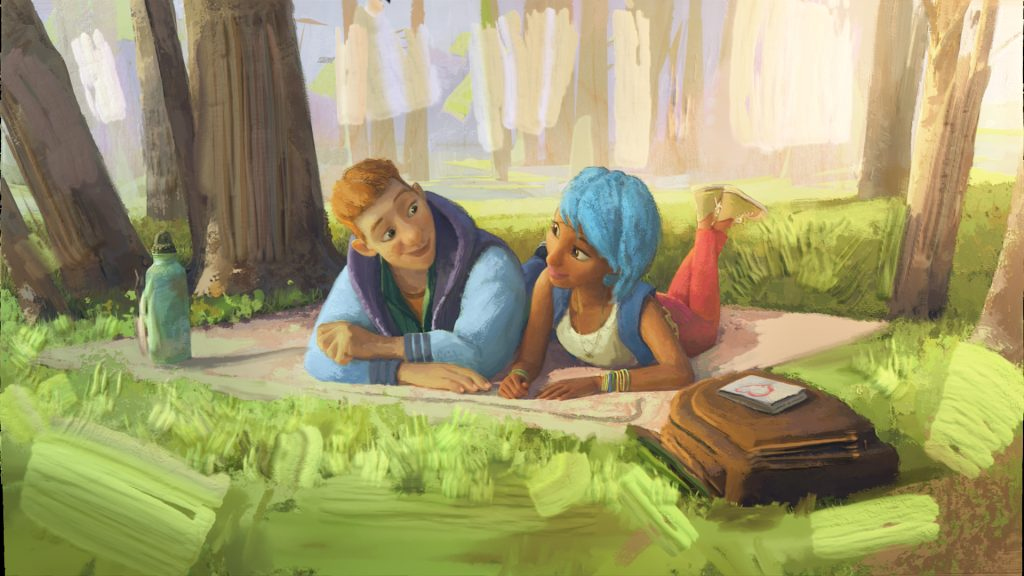
“The early stages are obvious for most younger people. You start with crayons, and then you go into grade school and have ruled paper available for pencils,” Wu said. “But once he graduates from college and tries to get gallery work, I have a lot of friends, myself included, who tried to make a living, but it’s really hard. And then I would say the instruction manual sequence was a representation of your working life stage. It was the longest section with one style because your working life is your longest stage until maybe you start a family or something else. And then going back to what you love, which is the painting of the couple, and at the end, the daughter drawing and starting her life.”
Of all the featured techniques, Wu said the painterly picnic sequence and the CG dragon segments took the most time for him and his team to work out. “Most of my time was spent thinking about the early life sections because they involve younger drawings, but I wanted to capture the great animation that we have here, so it was about how to do it the right way,” he said. “But when the two animators, Austin Traylor and Tyler Pacanat, jumped in, they knew exactly what I was looking for, and they didn’t need to do much testing. Their first pass was right on, so those actually took the shortest time.”
Regarding his professional growth over approximately five years of production, Wu said his goal was to truly learn the job of a director. “I wanted to showcase my directing skills, so I didn’t do any actual animation work. I just helped out a little bit.”
Wu said he was able to lean on Hall’s advice to expand his longtime leadership experience into directing others to do their best work. “I’ve worked with him on almost all his projects here. He just let me do my thing,” he said of his mentor. “But once the directing part started, he was like, ‘Oh, you got this.’ I only went to him if I was stuck with something. I’m kind of like that too, so if people come to me for advice, I’m a man of very few words, and I think Don’s kind of like that, at least with me.”
Disney Animation’s latest Short Circuit entries offer another example of why it’s one of the studio’s most worthwhile creative initiatives. Designed as an internal incubator for bold, personal ideas, the program empowers artists across departments to step into directing roles, collaborate across disciplines, and experiment with hybrid techniques that might not fit within feature production. As these two shorts demonstrate, Short Circuit is not just a training ground but a genuinely exciting space where risk-taking is encouraged, distinctive voices emerge, and some of the studio’s most inventive work is taking shape right now.