.png)

‘Dog Alone’: A Deeply Personal Short From BAP, One Of Portugal’s Most Distinctive Animation Studios
Stay informed with free updates
Sign up to get our news digest — delivered directly to your inbox twice a week.
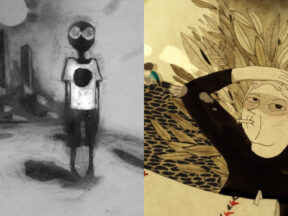
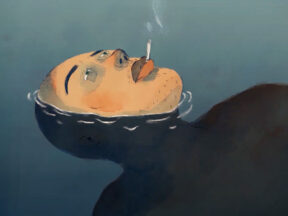
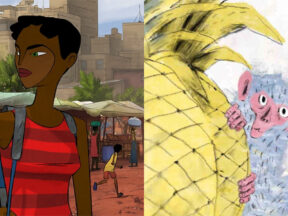
On the heels of Percebes (Alexandra Ramires & Laura Gonçalves, 2024), The Garbage Man (Laura Gonçalves, 2022), and Drop by Drop (Alexandra Ramires & Laura Gonçalves, 2017), among others, Marta Reis Andrade’s touching debut film Dog Alone is another in a line of unique animated productions from leading Portuguese outfit, BAP Animation Studios.
Together, these films dance on the line between reality and fiction, fusing elements of documentary with something leaning toward magical realism.
Speaking about this shared approach, Alexandra Ramires says that it grows directly out of the way they work at BAP. “We believe that it is linked to our experience as filmmakers and our vision of what it means to make films. Films are sometimes a powerful expressive tool for communicating feelings and thinking about our personal concerns and those of the contemporary world… basically, it’s as if we invite the voices of the reality that surrounds us to write the film with us.”
For Laura Gonçalves, the attraction lies in the tension between raw testimony and the open, metaphorical possibilities of drawing. “We find it really stimulating to explore this merge between these two very different worlds: on one hand, the real people telling their own stories in contexts that are important and meaningful for us as directors; on the other, the endless possibilities that 2D animation provides in creating infinite worlds filled with metaphors and poetry.” The real voices and contexts, she says, give “a very strong foundation of realness, which allows us to play (and go crazy) with the possibilities of the animation,” while still respecting the people and situations they are trying to document.
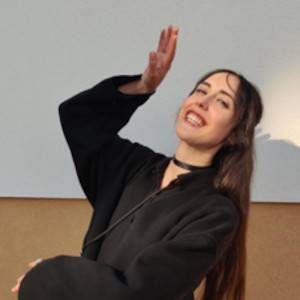
Andrade, who joined BAP in 2018, situates Dog Alone inside this same space. “Xá and Laura are amazing inspirations for me, and I am a great admirer of their work. I felt the stories being told here were very true and honest, but nonetheless extremely poetic.” What draws her to using recorded voices is the intimacy and specificity they carry: “Using voices that come from the actual people talking about events or feelings brings a closeness to the viewer. What they say is spontaneous and unique. It is not rehearsed, and that is an incredible beauty of capturing these traits.”
From this broader context of BAP’s hybrid documentary–magical realist practice, Dog Alone emerges as a particularly personal variation.
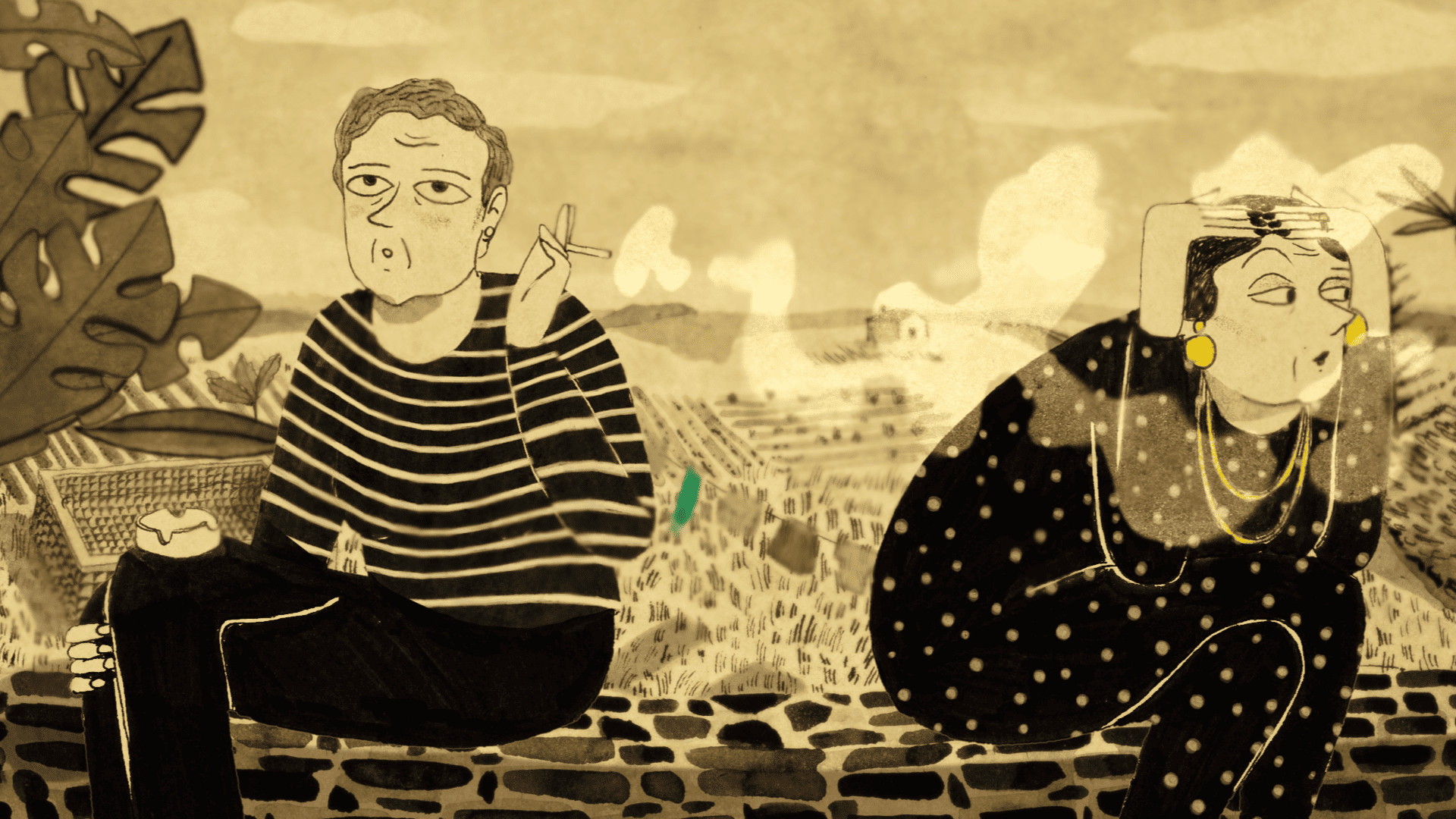
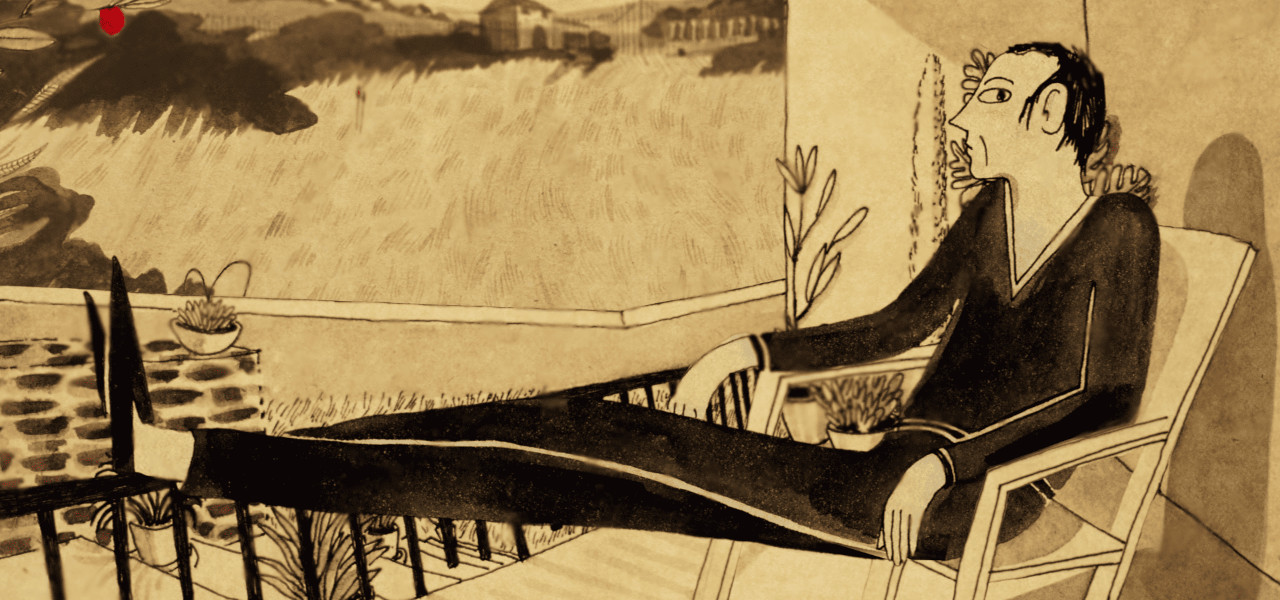
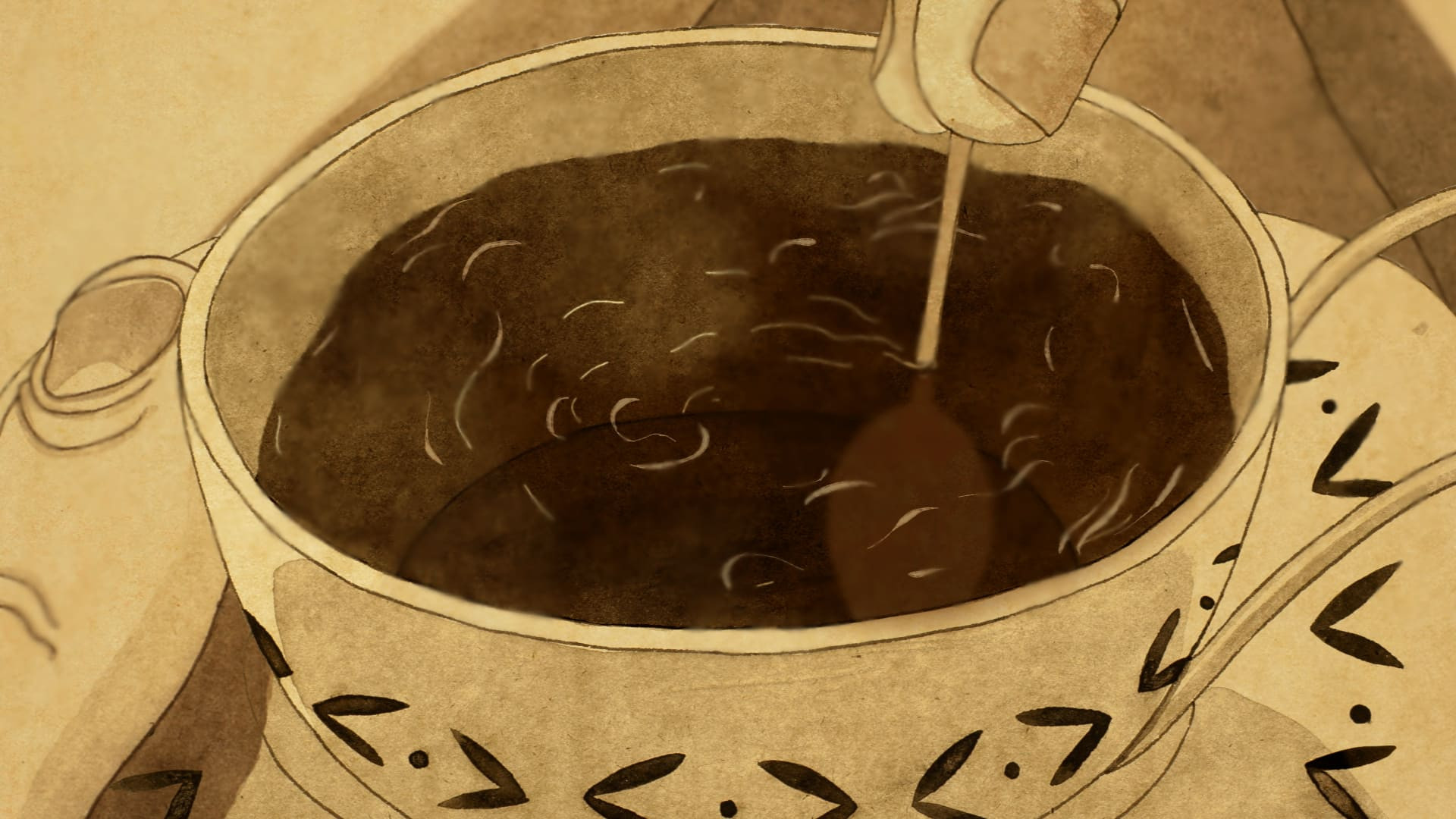
The film is drawn in sepia tones with small splashes of colour and follows a young, troubled woman in a city that feels overwhelming and alienating. Surrounded by strangers and unable to find calm or connection, she finally escapes to the countryside, returning to the home of her parents, aunts, and recently widowed grandfather. Nearby, a dog has been abandoned. When she first goes to see it, the dog is vicious and worn, and she is frightened. Gradually, she overcomes this fear. Through her bond with the weakened animal, she reconnects with her childhood, her family, and a part of herself she felt slipping away.
Dog Alone is a film about connection: with family, with nature, across generations, and within oneself. It seems to respond to a world that has become increasingly disconnected, while also acknowledging that time passes, things change, we age, and we die. Yet it also holds on to the idea that as long as we are alive, we may still be able to find the youth inside ourselves—those memories and experiences we thought were gone or unreachable.
Andrade explains that the film “was triggered by the learning and witnessing of the situation of the actual dog in the house next to my grandparents’ house. On that same balcony of the film, I heard what was going on through the reports of family.” The dog’s condition resonated deeply with her. “At that time, I realized that this was the true incarnation of loneliness, a feeling that was haunting me at that time.” Talking about the dog with relatives and neighbours, she noticed how each person responded differently. “When talking about the dog with my family members or any neighbour that would come around, I understood how each one deals with this feeling. My grandfather was resigned and was the only one who said, ‘As a dog, I can do nothing about my situation.’”
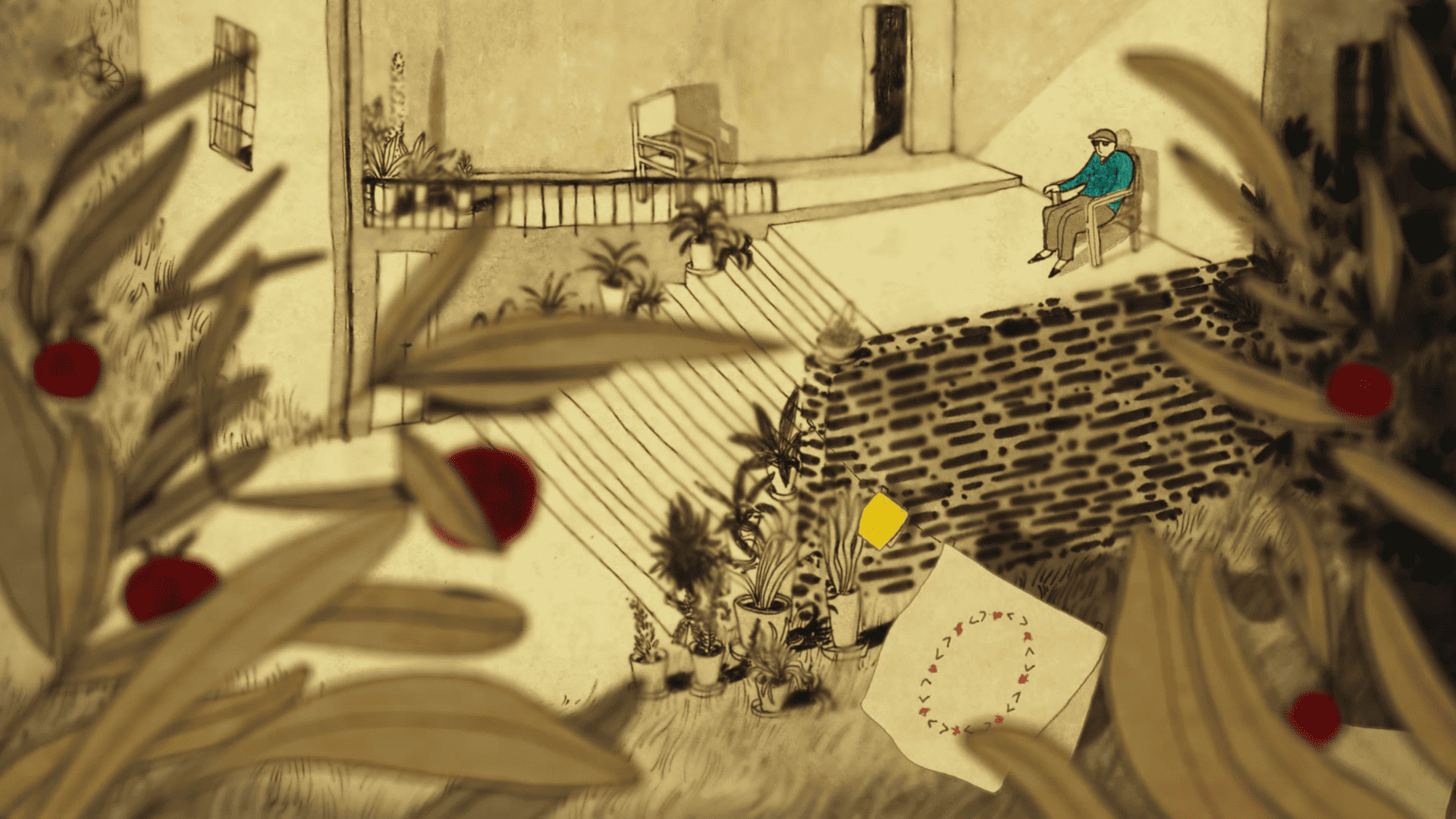
Because Dog Alone uses the real voices of her family, the recording process became one of the most difficult parts of making the film. “First, I was recording the conversations without much direction. I later started to interview them, but not just one person at a time. If you have more than one person being asked questions, the person feels more relaxed, and the speech becomes more natural and with real reactions. I wanted to capture their manner of speech and expressions.”
However, the original recordings could not be used. “They were too badly recorded. At that moment, I had a problem that I thought could be easy to solve, but it wasn’t.” She tried several methods. “I wrote the words down for them to read. This didn’t work at all. It made everything sound artificial. Then I tried saying the things they said before, and they repeated them the same way as I did. This didn’t work either. The third method was to ask the same questions in different ways so they could maybe reply the way they did in the first interview. This gave me some hope and a few answers. My aunts were fed up with me at this point.”
Finally, she repeated the original interview with one adjustment. “I asked them to speak in the present as if things were happening now. They were together in the same room, each with a little microphone attached to their clothes. This was the best method—and also the will of my family not to have any more of these recordings around.”
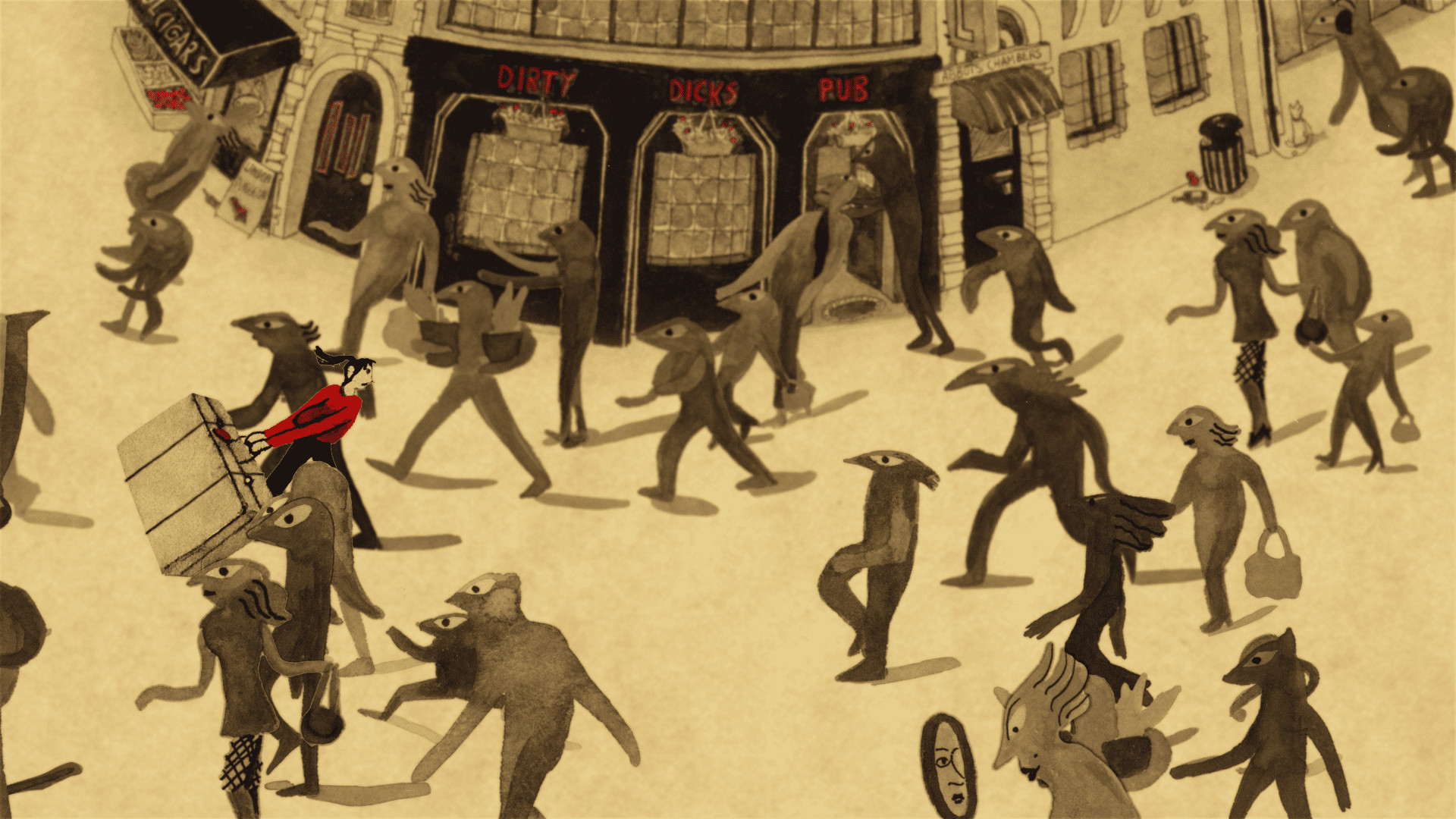
Visually, Dog Alone is dominated by sepia, but the main character and her grandfather appear in colour, while the rest of the family is in black and white. Andrade says the colours are minimalistic but deliberate. “Yes, the colours of the film are quite minimalistic, but they have a reason to be there, for me.” Her character wears red. “Marta’s character uses red, which goes along with her passion to change situations. Red is a warm colour, while blue is a cold colour. It was important for me to show that Marta wants to touch and show physical affection, while her grandfather really wants that warmth.” The blue of her grandfather’s clothing came directly from memory: “My grandfather used to wear a long coat when he was working in the garden that was completely blue, so I always associated that colour with him.”
Another visual idea emerged early and remained central: the main character becoming physically smaller as she climbs the stairs to her grandfather. Andrade says, “I always imagined Marta going upstairs to her grandfather and becoming smaller and smaller. I understood from the writing that it made perfect sense that she would become smaller and younger because she needs to get to her grandfather as a child. Physical affection is much easier when you are a child. People hug and play much more easily with children.”
Sound plays an equally important role in Dog Alone. Andrade worked with sound designer Bernardo Bento, who first joined the project to record the family’s voices. “As in all the phases, we did it together, discussing ideas and trying many different approaches. I did the sound of the animatic quite poorly, but with the main ideas already there. Then I passed it to Bernardo, who started to work on it.”
The music was developed with Grilo. “The music was done by Grilo from jam sessions we did together with different instruments, from the references I used in the animatic. I knew I wanted to use voices in the music, and since I play the violin, I made some melodies, and we used them in the final product.” Grilo orchestrated everything and built the main melody of the dogs running. “I started to work with the sound and the music early on because I wanted to achieve a symbiosis of both. I wanted the sounds to be part of the music. Bernardo did a beautiful job on the sound design, and it helped a lot that, with both Grilo and Bernardo, we had great communication. I felt they really understood my intentions.”
The sound was shaped closely to the emotional tone of each scene. “I guided the sound with the feeling asked by the scenes. It was essential to have moments without music and very simple sounds.” Andrade draws a clear distinction between the protagonist’s inner world and her time with family. “When the character Marta is in her own world, the music is more present and the situations become more surreal. However, when she is with her family, the most important thing for me was that it felt more real, so the sound becomes simpler and more realistic.” In at least one scene, sound even dictated animation choices: “The moment when the character is riding the dog and the music is very present was done in a way to be adjusted to the music.”
There were many challenging aspects to making Dog Alone. Andrade says, “I learned that I need to do the recordings better if I decide to record again. I did the script, the storyboard, and the animatic around 30 times until I felt it was right and faithful to what I wanted to tell. I wish to be faster in the future.”
The most difficult decision came early on: choosing whether the film should be documentary or fiction. “I couldn’t sleep at that time. I was really scared of making the wrong decision for the film. I felt loads of pressure that I created in my head about not disappointing people trusting me to do the film. I was afraid of making something that wouldn’t communicate my vision.”
Following bouts of anxiety and sleepless nights, she understood what she wanted. “I felt that I wanted to construct the story as an immersive experience, in the sense that there would be a character guiding the spectator through the events. It was also important for me that these events happen chronologically as well as poetically. I love real voices of people discussing things and the feeling of reality that documentaries give us, but the way I prefer to construct a story is through an adventure and so through fiction.”
Andrade’s family saw the finished film—everyone except her grandfather. “My family has seen the film, except my grandfather, who passed away soon after I received the funding to make it. He was extremely happy I got it. I miss him, and I think he might have liked the film.” Their reactions were emotional and specific. “My family, who appeared in the film, laugh at their own jokes from it. They really appreciated that I portrayed my grandfather, our village, and the house of my grandparents. Some members cry very much seeing my grandfather again, and they thank me for doing this, also for his memory. I am very glad they weren’t vexed by my portraits and that they could feel the film as an object that has a bit of all of us.”
Her own response remains emotional. “I miss my grandfather very much, and I am glad I hugged him many times before he went away.” She still thinks about the real dog who started it all: “I also feel sorry for the poor dog that nobody had the courage to touch, except the animal protection lady who came once and the undertaker when he was already cold.”