.png)
‘I’ve Seen That Kind Of Thing Before’: Why Eddie Alcazar Chose Clay Over Pixels For His ‘Bullet Time’ Video Game Segments (EXCLUSIVE)
Stay informed with free updates
Sign up to get our news digest — delivered directly to your inbox twice a week.
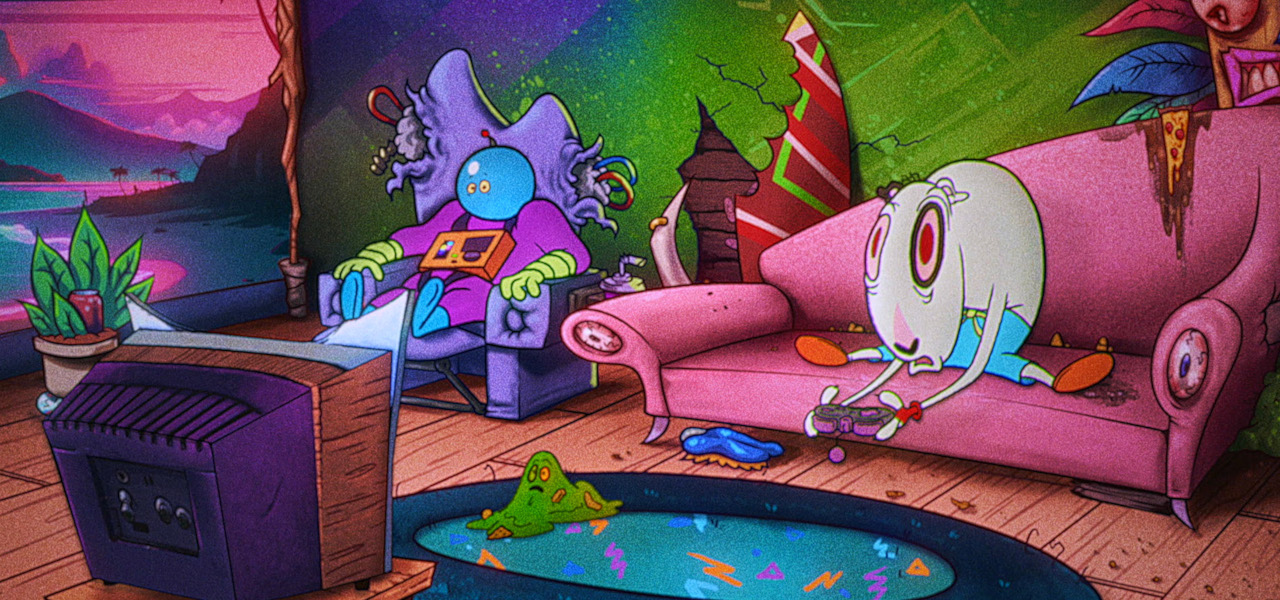
From the hypnotic surrealism of The Vandal to the monochrome precision of Perfect, filmmaker Eddie Alcazar has never shied away from blending form and function. But his latest animated short, Bullet Time, might be his most eclectic and unexpected work yet: a hyperkinetic, day-glo homage to ’90s cartoons, video games, and late-night cable weirdness, fused with labor-intensive stop-motion clay animation.
After screening at Fantasia and earning a devoted online following even before its July 28 wide online release, Bullet Time is a fever dream of hot pink explosions, psychotic mascots, VHS-era gaming logic, and off-the-rails narrative chaos. But buried beneath the surface-level madness is an ambitious experiment in form, particularly when it comes to the stop-motion sequences, a standout visual element, and the focus of an exclusive behind-the-scenes video we’re debuting this week.
A Visual Pivot From a Monochrome Past
Alcazar, known for his meticulous use of black and white and his often meditative tone, admits that Bullet Time was born out of a desire to do the exact opposite of what he’s best known for. “I felt less confident with color,” he told Cartoon Brew. “So I was like, alright, let’s go really hard with this.”
And go hard he did. The short is drenched in a radioactive palette of incandescent greens, magentas, and oranges, an aesthetic straight from the Liquid Television and What A Cartoon! ’90s. The character design leans into nostalgia with a vengeance, channeling Ren & Stimpy, Beavis and Butt-Head, and Earthworm Jim, while the world-building evokes everything from Rocko’s Modern Life to ClayFighter.
But the true showstopper? The video game sequences are rendered in stop-motion clay animation, a stylistic risk that could have derailed the short, but instead emerge as one of its most arresting features.
Clay Animation as Commentary and Craft
Originally, Alcazar considered using pixel art or lo-fi 2D graphics for the video game segments. But the idea felt too familiar, too safe. “I’ve seen that kind of thing before,” he recalled. “I was just trying to figure out a fresh new way of combining some styles.”
Enter stop-motion clay animation, a medium Alcazar had dabbled in before, but never like this. Bullet Time‘s video game sequences blend nostalgic charm with a physicality and surrealism that would be difficult to replicate in 2D or CG. It also helps the hits land harder in the short’s fictional fighting game.
To pull it off, Alcazar enlisted two veteran animators: Rich Zim and Dan Pasto. Zim, who worked on Pee-wee’s Playhouse, brought decades of practical experience, while Pasto added a fresh sensibility that helped bridge the old-school aesthetic with modern pacing. “It was a perfect thing,” Alcazar said. “Rich and Dan were just getting off another project, and the timing aligned.”
Despite the medium’s notorious demands, the stop-motion segments were completed on a relatively fast timeline, just a few months. “That’s really fast for stop motion,” Alcazar noted. “Something like [Cannes Directors’ Fortnight player] The Vandal took a year and a half.”
The labor is visible in every frame. Figures are deliberately exaggerated and stylized, trading realism for a warped elasticity. Characters pulsate with emotion as they bob up and down in place, as they did in the early console days of Street Fighter and Mortal Kombat. Movement is playfully erratic, and the environments feel sculpted rather than rendered, a contrasting and bold reminder that these scenes were built by hand.
An exclusive behind-the-scenes video shared with Cartoon Brew shows just how intensive the process was: armatures being painstakingly posed, lighting tweaked millimeter by millimeter, and sets handcrafted from scratch to reflect Alcazar’s vision.
From Passion Project to Pilot
Although Bullet Time currently exists as a standalone short, Alcazar has always seen it as a pilot, a suggestion of something much larger. “We’re working on the rest of the episodes now,” he confirmed. “There’s so much that could be expanded in the world.”
The story, loosely centered around a dog named Bullet and inspired by Alcazar’s real-life pet of the same name, is more about personality than plot. “There’s so much animation out there that’s trying to push story above everything,” Alcazar said. “I wanted to go back to characters, to expressions, to wackiness.”
That tonal shift came with a learning curve. “Most animation directors are animators. I’m not,” he admitted. “So I had to learn how to communicate everything visually — by sketching, by showing, not just telling. That was the trickiest part.”
To aid the transition, Alcazar brought in animation legend Bob Jaques, who directed the first two seasons of Ren & Stimpy. “I learned so much from him,” Alcazar said. “Stuff like line weights, focal points—things people overlook but are critical to the art.”
He also recruited Academy Award nominee Danny Elfman, who is known for composing the iconic theme to The Simpsons among his extensive catalog of work, to create an original score for the short.
The Future of Bullet Time
Whether Bullet Time becomes a full-fledged series remains to be seen. Alcazar has already fielded interest from distributors, but says he’s in no rush to hand it over. Inspired by success stories like Glitch Productions (The Amazing Digital Circus) and independent juggernauts like Vivienne Medrano (Hazbin Hotel), Alcazar is considering a hybrid approach that would allow him to retain control while leveraging streaming reach.
“There’s a lot of power in being an artist now,” he said. “More than before.”
Until then, Bullet Time stands as a singular piece of animation, rooted in the past but defiantly forward-looking. It’s a love letter to an era when animation was analog and unfiltered, made with precision and reverence.