.png)

Movistar Plus+ Ends Three-Decade Commitment To Spanish Short Films, Prompting Industry Backlash
Stay informed with free updates
Sign up to get our news digest — delivered directly to your inbox twice a week.
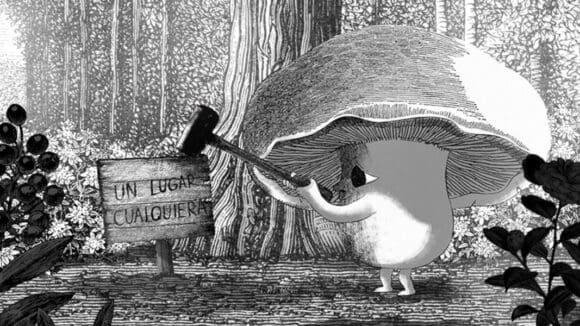
Last week at Annecy, Alberto Vázquez’s Decorado, based on his 2016 short of the same name, won the Paul Greimault Award after screening in the main feature competition at the world’s most important animation festival. Meanwhile, back in Spain, Telefonica’s Movistar Plus+, the country’s biggest telco, was closing its short film acquisitions department and ending Proyecto Corto, which helped finance that original short, bringing nearly three decades of private support for Spanish short films to an abrupt end.
The decision has sparked an outpouring of criticism from producers, directors, and animation organizations, many of whom credit longtime executive Guadalupe Arensburg with helping launch hundreds of careers.
Speaking to Cartoon Brew about Movistar’s decision, Vázquez argued:
As a director, I’m concerned about the closure of the Movistar Plus short film department. Led by Guadalupe Arensburg, the initiative has been operating for over thirty years, and thanks to its financial support, many films have been able to see the light of day. In my case, their help has been fundamental in bringing projects like Decorado and Homeless Home to fruition — projects that were difficult to finance and in which Movistar’s financial support and distribution were key. I would like to see some reflection on this matter so that this closure does not represent a setback in the commitment to short films, a format that is already difficult to promote. It is sad news, and I hope this can be reversed.
For generations of Spanish filmmakers, Proyecto Corto provided financing, television exposure, and industry validation at a stage when securing funding is often most difficult. It offered new directors and producers a path to complete ambitious shorts before they had the industry profile to finance projects on their own. The loss is expected to hit animation particularly hard, where short films often serve as the primary proving ground for those kinds of emerging directors and studios.
Damián Perea, founder and director of Animayo, Spain’s only two-category Oscar-qualifying animation festival, told us that to him, the greatest value of Proyecto Corto went beyond financing. “For me, the most valuable aspect was the visibility,” he said. “Having a short film broadcast on a channel like Movistar gave it a reach that’s very difficult to achieve through other means. It brought the format closer to a wider audience and helped people appreciate it more.”
Perea warned that the consequences would extend well beyond the projects currently in production. “Losing initiatives like this doesn’t just affect current projects,” he said. “It affects the future of animation and audiovisual storytelling in general. Hopefully, new platforms or institutions will step in to carry the torch, because short films need support and, above all, places where they can reach audiences.”
In a statement, MIA (Mujeres en la industria de la animación), which organizes the MIANIMA market with Movistar+ since 2021, urged Movistar Plus+ to reconsider the decision, arguing that “supporting short films means investing in the future of Spanish cinema, in the diversity of voices, and in the innovation that drives our industry.” The organization described the elimination of the department as the loss of “one of the few private initiatives providing stable support for short films in Spain,” warning that the impact will fall especially hard on emerging filmmakers and women directors.

Much of the reaction has focused on Guadalupe Arensburg, who spent more than two decades overseeing Movistar Plus+’s short film acquisitions. MIA credited her with creating opportunities for hundreds of filmmakers and defending short films “as a form of artistic creation with its own identity.”
Chelo Loureiro, whose Abano Producións has produced acclaimed animated shorts including Decorado, To Bird or Not to Bird, and The Body of Christ, said Proyecto Corto should be expanded rather than eliminated.
“I don’t think Proyecto Corto should disappear. Quite the opposite, it should be strengthened, because I sincerely believe there has never been another initiative in Spain dedicated to promoting short films like the one Movistar+ built,” Loureiro told Cartoon Brew.
She credited much of the program’s success to Arensburg, calling her “a tireless professional who travels to all the major festivals and markets in search of talent.” Loureiro said Arensburg’s work resulted in support for 223 filmmakers who became “the finest breeding ground for Spanish cinema.”
She added that Movistar+ had already benefited from that investment by selecting directors from Proyecto Corto for larger productions that are now succeeding internationally. “For all of these reasons,” Loureiro said, “I don’t believe Movistar+ will abandon this project or allow Guadalupe Arensburg, whose depth of knowledge is unmatched in Spain, to stop dedicating herself to supporting Spanish cinema through short films.”
Iván Miñambres, founder of Uniko and a producer of Alberto Vázquez’s Birdboy: The Forgotten Children, Unicorn Wars, and the aforementioned Decorado, described the closure as the end of “an era that shaped the history of Spanish short filmmaking.” He said Arensburg did far more than acquire films. “She believed in them, championed them, gave them visibility, and helped hundreds of filmmakers find an audience,” he said. “Her sensitivity, generosity, and trust have left an indelible mark on all of us.”
According to José Luis Farias, director of Next Lab and Weird Market, producer at the Quirino Awards, and Video games coordinator for Annecy’s MIFA market, Arensburg’s work is directly responsible for the boom in Spanish cinema over the past couple of decades. “Guadalupe’s work at Movistar and her support for short films has been fundamental to the success we’re experiencing now. Short films are a medium in themselves, but they’ve also been a springboard for many talented individuals who are now directing feature films and series… It’s essential that the Movistar Plus short film project continues, because otherwise, we’ll leave a generation without a creative outlet, and we’ll regret it in the very near future.”
For Leticia Montalva of Valencia’s Pangur Animation, the relationship with Arensburg stretched back to the studio’s beginnings. She said Movistar Plus+ backed every one of the company’s shorts, from Interns and Pietra to Carmela and Only Rats. “Guadalupe was present at every stage of that journey,” Montalva said. “Her trust and commitment were fundamental to the growth and consolidation of our studio.”
Director Alicia Núñez, whose One-Way Cycle was supported by Movistar Plus+, said filmmakers rely on programs like Proyecto Corto to bridge the gap between creating work and reaching audiences. She called the decision “a step backward for the industry” that will mean “fewer opportunities, fewer voices, and fewer chances for unique and distinctive projects to come to life.”
Rocío Benavent of Saltarinas said Movistar Plus+’s acquisition of the Goya-nominated animated short Todo Bien helped transform the small production company by introducing its work to a broad audience. She added that Arensburg later secured a pre-buy for the studio’s upcoming animated documentary Cuidadoras, saying that support was instrumental in establishing the company’s place within Spain’s animation industry.
Whether Movistar Plus+ reverses course remains to be seen. For Spain’s animation and live-action independent film communities, however, the closure marks the end of one of the most important institutional supporters of Spanish short filmmaking, leaving a gap that many believe will be difficult to replace.