About Amid Amidi

test

“Road Regrets” directed by Jon Busby

I appreciate how this video for Dan Mangan’s “Road Regrets” breaks from the standard anthropomorphic representation of cars in animation. The design of the car, along with the visual storytelling, project just enough personality to make the piece work. The video is directed and designed by Jon Busby, who is a co-founder of the new Vancouver-based outfit Blatant.

Natural Animation by David Montgomery

Florida-based filmmaker David Montgomery creates animated films entirely out of objects found in nature. The imagery found within these pieces, like Pollenating II above, is nothing short of mesmerizing. His latest piece, Carapace and Shell, a series of animated loops of seashells found on the beaches of Northeast Florida, will be screened at the Museum of Science and History (MOSH) in Jacksonville, as part of an ocean and marine-life themed exhibit. This Flickr page offers a hint of what I can only imagine is the intense amount of labor and organization that he invests into the making of each film. More of David’s work can be found on his website SilverfishCloset.com.

Most Unpaid Internships Are Illegal

Interns

A piece about internships in yesterday’s New York Times has been making the rounds, and it’s worth a peek for all animation students. It explains how most internships violate federal law and the government is beginning to crack down on employers who take advantage of free labor. Unpaid internships in New York’s non-union animation scene are particularly notorious; most studios (big and small) have at least a couple interns and certain ones have been known to employ generous numbers of unpaid interns simultaneously. No wonder then that the Times article calls out a local animation studio:

At Little Airplane, a Manhattan children’s film company, an N.Y.U. student who hoped to work in animation during her unpaid internship said she was instead assigned to the facilities department and ordered to wipe the door handles each day to minimize the spread of swine flu. Tone Thyne, a senior producer at Little Airplane, said its internships were usually highly educational and often led to good jobs.

From an economic viewpoint, unpaid interns make perfect sense for companies, but from an ethical viewpoint, it’s questionable behavior (and from the government’s point of view, it’s illegal). When I was looking to hire a personal assistant, a number of friends and associates advised me to offer the position as an unpaid internship. Despite the appeal of such an idea (who doesn’t like to save money?), I declined and opted to hire an assistant with an hourly wage. I’ve also been on the other side; when I was a kid, I found experience as an unpaid intern. Looking back on it, I regret my youthful naivete. Bottomline: if you’re doing the work, you deserve to be compensated. People like to villainize Walt Disney for paying his employees meager wages in the 1930s, but what they forget is that he paid even the lowliest of the traffic boys, which is more than can be said for many stingy contemporary animation shops that ride on the backs of free labor.

If you’ve got stories, positive or negative, about your experiences with animation internships, please share them with the rest of us. A similar take on internships can be found on the blog of Richard O’Connor, who is a co-owner of Asterisk studio in New York. He writes that at Asterisk, “We pay everybody (unless you’re working for school credit). In part because that’s the law, in part because we’re profiting (in theory) from a worker’s contributions.”

Jorge Gutierrez and Sandra Equihua

Husband-and-wife animation team Jorge Gutierrez and Sandra Equihua (the creators of El Tigre) were interviewed by Lynda.com about their animation careers. Three of the videos are available for free on Jorge’s blog, while the rest are behind a subscription wall. This video about their art education sheds light into the stigma that artists face in many countries for choosing a career in the visual arts:

Glitch in the Grid by Eric Leiser

Tantalizing teaser for Glitch in the Grid, a forthcoming feature by Eric Leiser, whose earlier film Imagination was mentioned on the Brew a couple years back. I’m really digging Leiser’s eclectic mix of styles, especially how he applies stop-motion for site-specific landscape animation. Check out this article for more details about the film or visit Eric’s website AlbinoFawn.com to learn more about him and his work.

Gul by Adnan Hussain

Gul

Adnan Hussain‘s short film Gul (Flower) draws the viewer in with its striking impressionistic CG imagery, but keeps the viewer engaged with its storytelling, which carries a clear and powerful message even as it verges on obliqueness. A Quicktime version of the film can be found on Adnan’s website.

I asked Adnan via email if he could share some details about the production of Gul. Here is what he wrote:

I’m a Los Angeles-based Pakistani-American artist working primarily in animation and live action vfx. Gul (Flower), an interpretive piece meant for the viewer to connect their own experiences, is my first short film. It is the culmination of personal art and skills learned as a technical director at Walt Disney Feature Animation, Sony Pictures Imageworks and other studios. It was created in a stack of sketchbooks, 3D Studio Max, Photoshop, Painter, Digital Fusion and Premiere. I studied non-photorealistic rendering papers and works by Egon Schiele, Bill Sienkiewicz and Kent Williams besides doing a ton of my own paintings to create the raw painted look of the film. Scripts were developed to repaint rendered frames layer by layer with custom settings to create the painted look efficiently.

By the end of 2007, I had built enough models, animation and pipeline to quit my job and finish it. I worked on the film, then back packed through Central Asia before finding my way to Jamshoro, Sindh, Pakistan to record the score of a yet to be colored version of the film. Thanks to incredible Sindhi Folk musicians lead by Ustad Anb Jogi on Dholak, Jairam Jogi and Nasir Jogi on Murli, Mohammed Buksh on Pakistani Banjo, Ibrahim Jogi on Tali and LA-based Brian Stroner on sound design, the film was completed in May 2009.

So far it has screened at Slamdance, Patios Human Rights, Mill Valley, Anim’Est, Maelstrom and Montezuma Film Festivals as well as winning Canada Film Festival’s Rising Star Award of Excellence and the Accolade Award of Merit.

Hussain tells me that he is currently in pre-production on his next short and is looking for freelance opportunities around the globe.

Theater Chains Raising 3-D Ticket Prices Today

Beginning today, the Wall Street Journal reports that many major movie chains, including Regal Entertainment Group, Cinemark Holdings Inc. and AMC Entertainment Inc., are raising prices for 3-D movie tickets. It reflects the steepest price increase in a decade. 3-D ticket prices are rising by as much as 26% in some areas, though the average increase will be closer to 8%. The average increase for IMAX screens is 10%. Some theaters in metropolitan areas will be charging nearly $20 for IMAX admissions.

The WSJ article, which is behind a subscription-wall, acknowledges that movie studios are wary the price increases could spark a consumer backlash:

Some movie-studio executives expressed concern that the price increases might be too much too soon. “The risk we run is that we will no longer be the value proposition that we as an industry have prided ourselves on,” said a distribution executive at one major studio, who added that he was worried movies would become “a luxury item.”

But studios also like the increases because they split box office proceeds with theater operators. Dan Fellman, who is president of domestic distribution at Warner Bros., a studio that can’t even be bothered to make true 3-D films, approved of the price increases. “The exhibitors are trying to push the needle on ticket prices and see where it ends up,” he said. “Sure, it’s a risky move, but so far charging a $3 or $4 premium has had no effect on consumers whatsoever, so I’m in favor of this experiment to raise prices even more. There may be additional revenue to earn here.” Warners will open Clash of the Titans, a regular film that has been retrofitted for 3-D screens, next week.

Related reading in today’s Wall Street Journal: a piece called Will This 3-D Fad Fizzle Too? In the piece, Peter Decherney, a professor at UPenn, drew a smart parallel to the first 3-D bust. He said that in the 1950s, “3-D died out when the studios realized that television was a boon for Hollywood, not competition.” He predicts the same will happen again. “As studios find ways to profit from Internet and mobile distribution, they will be less interested in competing with new technologies.”

Free Animation Book Idea #2

Picking up where we left off last month, here’s another book idea that’s free for the taking. The proposal is rather straightforward: a collection of fine artwork created by animation artists. This was actually the first book idea I ever pitched (and subsequently had rejected) around 2001. I still think it’s a keen idea.

While most animators dabble with artwork on the side, a certain subset has treated their extracurricular artistic pursuits with the same passion and discipline as their animation day jobs. Seeing their artwork reveals unique insights into the artistic process, and serves as a fascinating study of the compromises that individual artists have to make when synthesizing their work for the group-oriented demands of animation production.

The key to such a book would be curating it with the right mix of artists. It wouldn’t be too difficult to get started. Any number of personal blogs and websites showcase the fine art of contemporary animation artists. There are also a handful of websites showcasing examples of artwork by Golden Age animation artists. For example, Chuck Jones has this page of personal work:Chuck Jones

Disney and UPA background painter Bob McIntosh is repped at Trigg Ison Fine Art:Bob McIntosh

McIntosh’s co-worker at Disney and UPA, Jules Engel, is displayed here: Jules Engel

Examples of Marc Davis’s art are scattered online here, here, and here.Marc Davis

And Len Glasser has a video of his personal art projects posted onto YouTube:

These guys are just the tip of the iceberg. The richness and diversity of artwork by animators spans across the twentieth century through every conceivable art movement and style. This has the potential of being a beautiful and very unconventional animation art book.

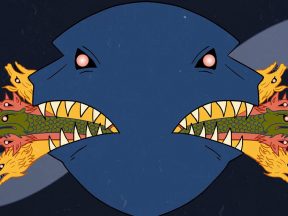
DreamWorks and Wal-Mart Partner For Dragon

Walmart and DreamWorks

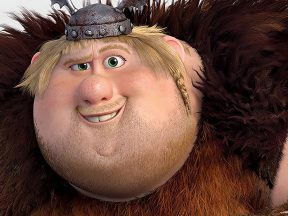
The Wall Street Journal reports that Wal-Mart will be the exclusive retailer for merchandise related to the DreamWorks feature How To Train Your Dragon. According to the paper, 95% of the products tied in to the movie will be available only at Wal-Mart, including “apparel and toys to custom-made Oreos with a red filling, to symbolize the fiery exhalations of the titular creatures.” The video on the WSJ website has more details about the extent of the deal, and mentions that Wal-Mart is the film’s master toy licensee and was involved in product and package design.

Rinky Dink by John Dilworth

Rinky Dink

A new short by John Dilworth (Courage the Cowardly Dog, Dirdy Birdy) is always an occasion for a post. Rinky Dink combines drawn animation with stop motion and photo cut-outs. It has the trademark Dilworthian oddness, more than a few giggles, and a cute (if common) message. The film can be viewed on his website StretchFilms.com. (Click on the little yellow creature on the upper left of the site.)