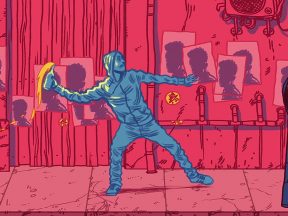
The Orange is a droll and effective piece of storytelling directed by Nick Fox-Gieg and based on a story by Benjamin Rosenbaum. It was created in Flash and AfterEffects. Gieg’s earlier short A Good Joke is another fun diversion.
Author Archives: Amid Amidi
Monday Morning Inspiration: Three Oscar-Winning Shorts
Here’s a delightful way to begin the week. Cartoon Brew reader Saturnome writes:
Your post last week featuring Bob Godfrey’s Great made me realize how some of the animated film Oscar winners are nowhere to be found on the Internet. I have uploaded some of the rarest ones: “Is It Always Right To Be Right?,” “The Box,” and “Leisure.” It’s all on my YouTube page. From what I know, this make “Herb Alpert and the Tijuana Brass Double Feature” the only Oscar-winning short I haven’t seen anywhere around.
For convenience, I’ve also embedded the videos below. Thank you, Saturnome!
The Box (1967) directed by Fred Wolf
Is It Always Right To Be Right? (1970) directed by Lee Mishkin with design by Corny Cole and narration by Orson Welles
Leisure (1976) by Bruce Petty
Chuck Jones: Memories of Childhood

Set your Tivos! Next Tuesday, March 24, is the premiere of Chuck Jones: Memories of Childhood, a half-hour documentary on Turner Classic Movies. The film airs at 8pm (ET) followed by eleven Jones shorts and the feature-length The Phantom Tollbooth. Memories of Childhood, directed by Peggy Stern, is based on interviews with Jones from 1997. The documentary also includes new animated sequences by John Canemaker that bring to life moments in Jones’s childhood, as well as clips from his films and archival materials. To anybody familiar with the Jones autobiographies, the documentary won’t shed a whole lot of new light onto his early years (the biggest revelation is that he was physically abused by his father). Nevertheless, it’s a lovely presentation that’s enjoyable to watch and serves as a solid introduction to the master animation director.
For another viewpoint on the documentary, see this review in the NY Press by C. Edwards, which says:
The scenes with Jones, which feel like snippets that didn’t make it into a larger interview, are inter-cut with simple pieces of animation directed by award winner John Canemaker. Designed to draw parallels between Jones’ words and his career, the “newly animated” segments would be overshadowed by the work of Jones, which is probably why they show so little of it.
If you go to the linked review above, there’s also a lengthy response from Jones’s grandson Craig Kausen, who offers his take on the documentary.
MouthOff
Lots of interesting new animation-related iPhone apps are being released, and I’m going try and write about as many as I can on the Brew. Mouthoff is an iPhone app that applies a crude animated lip-sync to voice inputs into the phone. It’s kind of like Clutch Cargo in reverse–instead of cartoons with human mouths, it’s real people with cartoon mouths. It can be downloaded for $1 from the iTunes store. Here’s an example of how it works:
(Thanks, Rob)
M. Wartella Animation on Xavier: Renegade Angel

Cartoonist M. Wartella (Wonder Showzen, Superjail!) created a stylish Aztec-art inspired two-minute segment for tonight’s episode of Xavier: Renegade Angel on Adult Swim. The segment is previewed below. Wartella discusses his creative process and offers a short ‘how-to animate’ video in this interview on Cold Hard Flash (if only creating animation was as easy for the rest of us).
Seth MacFarlane’s Hulu Commercial
Family Guy creator Seth MacFarlane has apparently become enough of a celebrity to appear as himself in a commercial for Hulu:
Cloudy with a Chance Of Meatballs Trailer

Sony Pictures Animation released the trailer today for their next feature, Cloudy with a Chance of Meatballs. Watch it here. The eyes on the characters are bigger than in most Pixar/Dreamworks-style CG features so I suppose they’re going for a “cartoony” aesthetic.
Annecy 2009: The Year Shorts Went Mainstream

The official selections have been announced for the 2009 Annecy International Animated Film Festival. Of particular interest is to see how many films in the shorts category have already been hits on-line. There’s Muto’s wall-painted animation Blu, PES’s Western Spaghetti, David O’Reilly’s Please Say Something, and Takena Nagao’s Chainsaw Maid, which is probably not even eligible since it’s from 2007. The music video category also includes the Rex the Dog music video “Bubblicious.”
Can anybody point to a short film from, let’s say Annecy in 1985, that was seen by millions of people at the time of its release. This year’s competition program offers numerous shorts that fall into that category and it’s exciting as hell. Even a decade ago, animated shorts remained a fringe-culture oddity seen by a relative handful in festivals and touring-compilations. Thanks to the Internet though, independent animation has been lifted out of the cultural ghetto and is quick becoming as visible and mainstream as it was during the Golden Age of theatrical animation when shorts preceded feature films.
What we are seeing are the beginnings of a new age of animated shorts, an age where short-form animation is an integral part of the cultural mainstream. As shorts increase their visibility, more and more people will see them and be inspired to create their own, which is great news for everybody, except for animation festivals like Annecy which must begin to rethink their roles or face the risk of irrelevancy. Festivals are no longer in a position to introduce these films to the audience because there’s a good chance the audience has already seen them. Therefore, festivals must find new ways to add value to their programming, whether through creating connections between the rich history of the art form and the contemporary shorts movement, or looking to the future and bringing understanding to where all of this is headed. Most importantly, they could begin to serve as a focal gathering point for artists and businesspeople who want to help one another make money from the animation that is being produced.
Up is Down by Millie Goldsholl
It’s exciting when you’re introduced to the work of a filmmaker that you’ve never heard about, such as last weekend when I stumbled upon Millie Goldsholl’s powerful and beautiful 1969 short Up is Down. Now the question I find myself asking is why hadn’t I heard of her before.
She wrote, designed and directed the film by herself. Millie, with her husband Morton, ran Goldsholl Associates, a commercial/graphic design and animation studio in Chicago. Her husband’s name is actually quite familiar to me as he was a well-known mid-century graphic designer, but I had no idea that both he and his wife were also filmmakers.
The only information I could dig up online about their animation practice was in a couple of blog posts that Michael Sporn had on his blog recently–a 1975 article from Millimeter Magazine and a few more details from a 1976 article from the same magazine.
Morton and Millie made numerous short films during the Sixties. One of Mort’s live-action efforts, about the history of paper, is also available for viewing online. From the info on this website, we can deduce that Morton and Millie most likely attended the School of Design in Chicago, which was run by Hungarian-born Bauhaus instructor László Moholy-Nagy. Together, the Goldsholls were making film experiments as early as 1942. They appear to have been a fascinating couple and I hope to learn more about them in the future.
Bob Godfrey’s Great (1975)
A rare treat is now online: Bob Godfrey’s epic animated short Great. This irreverent musical about 19th century British engineer Isambard Kingdom Brunel was the first British animated short to win an Oscar. It also won the BAFTA in 1975. Godfrey’s films usually don’t last long on YouTube so take a gander before it’s gone:
Millard Kaufman, RIP

Millard Kaufman, the Hollywood screenwriter who was instrumental in the creation of Mister Magoo, passed away last Saturday at age 92. The LA Times provides an informative obituary. He received a story credit on the first Magoo short Ragtime Bear in 1949, and along with John Hubley, is considered to be one of the primary architects of the character. In addition to the Magoo short, he co-wrote the UPA Fox and Crow short Punchy de Leon with Phil Eastman, and if I’m not mistaken, he also wrote a number of military training films (uncredited) for UPA during the 1940s.
In memory, here is the short Ragtime Bear:
Where Cartoon Brew Readers Work and Study
Last weekend marked the 5th anniversary of the Cartoon Brew blog. I thought it might be fun to celebrate by looking at who’s reading the blog nowadays, especially since we’ve been experiencing record-breaking site traffic since the beginning of the year. After examining the reports on Google Analytics (something which I’d never bothered to do in-depth before), I learned that the majority of visits to Cartoon Brew come through Internet service providers, which means that we have no idea of the company or educational affiliations of those readers. However, a not-insignificant percentage of readers visit from their jobs or schools and this is the data we’ll be looking at today.
In the period between January 1st and March 15, the top private corporate network that we received visitors from was Pixar, followed closely by DreamWorks, Disney, Viacom (Nickelodeon), Blue Sky, Turner (Cartoon Network), Laika and Electronic Arts. As far as schools go, the biggest traffic came from CalArts folllowed by Savannah College of Art and Design, School of Visual Arts, Ringling and Sheridan. In this two-and-a-half month period, Pixar employees snagged the top spot by logging over 3,700 visits. Averaged out to a daily figure, it amounts to quite a few readers emanating from just one company.
Some other surprises: There are a lot more readers at videogame companies than I knew we had. There are also lots of colleges and universities on the list that don’t have well-known animation programs, but apparently have significant numbers of students who are interested in animation. The amount of traffic we receive from people working at the cable channel Starz Encore is also perplexing. I have no idea why we’re so popular over there.
The list of the top 86 private networks driving traffic to the Brew can be seen after the jump. To keep it manageable, I’ve limited the survey to only companies/schools that have logged 100 or more visits between January and March. (Note: I took the info straight from an Analytics report so I apologize that the network names are uncapitalized.)
Send a Canadian to CalArts
A lot of young artists apply to CalArts and get rejected. But what happens if you’re accepted into the prestigious program and can’t afford to attend? That’s the situation that 25-year-old Canadian artist Dan Caylor finds himself in after receiving a letter of acceptance last week.
Dan writes on his website, “Unfortunately, my family isn’t rich, and being from Canada, I’m not eligible for any government loans or funding. With a price tag of $200,000, I’ll need all the help I can get. I’m doing everything I can to make my dream a reality, including asking everyone for anything they can spare. Desperate times call for desperate measures. If enough people can help me, I can turn my bittersweet acceptance letter into the beginning of a dream come true. Every penny counts.”
After looking at his blog, it’s obvious that Dan is not only a talented artist, but that he’s also a passionate student of animation, its history, and understanding the individual elements that comprise successful filmmaking (storytelling, shot selection, staging, movement, design, etc.). His blog is also a nice resource for other artists offering excerpts from Don Graham’s classic book Composing Pictures and high-quality video of Michael Caine discussing his acting techniques.
This is the first time I’ve ever seen a student post a public appeal for funds to attend CalArts. And it would be a shame if he couldn’t attend, especially after reading about all the effort that Dan made to get accepted into the program. So Cartoon Brew is not only going to encourage donations, but on behalf of Jerry and myself, we’re throwing $40 into the pot to get Dan started on the road to Valencia. Find out how to give a few bucks to the cause at OnAnimation.com.
Cigarette Man
This is a smokin’ piece of stop-motion animation…
(Thanks, David O’Reilly)
The Cartoon Modern YouTube Playlist
Since Cartoon Modern was published a few years ago, the most frequently asked question I’ve received about the book is, “Where’s the DVD?” While I was working on Cartoon Modern, we considered including a DVD that showed the animated pieces discussed in the book, but practical issues of time and money prevented it from happening. Since then, I’ve spoken to a few people about producing a DVD and while nothing has come of those discussions, it’s not out of the realm of possibility that someday I’ll put together a curated collection of commericals, shorts and industrial films related to that period.
Until that happens, let me point out the next best thing: a “Cartoon Modern” playlist on YouTube created by an awesome user who goes by the name of criticalmetrics1. I have no idea who this person is, but I want to thank them for putting so much effort into creating this playlist. They’ve even gone so far as to organize the films by the contents of my book. There are a hundred items on the list but because of copyright takedowns, only ninety-three are currently available for viewing. Still, that’s enough stylized cartoon animation to keep anybody busy for a while. If you know of other Cartoon Modern-related YouTube links, feel free to add them to the comments below.
The Cartoon Modern playlist: