brewmasters
JERRY BECK
bio & contact
view posts by jerry
AMID AMIDI
bio & contact
view posts by amid
VIEW POSTS BY
“pes”
by pes
September 21, 2009 12:34 am


Chainsaw Maid has gotten a fair share of play this year, but I thought it deserved a bigger shout out here on Cartoon Brew. The idea to match up colorful plasticine with the zombie genre was a revelation for me—a perfect match. Show me a better use, or at least one that’s more fun, for plasticine.

The film is very well edited and shows a lot of directorial promise. The director, Takena Nagao, takes the zombie genre and replicates its idiosyncrasies flawlessly. The music is delightfully creepy, and works like a charm.  The candy-colored world is almost edible and had me wondering what purple brain blood tastes like. From a storytelling perspective, Chainsaw Maid mixes reaction shots, wide angles and close-ups better than some of the feature films I’ve seen recently.

Perhaps most impressive of all is Takena’s use of the moving camera: the quick zooms, the subtle pans and tilts, the lens recalibrating during a shot to find the action (e.g. 2:53-3:02). It takes confidence to move a camera like this, and even more confidence when you’re doing it in-camera without the aid of rigs/motion control. Takena uses it to add tension, believability, and dynamism to the film at just the right points—in other words, not just for the sake of moving a camera, as so many directors (amateur and professional alike) tend to do.

All in all, I find it super-refreshing to see a talented young filmmaker having so much fun and I can’t wait to see his future work.

PS. This is a link to Takena Nagao’s YouTube channel. And if you like Chainsaw Maid, check out Takena’s latest film, Pussycat.

by pes
September 14, 2009 9:36 am


There’s a “creative grooming” trend happening in the US right now. Some of the more spectacular results have been photographed by poodle paparazzo Ren Netherland, who travels around the country in a bus which functions as a mobile photography studio.

To see more “Poodle Doodles” including a Poodle Fairy, a Poodle Chicken, and a Poodle Jack Sparrow, go here.

by pes
August 12, 2009 3:52 pm


El Empleo, created by Santiago Bou Grasso from Argentina, is a five-minute film that I feel should be about three minutes long.  Usually, I find this an inexcusable crime on the part of the filmmaker, one of the cardinal sins of making a short film (to me it shows a lack of respect to the viewer and a lack of self-awareness on the part of the filmmaker).  But, in the case of El Empleo, I still like the core idea a lot and find the film recommendable despite my issues with its pacing.  It’s got a clever hook, and the filmmaker explores his idea thoroughly and structures it well.

by pes
December 16, 2008 7:00 am


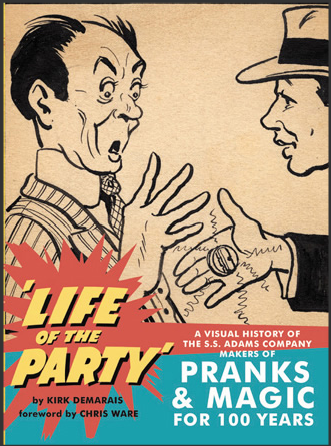
If you are looking for a gift for someone this Christmas or just in the mood to buy something for yourself, my number one choice (and favorite picture book of the last year) would be Kirk Demarais’s:  Life of the Party: A Visual History of the S. S. Adams Company.

S.S. Adams was the mastermind behind many of the most popular gag/novelty pranks of the last century, including the Joy Hand Buzzer, the Dribble Glass, the Snake Can, the Squirting Nickel, the Bug in an Ice Cube, the Exploding Cigar, and hundreds of others.   As one writer put it,  “The man’s rivals must have felt toward him as other dramatists have felt about Shakespeare.” I’m not exactly sure who his rivals were - other fart-cushion manufacturers, maybe? - but the sentiment is right on.

This book is treasure and nostalgia all wrapped up in one, like reading the back of an old comic book and trying to decide whether to order the vacuum cleaner hovercraft or a new pair of X-ray specs.   The images are often enlarged so you can really appreciate the original art and packaging genius of Louis M. Glackens*, the cartoonist who Adams hired to bring all of his products to life.  I also confess a soft spot for the personal touch of ordering it direct from the factory in Neptune, New Jersey.  I wish all books were like this.

In 1906 Adams discovered the existence of a potent chemical called Dianisidine and began marketing it in small vials labeled  “Cachoo Sneezing Powder” (the company was originally called the “Cachoo Sneeze Powder Company”).   The powder was so powerful that you could fill a room with sneezing people simply by blowing it through a keyhole or a crack in a door.

While Adams was busy exploiting Dianisidine stateside for laughs, the Germans were on the other side of the Atlantic stuffing it into their artillery shells, wreaking further disorder in the trenches of their enemies as the chemical also inhibits breathing.  Fortunately for Adams, he had a good 35 years before the F.D.A. decided that Dianisidine wasn’t as “harmless” as his label proclaimed and banned it.  By then, Adams had built an entire business with the money he made and had already used it to create countless other novelty items, some of them just as successful, if not more so, than sneezing powder.

Asked to share some advice on what makes a great novelty item, Adams once said, “The best idea is to work with an ordinary everyday object which is around the house.”  Case in point is his “Snake Jam Jar”, also known as the “Snake Nut Can.”

Apparently, around 1915 Adams had a habit of leaving the jam jar lid unscrewed. His wife wasn’t too happy about it and she began checking the lid to catch him in an act of neglect.   So, Adams rigged the jar by stuffing a wire coil wrapped in colorful fabric, and sat in the wings waiting for his wife to come in and inspect it.  The rest is history: when the 4-ft “snake” jumped out of the jar at his wife, she let out a scream so loud that Adams knew instantly that he had a new classic.

You will spend hours soaking up the thousands of images in this unbelievably rich and beautifully-produced “Visual History.”  If you’re lucky, you may even find yourself curled up under the sheets with a flashlight and a magnifying glass, feeling just like a kid again.

Get it here directly from the S.S. Adams factory in Neptune, New Jersey.

*Glackens was also a successful director and animator.  Check his filmography here.  If anyone can turn up a sample of his work online, please share it in the comments.

by pes
November 4, 2008 9:53 am


As our financial markets continue to meltdown and our currency is in flux (I recently found myself staring blankly at a $14 Whopper at the Zurich International Airport),  Mark Wagner seems to be having the time of his life.

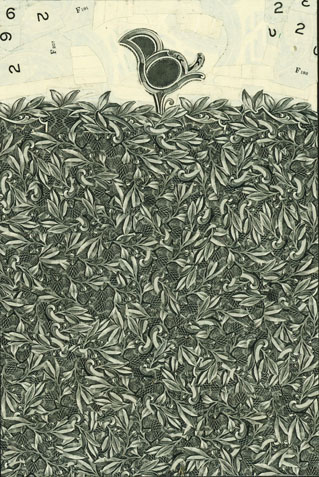
Wagner, a collage artist, has been busy cutting up thousands of U.S. one dollar bills and reshuffling the pieces into fantastic works of art.   The meticulousness of these collages is awe-inspiring.   Just one look and you can see what I am talking about.  Here’s Riddle of the Sphinx:  Click for a high resolution scan.

In one of my personal favorites, Marxism, Wagner scrambles the portrait of George Washington into a portrait of Groucho Marx, a clever reduction of our founding father to the father of Duck Soup.

In Bout,  George Washington is seen in a boxing ring fighting a shadow of himself, which is skillfully constructed by using the shaded parts of a dollar bill.   It’s a fantastic piece, and I’m sure it’s hanging in some investment banker’s living room right now.  Click for a high resolution scan.

I love thinking of Mark Wagner sitting in his studio, destroying money like a shredding factory.  Just the artist, thousands of dollar bills, and a few X-Acto knives.

It reminds me of that guy who discovered that pennies made before 1982 were 95% copper (as opposed to today’s which are 97.5% zinc), so he melted them down and sold the copper and made a fortune.* Of course, the government caught up with him, but there’s something similar going on here.  Our money is worthless -  more so every day - so Wagner cuts it up and turns it into art that sells for $20,000 a piece.  I love it.

Detail, Waiting to Close the Deal

*More on the bizarre worthlessness of our currency: Penny Dreadful from The New Yorker.

by pes
September 30, 2008 8:51 am


Editor’s Note: Welcome to the first post by award-winning filmmaker and regular Guest Brewer Pes.

Recently I’ve been spending a lot of time in the fabulous Woodlawn Cemetery in the Bronx — doing research for a new short film. It’s been no hardship to pass the day here…Woodlawn is one of the most beautiful cemeteries I’ve ever seen and feels more like an impeccably manicured park than a burial ground.

Woodlawn is home to many creative luminaries including Miles Davis, Herman Melville and Thomas Nast, and curiosity getting the better of me, I decided to stop by their graves to see what’s going on. I was slightly horrified to find that people choose to pay their respects to Herman Melville by balancing BIC and other cheap clickable ballpoint pens (the free kind you get at a bank) on his tombstone — so that it now looks a bit like a trash can. Despite this, I really like that Melville’s tombstone has a blank sheet of paper sculpted into the front, as if encouraging every visitor to think for a moment about the dreaded blank page at the end of life. I wondered momentarily if this was Melville’s last brilliant idea.

Herman Melville's Tombstone

In my wanderings in the cemetery, some other interesting things have happened. For instance, one day I was photographing a tombstone and just as I clicked the camera, a rabid wolf or wild dog thing jumped from behind the tombstone baring his teeth at me. My heart raced. I was in the center of the cemetery, alone, and I hadn’t seen anyone for at least an hour. I instantly thought about being mauled alive by this thing. Would my tombstone read something like “Eaten alive by a wolf right on this spot”? Fortunately, I held my ground and the thing ran away. Evidently he was more scared of me than I of him. I later learned from a groundskeeper that what I had seen was one of the cemetery’s resident (and harmless) coyotes and that I should be happy to have seen him without having to pay admission to the nearby Bronx Zoo.

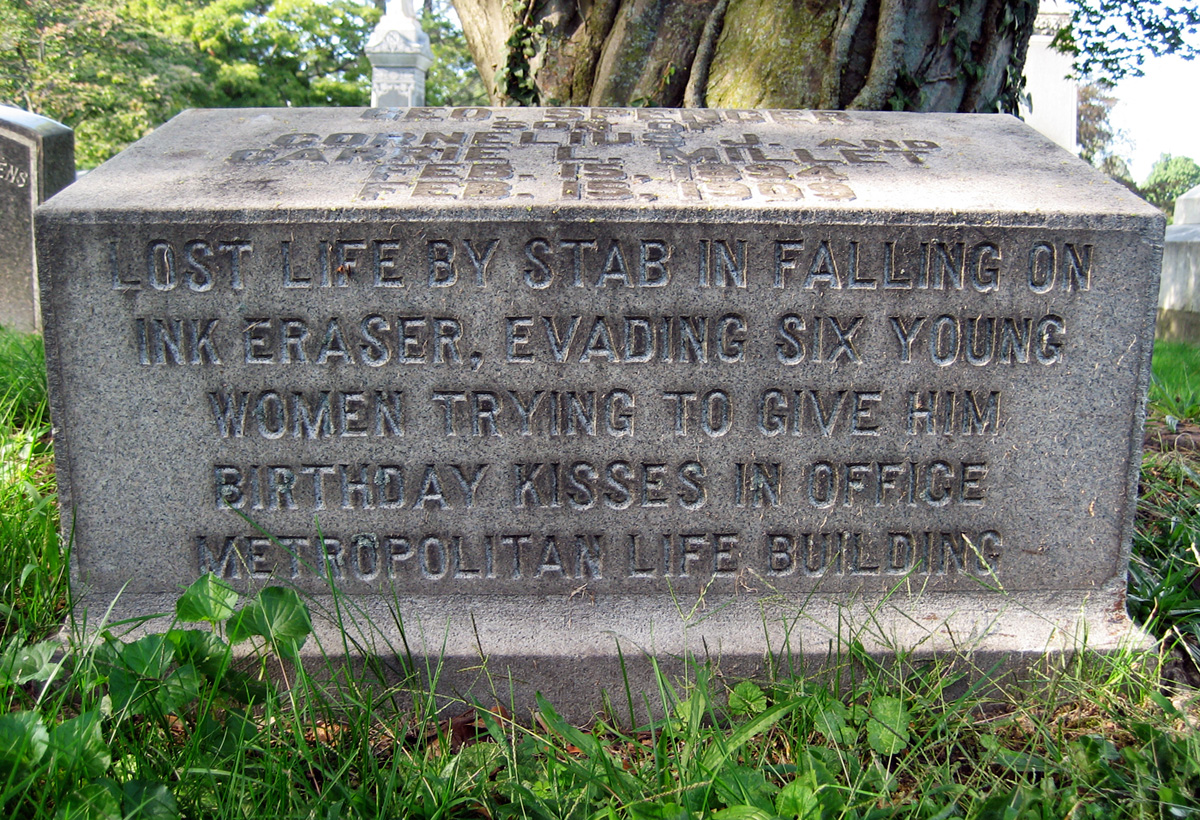
In another corner of the cemetery, on another day of research, I stumbled upon this fascinating tombstone, which tells of a 15-year-old boy who died on his birthday in 1909 in a most unfortunate manner. The tombstone has to be seen to be believed: click to enlarge.

Curious, I did a little research. First, the Penbid website (yes, an Ebay for pens!) clarified this little thing called an “ink eraser” : “Modern ink is dye or stain, but writing of the early period was done with inks containing carbon as a pigment and on animal skins (such as vellum or parchment) or on paper made entirely from rags. Carbon ink did not penetrate these writing surfaces but dried on the surface, sort of like paint. This explains the tools known as steel erasers or ink scrapers [aka 'ink eraser'], which were used for scraping mistakes from the writing surface.”

So, basically an “ink eraser” was a knife, kind of like an X-Acto blade: and George Spencer Millet fell on his while trying to avoid getting the cooties on his 15th birthday.

The Ink Eraser

But did the ink eraser stab him in the eye or in the heart when he fell on it? And what about the girls, throwing birthday kisses at him? What happened to them? Just how did this horrifying scene unfold? After a bit more research I uncovered this New York Times article from February 16, 1909 (links to downloadable PDF article) which helps reconstruct the horrifying event and adds some interesting plot details along the way.