.png)
2026 Oscars Short Film Contenders: ‘Capybaras’ Director Alfredo Soderguit
Welcome to Cartoon Brew’s series of spotlights focusing on the animated shorts that have qualified for the 2026 Oscars. The films in this series have qualified through one of multiple routes: by winning an Oscar-qualifying award at a film festival, by exhibiting theatrically, or by winning a Student Academy Award.
Today’s short is Capybaras from Uruguayan director Alfredo Soderguit, produced by Autour de Monuit, Estudio Palermo, and Pájaro. The short qualified for the Oscars by winning the Best Latin American short film Award at Chilemonos.
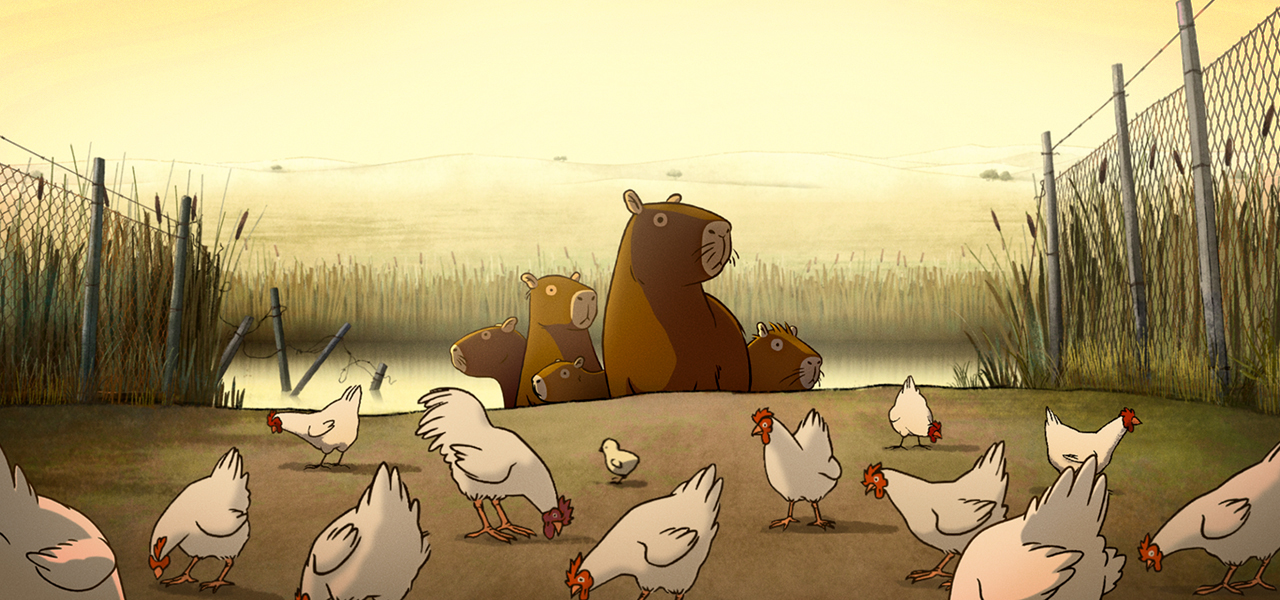
Capybaras, based on Soderguit’s book of the same name, follows a family of gentle capybaras who flee into a chicken coop at the start of hunting season, only to be met with suspicion and territorial unease from the resident hens. As tensions simmer, the curiosity and openness of the youngest animals slowly bridge the divide, sparking an unexpected bond that challenges fear, prejudice, and the rules of the farmyard world. Told in warm, thick-lined 2D animation, the film uses simple yet evocative designs, textured backgrounds, and subtle character acting to convey emotion and humor, creating a charming atmosphere that enhances themes of coexistence, empathy, and the quiet bravery of those willing to connect across differences.
Cartoon Brew: What was it about this story or concept that connected with you and compelled you to direct the film?

Alfredo Soderguit: In my hometown and in many other rural towns in Uruguay, some people used to call poor people “carpinchos” (capybaras) in a derogatory, but naturalized, way. During my childhood, I didn’t fully understand it. Some of them were my neighbors and schoolmates. Also, capybara hunting was quite common in Uruguay. A few years ago, I started designing human characters with capybara heads, trying to find a story to tell about those memories. After some time, the story emerged. My grandmother’s apartment building became a chicken coop, and the capybaras became immigrants, refugees fleeing the violence of hunting season.
What did you learn through the experience of making this film, either production-wise, filmmaking-wise, creatively, or about the subject matter?
Working with two such experienced production companies as Autour de minuit and Pájaro was a privilege; I learned a great deal about their production process. On a creative level, we never lost sight of the subject matter; every movement and every sound was created with full awareness of what we wanted to convey. Even using classic cinematic language, there are risks we must take. Then the most surprising learning experiences come from interacting with the audience once the short film is released. The questions, the digressions, the understanding, and the importance that certain details acquire. Both during production and during the screening, opinions are shared, and each work we create becomes part of a conversation.
Can you describe how you developed your visual approach to the film? Why did you settle on this style/technique?
Every film and book I’ve made before is completely different. I love exploring visual styles and narrative formats. This short film has a classic 2D style that focuses on the characters’ expressions, the rhythm of the actions. To create the right atmosphere in the scenes, we were aiming for a very natural and peaceful look. The scenes look like a place that could exist, a place you might have seen before, whether in a book, a film, or in real life. We felt that this painterly, handcrafted 2D style was an excellent choice to achieve these goals and bring a touch of tenderness to a story that faces an adverse situation.

What challenges did you face in adapting your own book into animation? Did you try to push yourself or the story in any way that you perhaps couldn’t do in the book?
The book’s illustrations depict bucolic scenes containing emotion and subtle details; the essence of the story resides within them, but the narrative thread is sustained by the text. I believe the main challenge of the adaptation was reconstructing that narrative thread through movement and sound while remaining faithful to the emotions and metaphors of the book without using a single word. I didn’t find it particularly difficult; in fact, I enjoyed it immensely. It was like adding a new layer to the story and to the reflections that began with those capybara-headed characters I drew to represent my childhood neighbors.