.png)
Oscar Shortlist Interviews: Director Florence Miailhe’s On Her Favorite Shot From ‘Butterfly’ (EXCLUSIVE)
Stay informed with free updates
Sign up to get our news digest — delivered directly to your inbox twice a week.
We invited the filmmakers behind each of this year’s 15 Oscar-shortlisted animated shorts to share their favorite shot from their film and explain why it’s special to them.
Nomination voting starts on January 12 and runs through January 16.
Today, we’re checking out director Florence Miailhe’s favorite shot from Butterfly, a hand-painted adaptation of the remarkable real-life story of Alfred Nakache, an early 20th-century Jewish Olympic swimmer who faced tremendous racism at the 1936 Berlin games, was later imprisoned at Auschwitz, where he was the only survivor from his family, and eventually returned to compete in the first post-war Olympics in London in 1948. Using images created directly in front of the camera’s lens with paint, pastel, and sand, the film offers a sweeping recounting of memories from Nakache’s childhood through his later years, each tied to water.
Here’s Miailhe’s favorite shot, and her explanation of how it encapsulates everything she hoped to achieve with the film:
I chose this shot because it perfectly summarizes the principle of the film, in which we see a 67-year-old man who, during one last swim, recalls the most significant memories of his life.
Some of these memories are happy, while others are traumatic. The story is that of Alfred Nakache, one of the greatest French swimmers of the 1930s and 1940s. Born Jewish in Constantine, he was caught in the turmoil of history. He suffered under the laws enacted by the Vichy regime, which, after excluding him from French competitions, led him to Auschwitz-Birkenau, where his wife and daughter were murdered.
I didn’t want the film to be a documentary or an exact biopic of Nakache’s life. I wanted to tell the story of a man who spent his life in the water, blending in almost supernatural elements.
The water is shown as a character—sometimes kind, sometimes frightening, a source of pleasure as well as pain. All the events that happened to him are linked to it. It was where he had his first encounters, won his first victories. He learned to tame it, and in return, the water helped him overcome his fears and despair.
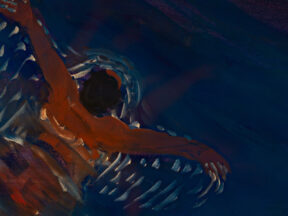
In this shot, I imagine his first encounter with his wife, who, like a siren, enchants him. Captivated, he loses himself in her hair, which transforms into a wave and carries him along. The older Nakache swims, chasing his memories, which he rediscovers by diving, young again, falling in love at first sight with this apparition.
The entire film is based on this principle: the water serves as a passage between past and present.
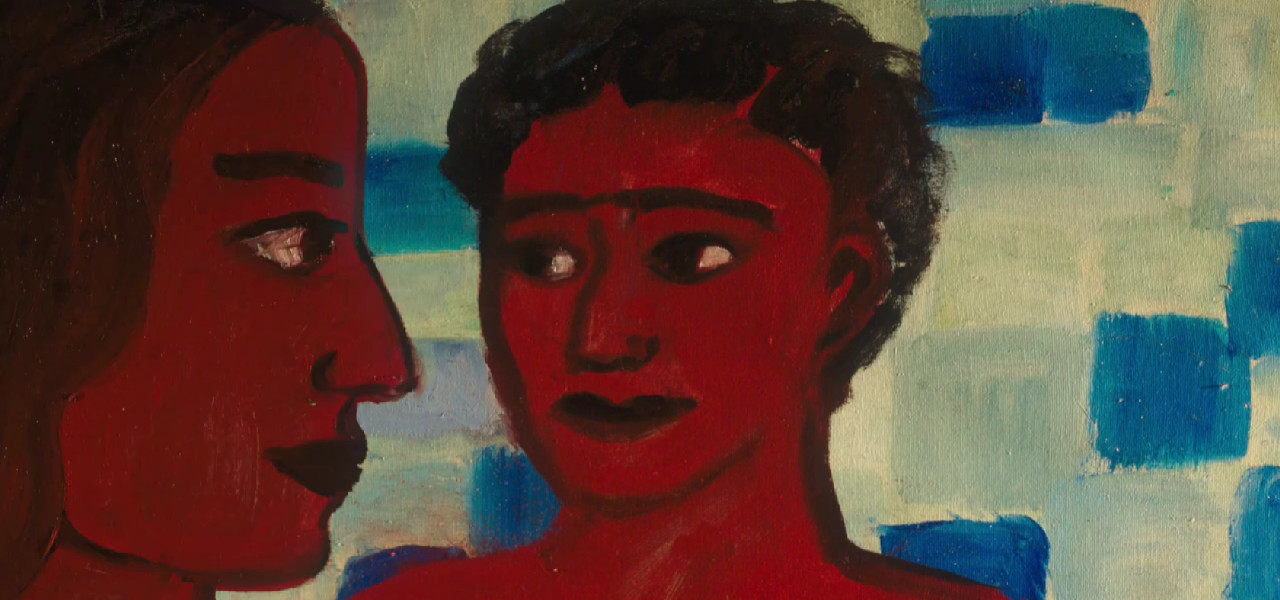
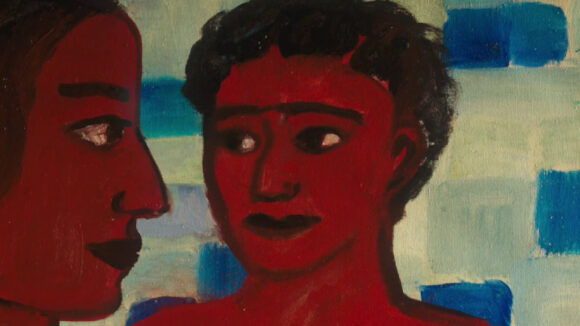
I enjoyed animating this shot. Everything is done on a single plane, directly on the canvas. There are no special effects, no computer use. Only the painting creates the illusion of movement and the swimmer’s moves, even though he remains at the center of the frame throughout the shot. The reverse shot shows the object of his desire, which appears as the bubbles rise to the surface.
Animation allows for this kind of ellipsis and metamorphosis. And that is its great strength.