.png)
Book Excerpt: OIAF Artistic Director Chris Robinson’s ‘Watch Me Jumpstart’ (EXCLUSIVE)
Stay informed with free updates
Sign up to get our news digest — delivered directly to your inbox twice a week.
Chris Robinson has spent more than three decades championing independent animation as artistic director of the Ottawa International Animation Festival. He is also a prolific author and critic, and, closer to home, a longtime Cartoon Brew contributor whose candid writing has appeared on this site for years.
His latest book, Watch Me Jumpstart: Strutting and Stumbling Through Animation, is what Robinson calls a “distorted memoir”: a personal and characteristically irreverent account of a life spent inside the international animation festival circuit. Published by CRC Press, the book traces the people, films, arguments, accidents, and late nights that shaped his ideas about animation.
In the exclusive edited excerpt below, taken from the chapter “Summer Days,” Robinson recalls his unlikely path from selling tickets at the Canadian Film Institute to working on the 1992 OIAF, and the films that permanently changed how he saw animation.
Chapter 2 – Summer Days
My unanticipated debut at the Canadian Film Institute was on September 18, 1991. There was one film playing that evening: Friends, Comrades by Rauni Mollberg. That’s about all I remember of that first night.
My job was pretty simple. I worked two or three nights a week. Everything was by hand. I had to collect the cash float, grab the box-office forms, and bike to the National Archives of Canada auditorium where the films were screened. (On Tuesday nights, we screened films at the then–Canadian Museum of Civilization in Gatineau, on the Quebec side of the Ottawa River. They already had their own staff, so it was on me to bike over there and sell CFI membership cards to anyone who might want one.)
The CFI regulars were an odd bunch, a gaggle of cinema-literate misfits. Some were shameless in the way they’d try to rip us off (reusing “free admission” cards they’d been given). Some were just utterly rude and entitled. Thankfully, on occasion a projectionist would have a big chunk of hash (that looked like a big chocolate bar) and we’d share a smoke. Soon, all the audience problems vanished.
Aside from doing box office and ushering, it was up to me to pay the projectionist at the end of each night (when we actually made enough money!). On non-screening days, I had to coordinate getting the film prints to and from distributors or other venues. Beyond that, I helped with distribution of our bi-monthly screening calendar. I’d package the calendars up and walk or bike them around town to assorted shops and restaurants. Eventually, I started helping write the calendars, roughing out media releases, and occasionally even programming. My first programming attempt was a Woody Allen/Ingmar Bergman mini-festival. I lined up Allen films with the Bergman works that clearly inspired them. I was instantly hooked on programming.
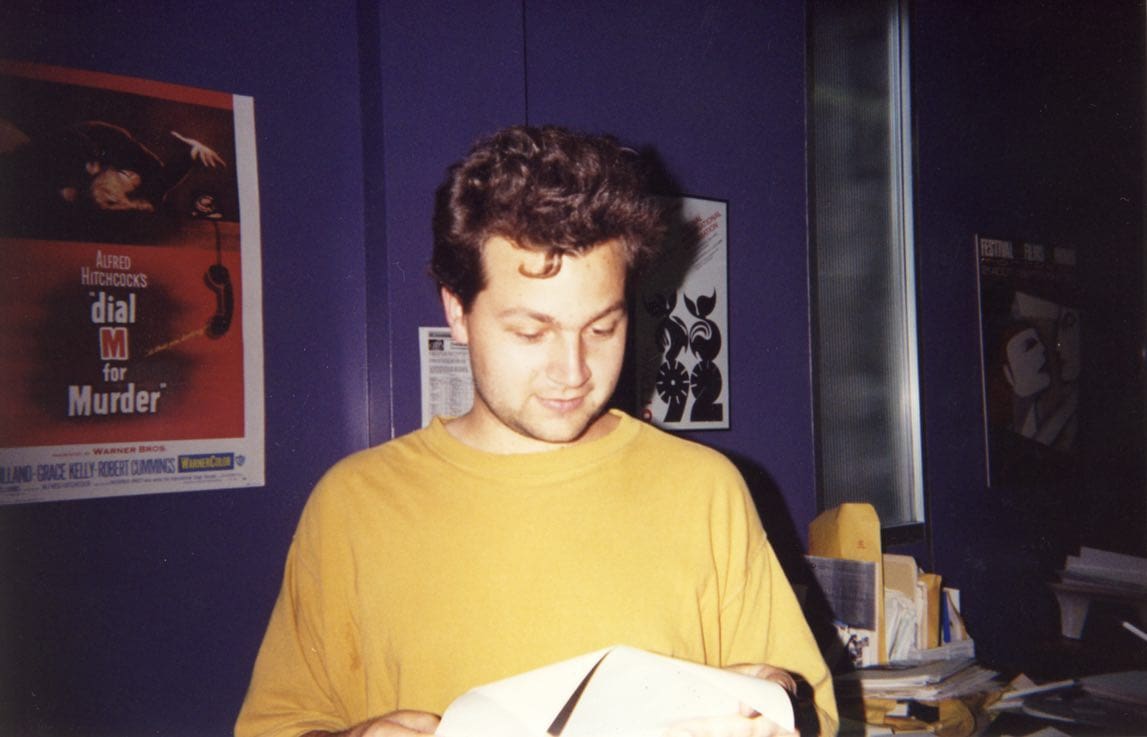
So, just what was this Canadian Film Institute? Well, I’ll tell you. Founded in 1935 as the National Film Society, it was Canada’s first film society and played a pivotal role in exhibition, distribution, archiving, and film education. The Canadian Screen Awards have their roots in the CFI, while the Toronto International Film Festival and Cinematheque Ontario owe some of their beginnings to it.
Unfortunately, by the time I arrived, this thriving institute that had once employed 30–40 people was a shell of itself. Just a handful remained. The CFI rented videotapes and 16mm film prints to schools and cared for a UNESCO collection, much of it stored in disused jail cells beneath the Arts Court building. There was also a programming director, an executive director, and a full-time accountant (I never understood why an organization this small required one).
After a few months, I came into the office one day and met another staff member. His name was Tom Knott. He’d been away in Los Angeles, and it seemed he ran another division of the CFI: the Ottawa International Animation Festival (OIAF).
In early 1992, I officially started doing work for the OIAF. My initial job was to oversee the processing of each and every film submission that was mailed in. These films were candidates for the OIAF’s short film competition.
Back in those days, animation festivals were still biennial because you didn’t get a lot of turnover with new films. There were four main festivals: Annecy, France (the oldest and largest in the world), Animafest Zagreb (founded in 1972), the OIAF (founded in 1976), and Hiroshima (1985). These festivals all functioned under the approval of ASIFA (the International Animated Film Association). ASIFA, then as now, was a volunteer organization of animators from around the world. Animation festivals were originally founded to provide a space for non-commercial animators to showcase their films. It was also an important meeting point for artists from both the West and those living behind the so-called Iron Curtain.
ASIFA helped to establish an assortment of rules and regulations that strove to protect individual filmmakers. And back then the festivals were quite cooperative with each other. Everyone had their sort of set space. Annecy was held in June during odd years, Zagreb in June during even years, and Hiroshima and Ottawa were held during even years as well.
The OIAF had its ups and downs. After its early Ottawa editions, the CFI was allegedly facing a sizable deficit and could no longer organize the festival. The OIAF moved to Hamilton in 1984 and then Toronto in 1986. According to a few people who attended the festivals in those years, the Hamilton and Toronto events were unmitigated disasters. Finally, Frank Taylor, Executive Director of the Canadian Film Institute, brought the OIAF back to Ottawa under the CFI banner in 1988, where it has remained up until the time this book hit the presses.
I knew none of this in 1992.
Where were we? Right, my job. So, each day, I’d go down to the mailroom and gather up the piles of packages sent to us. Usually I had to bring a big bin or trolley to collect them all. Then, once back at the office, I’d open up every package. For each submission I’d grab a paper file folder that would end up holding the entry form, stills, biography, and whatever other printed materials were sent.
But before that I had to type the entire entry form into our computer database (I have no idea what program it was!). It was pretty tedious work, but I enjoyed discovering all these new faces, places, and films. I swear I learned more about the world (postal codes, different spelling, Cyrillic, cities, countries) from this work than I ever got from a high school geography or history class. Hell, combined with my Film Studies courses, I learned about the world via cinema.
After typing in all the pertinent information, I’d then print off labels that had the title, director, category, and entry number. Then I’d stick one on the file folder and another on the VHS, ¾-inch tapes, or the film cans. The folder would be filed away in a metal cabinet (one of many we had) while the films would be placed on shelves or assorted bins. A lot of office space was occupied by these materials.
When I hear animators complain today about the festival process, I just shrug. They have no idea how easy it is today. Imagine, animators before the end of the 20th century had to manually submit to each festival. This meant not just having to write out each entry form, but also having multiple stills printed, extra film or video copies, and then walking to the post office and paying to ship it all to a festival. I have a tough time sympathizing with contemporary animators who can easily cut and paste their info into a festival’s online entry form, can digitally produce stills, and, easiest of all, just send us a link to their entry.
These were also the days before the internet. There was no social media to amplify marketing or calls for entries. In those days, we had to design and print the entry form each year along with accompanying newsletters—mailed out twice a year—that provided brief details about the upcoming festival.
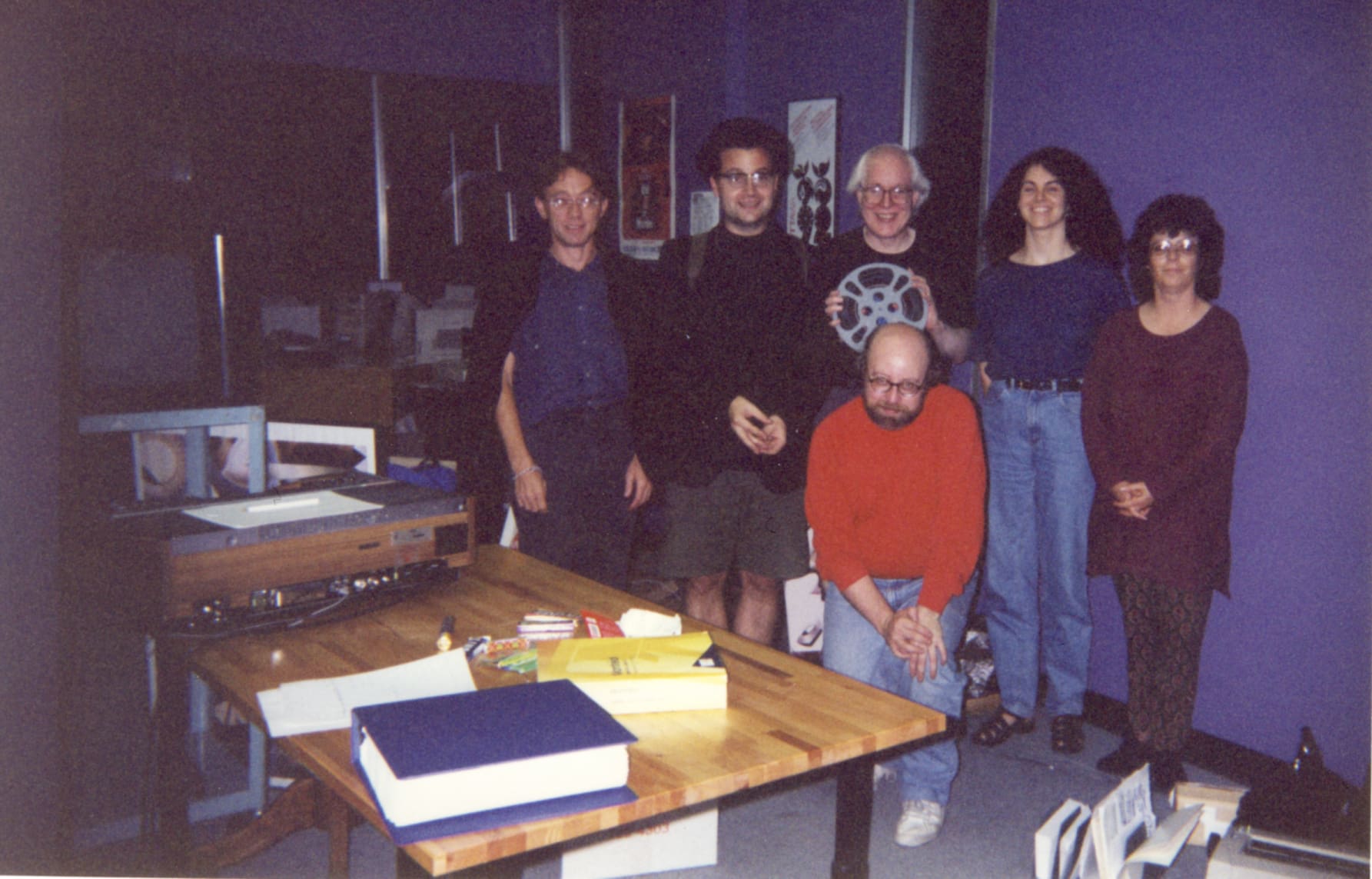
The next step came in the summer. The OIAF, like all the ASIFA festivals back then, had an international selection committee chosen each year. Those four or five members would then be flown to Ottawa, put in hotels, and fed during the week required to go through each submission. For the tapes, we’d watch them in and around the office, but for the films, we’d have to book the National Archives cinema for a couple of days.
My next OIAF job was to oversee and coordinate the selection committee during their stay. That meant providing breakfast, taking them for lunch and dinner, etc., and then either playing the tapes for them or being the liaison between them and the film projectionist. Then as now, a submission was stopped when the committee unanimously agreed. Every so often, one stubborn committee member would insist on watching the rest of the film or having it fast-forwarded (as if expecting a miracle, one that almost never came). I recall a lot of exasperated committee members impatiently waiting for that last stubborn member to see the light and stop the entry that had no shot at getting in. One year I went through their notes (we gave them binders with printed sheets inside for each entry!) and one committee member had made a drawing of another being strung up on a rope. We’d sometimes make time to go through their notes, which ranged from thoughtful comments on a work to utter hatred of a film.
The cinema screenings were a bit trickier. There was no fast-forwarding. It was all or nothing. As always, committees started slow, getting a feel for the films and each other, but usually by day two they were starting to go through things faster… but yes, with film prints, it had to be unanimous to stop a film and you’d better be damn sure. Oh, and to make it exciting, there were occasional mishaps with the film prints. I recall one particular time when an inexperienced projectionist (we might have been forced to use him for whatever reason) arrived in bad shape, having just been dumped. Forlorn and unfocused, at least one film print caught fire because of his heartbreak.
Back in those days, they would vote through a scoring system that had been introduced at the OIAF by Prescott Wright in the 1970s. Completed sheets would be forwarded to Tom Knott in the office, and he’d input everything into the computer. Once they finished the films, they’d go through their shortlist and make their final decisions.
Once they were finished and out of town, the next step was notifying the filmmakers of the committee’s decisions. Again, this involved designing, printing, and mailing. A pretty costly and tedious process compared to hitting a keyboard button today.
ASIFA-sanctioned animation festivals all had separate selection committees and juries (OIAF ’92 used the same committee and jury because of budget problems). They would not only pay for the hotels and flights for the selection committee to come in the summer, but they also paid for them to return when the festival was on. This was on top of paying hotels and flights for the jury. It’s insane when you think about all the money that went towards this (something that I’d remember when I took over the OIAF).
So, yeah, then that whole process of notifying the filmmakers, arranging the shipping of their screening copies—in those days, we paid to return all materials via ground shipping. We’d also sometimes have to work with other festivals to coordinate a film’s arrival and departure. It was quite a nice collaborative initiative that festivals did back then; they’d gladly forward a film on to its next festival if the filmmaker asked.
Meanwhile, my other work involved mailing and distributing flyers, helping with the coordination of the program books, and even driving to Montreal’s Mirabel airport to collect guests. Back then, Montreal had two airports. Mirabel handled international flights while Dorval (now called Montréal–Pierre Elliott Trudeau Airport) took care of continental ones. As such, it was easier to just send a driver to collect the international guests than have them transfer to Dorval. This was also another way I got to meet international animators and producers.
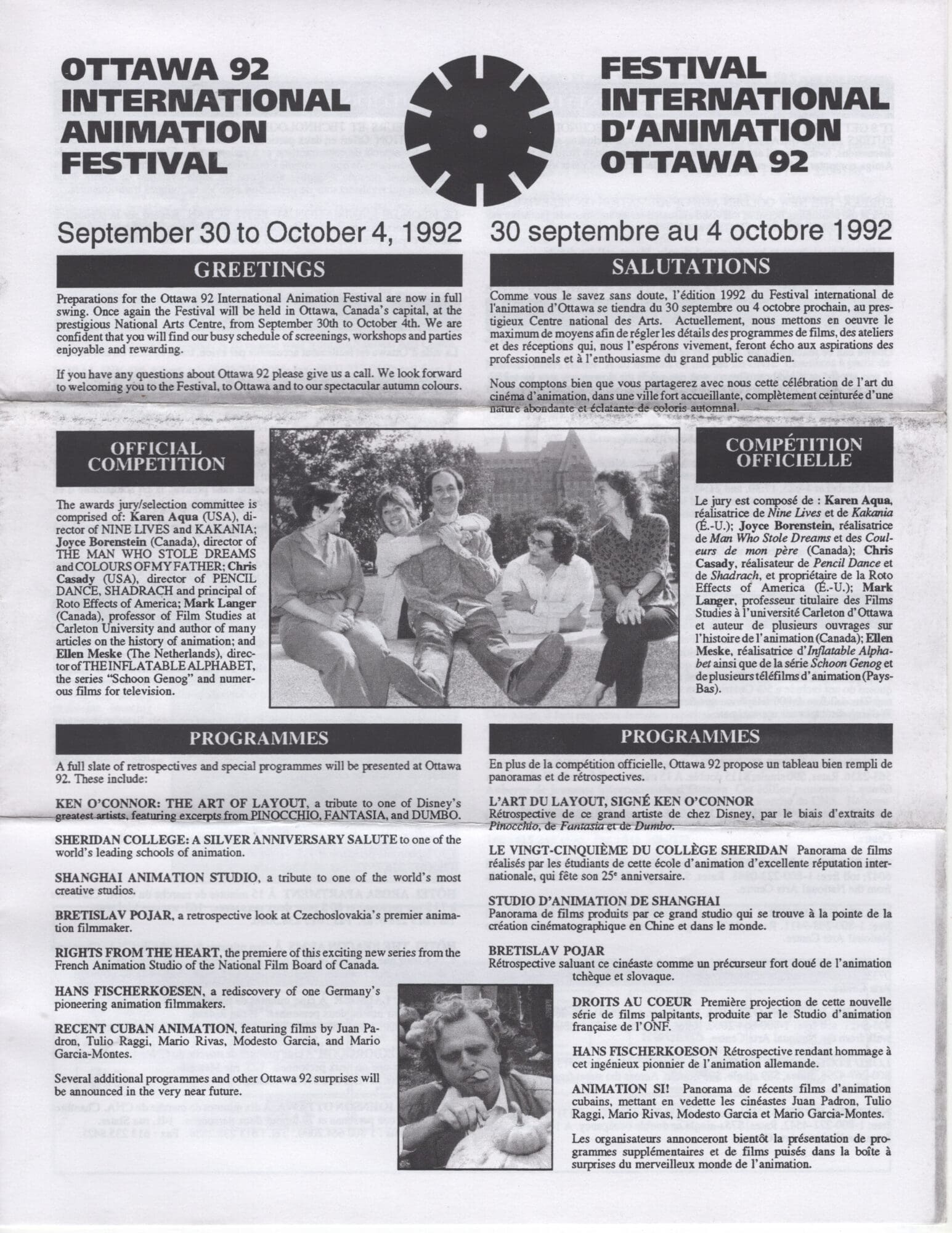
I didn’t do much at OIAF ’92. I mostly sat at the media table in the National Arts Centre (then the sole space of the OIAF), once getting ripped into for the lack of French translation at the festival. In hindsight, the person was right, but they were also unnecessarily unpleasant and smug. And me being the contrarian, I’m sure I went right back at the guy. (Maybe this is why someone called me the John Woo of diplomacy once. Someone told me that I burst down the door and open fire before asking questions.) Other than briefly attending the opening party, I really didn’t have much to do at the festival and went home most nights.
After it was all said and done, it was my job to help package and post back the films and any uncollected awards.
That first year with the OIAF was monumental for me. First, having to watch those 750 entries was mind-opening. I distinctly recall the thrill of seeing Raimund Krumme’s Crossroads, Phil Mulloy’s Cowboys, and Ren & Stimpy (where I learned that the creator was from Ottawa and attended the same high school as me). Crossroads and Cowboys had the most impact on me, largely because they were minimalist and looked like something anyone could do, yet within these deceptively simple and raw drawings were works that tackled themes of identity, masculinity, racism, etc.
At this moment I am looking back through the catalogue from that year, and the list of competition filmmakers is pretty close to an animation hall of fame: Caroline Leaf, Jerzy Kucia, Piotr Dumała, Stephen Hillenburg (pre-SpongeBob), Michaela Pavlátová, the strangely forgotten David Anderson, Joan Gratz, Georges Schwizgebel, Henry Selick, Barry Purves, Amy Kravitz, Wendy Tilby, Danny Antonucci, Paul Fierlinger, Gil Alkabetz, Co Hoedeman, and Igor Kovalyov.
What I most appreciated was that these artists were tackling some tough subjects, all within this short format. Over in Film Studies, I was being screened Bergman, Godard, Antonioni, Kubrick, Pasolini, and so much more, yet here were a bunch of “cartoons” tackling similar hefty ideas just as effectively, often under 10 minutes.
From that moment, I never saw animation the same way.