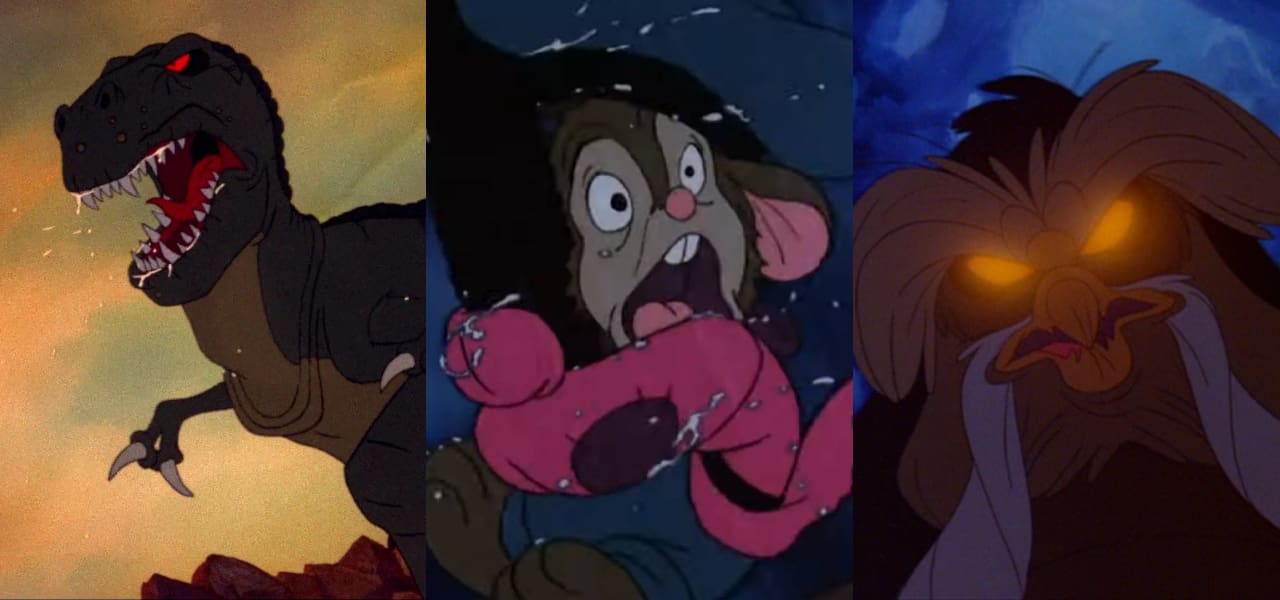
The Don Bluth Scenes That Still Give Us Nightmares As ‘An American Tail’ Turns 40
Stay informed with free updates
Sign up to get our news digest — delivered directly to your inbox twice a week.
Don Bluth’s An American Tail opened in theaters on November 21, 1986. To mark its 40th anniversary, we’re revisiting some of the scariest moments in Bluth’s filmography.
If you’re familiar with Bluth’s movies, you know that each usually has at least one scene sure to terrorize children. We’ll start with the unforgettable thunderstorm in An American Tail, when the waves turn into monstrous sea gods.
https://t.co/aqtW48eSNQ
— Cartoon Study (@CartoonStudy) November 20, 2026
A lot of people talk about scenes from Disney movies that scared them as children. With a few exceptions, I don’t remember being particularly frightened by those. Sure, Ursula turning into a giant sea goddess in The Little Mermaid is hair-raising in the moment, but then she’s satisfyingly defeated and we all go away happily humming “Under the Sea.”
I distinctly remember being unsettled by several moments in Bluth’s movies as a kid, and I think it comes down to the sudden shifts in tone. Everything will be sugary sweet, and then out of nowhere the lighting turns harsh, the music gets ominous, and ravenous creatures are viciously attacking our heroes for reasons that are often hard to fathom.
Even in the more upsetting moments of a Disney or Pixar cartoon, you get the sense that the filmmakers have a firm grip on the story and will guide you to a happy ending. A Don Bluth picture can feel like a madman is at the wheel and you have no idea whether you’re about to ram into a lamppost. That’s part of what gives his movies their flavor, as this scene from An American Tail shows.
https://t.co/C9VxYYtyXe
— Cartoon Study (@CartoonStudy) November 20, 2026
Bluth was a rising star at Disney in the 1970s. He animated on Robin Hood and The Rescuers, headed up the animation on Pete’s Dragon, and directed the short The Small One. In 1979, during production of The Fox and the Hound, Bluth decided Disney had lost its way. He staged a walkout, taking a team of artists with him to form Don Bluth Productions.
The studio’s first film, the short Banjo the Woodpile Cat (1979), began life in Bluth’s garage while he was still at Disney. The ferocious dogs give you a taste of the terrors to come, although the bouncy score, complete with xylophone, takes the edge off.
https://t.co/rZD5T7MV1S
— Cartoon Study (@CartoonStudy) November 20, 2026
Bluth’s first feature, The Secret of NIMH (1982), is probably his best. I love its dark fantasy atmosphere, from the stellar painted backdrops and Jerry Goldsmith’s magical score to the lavish hand-drawn effects that look like something out of an early ’40s Disney feature. Bluth’s characters tend to gesticulate wildly, which makes Mrs. Brisby’s understated performance all the more striking. John Pomeroy’s animation of the menacing Great Owl is also outstanding.
https://t.co/ze1CWkBtki
— Cartoon Study (@CartoonStudy) November 20, 2026
The Secret of NIMH doesn’t shy away from unsettling imagery, especially when the scientists experiment on the rats. The psychedelic reaction to an injection is overwhelming, and the quiet that follows is just as unnerving.
https://t.co/3FHhWwVpuN
— Cartoon Study (@CartoonStudy) November 20, 2026
Now regarded as a classic, The Secret of NIMH was trounced at the box office by E.T. the Extra-Terrestrial. Goldsmith introduced Bluth to E.T. director Steven Spielberg, who offered to produce Bluth’s next movie, telling him, “Make me something pretty like you did in NIMH.” It’s easy to see why Spielberg was impressed. The climactic sword fight is as exciting as it is brutal.
https://t.co/FE3zdbSZgR
— Cartoon Study (@CartoonStudy) November 20, 2026
With Spielberg on board, Bluth took on Disney with An American Tail (1986), about a family of mice who emigrate to the United States. It was a massive hit, outgrossing Disney’s The Great Mouse Detective that year.
As with NIMH, some moments are unusually dark for a family film. I remember being unnerved as a kid by the attack of the Cossack Cats, which takes place alongside a raid in which realistically drawn humans are attacked and killed. The scene draws on the pogroms that swept through southwestern Imperial Russia in the 1880s. Antisemitic propaganda blamed Jews for the 1881 assassination of Tsar Alexander II, and the ensuing violence helped spur mass emigration, including to the United States.
As he would later do with the Russian Revolution in Anastasia, Bluth uses real events as a backdrop and gives the audience little historical context. The violence can be especially jarring when you’re a kid going in cold.
https://t.co/dNHnNNNA1Z
— Cartoon Study (@CartoonStudy) November 20, 2026
Production on An American Tail went smoothly, but Bluth’s follow-up, The Land Before Time (1988), hit some snags. Producers George Lucas and Steven Spielberg thought the T. rex was too scary, telling Bluth, “We’ll have kids crying in the lobby and a lot of angry parents. You don’t want that.” More than 10 minutes of footage were cut, much of it fully animated and in color. Most of it was lost. The cuts included a surprise attack by Sharptooth, close-ups of the dinosaur snapping its jaws, and an extended version of its fight with Littlefoot’s mother.
Bluth and Spielberg disagreed over the cuts and parted ways. Spielberg went on to direct a violent dinosaur movie of his own, Jurassic Park. Even after the cuts, Sharptooth still gets some great moments, like this one where Cera thinks the dinosaur is dead.
https://t.co/EiVtECHc7e
— Cartoon Study (@CartoonStudy) November 20, 2026
Both Bluth-Spielberg collaborations have a sad, lonely mood. In each, a child is separated from their family and left in a cold, unfriendly world with something threatening around every corner. For a little kid, it’s just about the scariest thing imaginable. James Horner’s scores deepen that sense of loneliness.
https://t.co/IRAbLWP6ov
— Cartoon Study (@CartoonStudy) November 20, 2026
Bluth’s bizarre supernatural fantasy All Dogs Go to Heaven (1989) also underwent last-minute changes. Several scenes were cut, and the Tommy guns were inexplicably replaced with ray guns. Charles B. Barkin’s dream of being sent to hell is a prime example of Bluth’s penchant for nightmarish imagery. Here’s the scene, along with a few moments deemed too creepy for the final cut.
https://t.co/99cE8O2uuV
— Cartoon Study (@CartoonStudy) November 20, 2026
Rock-A-Doodle (1991), built around a rooster who spoofs Elvis Presley, has long fascinated me. The studio found the film confusing and disturbing, so it cut scenes and added nearly nonstop narration to explain what’s supposed to be happening. It also added lucky charms to the Grand Duke’s demonic breath and feathers to cover Goldie’s ample cleavage. Our hero even gets drunk on what looks like milk.
The changes made an already deranged movie even more deranged. The plot makes no sense, and every scene feels like a cutesy-poo kiddie movie, a zany cartoon comedy, and a terrifying horror fantasy all got tossed in a blender.
In this early scene, right after a musical number with a smiling sun, a character we’ve never met and will never see again savagely attacks our hero, Chanticleer. The narrator tries to explain by telling us he works for the villain, whom we also haven’t met yet. Then all of Chanticleer’s friends turn on him. I love this crazy movie, and I never get tired of trying to follow its dream logic.
https://t.co/WxH42NSTdI
— Cartoon Study (@CartoonStudy) November 20, 2026
Bluth’s mid-’90s films, Thumbelina (1994), A Troll in Central Park (1994), and The Pebble and the Penguin (1995), were erratic and generally more lighthearted than his ’80s work. Still, Bluth rarely passed up a chance to draw a ferocious beast with gnashing teeth.
https://t.co/bDNQxQX4gQ
— Cartoon Study (@CartoonStudy) November 20, 2026
Anastasia (1997) was Bluth’s comeback. With a bigger budget from 20th Century Fox, he delivered his first bona fide hit since the ’80s. The movie combines warped historical fiction with Disneyesque fantasy, complete with demons, a talking bat, and a mad monk whose body parts keep falling off. The scene where Rasputin invades Anastasia’s dream and tries to get her to jump to her death is a nice bit of Bluthian morbidity.
https://t.co/7hW2HGjw6Y
— Cartoon Study (@CartoonStudy) November 20, 2026
Bluth’s final feature, the PG-rated sci-fi adventure Titan A.E. (2000), is often described as darker and edgier than his earlier work. I find it less disturbing than most of his films, maybe because I expect dark imagery in an action movie. It’s a lot more jarring in a film about adorable mice. Still, snapping a character’s neck onscreen is pretty intense for a PG movie.
https://t.co/m4L9fFmKQI
— Cartoon Study (@CartoonStudy) November 20, 2026
Bluth brought the same taste for the macabre to the Dragon’s Lair arcade games, which feature some of his most imaginative character designs.
https://t.co/VjhnVZzWnJ
— Cartoon Study (@CartoonStudy) November 20, 2026
Bluth’s storytelling can be haphazard, but I admire his commitment to full animation in the classic Disney style and his willingness to take his films in strange directions. There are plenty of pleasantly forgettable children’s movies, but a traumatic Don Bluth moment has a way of lodging itself deep in your subconscious. As Bluth himself once said, “If you don’t give the people something to really be frightened of, then when the salvation moment comes, it’s not as sweet.”
https://t.co/5nSoeo0g2K
— Cartoon Study (@CartoonStudy) November 20, 2026
Which scenes in Bluth’s movies got under your skin as a kid? Let us know in the comments. We’ll close with one last bit of nightmare fuel from An American Tail.
https://t.co/LsNH6fWXhy
— Cartoon Study (@CartoonStudy) November 20, 2026