.png)
30 Cartoon Visions Of Robot Takeovers And Technology Gone Mad
Stay informed with free updates
Sign up to get our news digest — delivered directly to your inbox twice a week.
Pixar’s new movie Toy Story 5, in which the toys’ existence is threatened by a tablet called Lilypad, is currently dominating the box office. So we’re riding that wave by highlighting films throughout animation history that deal with robot takeovers and technological progress gone mad.
We’re all familiar with friendly cartoon robots in films like Wall-E and The Wild Robot, as well as in series like My Life as a Teenage Robot and Whatever Happened to… Robot Jones?, but what happens when the robots stop being so friendly and rise up against us?
We’ll start things off with a clip from George Pal’s brilliant stop-motion short Rhythm in the Ranks (1941), where wooden toy soldiers are attacked by a mechanical militia known as the Screwball Army. Pal and his team employed a method called replacement animation, creating uniquely carved wooden puppets for each individual frame of animation, with a typical seven-minute Puppetoon requiring 9,000 carved puppets in all. This not only allowed Pal to squash and stretch his characters like taffy, but also gave his films a delightfully hand-crafted feel, as you can see in this clip from the excellent Puppetoon Movie Vol. 3 Blu-ray.
— Cartoon Study (@CartoonStudy) June 21, 2026
For some background on robots in fiction: L. Frank Baum introduced the world’s first humanoid robot, named Tik-Tok, in his 1907 novel Ozma of Oz. In the book, Tik-Tok is referred to as a clockwork man; the term “robot” wouldn’t be coined until Karel Čapek’s 1920 play R.U.R., a sci-fi story about robots who revolt against their creators.
In animation, mechanical horses and cows appeared throughout the silent era, but as far as I’m aware, the first cartoon android (i.e. humanoid robot) showed up in the Farmer Al Falfa short The Iron Man (1930). As with most cartoons from the Van Beuren studio, the outcome is both nightmarish and slightly inscrutable.
— Cartoon Study (@CartoonStudy) June 21, 2026
Technocracy, the idea of a society governed by scientists where machines do all the work, was a hot topic during the Great Depression. In response, nearly every Hollywood cartoon studio of the era made a short where our hero (Bosko, Scrappy, Oswald the Lucky Rabbit, etc.) invents a robot to do his chores for him, usually resulting in the darn thing going haywire and trying to kill its master. One of the best of this little subgenre is Ub Iwerks’ Techno-Cracked (1933), where Flip the Frog’s lawn-mowing robot goes on a mowing spree, and finally turns on Flip when he tries to stop it. I love the crazy forced perspective in the shot where the robot marches toward us like Frankenstein. This clip comes from Thunderbean’s highly recommended Flip the Frog Blu-ray collection.
— Cartoon Study (@CartoonStudy) June 21, 2026
In Disney’s Modern Inventions (1937), Donald Duck visits the Museum of Modern Marvels, a beautifully designed art deco wonderland of contraptions and gizmos, which looks like an attraction you might see at Disneyland a few decades later. The machines here are so obstinately insistent on performing their duties that they make life miserable for Donald. This nice sequence is animated by Milt Schaffer.
— Cartoon Study (@CartoonStudy) June 21, 2026
Plenty of robots in films and cartoons today owe their existence to The Mechanical Monsters (1941), a Max Fleischer Superman short where a mad scientist uses flying automatons to steal jewelry. You can see the influence of the blocky robot designs here in early mecha anime (i.e. anime with giant robots and/or men in robot suits), which in turn influenced franchises like Transformers and movies like Pacific Rim. The Iron Giant and Sky Captain and the World of Tomorrow are also highly reminiscent of the short, and Hayao Miyazaki paid direct tribute to the film in Castle in the Sky. This clip comes from the new Blu-ray Fleischer Cartoons – Greatest Hits, Volume 1.
— Cartoon Study (@CartoonStudy) June 21, 2026
People losing their jobs to AI is a real concern at the moment, and William Hanna & Joseph Barbera anticipated that problem in the classic Tom & Jerry short *Push–Button Kitty (19*52). In the film, Tom’s owner replaces him with robot mouse-catcher Mechano in the name of “progress, the machine age, and stuff like that there,” but she begs for Tom to come back when Mechano goes on a destructive rampage.
— Cartoon Study (@CartoonStudy) June 21, 2026
Fiddling with machinery rarely turns out well in the Looney Tunes cartoons, whether that involves moving into some kind of automated house of tomorrow or luring prey with a voluptuous robot seductress. In Friz Freleng’s Robot Rabbit (1953), Elmer Fudd offloads his wabbit-hunting duties to a robot from Acme Pest Control, with disastrous results.
— Cartoon Study (@CartoonStudy) June 21, 2026
Chuck Jones’ To Hare is Human (1956) might be the first cartoon to feature a computer, and is perhaps the Warner Bros. cartoon most relevant to our times. Wile E. Coyote builds a supercomputer called the UNIVAC to think for him and he slavishly obeys everything it tells him to do, no matter how self-destructive.
— Cartoon Study (@CartoonStudy) June 21, 2026
Many animated TV series of the 1950s and ‘60s deal with robot nuisances, whether that’s Rocky & Bullwinkle battling Metal-Munching Moon Mice or George Jetson losing his job to the Uniblab. I’m particularly fond of the villainous Solenoid Robots from Fred Crippen’s underrated Roger Ramjet. Executive producer Ken Snyder pretending to sound like a robot is so much funnier than an actual electronic voice would have been.
— Cartoon Study (@CartoonStudy) June 21, 2026
It’s a growing problem in schools right now that kids are using ChatGPT to write their homework assignments for them. The little boy from Jaak and the Robot (1965), an Estonian cartoon by Heino Pars, goes one step further and sends a robot replacement to school in his place. For not entirely clear reasons, the robot raises a ruckus in the classroom and then returns home to seek revenge on the boy. The charmingly herky-jerky stop-motion here is a wonderful antidote to the soulless AI-generated slickness we see so much of online.
— Cartoon Study (@CartoonStudy) June 21, 2026
Czech stop-motion genius Jiří Trnka took on the topic of robot replacements in The Cybernetic Grandmother (1962), in which a little girl’s loving grandmother gets swapped out with a machine. Despite the lack of facial expressions on the characters, you can sense the girl’s unease with this insulting parody of life through her hesitant body language. Trnka said he was not against technology, but felt our reliance on it was depriving us of our humanity. He told writer Ivan Klíma, “We entrust everything into the hands of machines. They will think for us, watch over us, amuse us; they’ll write books and draw. And this fiddly job?” He pointed at an animator. “A machine will be able to do it a hundred times faster and better. But what’s the result? We do it to express our feelings, our fears or ourselves. What or whom will a machine express?”
— Cartoon Study (@CartoonStudy) June 21, 2026
Henry David Thoreau once observed, “Men have become the tools of their tools.” That’s borne out in the Romanian short Three Apples (1979) by Ion Popescu-Gopo, where the robot meant to help collect apples soon becomes the sole recipient.
— Cartoon Study (@CartoonStudy) June 21, 2026
One of the most haunting of all animated shorts is There Will Come Soft Rains (1984), a film from Uzbekistan directed by Nazim Tulakhodzhayev, based on a short story by Ray Bradbury. The film depicts an automated house continuing to go through its routine even after the technology-reliant human race has obliterated itself. Most chilling of all, you can see from the date on the wall that the film takes place in 2026.
— Cartoon Study (@CartoonStudy) June 21, 2026
Osamu Tezuka’s parable Push was released in 1987, but it feels so topical it could’ve been made yesterday. The film features vending machines that pump out robotic approximations of anything you could possibly want. The only thing they can’t generate is a replacement Earth. While watching this, it’s hard not to be reminded of the energy and water resources AI data centers are eating up under the pretense of giving us what we want.
— Cartoon Study (@CartoonStudy) June 21, 2026
Robots have been a major presence in anime since the 1960s, but not all anime robots are as upstanding as Astro Boy and Gigantor. Most of the segments in the Japanese anthology feature Robot Carnival (1987) show robots turning on their masters, with Takashi Nakamura’s stunningly animated “Chicken Man and Red Neck” segment being a particular standout. This wordless, nightmarish sequence recalls “Night on Bald Mountain” from Fantasia as robot monsters overtake Tokyo and terrorize the one remaining human inhabitant.
— Cartoon Study (@CartoonStudy) June 21, 2026
Another anime robot worth bringing up is 444-1 from the “Construction Cancellation Order” segment of Neo Tokyo (1987). Once again hearkening back to Fantasia, the robot construction workers resemble the magic brooms in “The Sorcerer’s Apprentice” as they resolutely continue on their mission and won’t take no for an answer when told to stop. This underrated sequence was directed by Katsuhiro Otomo, future director of the classic Akira, who would return to the theme of unstoppable robots again and again. Thanks to Animation Obsessive for the subtitles on this clip.
— Cartoon Study (@CartoonStudy) June 21, 2026
Bill Kroyer’s hilarious short Technological Threat (1988) involves an office full of cartoon wolves who are replaced by robots one by one. The clever combination of Tex Avery-esque hand-drawn 2D animation for the wolves and computer animation for the robots was groundbreaking in 1988, and it still looks great today.
— Cartoon Study (@CartoonStudy) June 21, 2026
The problem of deepfakes is presaged in an episode of Batman: The Animated Series titled “His Silicon Soul,” where robot lookalikes try to take out their human counterparts. However, because the duplicant has been implanted with Batman’s information and personality profile, and Batman would never take a life, its directive to eliminate Batman conflicts with its own input.
— Cartoon Study (@CartoonStudy) June 21, 2026
Robots go berserk so often in animated TV series that it’s presented as a foregone conclusion in a memorable episode of The Simpsons, titled “Itchy & Scratchy Land,” where the animatronics at an amusement park go rogue.
— Cartoon Study (@CartoonStudy) June 21, 2026
And in Dexter’s Laboratory, many of Dexter’s robot creations prove uncooperative. The episode “Ultrajerk 2000,” which features a spoof of HAL 9000 from 2001: A Space Odyssey, is a good example of this tendency.
— Cartoon Study (@CartoonStudy) June 21, 2026
Many of these cartoon robots are created with good intentions, but they go too far in their mission. The Nanobots in Jimmy Neutron: Boy Genius and the Safety Bots in Codename: Kids Next Door end up trying to eradicate children in order to protect them. In the Powerpuff Girls episode “Uh Oh Dynamo,” the Professor builds the girls a giant robot to fight their battles for them so they won’t get hurt, but the metallic menace destroys Townsville in its mad quest to save the day. Dynamo’s little victory dance is a nice touch.
— Cartoon Study (@CartoonStudy) June 21, 2026
Futurama frequently plays with the idea of a robot mutiny against humans. Bender has suggested he would betray humanity at a stone’s throw, and in the episode “Mother’s Day,” the machines and appliances from Mom’s Friendly Robot Company go on strike.
— Cartoon Study (@CartoonStudy) June 21, 2026
And let’s not forget the memorable SpongeBob SquarePants episode “Welcome to the Chum Bucket,” where Plankton puts SpongeBob’s brain in a robot.
— Cartoon Study (@CartoonStudy) June 21, 2026
The notion of machines taking on creative work is explored in the South Park episode “Funnybot,” where the Germans invent a humor machine that puts comedians out of work with its hilarious catchphrase “awwwkward.” Inevitably, the Funnybot decides to destroy the earth as the punchline to the ultimate joke.
— Cartoon Study (@CartoonStudy) June 21, 2026
The Netflix anthology series Love, Death & Robots regularly sets its episodes in a futuristic society where robots have taken over. The episode “Automated Customer Service” shows how it all started, when a Vaccubot goes against its master’s orders.
— Cartoon Study (@CartoonStudy) June 21, 2026
So how can these killer robots be stopped? Well, good news, if you happen to be fictional at least: robots in TV shows often self-destruct when presented with a logical paradox, as demonstrated in Star Trek (to be fair, this isn’t foolproof: the evil Robot Santa in Futurama gets its head blown up by a paradox but then immediately grows another, remarking, “Nice try, but my head was built with paradox-absorbing crumple zones”). Or better still, bombarding a robot with illogical cartoon weirdness can cause it to short-circuit, as seen in Uncle Grandpa. That’s Weird Al Yankovic voicing the robot.
— Cartoon Study (@CartoonStudy) June 21, 2026
In addition to shorts and TV series, several animated features have played with the idea of a war between humans and robots, including the family comedy The Mitchells vs. the Machines and Shane Acker’s post-apocalyptic sci-fi film 9, where all organic life on Earth has been wiped out by the Fabrication Machine.
— Cartoon Study (@CartoonStudy) June 21, 2026
As for Pixar, Toy Story 5 isn’t the first time the studio has explored technology gone awry. Wall-E might be cute, but the film he stars in is a cautionary tale about a society so reliant on technology that they’ve forgotten how to walk and make decisions for themselves. And in The Incredibles, the villainous Syndrome creates a learning robot called the Omnidroid that figures out how to bypass its controls. Ultimately, the only thing that can destroy it is itself. Legendary Disney animators Frank Thomas and Ollie Johnston provide their own voices at the end of this clip.
— Cartoon Study (@CartoonStudy) June 21, 2026
And speaking of Pixar, the great Teddy Newton – character designer on The Incredibles and Ratatouille and director of the short Day & Night – created a hilariously cynical live-action satire of the animation industry called The Studio of Tomorrow (2006), which feels particularly biting in the age of AI.
— Cartoon Study (@CartoonStudy) June 21, 2026
How about you? What evil robots or memorable technology-run-amok tales stand out to you? Let us know in the comments below. We’ll finish things off with one final Bugs Bunny clip.
— Cartoon Study (@CartoonStudy) June 21, 2026
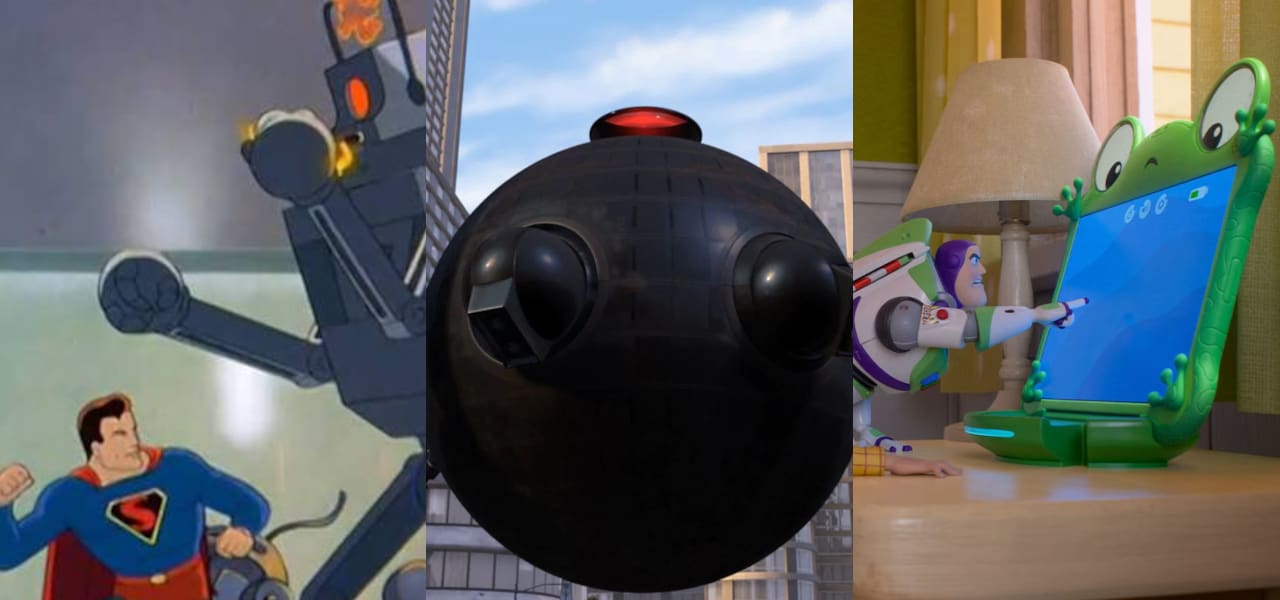
Pictured at top: The Mechanical Monsters; The Incredibles, Toy Story 5