.png)
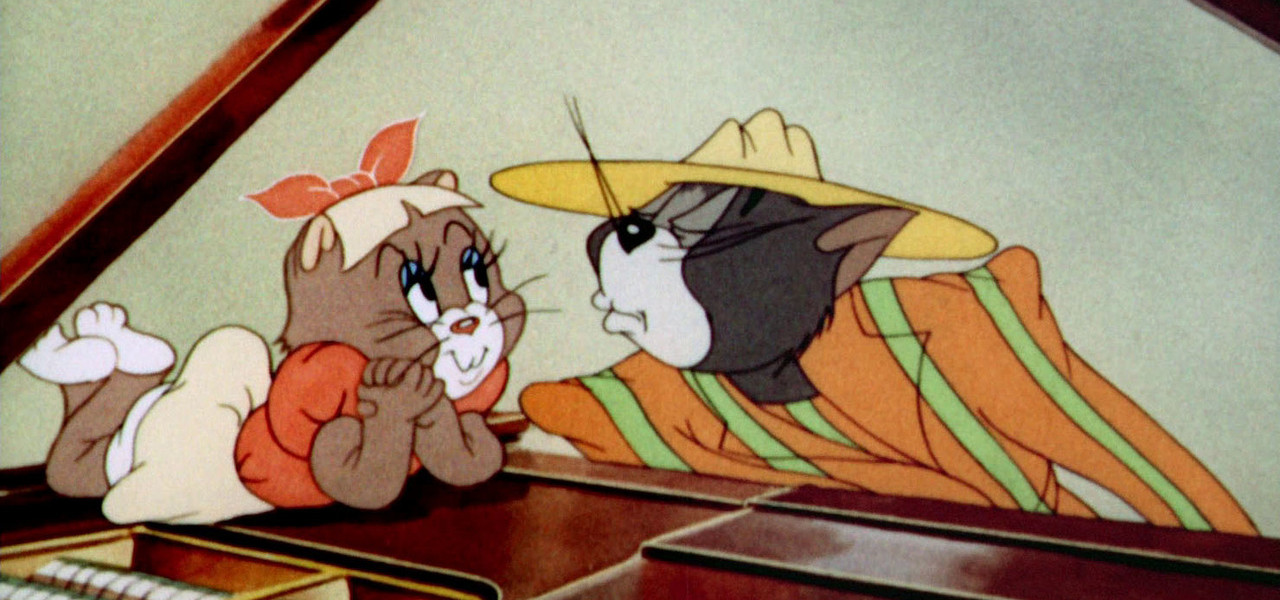
16 Times Tom And Jerry Actually Spoke
Stay informed with free updates
Sign up to get our news digest — delivered directly to your inbox twice a week.
Tom & Jerry first appeared on February 10, 1940, in the Oscar-nominated classic Puss Gets the Boot, and we’re celebrating the cat-and-mouse duo’s 86th anniversary with our favorite times the typically mute duo spoke.
Cartoon fans recoiled in horror when Tom and Jerry: The Movie (1992) blighted the pure slapstick of the original cartoons by giving Tom & Jerry voices. And yet, unlike the Road Runner cartoons, where it’s a hard and fast rule that the characters don’t speak, Tom & Jerry could occasionally pipe in with a comment or two in the classic shorts if the situation called for it. Directors William Hanna and Joseph Barbera seemed to understand that giving the characters consistent voices would throw the series off-balance, but having them talk or sing every once in a great while, and rarely with the same voice, could add an amusing level of unpredictability to the cartoons.
We’ll begin our overview of these off-kilter moments with one of the funniest Tom & Jerry gags, the pie bit in Quiet Please! (1945). You know right away where this is going, but Tom’s ignorance of the inevitable, and the fact that he’s suddenly speaking with this dumb guy voice, makes me laugh every time I watch it.
— Cartoon Study (@CartoonStudy) February 10, 2026
Tom & Jerry’s debut, Puss Gets the Boot (1940), marked William Hanna and Joseph Barbera’s first time directing together as a team, although only producer Rudolf Ising received screen credit. Studio management was unimpressed with the short, and Joe Barbera recalled, “MGM’s brain guy said stop making any more of those cat and mouse cartoons. What happens? A letter came in from a woman named Bessa Short. She was the head of a big Texas movie chain. She said, ‘When are we going to see any more of the delightful cat and mouse cartoons?’ So we started making them again.” The characters’ pantomime interplay is key to their charm, but the film includes a brief moment when Jerry prays in a sped-up squeak.
— Cartoon Study (@CartoonStudy) February 10, 2026
As we’ll see in this overview, Tom & Jerry sometimes made quick comments in their shorts, and Tom’s iconic screams, voiced by Bill Hanna himself, are an essential component of the series. However, there’s only one cartoon where the two exchange back-and-forth dialogue throughout the film, The Lonesome Mouse (1943). This feels like an experiment that didn’t quite work, similar to the short-lived attempt to give the Pink Panther a Rex Harrison-esque voice in 1965, but it’s fascinating to watch as a road not taken. The characters are voiced by Hanna and radio actor Harry Lang, who provided numerous vocal effects throughout the series, including Tom’s oft-reused laughing fit from Mouse Trouble (1944). The final line in this scene, expressively animated by Jack Zander, is a reference to Phil Harris, future voice of Baloo, who would crack cornball jokes on Jack Benny’s radio show and declare, “Ain’t that a lulu?”
— Cartoon Study (@CartoonStudy) February 10, 2026
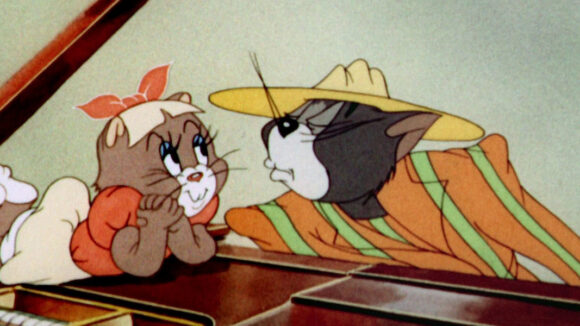
One of my all-time favorite Tom & Jerry shorts is The Zoot Cat (1944), which is loaded with ’40s culture and delightfully dated jive talk. In one classic scene, Tom adopts a French accent to woo his sweetheart, spoofing Charles Boyer’s performance as Pépé Le Moko in the romance drama Algiers, the same performance that inspired Pepé Le Pew, as a matter of fact. Impressionist Jerry Mann is doing the voice here, switching from Boyer to Groucho Marx to deliver the final punchline. Ken Muse animates the majority of this scene, while Irv Spence, the series’ wildest animator, takes over when Tom hops in pain at the end.
— Cartoon Study (@CartoonStudy) February 10, 2026
Another classic entry in the series is The Million Dollar Cat (1944), where Tom learns he will inherit a fortune as long as he doesn’t harm any living animal, even a mouse. Given the amount of abuse Tom suffers in this cartoon, I’ve always found this final line to be extremely satisfying.
— Cartoon Study (@CartoonStudy) February 10, 2026
In The Bodyguard (1944), the one where Spike the bulldog rushes in to defend Jerry any time he whistles, there’s a memorable moment when Tom delivers an evil laugh and snarls, “In me power.” For the voice, Hanna & Barbera called on Billy Bletcher, king of the cartoon bad guys, who was best known for playing Peg-Leg Pete and the Big Bad Wolf in the Disney cartoons. I love Tom’s sinister Grinch-like eyebrows in this close-up, drawn by future Mr. Magoo director Pete Burness.
— Cartoon Study (@CartoonStudy) February 10, 2026
As a kid, I was always baffled and amused by the two separate cartoons where Tom declares “DON’T YOU BELIEVE IT” in a deep, echoey voice. As it turns out, this is a reference to a forgotten radio show of the same name, hosted by Tobe Reed, which debunked myths and rumors. Here’s a clip from the show, followed by its inclusion in the Tom & Jerry shorts Mouse Trouble (1944) and The Missing Mouse (1953).
— Cartoon Study (@CartoonStudy) February 10, 2026
There’s a hilarious bit of dialogue in The Mouse Comes to Dinner (1945) where Tom is set on fire, again, while trying to woo a lovely lady cat. I especially like Tom’s dismissive chuckle, animated by Ray Patterson, before he fully processes what’s going on.
— Cartoon Study (@CartoonStudy) February 10, 2026
Jerry didn’t talk much in the cartoons, but he has quite a bit of dialogue in a sequence from the Gene Kelly musical feature Anchors Aweigh (1945). The combination of live-action and animation here was groundbreaking at the time, and it still looks incredible. The amount of work it must have taken just to animate Jerry’s reflection on the floor is mind-boggling. Jerry’s voice is provided by the multitalented Sara Berner, who not only voiced Tom’s girlfriends in The Zoot Cat and The Mouse Who Came to Dinner, but also played various classic Looney Tunes characters, including A. Flea, Mama Buzzard, and Mayzie La Bird, and was cartoondom’s resident Katharine Hepburn impersonator.
— Cartoon Study (@CartoonStudy) February 10, 2026
In the Oscar-winning Quiet Please! (1945), Tom lulls Spike to sleep with a melody sung by Harry Lang. As a child, I assumed “close your big bloodshot eyes” was an official lyric to Brahms’ lullaby, given that it’s used both here and in Friz Freleng’s Back Alley Oproar (1948), as sung by Sylvester.
— Cartoon Study (@CartoonStudy) February 10, 2026
I always get a kick out of the way Tom’s voice can vary so much depending on the needs of the moment. In the previous clip, Tom sounded like a streetwise trickster, whereas in Trap Happy (1946), he talks like a moron.
— Cartoon Study (@CartoonStudy) February 10, 2026
One of the best sequences in the Tom & Jerry canon is Tom’s performance of the Louis Jordan song “Is You Is or Is You Ain’t My Baby” in Solid Serenade (1946). Singer-trumpeter Ira “Buck” Woods provides Tom’s vocals, giving the short an authentic jazz flavor. The majority of this classic scene was animated by Ken Muse.
— Cartoon Study (@CartoonStudy) February 10, 2026
Speaking of great music, Scott Bradley’s uptempo score for Saturday Evening Puss (1950) is one of his most feverishly energetic. Nobody sings in this one, but there’s a funny moment when Jerry tries to shout over the loud music. You can only partially hear him, but it sounds like Bill Hanna himself doing the voice.
— Cartoon Study (@CartoonStudy) February 10, 2026
Tom & Jerry stopped talking as much in their 1950s appearances, and usually when they were compelled to speak, it was in a foreign language, like Jerry’s jungle gibberish in His Mouse Friday and Tom’s “en garde” in Tom and Chérie. Tom amusingly attempts to speak Spanish in Mucho Mouse (1957), one of the last shorts in the series to be directed by Hanna & Barbera. For the most part, the lushly animated, action-heavy Tom & Jerry cartoons are totally stylistically distinct from the talky TV cartoons Hanna & Barbera became known for, but in some of these later entries, you can see similarities to H-B’s TV output. For instance, Mucho Mouse features thick outlines and stylized design work by Ed Benedict, not to mention that Daws Butler, future voice of Yogi Bear, Huckleberry Hound, and Quick Draw McGraw, provides Tom’s voice.
— Cartoon Study (@CartoonStudy) February 10, 2026
There have been numerous attempts to resurrect Tom & Jerry after Hanna & Barbera left MGM, but most have failed to recapture the magic. Even animation genius Chuck Jones couldn’t quite get a handle on the characters, which Jones freely admitted. Of the Tom & Jerry shorts Jones directed, I think the best one is The Cat Above and the Mouse Below (1964), where Tom performs an aria from Rossini’s The Barber of Seville. The short resembles one of Jones’ operatic Looney Tunes shorts more than a Tom & Jerry cartoon, but it’s good fun on its own terms. Tom’s powerful baritone is supplied by Terence Monck, who won the Los Angeles regional San Francisco Opera auditions the same year this cartoon came out.
— Cartoon Study (@CartoonStudy) February 10, 2026
We’ll end this overview with a clip that doesn’t quite fall within our criteria, but is too good to leave out, Tom lip-syncing along to a country-western record in Texas Tom (1950). Ken Darby of the King’s Men is the one singing this catchy tune.
— Cartoon Study (@CartoonStudy) February 10, 2026
What are your favorite moments when Tom & Jerry talked or sang? Let us know in the comments below.