.png)
Snakes That Stole The Show: 16 Of Animations Most Memorable Reptiles
Stay informed with free updates
Sign up to get our news digest — delivered directly to your inbox twice a week.
With Disney’s Zootopia 2 hitting theaters and introducing the brand-new character Gary De’Snake, we’re taking a look at some of the funniest, creepiest, and most memorable cartoon snakes throughout animation history.
Let’s kick things off with an incredible sequence from Allegro non troppo (1976), Italian animator Bruno Bozzetto’s twisted spin on Disney’s Fantasia, which centers on the snake from the Garden of Eden.
— Cartoon Study (@CartoonStudy) November 26, 2025
Snakes didn’t score a lot of leading roles in cartoons throughout the Golden Age of Animation. They were generally used for one-off sight gags or were cast as villains terrorizing helpless woodland creatures in films like Disney’s Birds in the Spring (1933) and Columbia’s Indian Serenade (1936). One such villain is the snake from Rudolf Ising’s MGM short The Early Bird and the Worm (1936), who uses hypnotism to lure his prey, a common tactic among cartoon reptiles. What makes this snake stand out is the excellent animation by Bob Allen, who imbues the character with eerily vibrating eyes and a beckoning forked tongue.
— Cartoon Study (@CartoonStudy) November 26, 2025
One of the best cartoon snakes isn’t in a cartoon at all, but instead appears in the live-action musical Invitation to the Dance (1956). Director/star Gene Kelly was always looking to push the boundaries of what could be achieved in musicals, and for this film’s “Sinbad the Sailor” segment, he tapped Bill Hanna and Joseph Barbera to create animated characters he could dance with. The snake’s gyrations were based on the movements of dancer/choreographer Carol Haney, although the character jerks around with a snappiness that could only be managed by a cartoon.
— Cartoon Study (@CartoonStudy) November 26, 2025
Probably the most iconic cartoon snake is Kaa from The Jungle Book (1967), played by Sterling Holloway, who is doing a more sinister spin on his unmistakable Winnie the Pooh voice. The sight gags in the “Trust in Me” sequence, boarded by Vance Gerry and Floyd Norman, take great advantage of a snake’s unusual anatomy while also playing into the theme of Kaa lulling Mowgli into a false sense of security. The masterful animation here is by Frank Thomas, who meticulously studied the way snakes move to get the performance right and surmised, “Some people wonder why we go to such lengths to keep something of the real animal in our presentation. There is certainly a temptation to forego the study and effort needed to incorporate the animal’s anatomy and movements into our drawings. But if we were to throw out this special effort, we would soon have all the animals looking alike, and none of them looking like much of anything.”
— Cartoon Study (@CartoonStudy) November 26, 2025
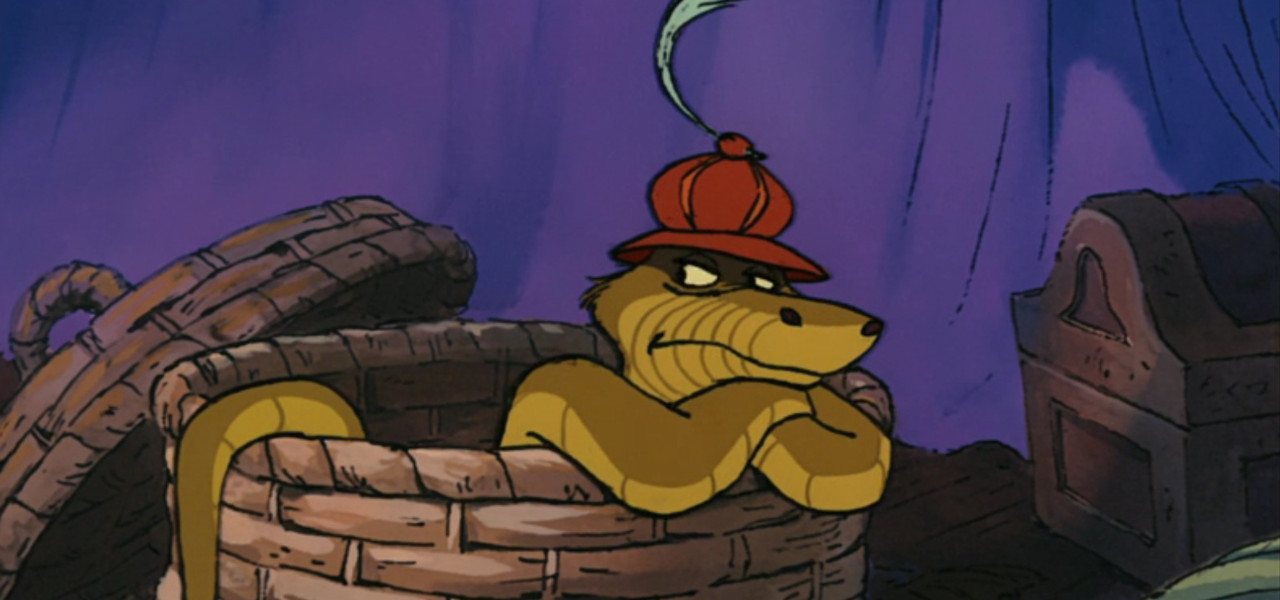
Another great Disney snake is Sir Hiss from Robin Hood (1973), voiced by gap-toothed English comedian Terry-Thomas. You would think acting choices would be limited for a character with no limbs, but in the hands of animator Ollie Johnston, the character’s prissy mannerisms rival the best live-action comedians. Sir Hiss crossing his “arms” – a gag devised by story artist Ken Anderson – is so wonderfully clever.
— Cartoon Study (@CartoonStudy) November 26, 2025
But let’s not get so hung up on these hand-drawn snakes that we forget about the stop-motion ones, like Ray Harryhausen’s dancing snake-woman from the live-action fantasy The 7th Voyage of Sinbad (1958). This is one of Harryhausen’s more cartoony creations, with loopy spaghetti arms that look like something out of a 1930s Betty Boop short. Later films like Dreamscape and Beetlejuice would also incorporate moments of stop-motion to bring forth monstrous snake creatures.
— Cartoon Study (@CartoonStudy) November 26, 2025
Animators are masters at presenting old ideas in fresh ways. A hero rescuing a damsel from a snake is all well and good, but what if the snake was a tape measure? That’s what we get in Two Balls of Wool (1962), a stop-motion film by Czech animator Hermína Týrlová about a sewing kit that comes to life. There’s no dialogue, no faces, and no details of any kind added to the props; the tape measure reads as a snake entirely due to the way Týrlová moves it around.
— Cartoon Study (@CartoonStudy) November 26, 2025
The 1970s saw the debut of several animated snake characters, including the Blue Racer from DePatie-Freleng and Crazy Legs from Hanna-Barbera. I’m partial to the wiggly purple reptile with the bulbous nose from the National Film Board of Canada short Hot Stuff (1971). The film was intended to be a PSA about fire hazards, but it’s mostly just an excuse for director Zlatko Grgić to indulge in his unique brand of absurd humor. Here’s God bestowing upon man (and snake) the gift of fire.
— Cartoon Study (@CartoonStudy) November 26, 2025
Snakes appear in several animated features of the ‘90s: Moses’ staff turns into a snake in The Prince of Egypt, Baba Yaga keeps a pet snake named Piloff in Bartok the Magnificent, and Jafar transforms himself into a snake during the climax of Aladdin. Although Andreas Deja was Jafar’s supervising animator, it was Kathy Zielinski who designed and animated the cobra version. You can tell Zielinski studied real snakes to capture those sharp, sudden moves when Jafar lunges for a bite.
— Cartoon Study (@CartoonStudy) November 26, 2025
Another Disney snake: Juju from The Princess and the Frog (2009), who amusingly doubles as a prop for his voodoo priestess master Mama Odie. According to supervising animator Andreas Deja, “I animated a scene where Mama Odie accidentally bangs Juju’s head against a ship bell. The following scene was a close up of the snake with its head vibrating. I needed to draw distorted, cartoony images of the head, and let me tell you, that particular day I couldn’t for some reason. Luckily, Eric Goldberg’s office was next door and ‘Mr Funny Guy’ made a couple of hilarious drawings which helped me a lot.”
— Cartoon Study (@CartoonStudy) November 26, 2025
Snake characters have also slithered their way into several computer-animated features of the past few decades, like Ajar in Sahara (2017), Blanca in The White Snake (2019) and Maddie in Back to the Outback (2021). One standout example is Viper of the Kung Fu Panda series, designed by Nicolas Marlet. The artists get very inventive with the many fun ways Viper can fight in martial arts battles without the aid of arms or legs.
— Cartoon Study (@CartoonStudy) November 26, 2025
One of the more menacing screen snakes is Rattlesnake Jake, the antagonist in Gore Verbinski’s lizard western Rango (2011), who sports a Gatling gun on his tail instead of a rattle. Lots of villains in recent animated features are played as goofy to avoid scaring children, so I appreciate that Jake is presented as a legitimate threat without sacrificing the film’s quirky humor (that sight gag with the fang is perfectly timed). The scaly texture on Jake looks like you could reach out and touch it (not that you’d want to).
— Cartoon Study (@CartoonStudy) November 26, 2025
Among computer-animated snakes, I’m particularly fond of the character design of Lutador, the noise-hating Burmese python in the musical Vivo (2021). He looks like a boldly-outlined character from a ‘90s Cartoon Network show converted into three dimensions. Joe Moshier led the character design on the film.
— Cartoon Study (@CartoonStudy) November 26, 2025
And we mustn’t forget Mr. Snake, the safe-cracking serpent from the Bad Guys films. This moment of chaos from The Bad Guys 2 shows the fun you can have with the bendy, stretchy bodies of snake characters. That 2D wild take is a nice touch.
— Cartoon Study (@CartoonStudy) November 26, 2025
For one of the best animated snakes of recent years, look no further than Yara Elfouly’s A Snake Called Perseus (2023) a zen short about a reptile who chases a butterfly through a post-apocalyptic desert. This film’s poetic symbolism leaves you with lots to think about, and the background art is stunningly beautiful.
— Cartoon Study (@CartoonStudy) November 26, 2025
There are plenty more snakes I could showcase here, including TV characters like Lola Boa from Brandy and Mr. Whiskers, Slips Python from My Gym Partner’s a Monkey, Craig from Sanjay and Craig, and Sir Pentious from Harbin Hotel, but let’s turn it over to you. Who are your favorite cartoon snakes? Let us know in the comments below. We’ll end things with a Cow and Chicken clip.
— Cartoon Study (@CartoonStudy) November 26, 2025