.png)
At View Conference, Executives From Sony, ILM, Skydance, And More Talk AI And Innovation, But Questions About Jobs Loom Large
Stay informed with free updates
Sign up to get our news digest — delivered directly to your inbox twice a week.
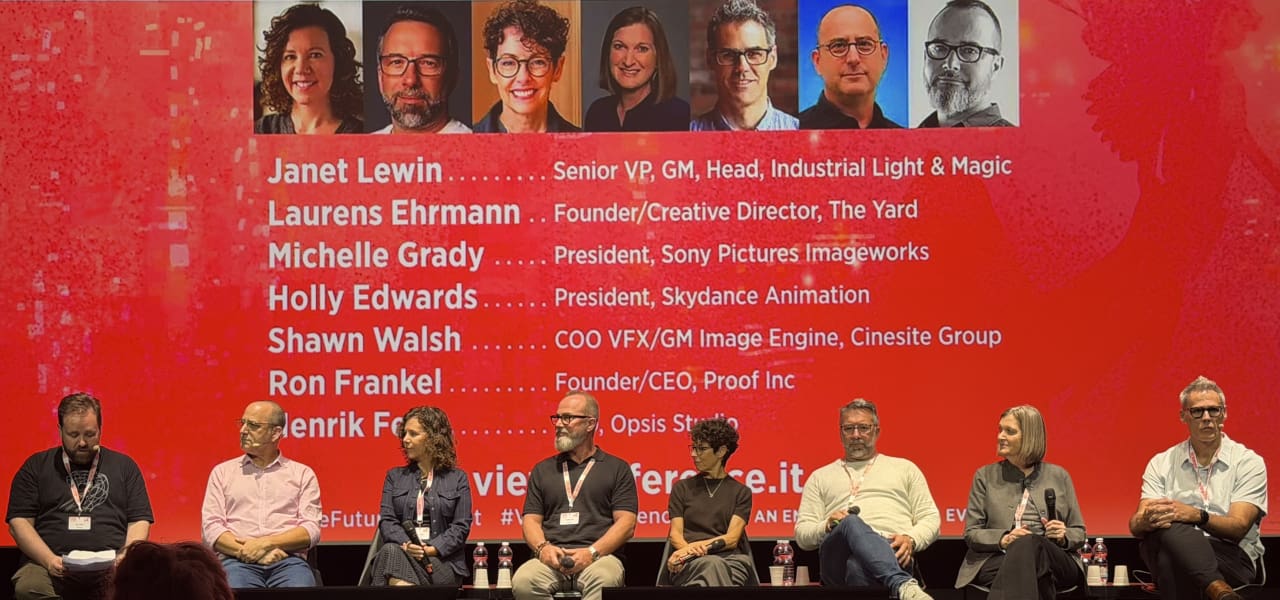
TURIN, Italy — Seven executives from some of the world’s leading animation, visual effects, and visualization studios gathered at Italy’s View Conference on Wednesday evening to discuss an industry facing profound technological and economic change, and what those changes might mean for the artists whose livelihoods depend on it.
Moderated by Ian Failes, editor of befores & afters and a former Cartoon Brew contributor, the panel featured Sony Pictures Imageworks president Michelle Grady, Industrial Light & Magic senior vice president and general manager Janet Lewin, Skydance Animation president Holly Edwards, Proof founder and CEO Ron Frankel, The Yard founder and creative director Laurens Ehrmann, Opsis Studio CEO Henrik Fett, and Cinesite Group COO of VFX and Image Engine general manager Shawn Walsh.
The wide-ranging discussion touched on generative AI, evolving production pipelines, new opportunities beyond traditional filmmaking, and the challenges of preparing the next generation of artists for an uncertain future.
AI, Efficiency, And Artistic Taste
Unsurprisingly, generative AI was a recurring topic during the talk and at View Conference at large, though executives generally framed it as part of a broader technological transformation rather than an immediate replacement for established production methods.
Walsh cautioned against rushing into wholesale changes without understanding their consequences.
“Dumping one entire process for something else that has an unknown end is not something that’s easy to adopt,” he said, arguing for a more gradual approach that preserves filmmakers’ creative intent and control.
“I think ultimately visual effects artists are going to be needed for the foreseeable future to manage this transition to whatever we’re transitioning to,” he added.
Ehrmann emphasized the importance of developing artists’ judgment, particularly as new tools accelerate production.
“We talk about how AI can compress execution time, but it cannot compress taste,” he said. “So, we really need our new generation of artists to understand how to judge an image, how to improve it.”
For Frankel, genAI’s potential lies partly in accelerating the creative exchange between filmmakers and visualization artists, allowing them to iterate on ideas more quickly.
“To be able to have a creative conversation at the speed of ideas is an incredibly powerful thing,” he said. “I don’t think we’re there yet, but I think these tools kind of open up a whole new possibility for how we can communicate creatively with our clients.”
Lewin acknowledged the uncertainty surrounding the technology, warning against expecting immediate solutions.
“There’s a fallacy about this magic bullet of AI and machine learning, and we just don’t know the extent to which these tools are going to transform,” she said. “But we have to keep an open mind about the possibilities.”
New Pipelines, New Possibilities
Beyond AI, the executives discussed other production technologies changing how animated films are made.
Grady offered one of the panel’s most detailed examples, describing Imageworks’ growing use of Unreal Engine in collaboration with Sony Pictures Animation. The technology was initially employed on KPop Demon Hunters, expanded for Goat, and is now being pushed considerably further on Spider-Man: Beyond the Spider-Verse.
“It’s wildly different than what we’ve done before,” she said of the upcoming sequel.
She explained that the film’s directors prefer to keep creative decisions open deep into production, and the new pipeline is designed to accommodate that approach.
“Those filmmakers are like jazz. They do not like to commit to anything. They like to experiment right down to the last minute.”
Imageworks developed a pipeline around what Grady called “story camera, story performance, and story lighting,” letting artists experiment with these elements before entering full production.
“We can see that happening more, that simultaneous building up of a film creatively, and it’s bringing more of our artists into the original, into the creative production,” she said.
Edwards, meanwhile, said Skydance Animation remains focused on exploring the creative potential of CG filmmaking rather than branching into unrelated businesses.
“We are still trying to push the animated movie itself,” she said. “We are really trying to figure out what we can do within the CG, like how do we use the CG […] to its best effect.”
Finding New Audiences
Several panelists discussed efforts to expand beyond conventional theatrical and television production.
Lewin revealed that traditional feature-film visual effects now account for just 40% of ILM’s work, with the remaining 60% spread across other areas.
The company is developing location-based entertainment, immersive experiences, and projects involving digital avatars of musicians. It has also partnered with Meta on immersive cinema experiences.
“All of these storytelling, high-quality visual effects, and interactive elements are converging in a really exciting way,” she said.
Fett revealed that his studio is working on a large-format traveling concert installation, applying its visualization expertise to experiences that engage audiences differently from traditional screen entertainment.
“Using our tool set, expanding it into these other areas that are super interesting, lively, bring audience to interact […] they speak differently to the audience than the passive mediums do,” he explained.
Edwards was particularly interested in changing audience habits and exploring new outlets for animation.
“I feel like our industry is kind of ripe for figuring out how to get the work out there in front of people in a different way,” she said, suggesting that there might be room for a new platform comparable to Adult Swim.
But What About The Artists?
The panel shared that optimism, but it contrasted with the employment situation many artists face today, and the future is even scarier. Major studios have kept cutting jobs even as executives tout new technologies, more efficient production pipelines, and expansion opportunities. For aspiring artists, the question isn’t simply what the industry might look like five years from now, but whether it will still have a place for them.
View attracts a diverse audience, from high-powered industry executives to students and aspiring artists, many of whom make considerable sacrifices to attend the conference. For those hoping to break into animation and VFX, executives’ enthusiasm for new technologies and business opportunities runs alongside a more immediate concern: finding work in an industry struggling with layoffs, consolidation, and shrinking employment prospects.
When the panel opened up for audience questions, we had to ask:
As new technologies transform production and studios face mounting financial pressure, how do executives balance their responsibility to protect the livelihoods of the artists who work for them with the pressure to keep their studios operational?
Grady acknowledged the seriousness of the situation.
“We don’t exist without artists, full stop,” she said. “The concern of disappearing is very real for us as organizations. If we don’t figure this out, if we don’t figure out how to use the technology in a way that creates great images using great artists, then we’ve completely failed.”
She acknowledged that the transition would be difficult for some workers, but hoped technological change would eventually create additional employment opportunities.
“We want to hold on to our people. We want to hold on to our companies,” she said. “We need taste. We need talent. There’s no other way to do it.”
Lewin was equally candid about the limits of executives’ control.
“Many of us are part of a parent company that makes decisions that we can’t control,” she said. “Additionally, we can’t control what projects get greenlit and when and how much visual effects is going to be required and what the budgets are.”
She argued that studio leaders must prioritize transparency, retraining, and finding new opportunities for employees, while acknowledging that some changes are unavoidable.
Fett, speaking as an independent studio owner, described protecting his workforce as a daily responsibility.
“The well-being of our artist pool […] is paramount,” he said. “That’s what I go to bed with, and that’s what I get up in the morning with.”
The responses reflected a shared recognition that artists are essential to the industry’s future, but offered fewer specifics about how studios intend to protect those jobs as technological and financial pressures intensify.
Tax Incentives And The Geography Of Employment
Another audience question addressed the industry’s dependence on geographic production incentives, asking whether artists might eventually work from anywhere rather than relocating to established production hubs. This question is particularly relevant in Italy, where local incentives lag behind those offered by several other European countries.
Fett said his fully remote studio was already pursuing that model, employing senior artists worldwide and negotiating with clients based on the team’s expertise rather than its location.
“Our artist crew is global,” he said. “Those are all senior folks. We’re very aggressive with our bidding, as we all have to be. So if that all works for you, that’s great. If that does not work, then we may not be a good fit for this project.”
He was particularly critical of how tax incentives influence where work gets done.
“I would really love to take a magic wand and turn this whole incentive thing away,” Fett said. “And we can be wherever we are, and we’re good as artists, or we’re not good as artists, and that’s why we get hired, or our people get hired.”
Frankel offered a contrasting perspective, arguing that studios working on major film and television productions have little choice but to follow the incentives that attract their clients.
“Those productions are going to places where there are tax incentives,” he said. “Those are decisions that are being made […] government-level decision-making. So our only choice is to be a local vendor within that ecosystem.”
He compared Proof’s expansion strategy to mushrooms popping up wherever work becomes available.
“We build out a talent pool around that because they have to live within that region,” he explained. “Every place has its rules. Our choice is to, we can either play within that sandbox or we can walk away.”
Frankel acknowledged that productions without geographic restrictions offer considerably more flexibility, but the exchange illustrated how differently studios must approach staffing and expansion depending on their clients, business models, and exposure to regional incentive programs.
An Uncertain Future
When asked what younger artists should prioritize, several executives argued against overspecialization.
Fett encouraged newcomers to build a broad foundation, noting that his remote studio relies on senior artists, making it hard to mentor younger talent.
“I would encourage younger people to really not look at the hyperspecialization, but learn your craft,” he said. “You want your tool chest to be whole.”
Grady offered three guiding principles: “Know your craft,” find strong creative collaborators, and remain adaptable.
Edwards similarly emphasized flexibility and the importance of studios providing training and opportunities for employees to move between departments.
For Frankel, the industry’s upheaval could ultimately produce entirely new approaches to storytelling. Comparing AI’s arrival to the invention of photography and the artistic movements that followed, he suggested that today’s uncertainty might precede another period of extraordinary creative experimentation.
“My hope, kind of deep down hope, is that we’re going to see […] an explosion of different forms of storytelling that come out of all this,” he said. “That we’ll need visual effects, that we’ll need all of the things that we do. They’re just going to look incredibly different.”
The executives offered plenty of reasons to be optimistic about the creative possibilities ahead. Less clear, however, was how those opportunities would translate into stable employment for the artists expected to realize them. For an industry already struggling with layoffs and consolidation, that distinction matters as much as any technological breakthrough.