.png)

More Than 220 Puppets, 142,000 Replacement Faces, And 2,776 Shots: The Astonishing Figures Behind Laika’s ‘Wildwood’
Stay informed with free updates
Sign up to get our news digest — delivered directly to your inbox twice a week.
Laika’s upcoming feature Wildwood is the studio’s most ambitious production to date, and almost certainly the most ambitious in stop-motion history. At this week’s View Conference in Turin, effects supervisor Steve Emerson hosted a detailed behind-the-scenes look at just how complicated making the film has been.
“Wildwood was 265 weeks from the start of stage animation through visual effects delivery,” Emerson told attendees. “My daughter, she was in elementary school when I started working on the film in February of 2020. She is now a senior in high school. She is considering colleges. She drives a car, and she is dating.”
The numbers are staggering. The production involved 223 handcrafted puppets, 132 practical sets, 728 handmade trees representing 10 Pacific Northwest species (the talk included a brief dendrology lesson), and 142,030 replacement faces. One shot required 1,124 individual facial replacements, a stop-motion record, according to Emerson.
But perhaps the most revealing figure was the film’s shot count.
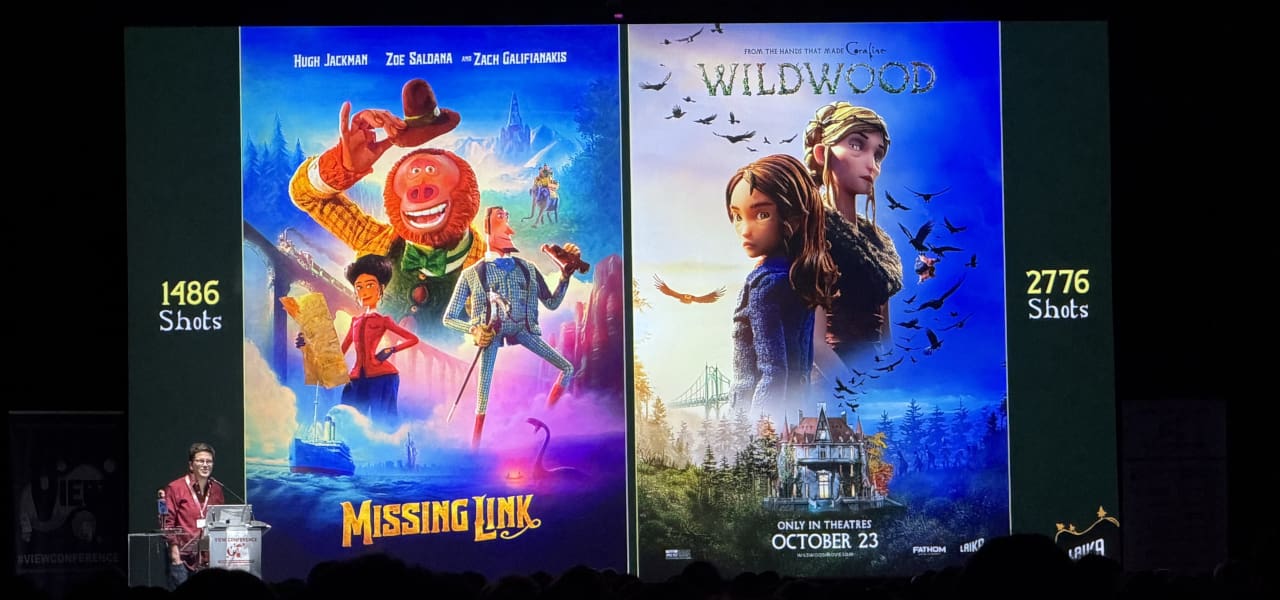
“Prior to Wildwood, our largest film to date, released in 2019, was Missing Link. That film had 1,486 shots. It was massive. It was bold. It was beyond anything we had done previously. And then we were presented with Wildwood, which was 2,776.”
“We were essentially going to be making two films,” he continued. “But beyond that, the shots themselves were infinitely more complex.”
Emerson explained that the production’s scale demanded an unusually sophisticated relationship between practical animation and digital effects.
“What’s more sort of consistent at the studio these days is that we will rehearse and we will block with multiple puppets, but then when it comes time to get the actual performance, we’ll split them out.”
By shooting characters separately and compositing their performances together, animators can concentrate on individual puppets without interfering with one another.
“Remember, we have basically a 10-inch inanimate object, and our goal is to get this thing into a movie theater and present it to the world and to human beings and create empathy and emotion.”
One of the presentation’s most intricate examples involved the film’s sinister, animate ivy.
“We didn’t want to do something in Houdini as is typical. We wanted to make it as hard on ourselves as possible.”
Rather than relying entirely on conventional digital simulation, the team developed the ivy’s movement through physical experiments, including stop-motion tests and footage of wires being pulled from miniature trees, photographed at 240 frames per second and played backward. The examples were impressive and almost unsettling in their jerky locomotion.
“It’s weird, and it’s twitchy, and it’s aggressive, and it’s nightmarish, and it was exactly the look that we were gunning for.”
For Emerson, those experiments reflected Laika’s commitment to preserving the character of handmade animation, even if the final imagery is created digitally.
“They’re keeping us honest, and we’re making sure anything that is digital that’s being done for the film belongs and is representative of that stop-motion universe.”