.png)
‘I Hope It’s An Antidote To Digital Content’: New Zealand Creators Behind ‘Kiri And Lou Go Raaa!’ Speak At Annecy
Stay informed with free updates
Sign up to get our news digest — delivered directly to your inbox twice a week.
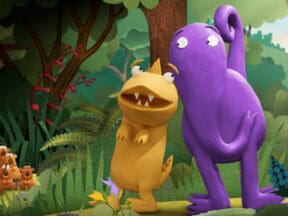
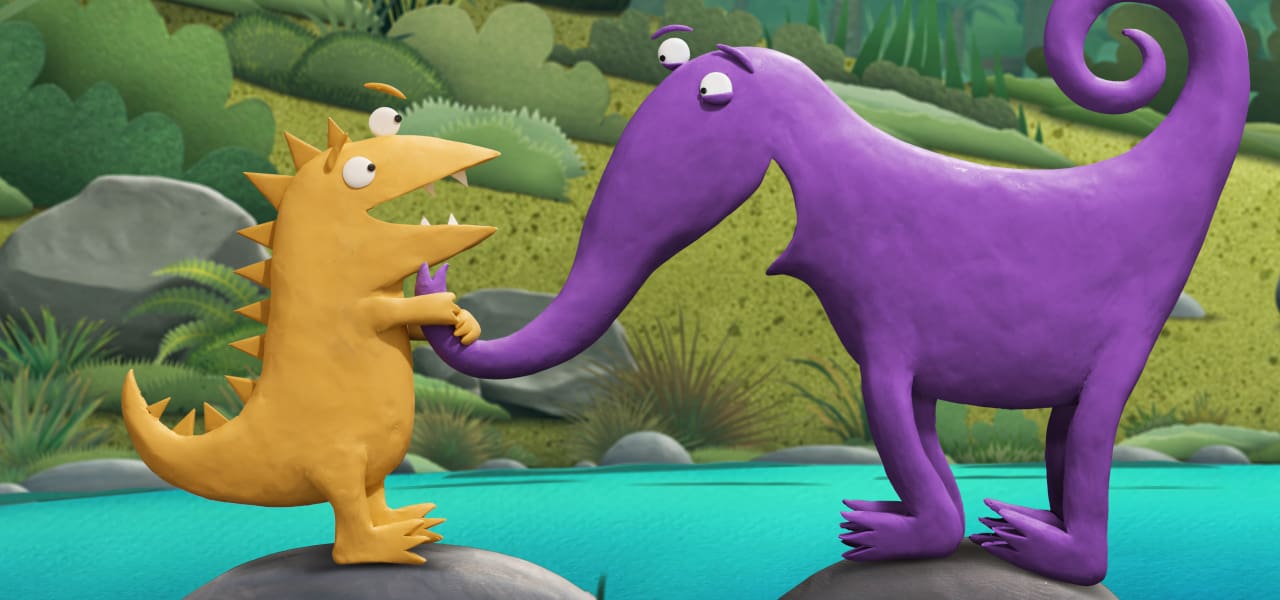
New Zealand’s first stop-motion feature had a spotlight in Annecy today in the form of a breakfast under the shadow of the Alps. Kiri and Lou Go Raaa is a continuation of Harry Sinclair’s colorful and wholesome claymation series, taking the bite-sized journeys its yellow and purple protagonists embark on and expanding them into a full-blown adventure.
During the panel, co-director Anthony Elworthy, New Zealand Film Commission CEO Annie Murray, and stars Jermaine Clement and Olivia Tennet competed with the Annecy sun for the attention of a group of journalists.
Murray began the panel with glowing praise for the uniqueness of Kiri and Lou, saying:
The show is distinctly New Zealand, and yet has traveled so well. So often, we see global appreciation requiring compromise and dilution, but Kiri and Lou shows that the opposite is true, that a deeply local story can resonate emotionally around the world.
Elworthy said that he initially encouraged Sinclair to make the series in 2D, but soon discovered the joys of stop-motion.
There’s something about it that, from a performance point of view, is a lot like acting. You’re acting in real time, it’s just a lot slower. There’s not really the option of going back and refining things. It all comes down to this one-off performance where you get a range of expressions and get to play with a lot of nuance.
For Clement, Kiri and Lou stands out for its calmness. “It’s so gentle compared to other shows. One piece of direction I got a lot was, ‘Can you give a bit less?’ which people never say. It’s always, ‘Give more!’”
Tennet connects deeply with the emotional exploration the show offers.
I get messages from adults who don’t have kids saying that the show made them cry because of how tough a time they were going through. Kiri and Lou was their five minutes of joy each day.
Kiri and Lou Go Raaa was animated using clay on glass tables, with eight animation stations set up simultaneously in the New Zealand studio, which itself had only 15 people working at any one time. The technique has limitations, but it also helped with the jump to feature filmmaking.
“We don’t have armatures, we don’t have to do rigging, we don’t make costumes, so we can create new characters very efficiently,” explained Elworthy. “It has its limitations. When we want a character to turn 180 degrees, you have to stop in between those positions. We adopted it as a style. When you see our characters, you see them either in profile or front-on.”
Talking to Cartoon Brew after the panel, Elworthy spoke about the incremental upgrades that making a feature allowed.
For the first time, we invested in better lights that were more controllable. It took the pressure off the compositors when grading the characters. We also finally had a dedicated camera person. Throughout the series, all the camera work was done by me and the animators as we went along. To have someone whose job it was to make sure the raw footage was carefully managed in terms of color made a huge difference.
Expanding for the feature meant developing talent at home, but also dipping into the global pool of animation talent. Animators from France, Spain, and the U.K. all ended up at the New Zealand studio.
“Stop-motion is something that has to be done in a shared space,” Elworthy told us. “You have so many people fulfilling different roles for each shot. A lot of the people we brought in have very refined talents, much better than mine. But then they have to come in and find our style for themselves. There would be a period where they had to let go of their own habits to get into the Kiri and Lou world, down to the minutiae of, ‘We don’t blink like that,’ and, ‘This is how the mouth should look.’”
The true aim for Elworthy going forward is to cultivate talent at home.
It’s important to me to try to grow an industry. One of the things we did with the movie was move the studio into a space that we rented from the University of Canterbury. In exchange, we gave students access to what we were doing. We took on a couple of interns who were doing a lot of the less glamorous work, and it was super helpful to us. That’s an ongoing relationship we have.
Back at the panel, Murray was proud to present something to preschool audiences that was not only a break from fast-paced content but also something with an authentic human touch.
The emotional truth is what comes through. That’s the core of the movie. It’s something that couldn’t have come from any other part of the world. It’s a beautiful example of how we can move forward as a local industry in a more sustainable way, understanding that animation can have both creative and commercial success. It’s something that the Film Commission believes in strongly.
Elworthy added, “I hope it’s an antidote to the prevalence of digital content. I understand that digital stuff is prevalent because directors and producers can go back and change the work of the animators until it’s just like everything else that’s being made. So there’s a way to make this stuff that’s more in the hands of the animators, that prioritizes creators, and allows the audience to see something new.”