‘The Cat In The Hat’ Directors On Bringing Seuss’s Printed Pages To CG Life
Stay informed with free updates
Sign up to get our news digest — delivered directly to your inbox twice a week.
Ninety-five years after Dr. Seuss, aka Theodor Geisel, published his first collection of stories in 1931, his works are still read around the globe. His 60 children’s books are masterpieces of wordplay and potent prose that guide generations as they amble toward maturity. One of his most famous books, The Cat in the Hat, debuted in 1957 and captures the joy of childhood chaos and the magic you can make out of boredom.
Following a 2003 live-action adaptation starring Mike Myers, The Cat in the Hat returned to development when Warner Animation Group acquired the rights in 2018. The studio tasked co-writers Erica Rivinoja (Cloudy with a Chance of Meatballs 2) and Alessandro Carloni (Kung Fu Panda 3) with co-directing their screenplay, with Bill Hader executive producing and voicing the Cat. In 2024, DNEG Animation came aboard to animate the film, and the result is a fresh interpretation of The Cat in the Hat tailored to modern kids and parents still as bored and disconnected as ever.
First-time director Rivinoja and veteran feature animation director Carloni sat down with Cartoon Brew to discuss the visual choices in their adaptation, their original characters, and how they expanded Geisel’s book into a feature-length tale.
Boosting the Book
From the early days of their screenwriting, Rivinoja says they knew the constraints of Geisel’s The Cat in the Hat needed to be opened up. “The book is very small. It’s one location over one short period of time, and it’s just a few characters,” she says. “But it was important to us that we take that book and those characters that are so beloved and put them on screen.”
She says they asked themselves why the events of the book happened and how the Cat got this weird gig showing up in the homes of bored kids on rainy days. Their answers set up the structure of the screenplay. “This movie’s going to show us that this hat is his company uniform, and he’s actually one of many specialists that entertain children on rainy days,” she explains.
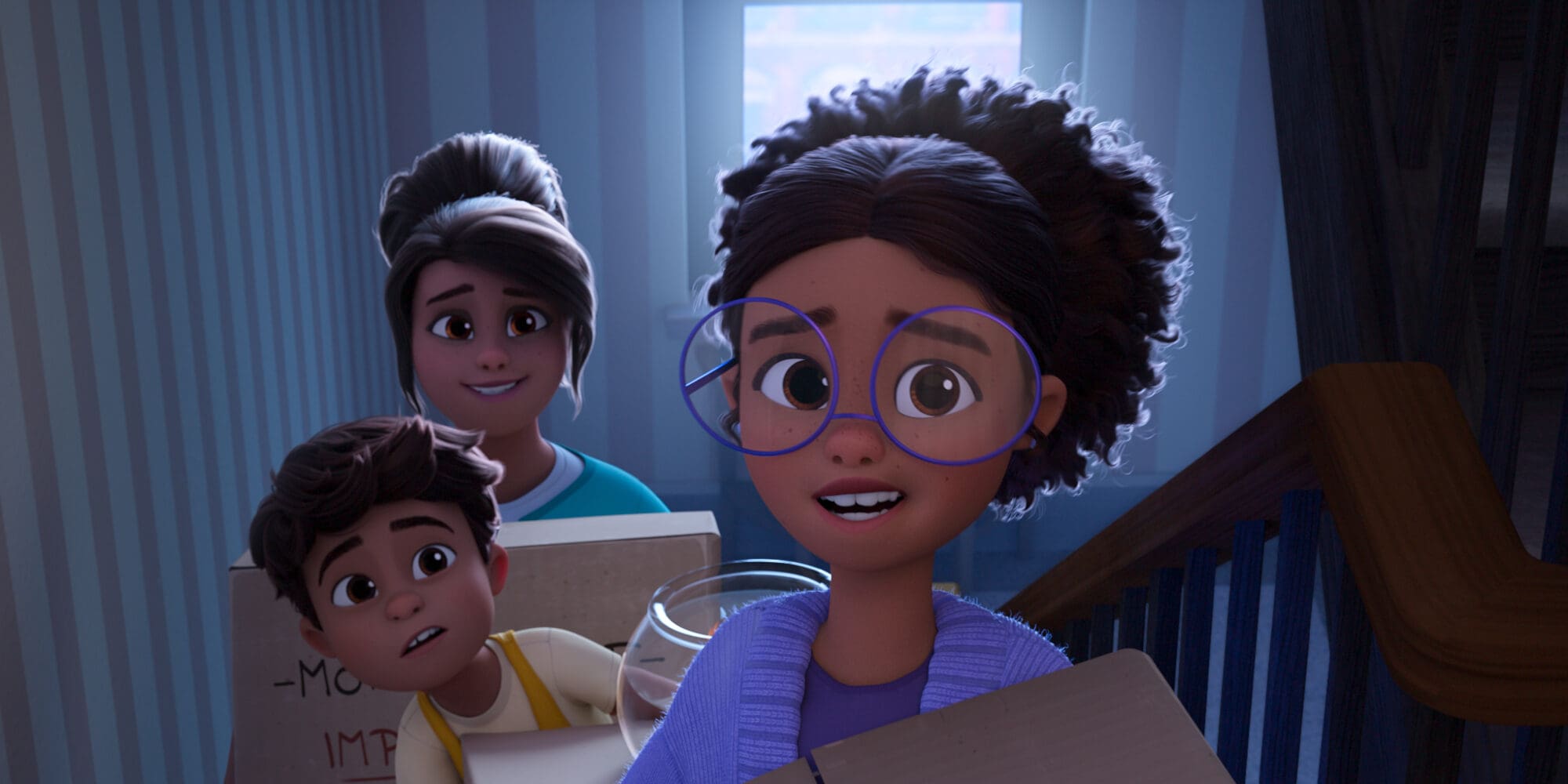
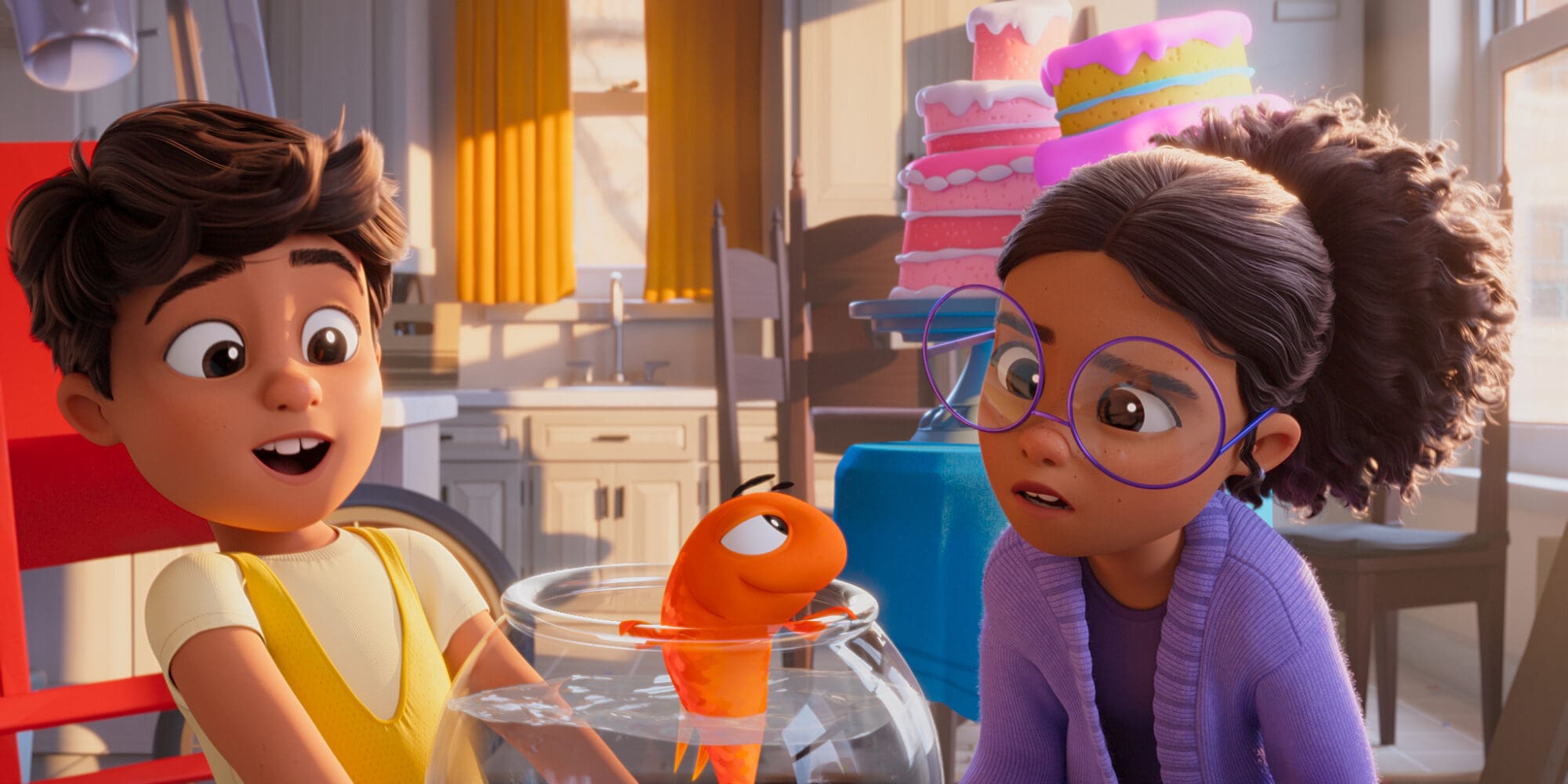
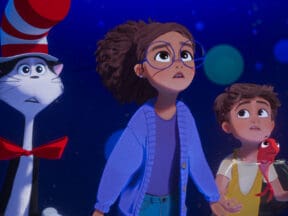
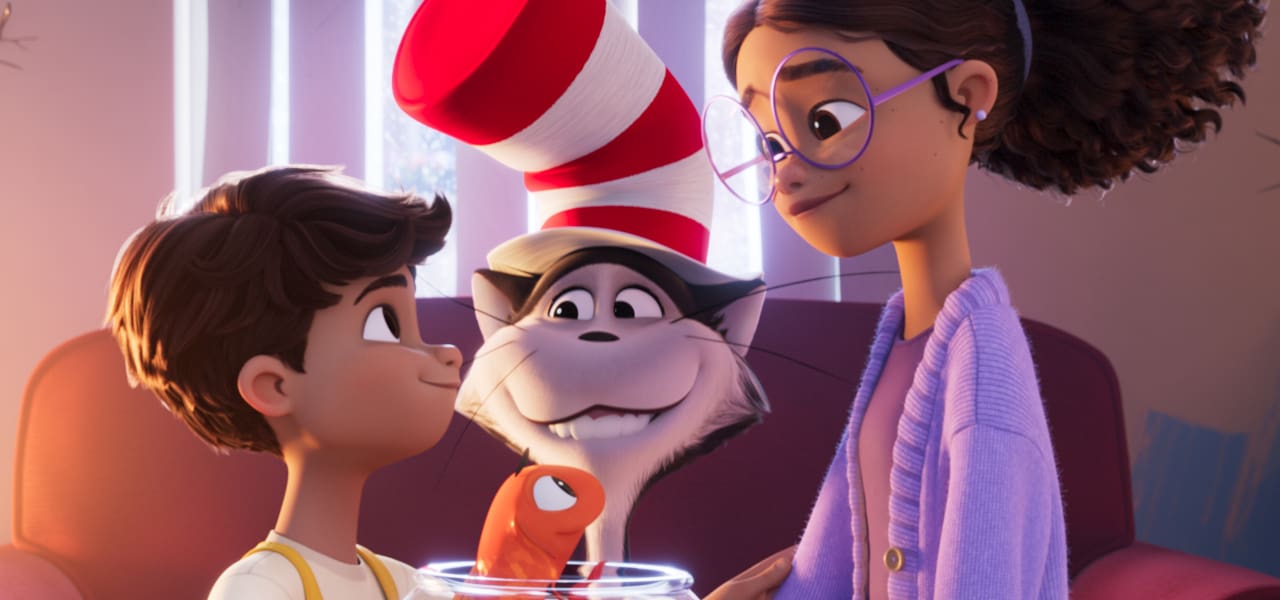
Carloni says that even though they modernized the expanded world of the Cat, they still wanted to feature siblings, older Gabby (Xochitl Gomez) and younger Sebastian (Tiago Martinez), who end up embarking on a journey with the Cat to better appreciate their family.
“In the book, the kids are very much understimulated, just looking at the rain waiting for something to happen. In our movie, we try to overstimulate them,” Carloni says of the kids. “They’re staring at the screen; they’re overwhelmed with games and social media. But the result is the same: disconnection and being uninspired and unmotivated. The Cat represents a force of nature that can come in and allow you to reconnect in the present, in the moment, and with the ones you love. So, in a way, even though we transform the source of the problem from the book, the result is the same: what happens when you disconnect from the here and now and the ones you love, and the Cat comes.”
The HQ, the Apartment, and the Box Worlds
As feature animation continues to explore fresh ways to move beyond established CG house styles, Carloni says they approached their visual decisions by focusing on story.
“This is the only Dr. Seuss book where a whimsical talking Seussian character comes into our world, as opposed to staying in Whoville or the world that Seuss creates,” Carloni points out. “And so, it presented us with the cinematic opportunity to create the real world and the Seussian magical world where he comes from. Then, we go into this magical world through nostalgia and memories. Foolishly, we ended up having three looks of picture, which ended up being such an amazing amount of work. But at least there’s pride in saying that this moment in animation allowed us to explore what the movie should look like, and we grounded that into the narrative necessity of our own story.”
Rivinoja says DNEG’s visual effects supervisor Matt Waters and digital effects supervisor Jean-François Lerouxy were especially important in helping them translate their ideas to the screen, along with production designer Aidan Sugano.
“Sugano had these wonderful ideas about really referencing printing in the Seuss world, so you’ll notice that there’s, like, occasionally print offset marks that you would have had in the books,” Rivinoja says. “There’s occasional paper textures and stuff; it was just so innovative and smart. The care that was given to make it seem like the book came to life was just so beautiful and amazing to me.”
Overall, Carloni says much of their design approach is tied to shape language. “We realized earlier on that we didn’t want to transform the characters themselves. What we wanted to transform is their surfacing, their rendering, their aesthetic, and the color palettes,” he explains. “And above all is the way the light hits. We first started to strip all the occlusion from the Seuss world. But we didn’t want to make the mistake of just going toward toon shading and letting it pretend to be 2D or hand-drawn. A lot of the work came from, we’re going to strip the occlusion and then we’re going to figure out, where is the light source that will give the three-dimensionality?”
He references one of his favorite scenes in the film as an example, where the Cat is being sabotaged by his boss, Mr. Hoogeboom (Giancarlo Esposito), with a potato on a string. “It became simplified, no occlusion, very flat, and then we gave it a bounce from the desk of the boss and it brought up this warm, three-dimensional light onto him. The goal was always to get to a place in which you look at it and you’re like, ‘Wait, what am I looking at? Is this traditional animation? Is it CG, or is it not?’ It was always about finding that balance. First, strip it all down, make it almost look toon-shaded, and then figure out where the softness comes from.”
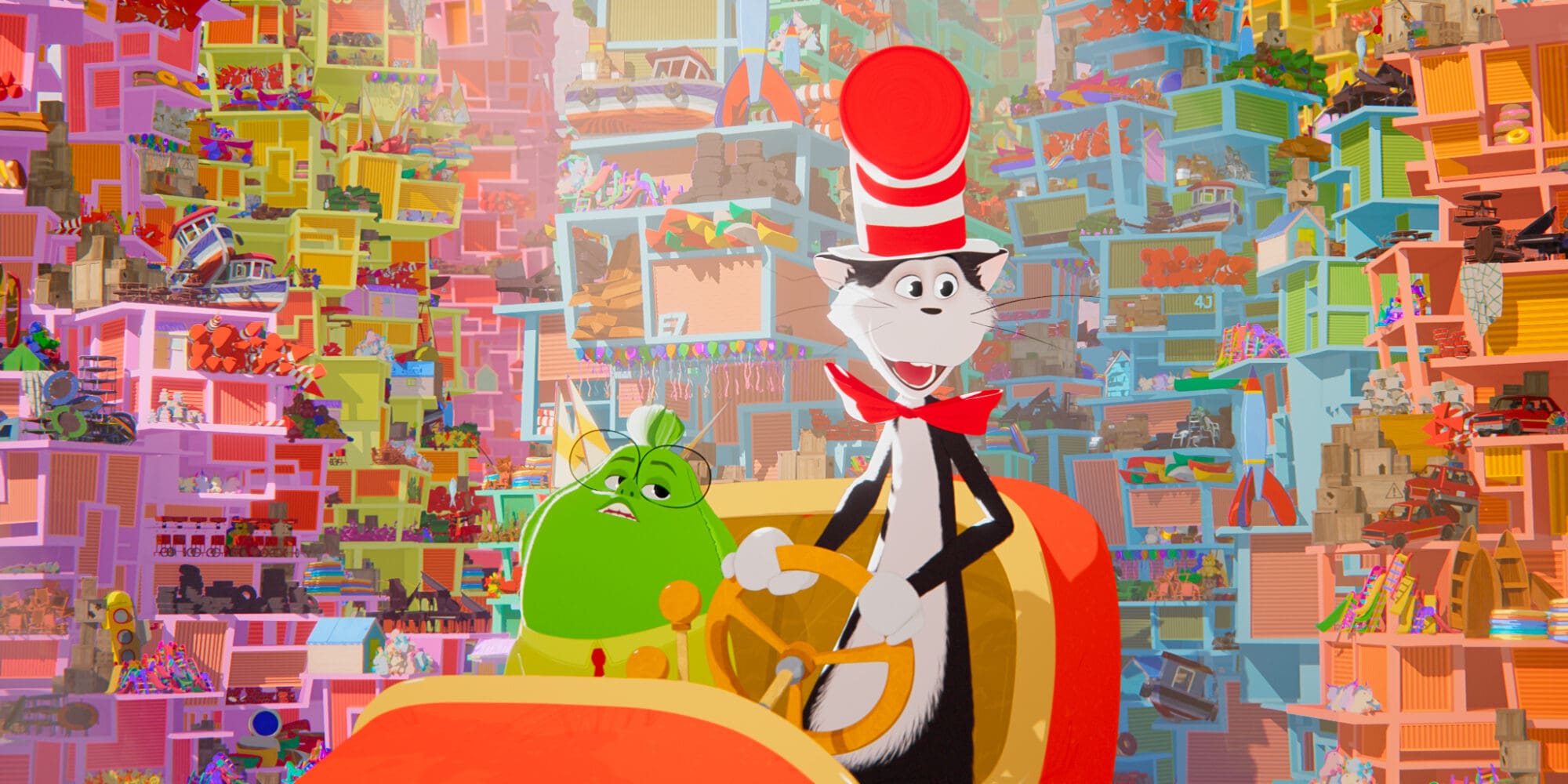
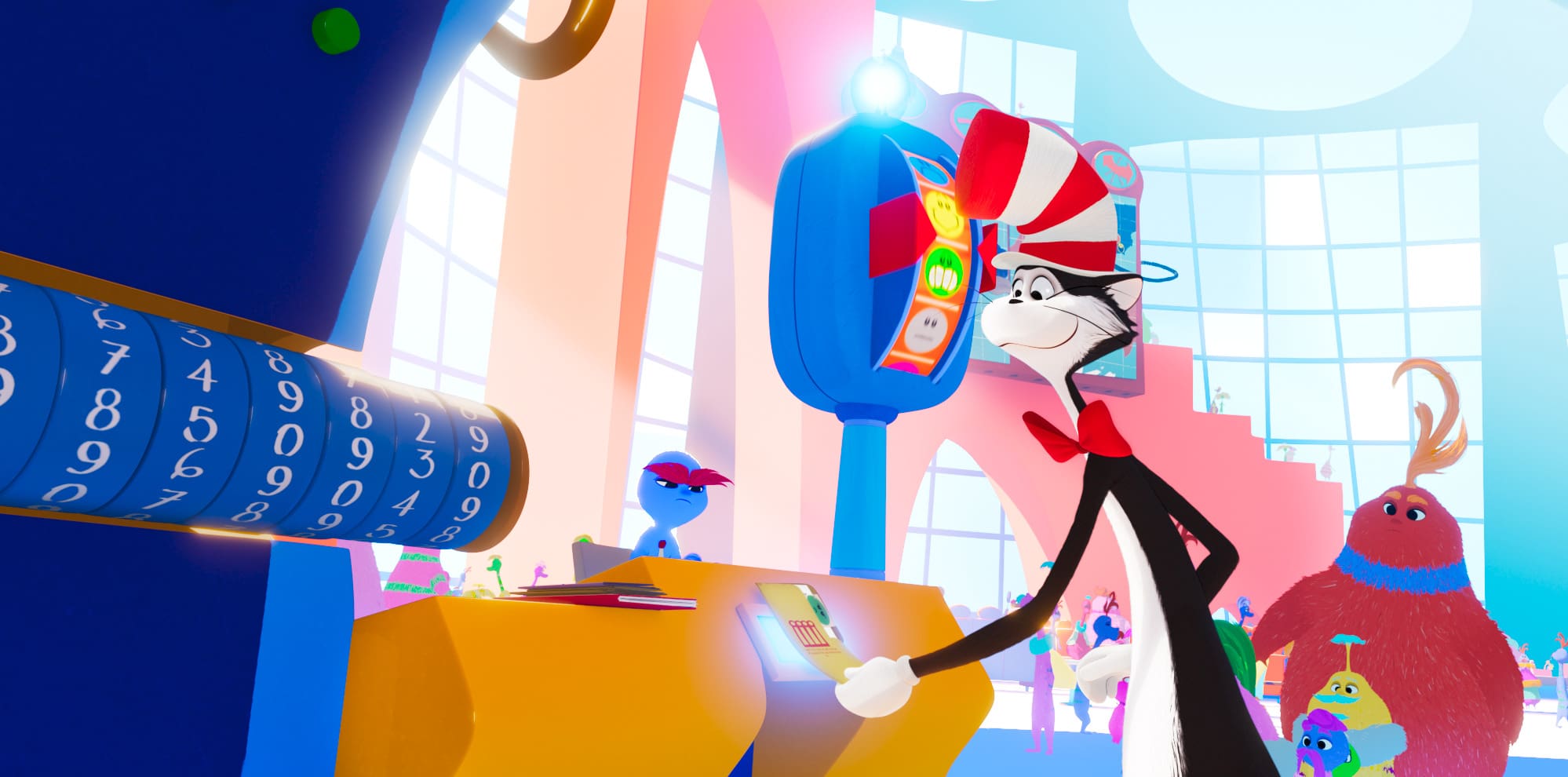
To distinguish the rest of the HQ area, where all of the various Seussian creatures assemble to get their child assignments, Carloni says they decided to include broken edges everywhere to make sure that the sharp edges of typical surfaces never looked too digital. “There’s this little sense that it’s a brushstroke, or a print offset,” he says of the impression it gives viewers. “It allows the element of organic mannerism to appear on screen, which very much fueled this notion of, ‘What am I looking at right now?’ which I love so much.”
Some Things
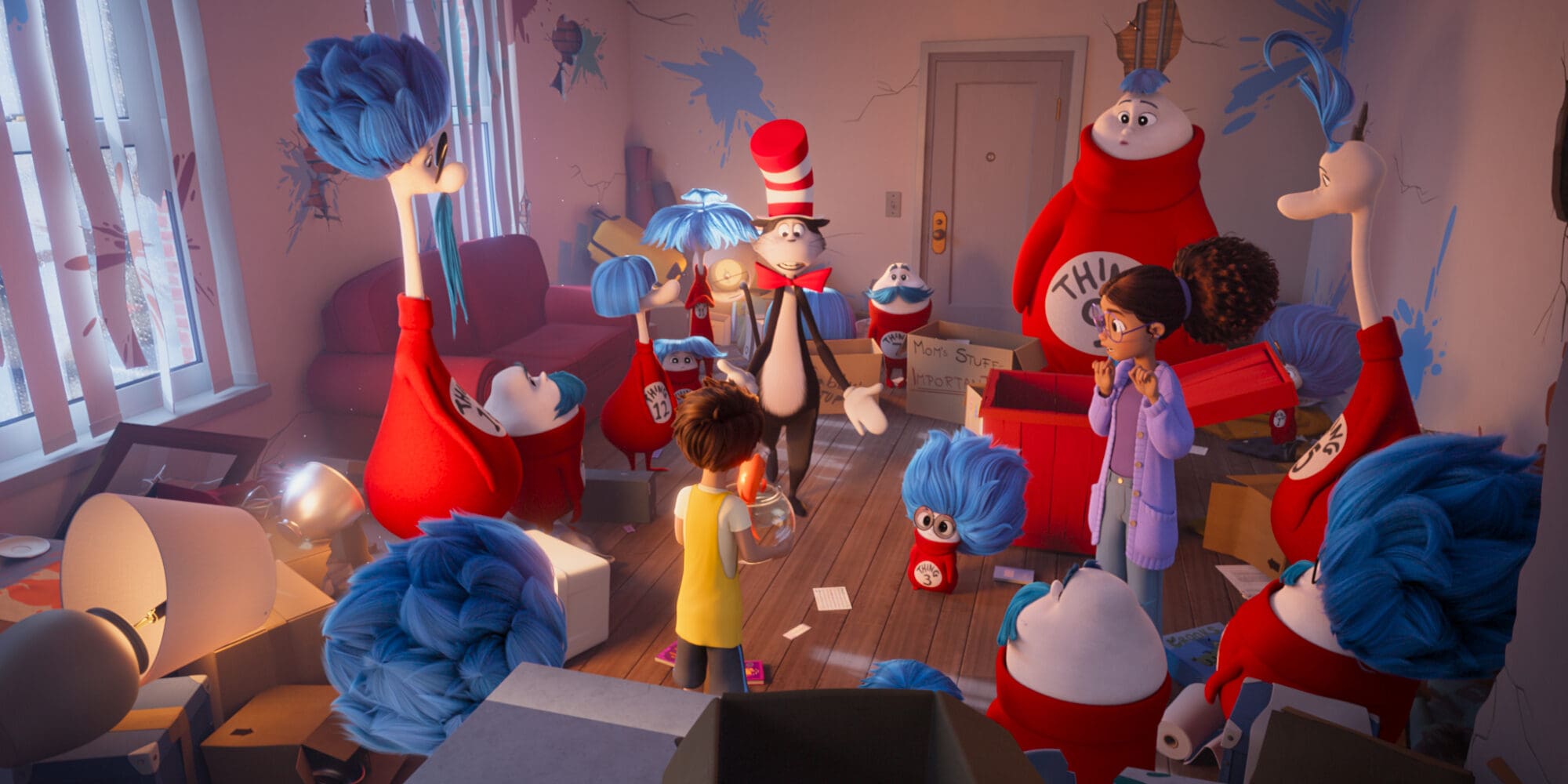
Two major additions to this version of The Cat in the Hat are a stalking villain called the Something and a community of Things that extends far beyond the book’s Thing 1 and Thing 2.
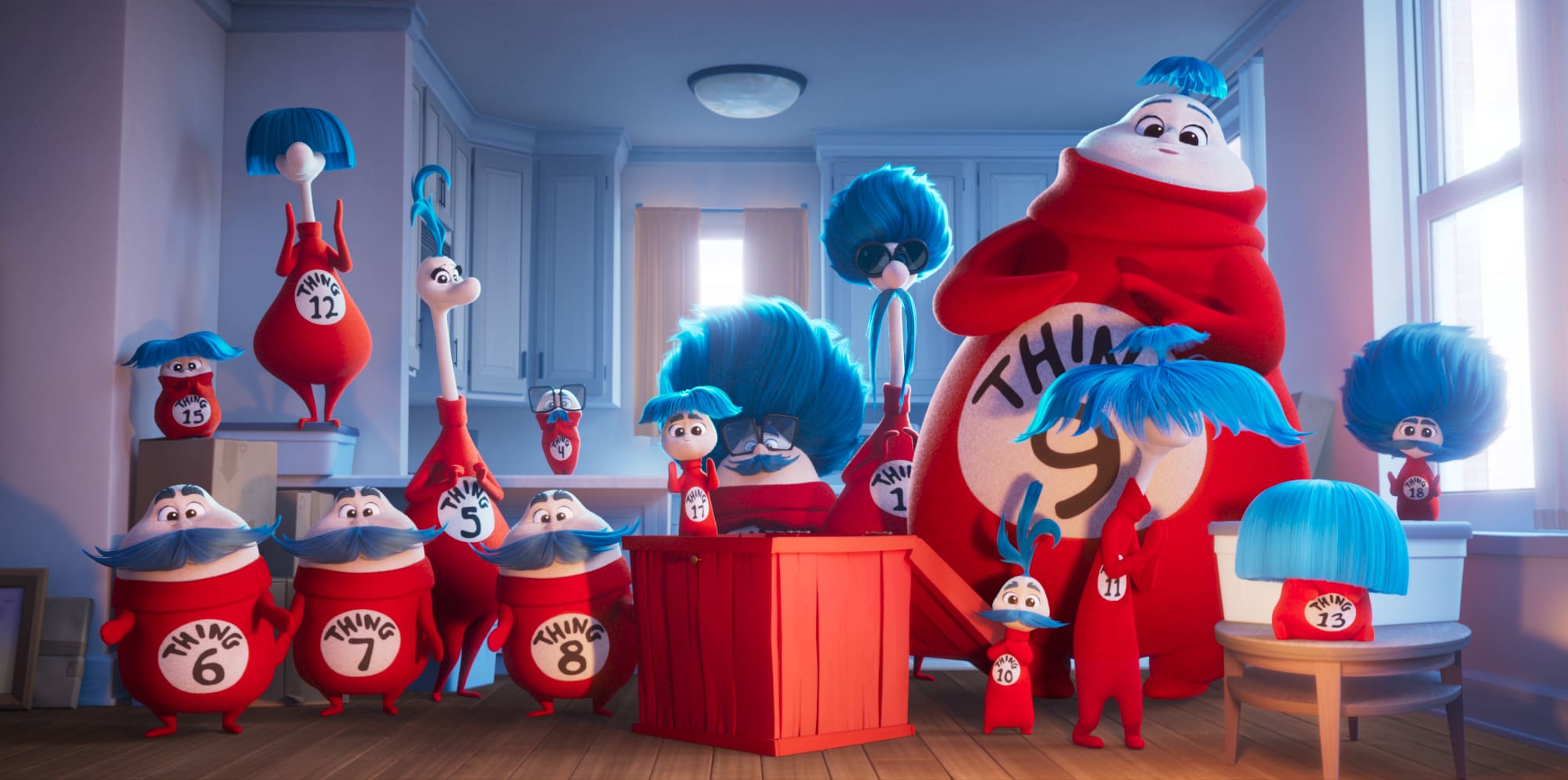
“Inherently, when people think of The Cat in the Hat, they think of a young reader book, and so our challenge was always to make it a film for all ages; something that would appeal to adults and not just for little kids,” Rivinoja explains. “With that came the directive, which we were very glad about, to have a real monster, to have real stakes and drama.”
When it came to expanding Geisel’s Things into a whole community of numbered, blue-haired creatures, Carloni admits they were the hardest thing to crack. “Mostly the question for us was, what are they doing on screen?” he explains. “They’re chaotic, but we don’t want just chaos to associate with comedy because that’s not really it. You need to figure out, what are they doing?”
Carloni says it took them a year to figure out the Things’ role, but their eureka moment came when they tried to storyboard a scene with the Things stalking the pet goldfish, Waffles (Matt Berry), for lunch.
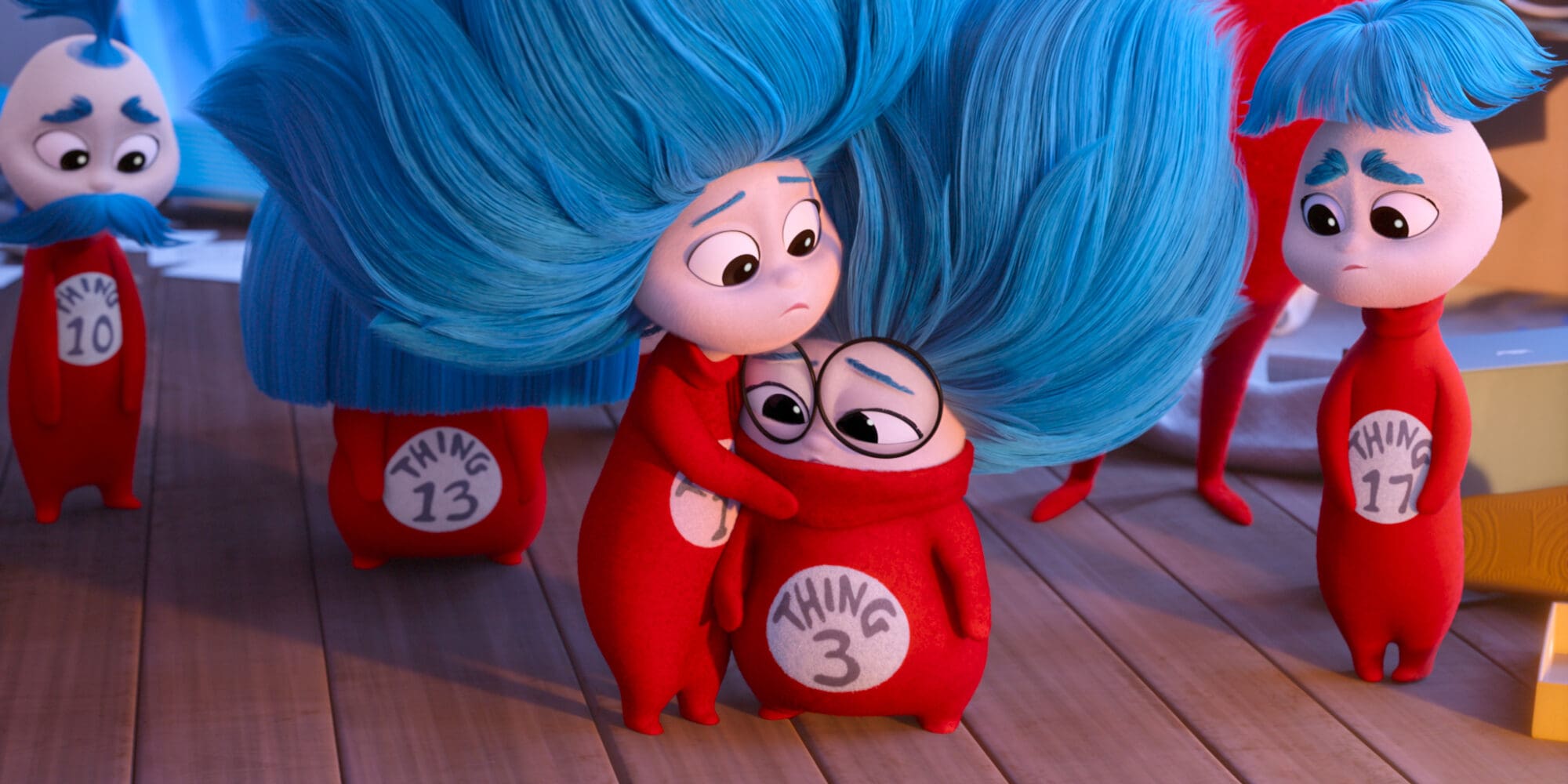
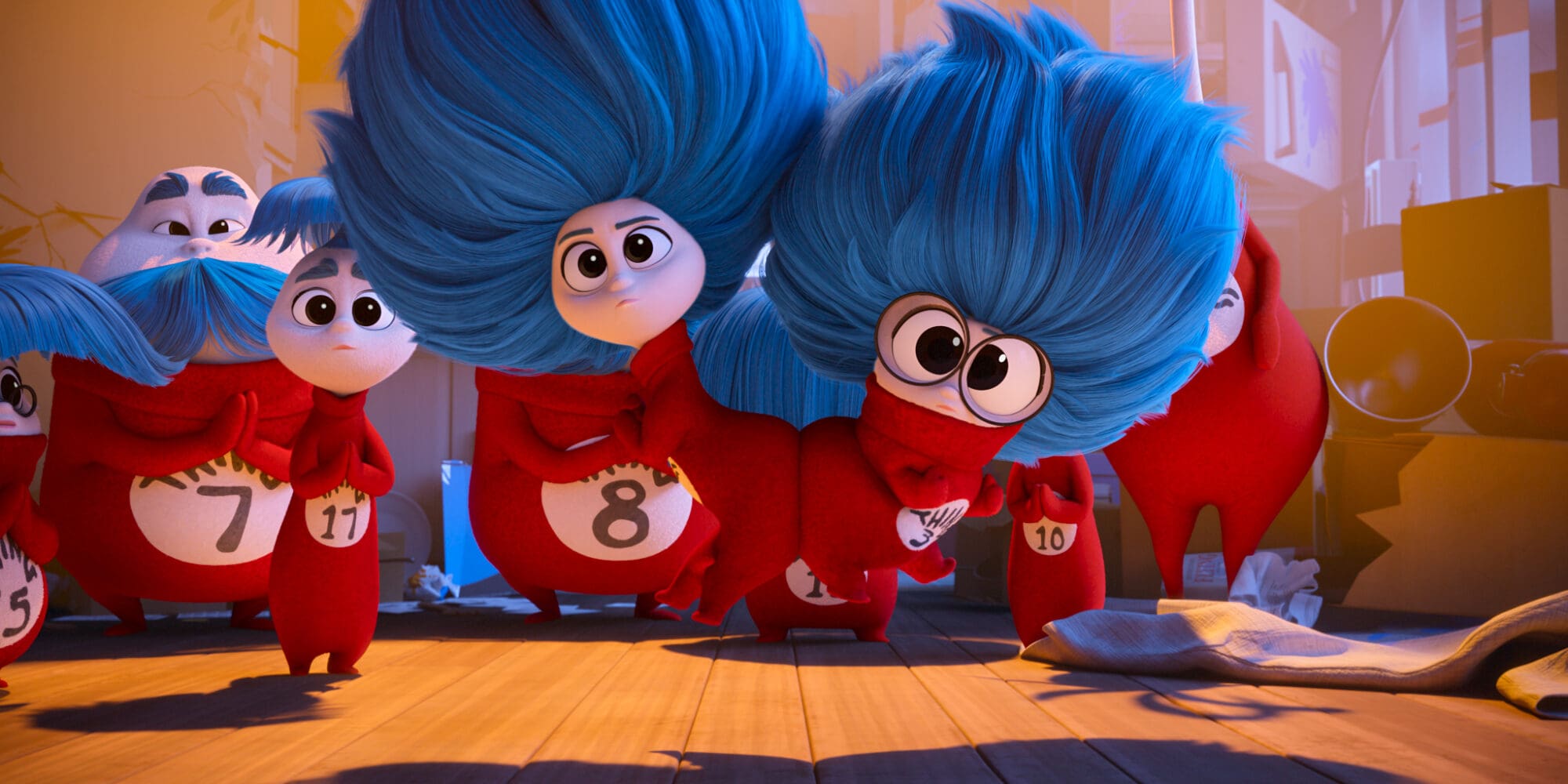
“We’re like, ‘It still doesn’t feel amazing,’” he remembers. “We knew that the landlord was a source of problems, and she would bang from below and run upstairs, and that became the idea: what if the [Things] try to communicate? The whole function of the Things for most of the movie is that they’re trying to communicate and it just so happens that their language is hilarious and visual and grounded in rhythmic mayhem. [Sebastian] is trying to communicate back with them, so it becomes a game of charades.
“Once we cracked it, and once we boarded it, and once we put it on screen, it was successful enough that the studio and the executives and everybody else asked us to put more of them in because they were not in the original third act,” he reveals. “But because we finally cracked it, people wanted more of it.”
Rivinoja says it was their head of story, Ryan Gaffney, who first came up with the idea of a rhythmic, nonverbal language for the Things. They then brought in choreographer and body movement expert Christopher Scott (Wicked) to help them develop the Things’ communication.
“He’s so brilliant and was so excited by this idea of a percussive language,” she says. “He got us the most amazing dancers from all walks of life. He got people from Stomp and b-boys and krumpers, and he even had a few ASL dancers who are deaf and who speak sign language to help develop this language.”
Carloni says Dr. Seuss Enterprises enthusiastically approved their big changes to the Things, too. “Technically, we were going to break a standard that stood from 1957 — there’s Thing One and Thing Two, and they look the same. And we said, ‘What if there’s three and seven and 25 and 50, and they all look different from one another?’ And they encouraged us.”
The release of The Cat in the Hat closes a years-long journey for Rivinoja and Carloni, and they’re very proud of the film. “The thing I love the most about our job, and at the same time the thing that is hardest, is not to tell stories but to create characters,” Carloni says. “The fact that the character we’re creating is something that also has lived in people’s homes for generations was exciting and daunting at the same time.
“Working with Erica and with Bill Hader truly shaped someone that I ended up falling in love with,” Carloni says of their Cat. “There’s always a moment working in filmmaking where you feel like you’re creating a character and then at some point, you’re no longer creating, but you meet them. When there are moments like that on screen where one specific line that we wrote was performed in a specific way by a brilliant actor, and then it moved in a specific way by a great animator, suddenly that’s a real person. I feel like that’s where I am with the Cat and I cannot wait for the audience to get to meet him too.”