.png)

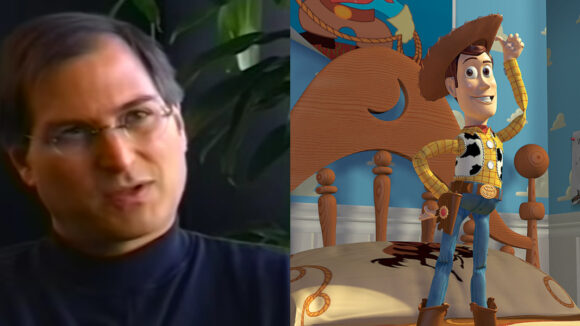
‘People Will Be Watching ‘Toy Story’ In 60 Years’: Watch Steve Jobs In A Never-Before-Seen 1996 Interview
Stay informed with free updates
Sign up to get our news digest — delivered directly to your inbox twice a week.
To celebrate Toy Story’s 30th anniversary, the Steve Jobs Archive has released a never-before-seen 1996 conversation with Steve Jobs, recorded exactly one year after the film’s original theatrical release. At the time, Pixar was still a one-film studio, but already transforming animation, technology, and Jobs himself.
The iconic executive traces Pixar’s origins to his first meeting with Ed Catmull at Lucasfilm in 1985. “Ed showed me what they were doing, and he shared with me his dream about making the first computer-animated feature film,” he recalls. “I bought into that dream both financially and spiritually. It took us ten years to do that, but we did it.” Toy Story’s success, he says, “came out really well” and quickly became one of the most successful animated films ever released.
But the path wasn’t initially so glamorous. For years, Pixar survived on commercial and VFX work, an approach Jobs calls a “poor business” to be in. You get paid once, he explains, “and the amount of profit you can make has been under pressure… down, and down, and down.” Sounds like some things never change.
In 1996, buoyed by Toy Story’s overwhelming reception and a record-setting IPO, Pixar shut down its commercial division entirely. “We couldn’t afford to have 25 incredibly talented people doing work-for-hire,” Jobs says, preferring a system in which “we own a piece of what we create.”
Throughout the interview, he describes Pixar as a rare fusion of Hollywood artistry and Silicon Valley engineering.
“Pixar is the only place in the world that can hire the best from both,” he says. Managing that talent meant inverting the usual hierarchy. “The CEO is actually at the bottom,” he says. “I feel like I work for most of these people.”
Working with Disney taught Pixar the discipline of story construction, editing a film before it’s animated. “You can’t buy that wisdom for love or money,” Jobs says. What technology enables, though, is never the point. “No amount of technology can turn a bad story into a good story. It’s the story, stupid.”
What excited him most was the endurance of great stories. “People are going to be watching Toy Story in 60 years,” he says, not for the graphics, but “because of the story about friendship.”
It’s been 30 years, and so far, the claim seems pretty prophetic.