

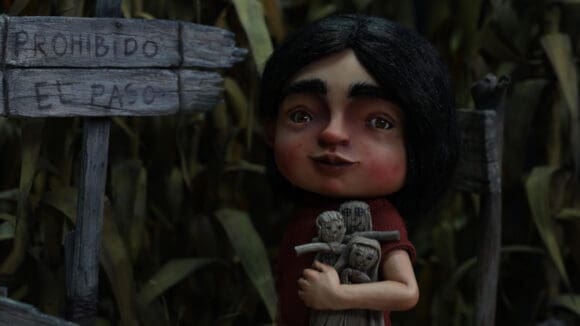
A Forbidden Cornfield Leads To Underworld Terrors In Mexican Stop-Motion Short ‘Dolores,’ Now Online
Stay informed with free updates
Sign up to get our news digest — delivered directly to your inbox twice a week.
A forbidden cornfield hides a subterranean tomb where two unsettling figures wrapped in corn husks wait in Dolores, the debut short from Mexican director Cecilia Andalón Delgadillo. Arriving online today for Halloween, the dialogue-free film draws on western Mexico’s pre-Hispanic heritage and Guadalajara’s stop-motion community to send a curious child somewhere she might never leave.
The short follows a seven-year-old girl who flees a fire demon and falls into an ancient, well-hidden grave, where two sinister inhabitants want her to stay forever. Only a kind, resourceful armadillo offers her a chance to escape. Following more than 80 festival selections and a 2025 Ariel Award nomination, the film is now available on Miyu Distribution’s Bang Bang YouTube channel.
Andalón Delgadillo began developing Dolores during the pandemic, encouraged by her husband to finally pursue a story of her own. Its ingredients were personal, drawing on family memories and her fascination with the Mexican countryside.
“Part of the inspiration comes from the stories my mother told me when I was little, about visiting a ranch in a rural area around here,” she told Cartoon Brew ahead of the short’s online release. “Part of it also has to do with one of my nieces, who was very outgoing. Somehow, the energy of Dolores’ character comes from her.”
Those elements came together around the tumbas de tiro, the pre-Hispanic shaft tombs of western Mexico. The setting also informed the armadillo character.
“I had come across something about it being a deity in the pre-Hispanic cultures here in western Mexico, connected to death,” she explained. “That seemed very interesting to me, because they’re precisely in this underground space, in the shaft tombs.”

The film’s two threatening figures connect that buried world to the cornfield above. Their designs draw on Mexican calavera imagery, with corn husks providing a material link between the two environments.
“Something very important was that they retain the corn husks,” Andalón Delgadillo said. “The corn was above them, and they preserve it in their materiality.”
Art director Mario González helped develop the characters’ appearance, while Andalón Delgadillo and Puebla-based artist Ángel Meléndez built the puppets. Her background in painting, printmaking, and theatrical puppets and masks fed into both the physical production and its staging.
“I make a lot of puppets and masks for theater, so I think that also influences some elements, even the camera direction, which is sometimes more static, as though it were theater,” she said.
That interest in working across disciplines also connects her to one of her principal influences, Jan Švankmajer.
“He doesn’t just direct or make animation. His work encompasses different disciplines: printmaking, sculpture, painting, collage,” she said. “I find that very interesting.”
Production took two and a half years, from the decision to make the film to its final master. Much of that work happened at El Taller del Chucho, where Andalón Delgadillo had worked on Guillermo del Toro’s Pinocchio. She first approached the studio’s director, Angélica Lares, for feedback on her screenplay before returning with a co-production proposal.

“Before El Taller del Chucho, productions were made in smaller places, in the homes and garages of the directors and filmmakers here,” she said. “Pinocchio and El Taller del Chucho mark a turning point in production models.”
Several Pinocchio crew members joined Dolores, including cinematographer Gilberto Torres. For Andalón Delgadillo, their experience helped preserve high production standards on a smaller project.
One particularly ambitious shot circles Dolores and the two skeletal figures through a complete 360-degree camera move. Animator Pablo Bedolla spent a week bringing it to life.
“That was planned from the construction of the set, from the mock-up for that shot,” she explained. “The set was made specifically for that shot. Of course, it worked for everything else, but that one was very important.”
Another challenge involved an armadillo rebuilding itself at a larger scale. Animator Nabí Orozco achieved the transformation in clay, working backward to create the effect.
“Instead of putting itself together, it was being taken apart, and then we see it in reverse in the film,” Andalón Delgadillo said. “There were several tests, and it took some time because of the particular requirements of the shot.”
“There’s a lot of magic in stop motion.”