.png)
That’s Really All Folks! Netflix Walks Away From Warner Bros. Deal, Clearing The Way For Paramount
Stay informed with free updates
Sign up to get our news digest — delivered directly to your inbox twice a week.
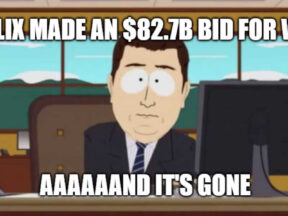
After months as the favored candidate to purchase Warner Bros. studio and streaming assets, Netflix has formally declined to increase its $82.7 billion offer, effectively ceding the transaction to Paramount and leaving one of the most consequential media deals in Hollywood history in the hands of the federal government.
In recent days, Paramount raised its offer and improved its terms, prompting WBD’s directors to determine that Paramount’s proposal constituted a superior bid under the existing merger agreement. That determination triggered a four-business-day period during which Netflix could revise its offer. Netflix didn’t need that much leeway, and the window closed today with the company choosing not to do so.
In a press release issued Thursday, Netflix co-CEOs Ted Sarandos and Greg Peters stated that the company would not match Paramount Skydance’s “Superior Proposal.” At the price required to stay competitive, Netflix said the transaction was “no longer financially attractive,” and thus it will not amend its existing merger agreement with WBD.
“The transaction we negotiated would have created shareholder value with a clear path to regulatory approval,” Netflix’s statement reads. “However, we’ve always been disciplined, and at the price required to match Paramount Skydance’s latest offer, the deal is no longer financially attractive, so we are declining to match the Paramount Skydance bid.”
Under the agreement announced last December, Netflix had planned to buy Warner Bros.’ studio and streaming businesses, including HBO Max, along with its vast content libraries, in an $82.7 billion cash-and-stock deal, later amended to an all-cash deal. The proposal was publicly endorsed by WBD’s board even as Paramount Skydance mounted a competing hostile bid.
Netflix’s decision today represents a decisive end to its pursuit of Warner Bros. and effectively clears the path for Paramount’s bid to move forward, barring legislative intervention. Shortly after Netflix backed out, an aide to Corey Booker, the top Democrat on the Senate Judiciary antitrust subcommittee, issued a statement asking Paramount CEO David Ellison to honor a previous offer to testify before Congress about the proposed acquisition.
For the animation industry, the development underscores the volatility of the ongoing consolidation reshaping Hollywood, as legacy studios and streaming giants continue to adjust to new industry realities. The long-term implications for Warner Bros.’ creative divisions and for the broader animation and entertainment landscape are uncertain.
While Netflix had promised that little would change at Warner Bros. under its proposed deal, Paramount has been less reassuring. When Ellison’s Skydance completed its merger with Paramount Global in August 2025, it was soon followed by large-scale layoffs affecting roughly 2,000 U.S. workers. Given the enormous debt that would come along with a Warner Bros. purchase under the winning bid, it seems likely that something similar may be on the horizon at the studio, which just celebrated its 100th anniversary in 2023.