.png)

Phil Tippett On His Studio’s Use Of Generative AI: ‘Like Having A Dog, It Trains You As Much As You Train It’
Stay informed with free updates
Sign up to get our news digest — delivered directly to your inbox twice a week.
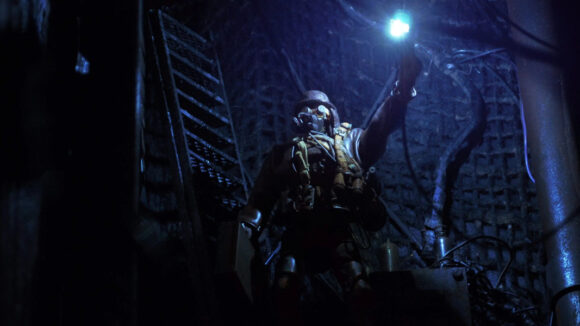
A short clip beamed across the screen at Italy’s View Conference: a gas-masked soldier peers through night vision, explosions erupt, and a battlefield dissolves into chaos. The clip is a test for Sentinel, the next project from Oscar-winning visual effects legend Phil Tippett. It set the stage for an intelligent reality check conversation about how Tippett Studio is confronting generative AI.
“We’re using AI as a tool. It’s simply to accelerate the process,” said Gary Mundell, CEO of Tippett Studio, introducing the panel titled Know Your Foe. “The essence of Tippett Studio is still there. The models have been manufactured, and they’re 100% done internally… we don’t incorporate any outside ones from the AI outside of assisting in animation and other ones for backgrounds and so on and so forth.”
Few figures are better positioned to speak about technological evolution in visual storytelling than Tippett. Over a five-decade career, he’s navigated every major shift in the medium from pioneering practical creature effects in Star Wars and Jurassic Park, to embracing computer-generated imagery when it first disrupted traditional model work. Now, the Oscar-winner is exploring how artificial intelligence might redefine visual craft once again. His studio’s recent credits include Star Wars: The Mandalorian and Grogu, The Toxic Avenger, and Marvel’s Ironheart.
Appearing remotely, Tippett joined a panel that included Remko Noteboom (principal software engineer), Mark Dubeau (art director), Tom Gibbons (animation supervisor), and Marc Morissette (VFX supervisor), moderated by production executive Colin Geddes.
‘A Creative Partner’
“The way I look at AI is as a creative partner, not as a thing in and of itself,” Tippett said. “All of the work that we’ve done experimenting with AI certainly proves that point — there’s a great deal of work to be done in terms of understanding how to integrate the kinds of things that you want to see without interference from this other entity making up its own stuff. So that’s kind of where we’re at right now… we’re just chasing the wave, really, is what we’re doing.”
Tippett compared today’s rapid AI evolution to his earlier shift from stop motion to CGI, and who better to comment on the shift? “What we’re dealing with now is the new technology AI, and what that is going to mean for the evolution of the entire world… the acceleration for its use is going to be, I mean, it’s already happening so much quicker than it happened with computer graphics.”
Training the Machine
For Noteboom, who leads the studio’s in-house AI development, the goal is to merge physical craft with digital speed. “We photograph real things and use that as training… the real things give a tactile feel as opposed to CG that it’s very hard to capture,” he said. “We can get AI training to produce really high-quality imagery and video using the live materials that we’ve actually created.” He went on to note, “AI is really bad at creatures that are non-human, and so we really struggle to get the AI to work with that.”
Mark Dubeau added later that maintaining an enclosed system is crucial: “There are a lot of cool tools that are open source, but on film that’s a no-go. Everything has to stay inside a closed system.”
‘The Bloom Comes Off the Rose’
Dubeau admitted he was “dragged kicking and screaming into this a little bit.” Early on, he said, “It was really the impression that I got with a lot of these tools — it’s incredibly Wild West. There’s something for everything.”
After initial excitement, realism set in. “At a certain point, the bloom comes off the rose a bit. And then you start looking at pictures in terms of, like, okay, how does this fit into our look? How does it fit our ethos? How directable is this stuff?” Still, he sees promise. “We want to make sure it’s our stuff, and we want to make sure that it’s something that is either directable or that it can give us wild card options while we’re trying to do a shot.”
‘A New Kind of Hammer’
Animation supervisor Tom Gibbons described AI as “a new kind of hammer.” “It’s a tool that’s not going to go away,” he said. “We’re trying to figure out ways that it can serve our purposes rather than we serve its purposes.”
He praised its improvisational potential: “It’s a great sketch pad… it comes back with any number of ideas, some of which you’ve never thought of.” But he also pointed to its limits. “It doesn’t act. The emotion or the emoting that you get out of AI performances is seriously lacking. It is a spectacle that can impress you, but you don’t feel it yet. A serious limitation.”
Tippett offered his own analogy: “The AI is kind of like having a dog. And what you realize is, when you try to train the dog, the dog trains you just as much as you train the dog.”
Gibbons added, “You throw a stick, and it comes back with a rock. You may really like that rock, but it was not the stick that you threw.”
Later, Tippett reflected on what the technology means beyond filmmaking. “The social ramifications of AI are going to change everything about how we conduct ourselves. So, you know, like the unknown, it’s unsettling, because we don’t know what the consequences are. I think we’re all on the same page regarding the uncertainty of that.”
Still, the studio’s outlook remains creative and inquisitive, not defensive. “If a stop-motion or CG animator sent me those as a reel,” Tippet said after viewing an AI-generated robot movement test, “I would hire him.”