brewmasters
JERRY BECK
bio & contact
view posts by jerry
AMID AMIDI
bio & contact
view posts by amid
TAG FOR
“Animators”
by amid
September 10, 2009 2:50 am


Chuck and Linda Jones

Is anybody following the official Chuck Jones blog? Because fans of Chuck should be! Chuck’s daughter, Linda, has been posting a fascinating series of letters that he wrote to her when she went off to boarding school in 1952. Even though a lot of the details are mundane, the value of sharing these letters is immense. They offer a totally new personal perspective on how Jones handled being a father at a time when he was also at the top of his game. There are also some great animation-related bits sprinkled throughout the letters, like his thoughts about working on the Roadrunner/Coyote shorts:

Been slamming through another Coyote and Roadrunner, as I may have mentioned. These are sort of money-in-the-bank type pictures. We don’t have to worry about establishing a premise or continuity or character development much or trick backgrounds. Everything’s pretty open. Just sit down and start drawing and when all the gags are roughed out, arrange them according to pace, so’s the picture will build in tempo, find myself a strong gag to end on and I’m in business. Timing is a snap because no dialogue and there’s no worry about making it too long, because I can time the gags as I go along and use just as many as I need. All in all, life could be very simple and maybe a little bit dull if all I had to do was direct coyote and r.r.s.

Read Linda’s intro to the series and then check out all of the letters. Start at the back with the first post if you want to keep proper chronology.

by jerry
September 6, 2009 7:30 pm


Artist and beloved CalArts instructor, E. Michael Mitchell, passed away early this morning. He was incredibly influential to many now working in the industry. Mitchell had worked extensively in animation with many credits, including conceptualizing FernGully: The Last Rain Forrest. One of his students, Spencer Ockwell, posted a tribute to Mitchell on his blog, including many photos of his amazing concept art. Here is his (woefully incomplete) IMDb page.

by amid
September 4, 2009 1:33 am


Ricky Nierva

Spline Doctors, one of the smartest animation podcasts around, has finally released a new episode, and the guest is UP production designer Ricky Nierva. I haven’t had a moment to listen to it yet, but I understand that Nierva speaks at length about his relationship with Maurice Noble. Can’t wait to hear it.

by amid
August 19, 2009 7:13 am


Sandro Cleuzo

Haven’t done this in a while, so here are a few artist blogs worth your time:

Animator Sandro Cleuzo’s blog is just over a week old, and it’s already filled with rare material, including work from unproduced Disney projects like Sweating Bullets and My Peoples. His credits also include Fantasia 2000, The Emperor’s New Groove, Tarzan, Home on the Range, Enchanted, Anastasia, Curious George, Asterix and the Vikings and the upcoming The Princess and the Frog. Check Sandro out at his cleverly titled Inspector Cleuzo blog.

Illustrator and Ice Age character designer Peter de Sève is also new to the blogging scene. I found it interesting to read a personal perspective on his forthcoming monograph, which I announced here last week. Visit him at PeterdeSeve.blogspot.com.

Dexter Smith has been working in animation since the groundbreaking Batman, the Animated Series. Since then, he’s worked on Superman, Samurai Jack, Johnny Bravo, My Gym Partner’s a Monkey, Clone High, Freakazoid, and a bunch of other stuff. I liked seeing the artwork and hearing the development story about his personal project True Romance. More at Dexter-Smith.blogspot.com.

by jerry
August 15, 2009 2:30 pm


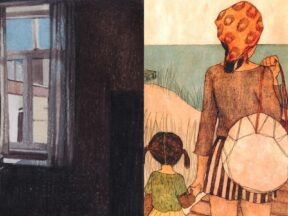
Alternative cartoonist and animator Mark Marek has been quite successful drawing comics, doing illustrations, animating and directing animation for some time now. His terrific new website shows off his past and present animated works, including an attempt (not in his usual primitive style, above) designing a moody, atmospheric Warner Bros. Animation logo for the company’s superhero shows.

by jerry
August 14, 2009 2:30 pm


Eve by Myron Waldman

Here’s a rare treat for Fleischer Studio fans - or anyone interested in clever, cartoon story-telling: the latest issue of The Comics Journal #299 (August 2009) features a complete reprint of Myron Waldman’s 1943 “graphic novel”, Eve.

Click on thumbnails below to see a few larger images of the cover, title page and an interior gag (the title graphic and interior page here are from my own battered copy of the original publication). This long-out-of-print classic tells the story of a big city working girl who seeks her true love while on vacation in Miami, Florida. It’s cute, funny and surprisingly heartfelt. The drawings are great and the book makes you wish Waldman had continued doing more stories like these, as opposed to the simplistic Casper animated cartoons he’d become synonymous with.

The Comic Journal has posted the entire novel online for subscriber’s only. The hard-copy magazine, which features an introduction by cartoonist Mark Newgarden, is on sale now. This is highly recommended!

by pes
August 12, 2009 3:52 pm


El Empleo, created by Santiago Bou Grasso from Argentina, is a five-minute film that I feel should be about three minutes long.  Usually, I find this an inexcusable crime on the part of the filmmaker, one of the cardinal sins of making a short film (to me it shows a lack of respect to the viewer and a lack of self-awareness on the part of the filmmaker).  But, in the case of El Empleo, I still like the core idea a lot and find the film recommendable despite my issues with its pacing.  It’s got a clever hook, and the filmmaker explores his idea thoroughly and structures it well.

by amid
August 5, 2009 6:02 am


Vic Haboush

Victor Haboush passed away on May 24, 2009 at age 85. A first-generation American of Lebanese descent, he was born on April 16, 1924 and grew up in Indianapolis, Indiana.

Vic Haboush
At home with his family. Vic is third from the right.

During World War II, he took part in the D-Day landings at Normandy as a member of the Coast Guard, and later served in the Pacific theater. (His brother was mortally wounded at Leyte.) Following the War, he attended Art Center College of Design on the G.I. Bill where he studied extensively with Lorser Feitelson.

Vic Haboush
Figure drawing from art school.

On the recommendation of his Art Center classmate Eyvind Earle, he was hired at Disney in 1952 to help finish layout on Peter Pan. His first association with Disney came earlier, when he helped Earle draw this Golden Book adaptation of Peter Pan. He built up an impressive list of credits at the studio including assistant art direction on Melody and Toot Whistle Plunk and Boom, and layout on Lady and the Tramp, Sleeping Beauty and 101 Dalmatians.

Vic Haboush
(l. to r.) Victor Haboush, Tony Rizzo, Walt Peregoy and Tom Oreb at Disney in 1958

Vic was one of Tom Oreb’s closest colleagues during the 1950s and they worked together as a team, especially in Disney’s TV commercial unit. The characters in this Cheerios ad were styled by Oreb with background layout by Vic:

He described to me in 2000 his relationship with Oreb:

“Eyvind [Earle] and I were the two hot new guys, and we developed a lot of people not liking us. We’d work on the weekends, we’d throw storyboards up…a lot of the old guys just absolutely turned on us. It was really kind of brutal in a way. But guys like Tommy [Oreb], Ward Kimball, Bill Peet, Don DaGradi, they didn’t have that closed kind of thing. Tommy really married Eyvind and I. He became our friend. He looked after us. He talked us up. So the three of us became really good friends. We started hanging out together and all of that. Eyvind was kind of like Tom’s equal. They were both in the same age range. And I was the young kid. I was probably nine nor ten years younger than both of them. I just became Tom’s protege. I idolized him.”

Vic Haboush
Concept art by Haboush for an unproduced industrial film. Click for larger version.

When Oreb left Disney to work at John Sutherland Productions, Vic followed, and they worked together on films like Destination Earth and The Littlest Giant. They both soon returned to Disney to finish Sleeping Beauty, where Vic played a key role in designing the “Thorn Forest” sequence. In an interview, he spoke about his work on the sequence:

“I saw these awful drawings of the Thorn Forest, these big huge thorns, and it was a big mess. Basil Davidovich told me, ‘Vic, Woolie [Reitherman] doesn’t want anybody working on it anymore.’ But I went ahead anyways and spent the next three weeks working on this sequence. Everybody’s kind of laughing because they know that Woolie’s going to be pissed off when he sees that I’ve wasted all that time on it. The problem is that when you draw a vine, it gets smaller as it’s coming towards you, and that destroyed perspective. I worked it out where the vine overlapped itself so as it came towards you, it would be coming in front of itself and that created the depth. So I see Woolie one day and I say, ‘Woolie, I’ve solved the thorn forest,’ and he says surprised, ‘What! We should be finished with that.’ I take the work to show him in his office and he looked at them and pushed them aside. I thought ‘Oh no, here it comes,’ and he says, ‘Haboush, these are wonderful. From now on you’re the thorn forest guy.’ For the next three months, all I did was draw those stupid thorns. Bill Peet would come in and say, ‘Vic, nickel a thorn, charge a nickel a thorn, don’t ask for a raise, just get a nickel a thorn.’”

Vic Haboush
Concept art from Disney’s How to Have an Accident in the Home. Click for larger version.

Vic worked at numerous other animation studios besides Disney, including Quartet Films, early seasons of The Flintstones and The Jetsons at Hanna-Barbera, and The Incredible Mr. Limpet at Warner Bros. He was the art director of UPA’s second feature Gay Purr-ee as well as the Mr. Magoo and Dick Tracy TV series.

Vic Haboush
Concept art by Haboush from Gay Purr-ee. Click for larger version.

He told me that one of the most embarrassing moments in his career was during a short film screening at the Academy. UPA owner Henry Saperstein had submitted one of the Dick Tracy episodes for Oscar consideration, and when Vic’s name appeared onscreen as art director, he shrunk low into his seat. Working on the inferior UPA TV shows made him realize the direction the animation industry was headed and he resolved to set out on his own. In the early-1960s, he launched a studio, Spungbuggy Works, in partnership with animator Herb Stott and storyman/designer/all-around creative dynamo John Dunn. It was at this studio that he worked with Dunn to develop numerous feature and TV concepts, many of which would be later produced by Friz Freleng, who lured Dunn to his studio DePatie-Freleng.

In the mid-1960s, Vic left animation and shifted into live-action. He started his own studio, Victor Haboush & Associates, which later became The Haboush Company. Over the next thirty years, he directed and photographed over 1,500 commecials, winning numerous Cannes Gold and Silver Lions, Clios and IBAs. His campaigns included the Kibbles N’ Bits “The Hook” campaign, numerous commercials featuring Ronald McDonald for McDonald’s, the Taco Bell “Crashing Bell” series, the Hefty Bag series with Jonathan Winters, early Keebler Cookies spots, and the Schlitz Malt Liquor “Bull” campaign.

Vic Haboush
Vic on commercial sets

One of his former producers Paul Babb said, “Vic was one of the go-to guys in the 1960s, ’70s and ’80s for commercials…He was no businessman but he was an incredible artist—and not just as a director. Try putting a pencil or a paintbrush in his hand, sit back and wait for something remarkable.” Vic might have agreed with the sentiment that he wasn’t an expert businessman. He knew how to sell an idea and he knew how to execute, but he was more interested in achieving a quality result than heeding the bottom line. He often told me that his studio wouldn’t have lasted had it not been for his brother, who served as his producer for many years. Jon Derovan, who was Vic’s producer during the final decade of his career, told Shoot magazine, “Victor allowed me to be a creative producer. He brought me into the creative process beyond the nuts and bolts of the business….He was generous. He was open to good ideas no matter where they came from–and he was quick to credit the person who came up with the idea. He would never take credit for an idea that wasn’t his.”

Even while he ran the studio, he remained connected to animation and art. He employed many animators over the years including John Kimball, Robert Swarthe, Dale Case, and the unheralded Robert Mitchell. Through his company, Vic produced three shorts directed by Mitchell—K-9000: A Space Oddity (1968), the Oscar-nominated The Further Adventures of Uncle Sam (1970), and Free (1972). His company also produced another art film, Paint (1968) directed by Norm Gollin and starring LA airbrush pioneer Charlie White:

I first met Vic around the year 2000 while I was researching the life of Tom Oreb. By this time, Vic had retired from filmmaking and was painting full-time. We hit it off and formed a friendship that endured until his death.

Vic’s attitude towards life was different from the majority of older people I’ve encountered. He was young at heart, with an insatiable curiosity about the world around him and a flexible thought process. His opinions about different artists evolved over time, much like his distinctive painting process, which often involved reworking an image dozens of times until he was satisfied. He refused to live in the past. Whenever we would get together, he couldn’t wait to discuss people he’d recently met, a new place he had visited, or a new book he’d read. He was as enthusiastic about younger artists as he was appreciative of veteran artistic colleagues. When he returned to animation one final time as a development artist on The Iron Giant, he became enamored with artists like Mark Whiting and Teddy Newton, the latter whose work he felt was some of the freshest he’d seen in a long time.

Vic Haboush
Vic drawn by Teddy Newton

To fully appreciate Vic, you had to know him in person. Charismatic and energetic even in later years, his social skills were second to none. Not only could he strike up a conversation with a random stranger, but he could also get their contact info and perhaps form a long-term friendship—and remarkably, he could do all of this inbetween sips of his morning coffee. He was Malcolm Gladwell’s concept of the “connector” personified.

Vic Haboush
Iron Giant development art by Vic Haboush

I always considered him more of a pal than a teacher, but looking back on the time we spent together, he was one of the most influential mentors I ever had. His enthusiasm for art was contagious and instilled in me an appreciation for the same, from Lundeberg to Diebenkorn to Vlaminck to Pascin. Vic didn’t always have the easiest time imparting his wisdom. He once spent an entire morning trying to explain to me why Cézanne’s work was such a remarkable accomplishment. I was too dense at the time to grasp what he was saying, but it eventually sunk in.

He was one of the earliest supporters of my writing, and we spent months developing a story book together, which gave me the opportunity to see how skilled he was handling story and character. He prodded me for years to pursue writing seriously, and that too eventually sunk in. I remember during one visit I had brought my camera along and he asked me to take a photograph of him. The results were less than spectacular. The director in him emerged, and I received a firsthand taste of what he must have been like to work with on a live-action set. With the assured confidence of a master cinematographer, he directed me where to stand and where to point the camera, and he set himself up properly in the natural light. Within seconds, we had a fine portrait.

Thank you, Vic. For being a mentor, an inspiration, and a friend. It was an honor knowing you.

He is survived by his wife Monica, three children—Auguste, Cedric and Laila—and six grandchildren.

Vic Haboush
Vic and I in 2008