|
|
|
|
TAG FOR “Internet/Blogs”Cartoon Brew's home for up-to-the-minute, unedited announcements and press releases direct from industry sources.
April 24, 2012 10:21 am
Jake Friedman emailed yesterday to tell me about BabbittBlog.com, a site dedicated to all things Art Babbitt. Jake has been researching a biography of the legendary animator for the last few years, and if the blog is any indication, there’s still a lot left to learn about Babbitt.
There’s no shortage of animation tips posted online nowadays, but this mass of how-to advice isn’t particularly well organized. Thankfully, Jonah Sidhom has created the Animation Article Database, an invaluable list of links to animation tips from industry pros, organized alphabetically. Canada’s only animator with three first names, Brandon James Scott, has an informative series of blog posts about creating Justin Time, a preschool animated series that is now in production on its second season. He takes the reader through the entire process from pitch to development to bible, and finally, production. April 4, 2012 9:09 pm
Last week, I wrote about YooToon, a new Internet animation channel created by Fairly OddParents creator Butch Hartman. The premiere episode launched today. Watch it: (Thanks, Jace Diehl) April 3, 2012 2:52 am
VCU Brandcenter student Kevin J. Weir finds public domain images on the Library of Congress Flickr stream and turns them into entertaining animated GIFs. The technique is a throwback to the work of Stan Vanderbeek and Terry Gilliam, but Kevin’s ideas are plenty fresh. March 21, 2012 12:05 am
Today I will once again sit down with Stuart Shostack for another hard hitting, riveting interview, covering a wide range of animation subjects. Stu’s Show will be broadcast live at 7pm Eastern/4pm Pacific at StusShow.com. It’s an internet radio program and its free to listen live today. After that, you can download the show anytime for 99¢. Today, we will be discussing all the latest events in animation – past, present and future. And especially Looney Tunes, Tom & Jerry, Noveltoons, UPA on DVD. We’ll take questions via phone and email from listeners; we might also talk about Terrytoons. Join us and listen in here. March 19, 2012 2:49 pm
Read UPDATES at bottom of the piece. When I speak to indie filmmakers, there’s always a lot of confusion about the potential money that can be earned by posting shorts on the Internet, especially by posting them onto YouTube. An article in last month’s Wall Street Journal shed some much needed light on the situation. The article said that those who join YouTube’s Partner Program receive between $1,500 and $4,500(US) for every million video views. The wide variance in price is attributed to the country and platform where the video is viewed. According to YouTube, they had 30,000 partners in 2011, up from 20,000 in 2010. “Several hundred” of those partners made more than $100,000, which is an 80% increase from the “couple of hundred” partners who achieved the six-figure earnings mark in 2010. Using that data, I think it would be fair to guess that they have at least 350 people earning six-figures, or slightly over 1% of their YouTube Partners. Using the numbers above, I decided to figure out what some of the most successful animators on YouTube are making. I’ve shared the numbers below, which are not yearly earnings, but based on the total number of views the filmmaker has received. Considering how difficult it is to make money with animated shorts, the numbers are fairly impressive, especially if viewed as a single revenue stream as part of a larger plan that includes broadcast sales to foreign TV channels, merchandising, dvd sales, digital downloads, and so forth. It’s also impressive that many of the most successful animators on YouTube are young filmmakers whose reputations were established exclusively online. Another important point to consider is that all of these animators have dozens of films posted on their channel. There are no examples yet of people earning this kind of money from just a handful of films. Simon’s Cat has the least videos of any of the channels below, with only twenty.
UPDATE (9:53pm ET): Since this piece was published, I’ve been in contact with Harry Partridge, one of the filmmakers whose estimated earnings were posted above. He posted a comment on Twitter that said in part, “I don’t make anywhere near half of their lowest ballpark. Crazy.” When he posted that comment on Twitter, he assumed that I was talking about yearly earnings. We cleared up that I was referring to total earnings based on the number of pageviews listed above, NOT yearly earnings. Harry also provided some ballpark figures for what he’s made from YouTube since 2009. The numbers turned out to be slightly more than half of the lowest estimated earning, which means he has been earning a more modest $750-800 per million pageviews instead of the $1,500-$4,500 claimed in the Wall Street Journal piece. More recently, he has joined with Channelflip, which he says pays him more annually than YouTube, but which is still a relatively modest sum. However, I should point out that I have confirmed with other filmmakers that they have earned the higher figures listed in the WSJ piece so there are apparently wide gaps between what different filmmakers earn. The lack of transparency in YouTube’s payments to its partners is a great reason to be having this discussion and leveling the playing field for filmmakers who are thinking of posting their work on that platform. UPDATE #2: Harry pointed out that though the videos were posted beginning in 2006, YouTube started paying out in 2009. I’ve updated the above to reflect that the earning period has been the last three years. He also writes, “Overall I’m not bothered by the article now it states that these are total earnings, my concerns about it arose from the fact that I thought it was yearly.” UPDATE #3: Filmmaker Cyriak wrote a comment below in which he says that he hasn’t monetized most of his video vieww as part of YouTube’s Partner Program. He says that his most recent earnings have been in the range of $600 per million video views. February 20, 2012 12:05 am
If you ever wondered what your favorite childhood cartoon characters might look like having sex, or doing something nasty, wonder no more. Out of Context Animation is a Tumblr site that posts unique frames from innocent animated films, which out of context could possibly be interpreted as something incredibly obscene. Here’s a couple of examples from the site below (click thumbnails to enlarge image). Mickey, Porky, Spongebob, Inspector Gadget… no one is spared. Nothing not-safe-for-work, but actually quite funny… or at least I think so. February 14, 2012 12:57 am
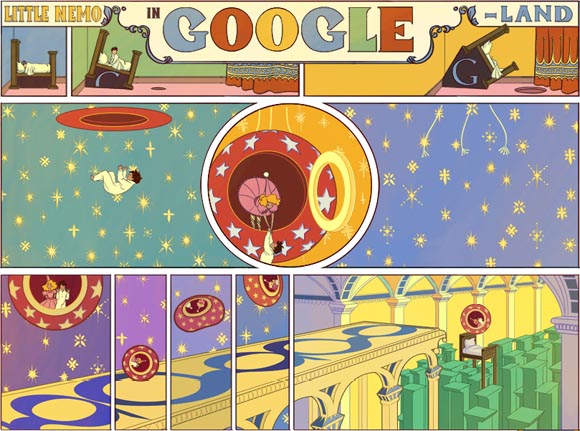
Be sure and visit Google’s front page today for an animated Valentine’s Day short with music by Tony Bennett. For a Google Doodle, it’s an impressively long piece. I hope they’ll be doing more of these long-form animated pieces in the future. The designer and writer of the piece was Willie Real and the animator was Michael Lipman (aka Lippy). Also, kudos to Google for not being afraid to slip in a nod to gay marriage. January 23, 2012 10:09 am
Less than a year after its launch, Kaboing TV has come to a virtual standstill. Billed as “an alternative channel for quality animation that serves both the cartoon fan and the animation community of artists and writers,” the idea was conceived by Joe Murray, the veteran creator of old-media shows like Rocko’s Modern Life and Camp Lazlo. Murray raised over $20,000 from a Kickstarter campaign in June, 2010 to launch the concept. Kaboing failed to gain traction with viewers. In the past year, Murray unveiled three original animated shorts based on his Frog in a Suit concept, and also presented six indie animated shorts. The combined viewership of those nine films was just 57,000 views. In an essay posted on his blog last week he described Kaboing as being “at a crossroads.” In an earlier blog post last month, he alluded to Kaboing as if it had already died, writing that it was like “watching the fuse to what promises to be a wonderful firework display, fizzle out at the moment of truth.” The Kaboing website, which hosted its videos on YouTube, hasn’t unveilved a new cartoon since September, 2011, and the last original Frog in a Suit short premiered last March. Murray blames virtually everything as a factor in the site’s lack of success, from a failed mainstream project that he had undertaken to no marketing budget to advertisers who wanted ownership of the shorts to the Internet’s desire for crude material. The simplest solution though is often the right one, and in this case, it would appear that Murray didn’t offer a compelling product that audiences wanted to see. The Internet is very good at identifying what it likes, and it doesn’t like the kind of traditional material produced by mainstream TV studios. Frog in a Suit felt too much like a standard-issue TV cartoon with all the timeworn elements that Internet audiences are trying to escape. It’s commendable that Murray is being upfront about the struggles of his start-up Kaboing TV, but his assignment of blame for the site’s failure seems misplaced to me. Reading between the lines of his January 18 post, he appears to believe that his work was of a higher quality than the kind of animation that becomes successful on-line. He expresses frustration that a “unicorn shitting rainbows” is more popular than his own work. But while some material is certainly more crude and raw, there are also breakout Internet hits like Simon Tofield’s Simon’s Cat which feature more elegant animation than anything you’ll find produced by a TV animation studio. The nineteen Simon’s Cat shorts, all animated by Tofield, have garnered over 215 million views on YouTube and spawned book and merchandising deals. In the past artists created properties to pitch and sell to TV networks or newspaper syndicates in the hope of making their characters famous. Tofield has succeeded where Murray couldn’t by showing its possible to create characters on one’s own terms, turn them into a success online without giving up ownership rights, and then wait for companies to approach you with licensing deals. YouTube, in fact, has spawned a new generation of animation creators who have become successful individual brands without the help of any middleman. An even more successful example is Dane Boedigheimer, whose Annoying Orange videos have accumulated nearly 600 million views on YouTube. His work has become so popular that Cartoon Network recently greenlit a series based on his characters. Here’s a list of individual filmmakers besides Tofield and Boedigheimer whose YouTube channels have garnered huge fanbases and (we may assume) some financial reward:
Most tellingly, none of these artists became successful by soliciting money from a Kickstarter campaign and none of them had marketing campaigns. They created their animation because they believed in it, and audiences responded to the work. As the mechanism of distribution matures on the Internet, more and more animators will discover that this kind of success is possible. December 14, 2011 12:05 am
Today I will sit down with Stu Shostack for another hard hitting interview, covering a wide range of animation subjects, on the internet radio program Stu’s Show. It’s being broadcast live at 7pm Eastern/4pm Pacific at StusShow.com. We will be discussing the latest events in cartoons – past, present and future. Looney Tunes on blu-ray, Tom & Jerry issues, UPA on DVD, I’ll give my opinion of the forthcoming Tintin movie and much much more… We’ll take questions via phone and email from listeners; we might also talk about Terrytoons. Join us and listen in here. December 7, 2011 12:05 am
Heads up on another free-wheeling interview with Hanna-Barbera veteran animators Jerry Eisenberg and Willie Ito, today on internet radio’s Stu’s Show. It’s being broadcast live at 7pm Eastern/4pm Pacific on StusShow.com. Both Willie and Jerry designed some great characters during their years at H&B, and Stu will dig in to get the whole story, along with a look at both gentlemens’ careers pre-and-post Hanna Barbera, in what promises to be a great show for every animation buff. And next week (Dec. 14th) yours truly, Jerry Beck, will be on the broadcast with a bunch of news about upcoming cartoon DVDs. I’ll remind you again next week. December 2, 2011 9:26 am
I love animated GIFs and the seemingly infinite variations on the form. Comic book artist Kerry Callen has come up with a new twist: animating vintage comic book covers and he pulls it off quite well. (via Mark Evanier) October 23, 2011 7:40 am
Tel Aviv-based animator Zach Cohen posts one new animated GIF loop every week on his Tumblr Ye Animated Git. There aren’t a whole lot of them posted yet, but the ones he has made are creative and fun.
|