.png)

Go Behind The Scenes Of ‘Love, Death + Robots’ S4 In An Exclusive Video And Conversation With ‘Spider Rose’ Director Jennifer Yuh Nelson
Stay informed with free updates
Sign up to get our news digest — delivered directly to your inbox twice a week.
Netflix’s Love, Death + Robots continues to push the boundaries of what short-form animation can do. The anthology has already secured four Juried Emmy Awards this year, with its episode “Spider Rose” also nominated for outstanding animated program.
Cartoon Brew has exclusive access to a new behind-the-scenes video from the show’s acclaimed fourth season, along with an interview with supervising director Jennifer Yuh Nelson, who helmed “Spider Rose.”
Nelson, who became the first woman to solo-direct a major Hollywood animated feature with Kung Fu Panda 2, later directed Kung Fu Panda 3 and made her live-action debut with The Darkest Minds. Now at Netflix, she oversees Love, Death + Robots while continuing to direct standout episodes herself.
Her latest effort adapts Bruce Sterling’s Spider Rose, carrying forward the series’ tradition of pairing provocative science fiction with stunning animation. She spoke with us about returning to favorite stories, designing a creature that’s equal parts ugly and adorable, and why sci-fi thrives in short-form animation.
This season revisits some familiar universes. What made you want to go back to certain stories?
Jennifer Yuh Nelson: We did that previously with Three Robots — we had two Three Robots episodes, and we also had in this season one that was based on a John Scalzi story — about the cat and the household service robot. That one is kind of like a prequel. Not a direct prequel, but it sort of has a feeling of the cat taking over the world. So that’s basically a prequel.
But this one’s unusual, with “Swarm” and Bruce Sterling’s world. There was still so much to do in there. That’s why we went back. These stories are favorites because they’re special. They’ve been rolling around on the hot list for a very long time. So when we plan a whole season, we look at all the possibilities, but there’s always a favorite. There’s the one that lingered. And sometimes that’s the one we build the whole season around. In this case, it was Bruce Sterling’s. “Spider Rose” was already on the list in Season 1.
You worked with Joe Abercrombie on the adaptation. Why was he the right person to write the screenplay?
Nelson: He is amazingly gracious and wonderful and very, very humble. And he’s also a friend of Tim’s. Tim [Miller] uses him a lot on many things. So entrusting the writing of something like this — which again is a favorite short story by an author Tim really respects and wants to make sure he does right by — you get a really great writer like Joe in there.
We talked through: What is the unification process of the story? What can we shift in order to make it visual? How do we make it fit into 15 minutes or less? That’s a big thing, because these stories are so dense. What’s the thing you’re going to focus on?
He’s very calm, quiet, thoughtful. He has enthusiasm, but in a very thoughtful way. Then he goes off for a while and sends something back that’s amazing. And then we go back and forth about how to shift this, or nudge that. Joe’s one of those people who’s just a cool human being, really easy to talk to.
How do you balance honoring the source with the needs of animation, especially when timing and pacing are so tight?
Nelson: That falls on me. As the director, I boarded most of it myself. Dan Milligan and I boarded it together. Dan Milligan, by the way, is an amazing storyboard artist. Legendary in his own right.
I basically split it in half, but I thumbnail a lot of it, very meticulously, so the pacing works, and we know how we’re going to tell the story. A really good short story has already gone through this incredible distilling process by the author — it’s already an exercise in minimalism. There’s so much discipline in that format.
And then you try to boil it down even more. I think we had 14 minutes of screen time. That was really tough. If there were a “Spider Rose” movie, you could expand it and really flesh it out.
Sci-fi thrives in short form, but less so in U.S. animated features. Why do you think that is?
Nelson: I think specifically in the West, features are viewed very much as a family film experience. So, they tend to be a little more comedy-based, a little gentler, less violent, less aggressive, all that stuff. And features have massive budgets, and you’re hanging that massive budget on one idea.
With short form, each one is a smaller bite. Each one is a smaller risk. So you can get very weird with each little piece of it. Each one doesn’t carry the entire studio-level budget of a feature. The larger the budget, the greater the fear. And so you have to mitigate that fear.
You’re directing your own episodes but also supervising the entire anthology. How do you balance that?
Nelson: As supervising director, I try to carve out time to work on my own episode. Usually, I can work the schedule with the producer so I can preserve my time and sanity.
But we also work with every short, each director, each studio, each designer. We stagger things so mornings I might be with people in Europe, evenings with people in Asia, and in between with people here. Constant Zoom calls, checking in, making sure they have what they need.
We catch a lot of stuff before Tim sees it, so when he does, he can just say, “Yes, great,” or give one note. Over four seasons, I definitely have a better idea of what Tim’s going to like. But Tim also says many times that he doesn’t want these shorts to all look like he made them. He wants variety. So our job is to support the directors and let their vision come through.
You were very involved in the mocap process. How does that affect the storytelling?
Nelson: Mocap, when it’s used well, is such a great, live, immediate process. I love working with the actors and honing in on the emotional thing. For example, when I was working with Emily O’Brien, who did the voice for Spider Rose, there’s a little moment at the end where she’s holding a puppet, giving her permission to eat her. And she says, “It’s okay,” with a little smile.
That wasn’t in the script. We found it on the day. We were trying it out, and I asked her, “Can you try saying this?” She did, and that’s what made it into the final moment. Those are the surprises you get when you’re actually working with real actors.
The creature shifts its appearance depending on who’s looking. How did you design it?
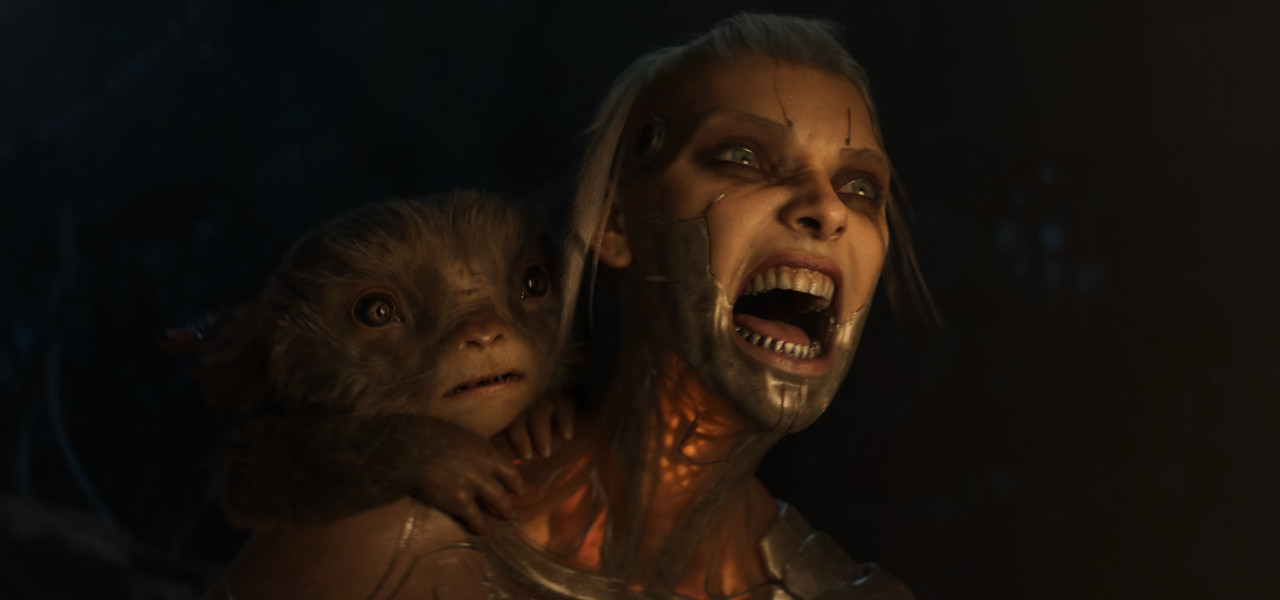
Nelson: Ugly-cute. That was the philosophy. Ugly, but cute again. Things like tardigrades, bush babies, French bulldogs, axolotls, we smashed them into one thing.
Throughout the short, it changes to look cute to whatever the host is, to bond with it more. We like to bond with things that look like us. So when you first meet it, it looks like the aliens’ version of a baby. Then it slowly changes into something more mammalian for Spider Rose, a face, little fingers, little nails, like a baby, but just a little off.
I did some sketches and handed them to Maria Panfilova, an amazing sculptor. She came back with these wide-eyed creatures in 3D. And when she put the little creepy baby hands on Nosy, I thought, “That’s it.” That’s what made it work.
Blur Studio animated your episode. What was that collaboration like?
Nelson: Blur is top of the top. Very high level of artistry and technical knowledge. You go to Blur when you want something to look really excellent.
I storyboard everything, thumbnail everything, and then we all look at it together. That’s the main line into my brain. And at every point, they never stop at “That’s what she wanted, that’s good enough.” They take it further. “Is it good enough for me? Is it worthy of Blur’s reputation?” They push themselves every step of the way.
It feels like getting the keys to a very high-performance sports car. You tap the pedal, and it just goes, tears your face off. That’s what Blur is like.
And as supervising director, how do you see the anthology’s studios working together?
Nelson: The amazing thing is that all these studios, who are usually competitors, are actually working together here. Encouraging each other, building off each other, sharing assets and technology. It makes all the studios better.
For example, in Season 1, Unit Image did Beyond the Aquila Rift and became famous for their facial subtlety. Now that level is the bar. So when we were doing the skin for Spider Rose, we had to be as good as that, if not better. Everyone feels that. Studios show each other animatics, and sometimes one says, “We can’t show ours this week, we need to fix it first.” It’s stressful, but in the best way.
All those little touches, skin translucency, stylization, so you’re not in the uncanny valley, that’s what everyone pushes toward. It’s all designed to fool you into thinking it’s real, while still being just off enough. That competition and collaboration makes the show what it is.